

A mobile phone battery wholesale inventory should be built around verified repair demand, not the length of a supplier’s catalog. The objective is to keep frequently requested models available while preventing cash from becoming trapped in slow-moving batteries.
For repair-parts wholesalers, distributors and refurbishment buyers, effective inventory planning requires five controls: a clear SKU hierarchy, accurate compatibility data, measurable reorder rules, batch traceability and a purchasing process that separates repeat stock from project-based demand.
What Makes Mobile Phone Battery Wholesale Inventory Different?
Mobile phone batteries are more difficult to manage than universal accessories because one battery cannot serve every device. Demand is divided across phone brands, device generations, battery model codes, physical dimensions, connectors and repair requirements.
A wholesaler may receive frequent requests for a small group of popular models while hundreds of older or regional models sell only occasionally. Buying every available battery in equal quantities creates three problems:
-
Fast-moving models run out too soon.
-
Slow-moving models occupy cash and warehouse space.
-
Similar-looking batteries become easier to misidentify.
Replacement batteries also require more careful storage and traceability than ordinary repair parts. Inventory age, packaging condition, battery flatness, model labeling and batch information all affect whether stock remains suitable for sale and installation.
The solution is not to reduce the catalog to only a few models. It is to give each model an appropriate stocking rule.
Build a Three-Tier Battery SKU Structure
A practical catalog can be divided into three inventory tiers.
| Inventory tier | Suitable models | Purchasing approach | Review priority |
|---|---|---|---|
| Core Stock | Models with frequent, repeatable demand | Maintain regular stock and planned replenishment | Review weekly |
| Controlled Stock | Models with moderate or less predictable demand | Hold limited quantities and reorder from confirmed sales data | Review monthly |
| Project-Based | Slow-moving, older or customer-specific models | Purchase against confirmed demand or consolidated orders | Review by inquiry |
Core Stock
Core Stock should contain models that repeatedly generate repair or wholesale demand. These products deserve the highest availability because a stockout can send regular customers to another supplier.
Core models should be selected using evidence such as:
-
Units sold
-
Repair-shop requests
-
Repeat-order frequency
-
Number of active downstream customers
-
Installation success
-
Return and warranty feedback
-
Supplier replenishment time
A model should not become Core Stock simply because the device was once popular. Current repair demand matters more than historical retail sales.
Controlled Stock
Controlled Stock covers models that sell, but not with enough consistency to justify large quantities. These batteries may serve regional device demand, premium repairs, older phones or customers with irregular purchasing cycles.
The correct approach is to maintain availability without overcommitting. Smaller orders, scheduled reviews and customer reservations can reduce the risk of holding too much stock.
Project-Based Stock
Project-Based models should normally be purchased after receiving a customer model list, forecast or confirmed order. This tier is suitable for long-tail devices, uncommon specifications and refurbishment projects that appear in batches.
Project-based purchasing allows a wholesaler to advertise broader sourcing capability without physically stocking every battery.
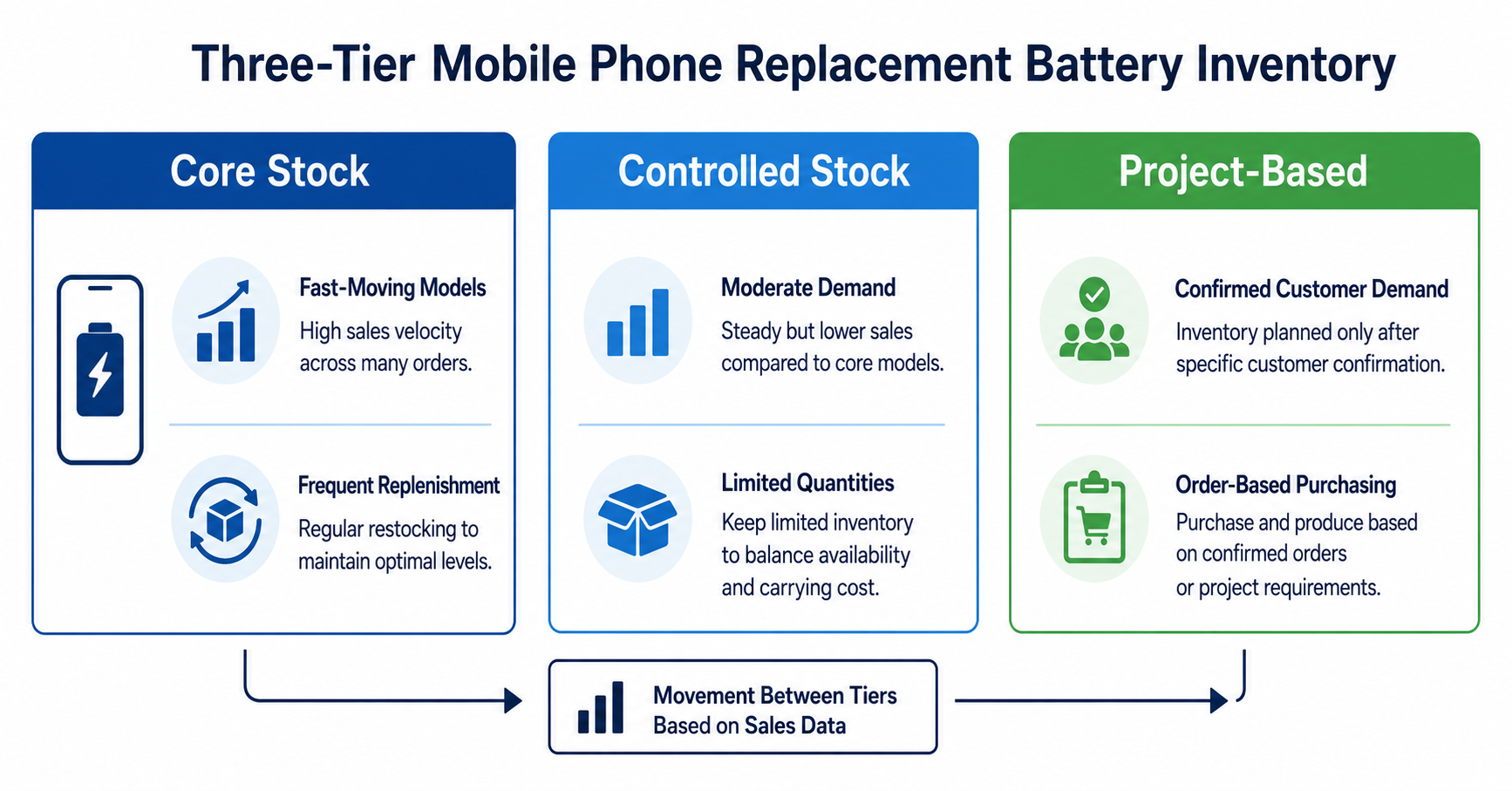
A well-planned mobile phone battery wholesale inventory allows models to move between tiers. If demand increases, a Controlled Stock model may become Core Stock. If repeat sales decline, a Core Stock model should be reduced before it becomes dead inventory.
Use Sales Data Instead of Guesswork00
1Inventory decisions become more reliable when every SKU has a small set of measurable indicators.
Average Weekly Demand
Calculate the average number of units sold each week over a relevant period. Separate one-time project orders from normal repeat demand so that a large temporary order does not distort the forecast.
Weeks of Stock Cover
Use this simple calculation:
Weeks of stock cover = usable inventory ÷ average weekly demand
“Usable inventory” should exclude damaged packaging, quarantined batches, customer reservations and units awaiting inspection.
Reorder Point
A basic reorder point can be calculated as:
Reorder point = expected demand during replenishment time + safety stock
Safety stock should reflect demand variation and the confirmed replenishment conditions for that model. It should not be identical across every SKU.
Sell-Through Rate
Sell-through helps identify whether incoming stock is moving as expected:
Sell-through rate = units sold ÷ units received
Review the result by model and batch. A high total sales figure can hide poor performance in individual SKUs.
Return and Complaint Rate
Sales volume alone does not identify a healthy SKU. Track complaints by model, batch and issue type, including:
-
Short runtime
-
Failure to charge
-
Unexpected shutdown
-
Installation mismatch
-
Connector or flex problems
-
Abnormal heat
-
Swelling reports
-
Packaging damage
-
Incorrect labels
Do not assume every complaint is caused by the battery. Installation, device condition, charging components and storage may also affect the result. The important step is to keep enough information to investigate.
Create a Compatibility Record for Every SKU
A product name such as “battery for Phone X” is not always enough for warehouse and repair control. Each SKU should have a structured compatibility record.
Recommended fields include:
-
Internal SKU
-
Device brand and model
-
Battery model or part code
-
Standard voltage
-
Rated capacity
-
Battery dimensions
-
Connector type and position
-
Flex-cable shape and orientation
-
Applicable device variants
-
Battery-information or repair-workflow notes
-
Packaging version
-
Supplier model code
-
Batch or production reference
-
Date received
-
Inspection status
Compatibility should be confirmed by actual device and battery specifications. Do not describe a battery as universally compatible because it appears physically similar to another model.
When a battery fits multiple devices, list each verified device variant instead of relying on a vague “multi-model” statement.
Separate Commercial Names From Technical Identification
Sales teams, warehouse workers and repair technicians may use different names for the same battery. This creates picking and quotation errors.
A stronger system connects three identifiers:
-
The customer-facing product name
-
The supplier’s model code
-
The technical battery or device reference
All three should appear in the inventory system. The warehouse label should remain short enough to scan quickly, while the full compatibility record should remain available to purchasing and technical teams.
If the supplier changes a label, connector, flex cable or packaging version, update the record before receiving the next batch.
Verify Samples Before Expanding Stock
A sample approval process should happen before a battery is promoted from Project-Based or Controlled Stock into Core Stock.
The test plan depends on the model and target channel, but buyers can consider:
-
Model and visual identification
-
Open-circuit voltage
-
Capacity test under defined conditions
-
Internal resistance comparison
-
Charging and discharging behavior
-
Protection-circuit function
-
Connector and flex inspection
-
Physical dimensions and flatness
-
Installation fit
-
Device startup and charging behavior
-
Standby or runtime observation
-
Packaging and label accuracy
Record the equipment, conditions and results. A printed capacity value or one successful installation is not enough to establish batch consistency.
Several samples should be compared when a wholesaler plans repeat purchases. The goal is not to find one excellent unit; it is to determine whether the supplied configuration is predictable.
Control Batches After the First Order
Sample approval does not remove the need for incoming inspection. Repeat orders can change because of component availability, packaging revisions or production adjustments.
Your mobile phone battery wholesale inventory should retain enough information to connect complaints with a specific receipt or batch.
Useful controls include:
-
Receiving date
-
Supplier batch reference
-
Quantity received
-
Sample-inspection results
-
Packaging version
-
Quarantine status
-
Customer shipments from the batch
-
Complaint type
-
Corrective action
-
Replacement or credit status
Do not mix unverified new stock with an accepted batch before inspection. If the battery configuration changes, determine whether compatibility or performance needs to be validated again.
Match Inventory to the Customer Channel
Different customers create different stock patterns.
Independent Repair Shops
Independent shops usually need common models in smaller mixed quantities. Availability and identification accuracy may be more important than maintaining a very deep quantity of one SKU.
Repair Chains
Repair chains benefit from standardized model lists, consistent packaging and clear complaint reporting across locations. Forecasts can often be consolidated across stores.
Refurbishment Facilities
Refurbishers may need larger model-specific batches based on the used-device inventory they acquire. Their demand can change quickly between projects, so forecasts and confirmed device lists are essential.
E-Commerce Sellers
Online sellers need accurate compatibility descriptions, protective packaging, barcode control and a process for updating listings when product revisions occur.
Regional Distributors
Distributors need a balanced catalog that supports their downstream repair network. They should distinguish true repeat demand from occasional requests collected by the sales team.
Private-Label Buyers
Private-label programs add artwork, packaging, labels and minimum production considerations. Buyers should apply stricter volume validation before creating customized packaging for a slow-moving model.
Build a Better Mixed-Model Purchase Order
A mixed-model order should not be a spreadsheet containing only product names and quantities. It should reduce ambiguity before the supplier confirms pricing and production.
Include:
-
Buyer SKU
-
Device model
-
Battery or part code
-
Required capacity and voltage
-
Connector or flex reference
-
Packaging type
-
Label requirement
-
Barcode
-
Quantity by model
-
Sample requirement
-
Target market
-
Required documents
-
Requested delivery window
-
Special inspection requirements
Ask the supplier to identify uncertain models before confirming the order. A clarification before production is less expensive than discovering a mismatch after international delivery.
MOQ, sample availability, packaging quantities, lead time and documentation should be confirmed for the specific model list and customization scope. Do not assume that one commercial condition applies to every battery.
Common Inventory Planning Mistakes
Stocking Every Model Equally
Equal quantities ignore real demand. Fast-moving models sell out while long-tail stock remains unsold.
Using Device Popularity as the Only Forecast
A phone with strong historical sales may no longer produce high repair demand in the buyer’s current market.
Ignoring Inventory Age
A battery should not be treated like a metal bracket that can remain on a shelf indefinitely without review. Storage conditions, packaging and inspection status require attention.
Combining Similar Models Under One Label
Similar names do not prove identical dimensions, connectors or electrical specifications. Combining them increases picking and compatibility errors.
Reordering From Revenue Alone
Revenue does not show unit movement, batch quality or return risk. Review quantity, gross margin, sell-through and complaints together.
Customizing Packaging Too Early
Private-label packaging can strengthen a product line, but it also increases commitment. Confirm repeat demand before creating customized materials for long-tail models.
How ESC Can Support Battery Inventory Projects
ESC works with professional battery buyers serving repair, refurbishment, wholesale and private-label channels. Project support can be discussed around model confirmation, sample evaluation, labeling, packaging and mixed-model quotation requirements.
ESC’s published production overview lists stages including incoming-quality control, battery-capacity testing, aging, appearance inspection and finished-product checking. Buyers can review the current overview on the About ESC page.
For additional guidance on batch-oriented phone battery sourcing, see ESC’s article for iPhone refurbishment battery buyers. Available products and model coverage can be reviewed through the ESC product center.
Exact battery specifications, MOQ, sample arrangements, documents, packaging and delivery conditions must be confirmed for the selected model list and order.
Frequently Asked Questions
How many battery SKUs should a wholesaler keep?
There is no universal number. The correct range depends on verified repair demand, active customers, available capital, replenishment conditions and the size of the target market. Start with evidence-based Core Stock and add long-tail models through controlled or project-based purchasing.
How often should battery inventory be reviewed?
Core Stock should be reviewed more frequently than slow-moving models. The review schedule should reflect sales velocity, replenishment time, inventory value and complaint risk.
Can a supplier combine different phone battery models in one order?
Mixed-model purchasing may be possible, but commercial terms depend on the models, quantities, packaging and customization requirements. Submit a detailed model list for confirmation instead of assuming one MOQ applies to every SKU.
What data should be checked before reordering?
Review usable stock, average demand, open customer orders, replenishment time, batch feedback, returns, packaging inventory and planned promotions.
How can buyers reduce dead battery stock?
Use Core, Controlled and Project-Based tiers; purchase long-tail models against confirmed demand; review inventory age; and reduce quantities when repeat sales decline.
What should be tested before adding a new Core Stock model?
Confirm identity, capacity, voltage, internal resistance, charging and discharging behavior, protection function, installation fit, connector position, dimensions, packaging and batch consistency.
Why is traceability important for wholesale batteries?
Traceability connects a complaint to a model, receipt, batch and customer shipment. Without it, the buyer cannot isolate affected stock or investigate the cause efficiently.
Conclusion
A mobile phone battery wholesale inventory becomes more profitable when every SKU has a purpose. Core models protect availability, Controlled Stock preserves flexibility, and Project-Based purchasing expands coverage without forcing the buyer to hold every product.
Use real sales data, accurate compatibility records, structured sample checks and batch traceability to guide purchasing. Review both sales and quality feedback before increasing stock.
Send ESC your target market, customer type, device-model list, expected quantities, packaging requirements and required documents. ESC can review the request and prepare model, sample and mixed-order options for confirmation.