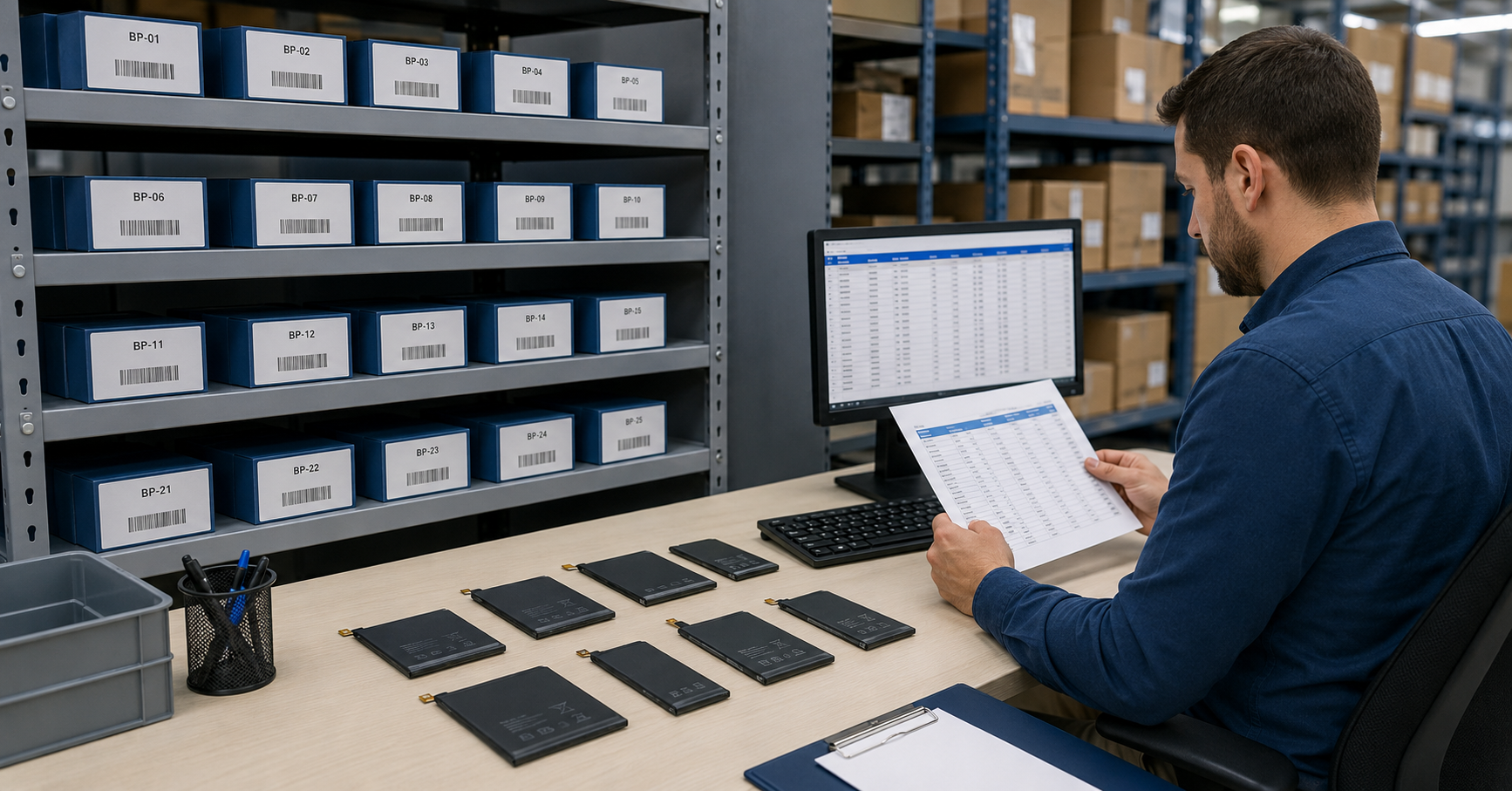

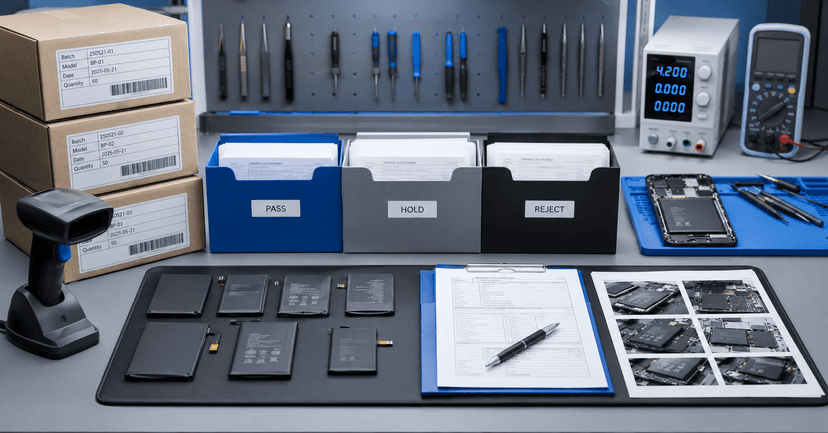
Mobile phone battery warranty claims should be handled through evidence, classification, and traceability—not through a simple argument about whether a battery “works.” For repair chains, refurbishment facilities, wholesalers, and private label brands, a useful claim process must connect the reported problem with the battery model, batch, installation conditions, test results, and agreed warranty terms.
A structured workflow helps both buyer and supplier distinguish product defects from compatibility errors, installation damage, device-side faults, storage problems, incomplete evidence, and normal differences in customer expectations. It also turns after-sales records into information that can improve future purchasing and quality control.
Why Battery Warranty Claims Become Difficult to Resolve
Many battery claims begin with a short message:
-
Battery drains quickly.
-
Phone does not charge.
-
Battery percentage is unstable.
-
Battery is swollen.
-
Phone shuts down.
-
Connector does not fit.
-
Battery Health does not display as expected.
-
Customer wants a replacement.
These descriptions identify a symptom, but they do not establish the cause.
A “fast drain” complaint may involve battery capacity, high internal resistance, an unsuitable battery version, device settings, background software activity, charging-circuit problems, or unrealistic runtime expectations.
A “no charging” complaint may involve the battery, connector, installation, charging port, charger, cable, phone motherboard, or incorrect model selection.
The purpose of a claim workflow is not to blame the buyer, installer, customer, or supplier. It is to collect enough evidence to make a consistent decision.
Define What a Warranty Claim Means
A warranty claim is a request for a remedy under the commercial agreement. It is not automatic proof that the battery contains a manufacturing defect.
Before orders begin, buyers and suppliers should define:
-
Products covered by the agreement
-
Warranty scope
-
Warranty start point
-
Claim-submission period
-
Required evidence
-
Excluded conditions
-
Sample-return requirements
-
Credit, replacement, or other resolution methods
-
Response responsibilities
-
Treatment of transport or installation damage
-
Treatment of mixed-model or compatibility errors
Warranty depends on the specific product and agreement. Do not assume one warranty duration or remedy applies to every battery model, packaging format, market, or customer.
Private label buyers should also align their downstream customer policy with the supplier agreement. Promising customers broader coverage than the upstream agreement can create an unplanned commercial gap.
Build a Standard Warranty Claim Evidence Pack
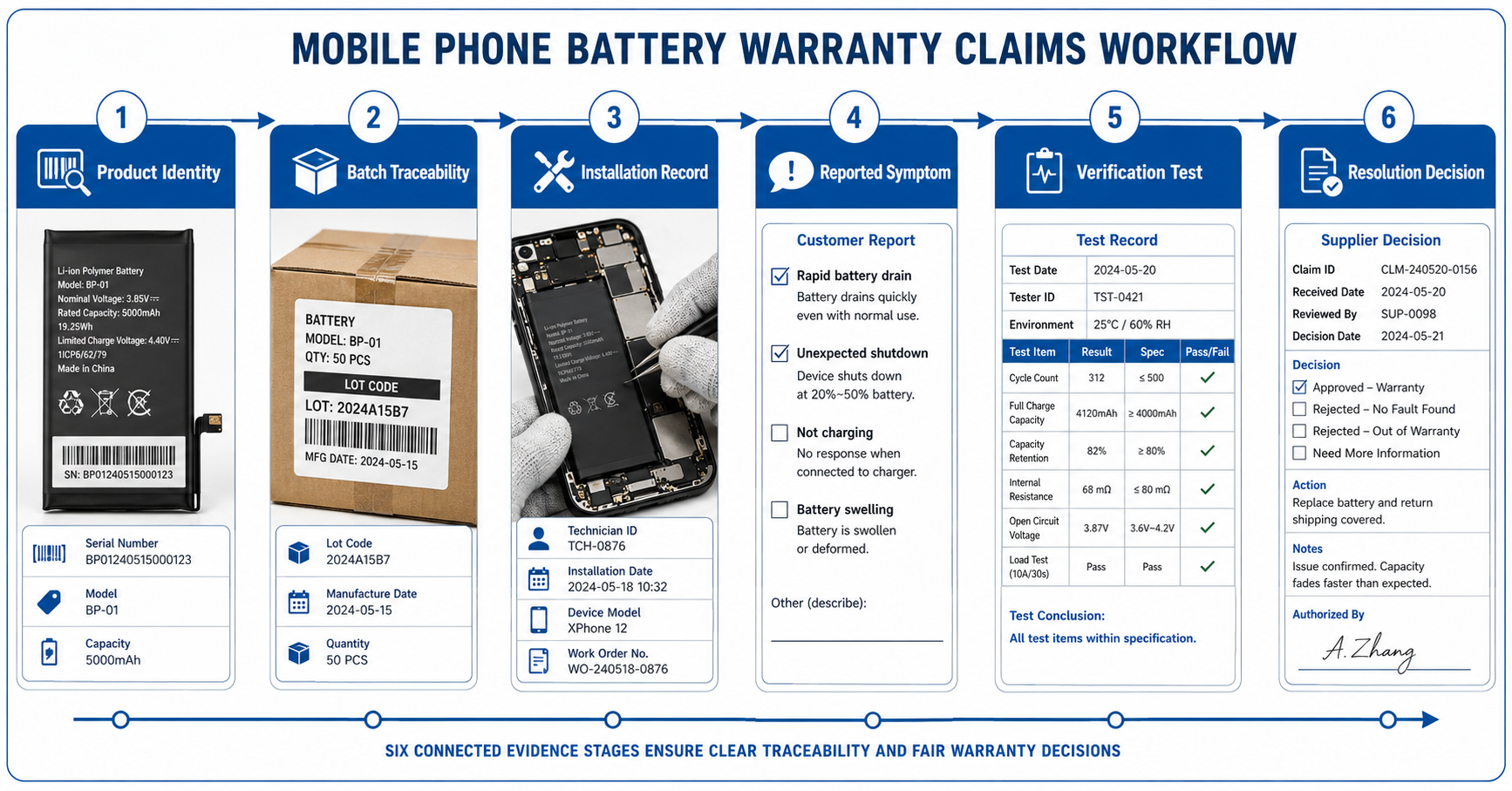
A complete evidence pack should answer six questions.
1. What product is involved?
Record:
-
Buyer SKU
-
Supplier SKU
-
Battery model
-
Intended phone model
-
Original battery reference when available
-
Voltage and labeled capacity
-
Battery version or product tier
-
Packaging type
-
Quantity affected
Compatibility must be confirmed by device model and battery specification. Do not classify a wrong-model battery as a performance defect until the product identity has been checked.
2. Which batch or shipment is involved?
Record:
-
Purchase order
-
Invoice or shipment reference
-
Arrival date
-
Carton or lot number
-
Date code where available
-
Packaging label photograph
-
Quantity received
-
Quantity installed
-
Quantity reported
-
Remaining stock location
Batch traceability helps determine whether the issue concerns one battery, one carton, one production lot, or several shipments.
3. How was the battery installed?
Record:
-
Installation date
-
Technician or facility
-
Device model
-
Condition of the phone before repair
-
Reason for battery replacement
-
Connector and flex inspection
-
Installation photographs where practical
-
Whether the device had previous repair damage
-
Initial power-on and charging result
Installation evidence is especially useful when a complaint involves damaged flex cables, poor connector contact, physical pressure, puncture, or other mechanical conditions.
4. What symptom was reported?
Use a controlled list rather than only free-form notes:
-
No power
-
No charging
-
Fast drain
-
Unexpected shutdown
-
Unstable percentage
-
Abnormal heat
-
Physical swelling
-
Connector or fit problem
-
Battery-information issue
-
Packaging or label error
-
Wrong model
-
Cosmetic damage
-
Other
Also record when the symptom appeared:
-
Before installation
-
During installation
-
At first power-on
-
During initial charging
-
Within early use
-
After an extended period
-
After storage
-
After transport or customer return
5. What verification was performed?
Depending on the complaint, the record may include:
-
Visual inspection
-
Model and connector confirmation
-
Open-circuit voltage
-
Internal resistance
-
Controlled capacity test
-
Charge and discharge observation
-
Installation in a verified compatible phone
-
Standby observation
-
Battery percentage behavior
-
Connector inspection
-
Flex-cable inspection
-
Device-side diagnostic check
-
Comparison with an approved sample
Test records should identify the battery model, test equipment, procedure, load or current, environment, date, and result. Do not turn an undocumented observation into a universal product claim.
6. What resolution is requested?
State whether the buyer is requesting:
-
Technical analysis
-
Replacement product
-
Credit
-
Sorting support
-
Rework
-
Additional samples
-
Expanded batch inspection
-
Corrective-action report
-
Packaging correction
-
Model confirmation
-
Other agreed action
A clear request helps the supplier respond to the commercial issue instead of only acknowledging the complaint.
Classify the Claim Before Deciding the Remedy
A claim classification system separates symptoms from probable causes.
| Claim category | Typical evidence | Possible next action |
|---|---|---|
| Product identity | Wrong label, SKU, connector, or model | Isolate stock and confirm shipment scope |
| Compatibility | Battery does not match the intended device | Correct the model mapping or product selection |
| Physical condition | Swelling, leakage, deformation, damaged insulation | Isolate safely and escalate immediately |
| Installation | Damaged flex, forced connector, puncture, poor placement | Review installation evidence and technician process |
| Electrical performance | Capacity, voltage, internal resistance, or discharge concern | Perform defined tests and compare with agreed criteria |
| Functional behavior | No charging, shutdown, unstable percentage | Check battery, installation, and device-side causes |
| Packaging or labeling | Wrong box, barcode, warning, or artwork | Sort, relabel, rework, or replace affected stock |
| Storage or transport | Damage or abnormal condition after logistics or storage | Review packaging, shipment, and storage records |
| Insufficient evidence | Model, batch, symptoms, or tests are unclear | Request missing information before deciding |
| No fault found | Complaint cannot be reproduced under recorded conditions | Retain evidence and monitor for recurrence |
The classification is not a final technical conclusion by itself. It provides a consistent route for investigation and commercial handling.
Use a Seven-Step Claim Workflow
Step 1: Register the claim
Assign a unique claim number and record the submission date, customer, SKU, quantity, and reported symptom.
Do not manage important cases only through scattered chat messages. Centralized records make repeated issues easier to detect.
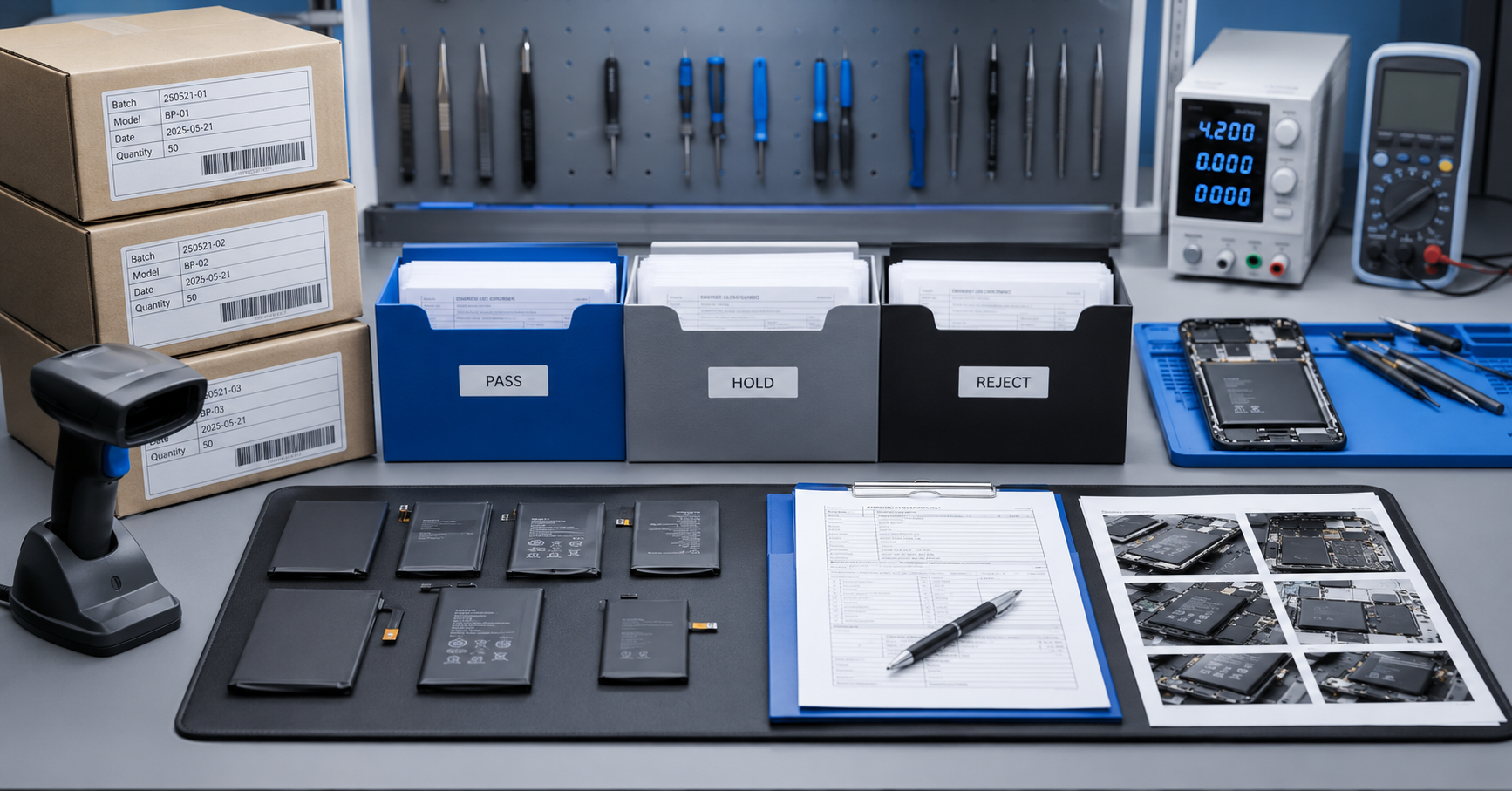
Step 2: Isolate affected stock
Separate returned, complained-about, or suspect batteries from saleable inventory.
If a battery is visibly swollen, leaking, physically damaged, or abnormally hot, do not treat it as normal stock. Avoid charging or installing it and follow an appropriate damaged-lithium-battery procedure.
Step 3: Verify product and batch identity
Confirm that the claimed battery matches the order, packaging, device, and approved specification.
Wrong-model, mixed-carton, or label errors should be identified before performance testing.
Step 4: Review installation and device conditions
Check whether the connector, flex cable, dimensions, battery version, and phone model agree.
Where relevant, inspect the charging port, device condition, repair history, and installation photographs. A battery complaint can coexist with a phone-side or repair-process problem.
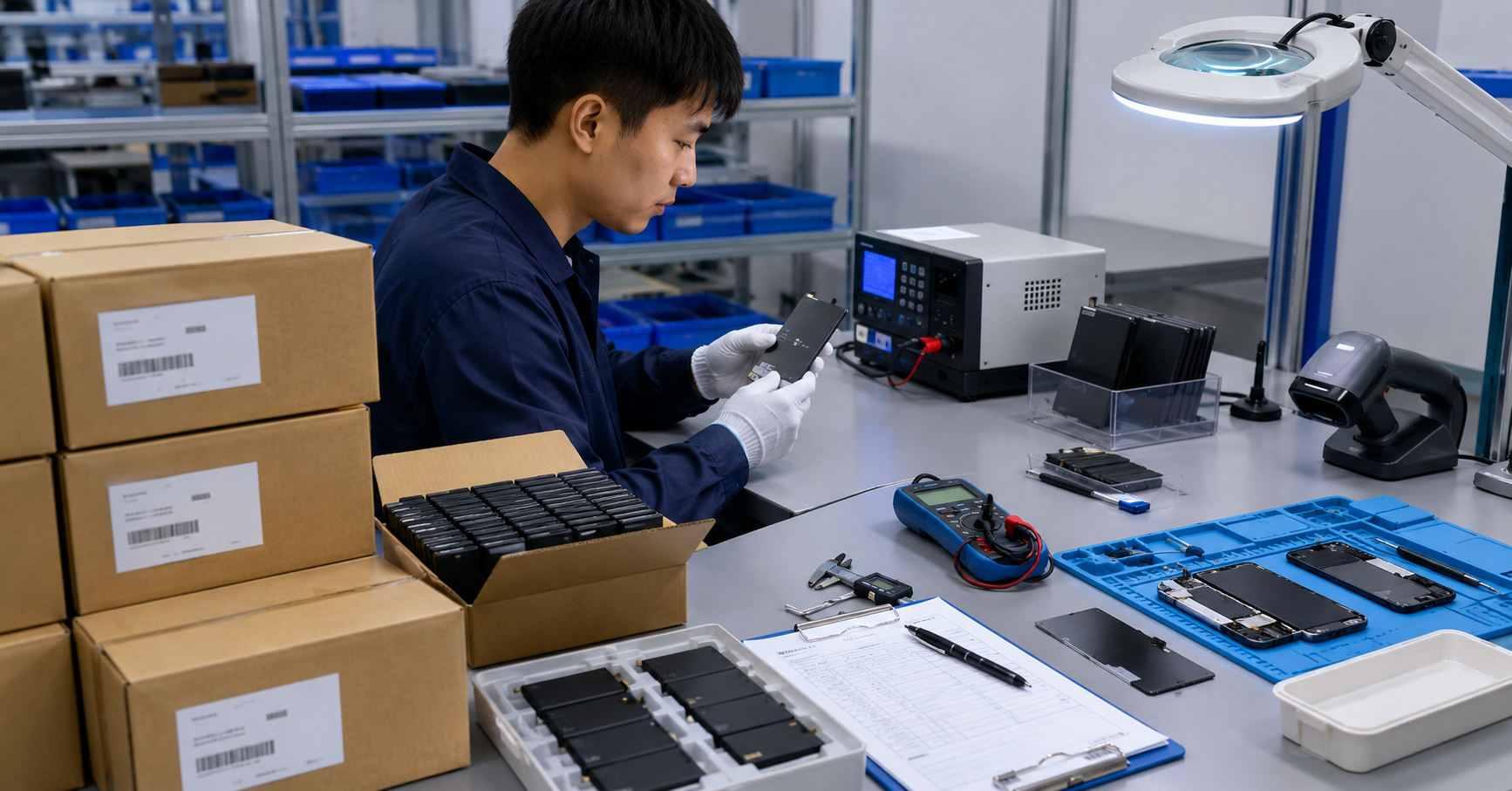
Step 5: Reproduce the symptom
Use a defined test or verification process appropriate to the complaint.
Do not continue destructive or unsafe testing on physically damaged batteries. For other complaints, record the equipment, method, conditions, and result.
If the symptom cannot be reproduced, record “no fault found under the stated test conditions” rather than claiming that the customer’s experience was impossible.
Step 6: Decide the disposition
Possible decisions include:
-
Claim accepted
-
Claim partially accepted
-
More evidence required
-
Product returned for analysis
-
Wrong model or compatibility issue
-
Installation-related issue
-
Transport or storage issue
-
No fault found
-
Commercial goodwill resolution
-
Claim rejected under the agreed terms
The reason and supporting evidence should accompany the decision.
Step 7: Feed the result back into purchasing and QC
After resolving the immediate case, ask:
-
Is this an isolated unit or repeated batch issue?
-
Does incoming inspection need another check?
-
Does the compatibility list need correction?
-
Should packaging or labeling change?
-
Does the sample-approval standard need revision?
-
Does the supplier need a corrective action?
-
Should the claim evidence form be improved?
-
Is customer communication creating unrealistic expectations?
This final step converts mobile phone battery warranty claims into prevention.
Separate Unit Claims From Batch Signals
One failed unit does not automatically prove that an entire shipment is defective. At the same time, repeated similar claims should not be handled as unrelated incidents.
Track claims by:
-
Buyer SKU
-
Supplier SKU
-
Phone model
-
Battery version
-
Purchase order
-
Production lot
-
Carton
-
Installation facility
-
Technician
-
Complaint category
-
Time to complaint
-
Resolution
-
Repeat occurrence
The goal is not to create a percentage without context. The goal is to identify concentration.
For example, repeated connector complaints from one lot may indicate a product or packing issue. Similar damage from one installation facility may indicate a process problem. Battery-information complaints limited to one phone model may indicate that the product version or customer explanation needs review.
Create Clear Evidence Requirements for Different Claims
Fast drain
Useful evidence may include:
-
Exact phone and battery model
-
Installation date
-
Standby and usage conditions
-
Charging behavior
-
Capacity test under defined conditions
-
Internal resistance measurement
-
Comparison with another device or approved sample
Avoid diagnosing the cause from a screenshot alone.
No charging
Check:
-
Correct model
-
Connector condition
-
Flex-cable condition
-
Installation
-
Charger and cable
-
Charging port
-
Device charging circuit
-
Battery voltage
-
Result with a verified battery where appropriate
Unexpected shutdown
Record:
-
Battery percentage at shutdown
-
Device load or activity
-
Temperature or environment
-
Charging history
-
Battery and phone model
-
Whether the symptom can be reproduced
-
Voltage or other agreed test results
Swelling or physical damage
Prioritize safe isolation and photographs. Do not press, puncture, charge, or repeatedly install a visibly damaged battery.
Risk depends on cell quality, protection design, storage, charging, installation, and operating conditions. No responsible supplier should promise zero swelling or complete safety under all conditions.
Fit or connector problem
Provide:
-
Battery and phone model
-
Original battery photographs
-
Claimed battery photographs
-
Dimensions
-
Connector close-up
-
Cable route
-
Installation-area photograph
-
Packaging and SKU label
This evidence helps distinguish a wrong model from a dimensional or assembly variation.
Define Responsibilities in the Commercial Agreement
Before mass purchasing, clarify:
-
Who collects end-customer evidence?
-
Who performs initial verification?
-
Which tests are required?
-
Who pays for sample return or analysis?
-
How are damaged batteries transported or handled?
-
What quantity triggers expanded investigation?
-
How are replacement or credit decisions recorded?
-
How are urgent safety complaints escalated?
-
How are recurring issues reviewed?
-
How are component or specification changes communicated?
The answer may differ by product, order size, market, and business relationship. These terms should be confirmed for the actual agreement.
Match the Claim Process to the Buyer
Repair chains
Repair chains need a simple technician form, clear model identification, installation photographs, and a centralized claim record across stores.
Refurbishment facilities
Refurbishers need batch-level traceability, repeated-device observations, final-test records, and clear separation between component failures and device-side issues.
Wholesalers and distributors
Wholesalers need carton and SKU traceability, evidence requirements for downstream customers, and a process for identifying whether multiple stores report the same issue.
E-commerce sellers
Online sellers need packaging records, listing accuracy, customer photographs, return reasons, and a method for separating product complaints from incorrect purchases or installation problems.
Private label brands
Private label buyers need warranty wording, claim forms, product-tier definitions, packaging records, supplier responsibilities, and corrective-action tracking.
Warranty Claim Checklist
Before submitting or approving a claim, confirm that:
-
The buyer SKU and supplier SKU are recorded.
-
The phone and battery models are confirmed.
-
The affected quantity is stated.
-
The purchase order and batch are traceable.
-
The symptom uses a controlled claim category.
-
The date and stage of failure are recorded.
-
Installation evidence is available where relevant.
-
The battery’s physical condition is documented.
-
Test methods and conditions are recorded.
-
Unsafe batteries have been isolated.
-
The requested resolution is clear.
-
The decision refers to the commercial agreement.
-
The result is fed back into purchasing, QC, or customer communication.
-
Repeated claims are reviewed as a possible batch signal.
Frequently Asked Questions
What evidence is needed for a mobile phone battery warranty claim?
At minimum, record the battery and phone models, buyer and supplier SKUs, order or batch reference, symptom, affected quantity, installation information, photographs, verification results, and requested resolution.
Does a customer complaint prove that the battery is defective?
No. A complaint identifies a problem that requires review. Compatibility, installation, device condition, storage, transport, and test evidence may all be relevant to the final decision.
Should every complained-about battery be returned to the supplier?
Not necessarily. The agreement should define when photographs, test records, retained samples, or physical returns are required. Damaged-lithium-battery transport must be handled appropriately.
How should a “no fault found” case be recorded?
State the test method and conditions, record that the symptom was not reproduced, retain the evidence, and monitor whether similar claims recur. Do not describe the original complaint as false without evidence.
When should a single claim trigger a batch investigation?
There is no universal number. Consider the severity, claim type, repeat pattern, batch concentration, customer impact, and commercial agreement. A serious physical safety concern may require immediate escalation even if only one unit is reported.
How can warranty records improve supplier performance?
Structured records reveal repeated problems by model, batch, connector, packaging, installation site, or complaint category. Buyers and suppliers can then improve specifications, sample approval, incoming inspection, packaging, training, and corrective actions.
Turn After-Sales Records Into Quality Improvements
Mobile phone battery warranty claims are easier to resolve when every case has a traceable product identity, batch, symptom, verification method, and decision. This protects both sides from decisions based only on incomplete messages or assumptions.
A consistent claim workflow also produces useful purchasing data. It can reveal compatibility gaps, packaging errors, repeated batch issues, unclear customer expectations, or missing inspection controls before they become larger problems.
Send ESC your battery model list, order reference, batch information, complaint category, photographs, available test records, and requested resolution. ESC can review the submitted evidence and discuss the next verification or commercial step according to the specific product and agreement.