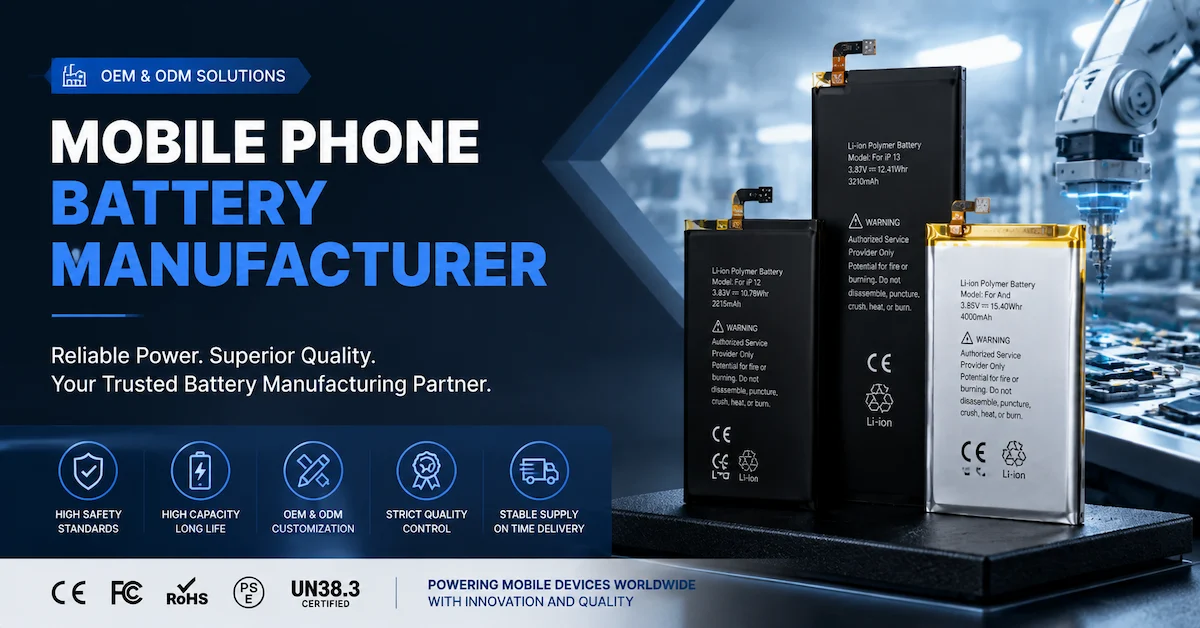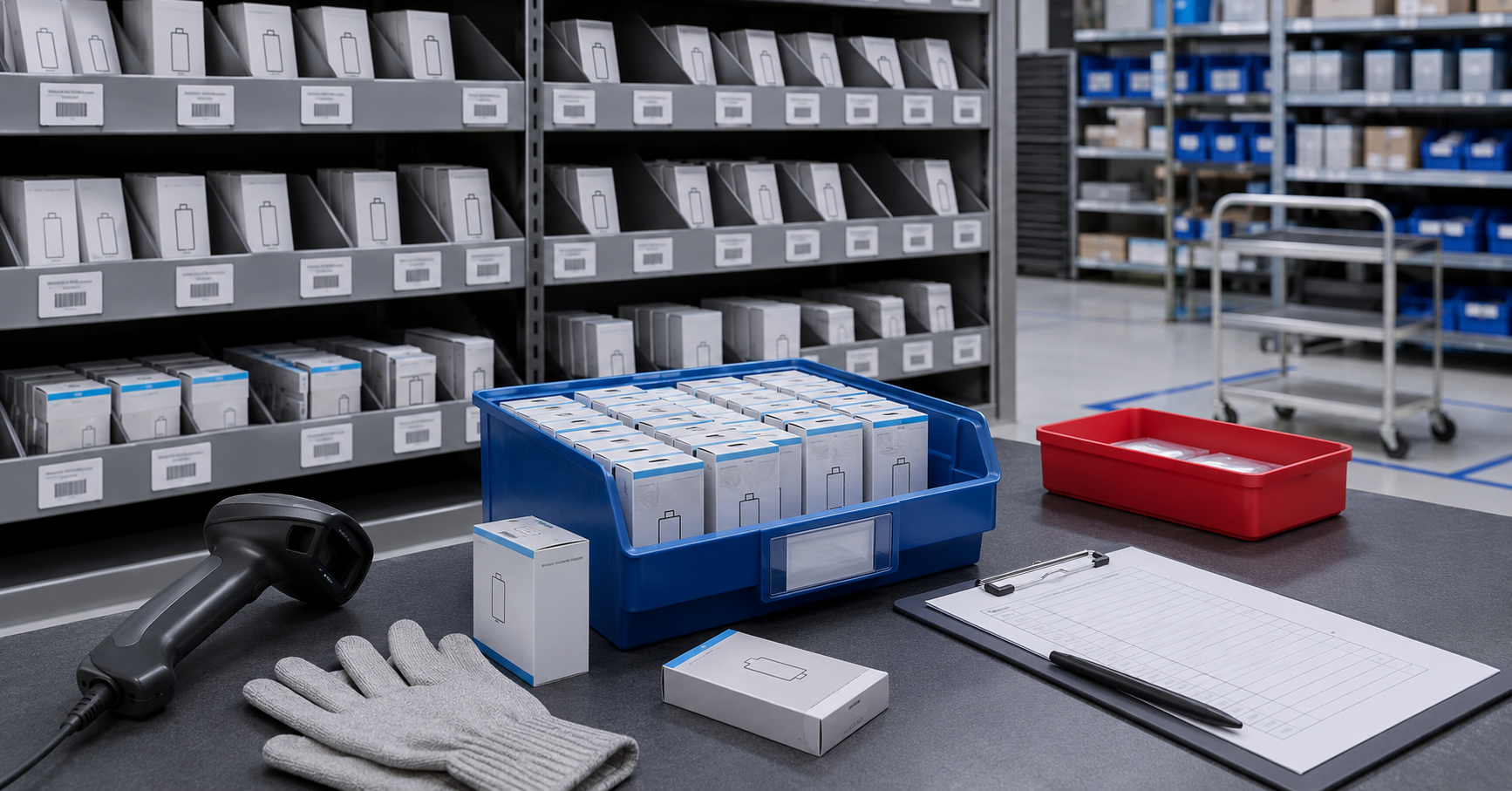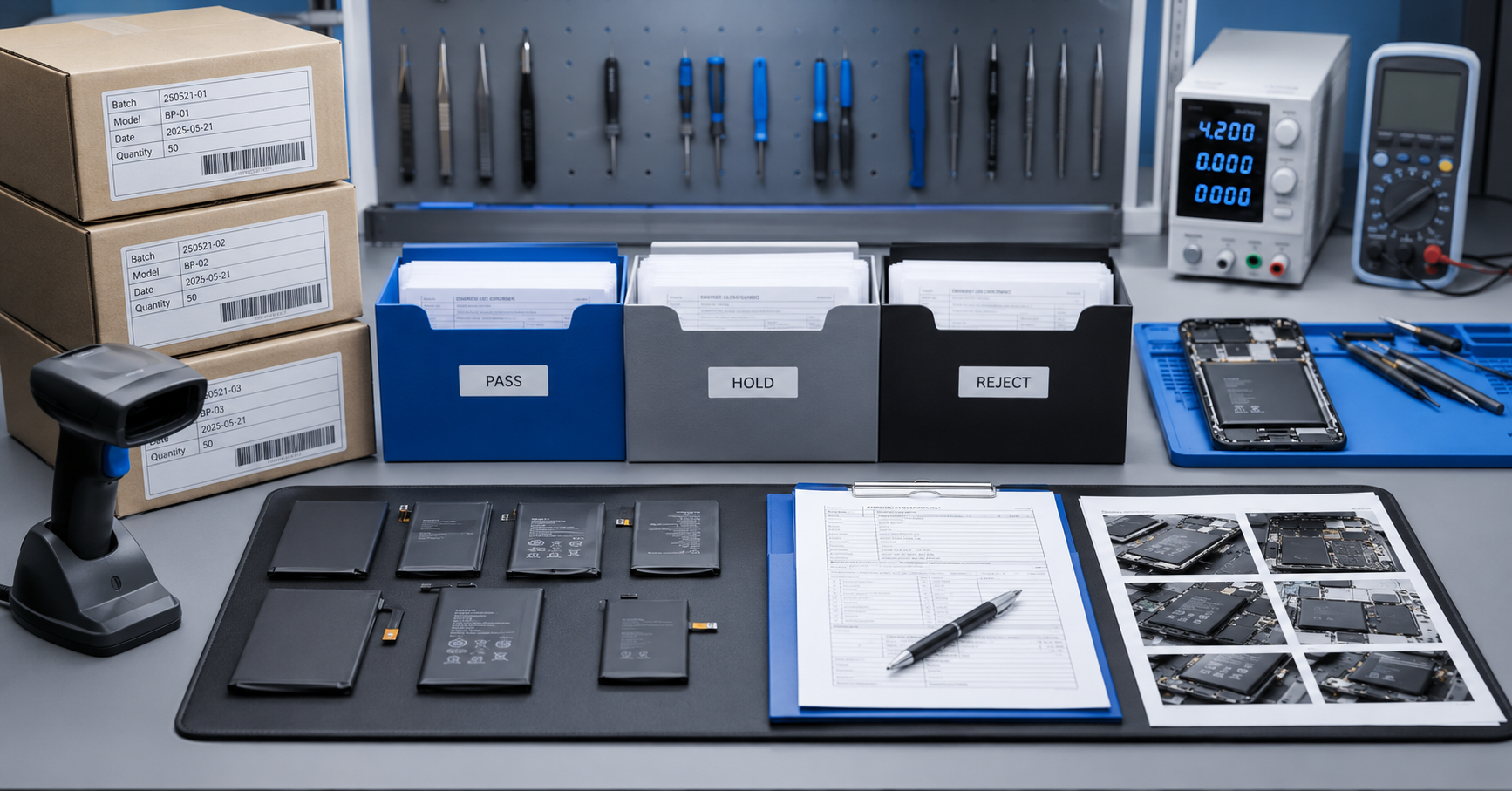

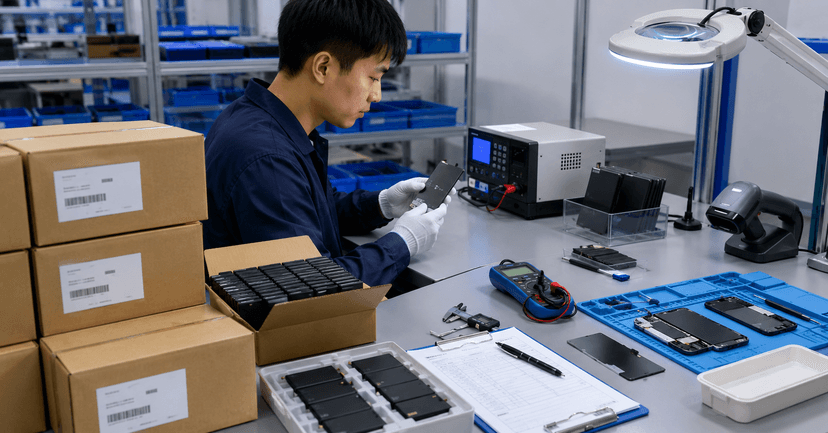
Mobile phone battery incoming inspection should determine whether a shipment matches the approved specification and is suitable for release—not simply whether the cartons arrived undamaged. For wholesalers, repair chains, refurbishment facilities, and private label brands, incoming quality control must check shipment identity, model accuracy, mechanical fit, sampled electrical behavior, packaging, documentation, and variation across the batch.
The most effective process is risk-based. Buyers should inspect every shipment at the carton and SKU level, sample individual batteries according to an agreed plan, and reserve installation or performance testing for the models and risks that matter most. The result should be a documented decision: release, conditional release, hold, sort, rework, or reject.
Why Receiving the Correct Quantity Is Not Enough
A warehouse may receive the correct number of cartons while still accepting the wrong product.
Similar phone batteries can have small but critical differences in connector position, flex-cable shape, dimensions, voltage specification, label reference, or post-install behavior. These differences may not be visible from the outer carton.
Problems can also be unevenly distributed. One sample from the top of a carton may look acceptable while another carton or production lot contains label errors, surface damage, unstable readings, or mixed models.
The commercial consequences depend on the buyer:
-
Repair chains lose technician time when batteries require repeated fitting or troubleshooting.
-
Refurbishment facilities lose production flow when a batch cannot pass final-device testing.
-
Wholesalers face downstream claims when cartons contain mixed or mislabeled models.
-
E-commerce sellers experience returns when compatibility information or packaging is inaccurate.
-
Private label brands carry the reputational cost because their name appears on the product.
Incoming inspection cannot prove every aspect of long-term battery performance. It can, however, identify obvious shipment errors, unusual variation, installation problems, documentation gaps, and warning signs before products enter inventory or reach customers.
Define the Approved Reference Before the Shipment Arrives
An incoming inspector needs a controlled reference. Without one, the inspection becomes a subjective comparison against memory, product photos, or a sales quotation.
The approved reference should include:
-
Buyer SKU and supplier model code
-
Intended phone model or models
-
Battery part reference when applicable
-
Approved product and label photographs
-
Nominal voltage and labeled capacity
-
Length, width, and thickness requirements
-
Connector type and orientation
-
Flex-cable shape, length, and bend position
-
Protection-board or battery-system requirements
-
Packaging, barcode, and carton-mark specification
-
Approved artwork revision
-
Required shipment documents
-
Agreed inspection methods and acceptance limits
-
Approved sample or controlled sample record
Compatibility must be confirmed by device model and battery specification. A similar shape, matching brand family, or identical-looking connector is not enough.
If the supplier changes a cell, connector, flex cable, protection board, label, adhesive, insulation component, or packaging material after approval, the buyer should be notified before production. Whether a change requires new samples depends on its effect on compatibility, function, compliance, packaging, and customer-facing claims.
Build a Three-Level Incoming Inspection Plan
A practical plan separates checks by cost and risk. The buyer does not need to perform every possible laboratory test on every battery.
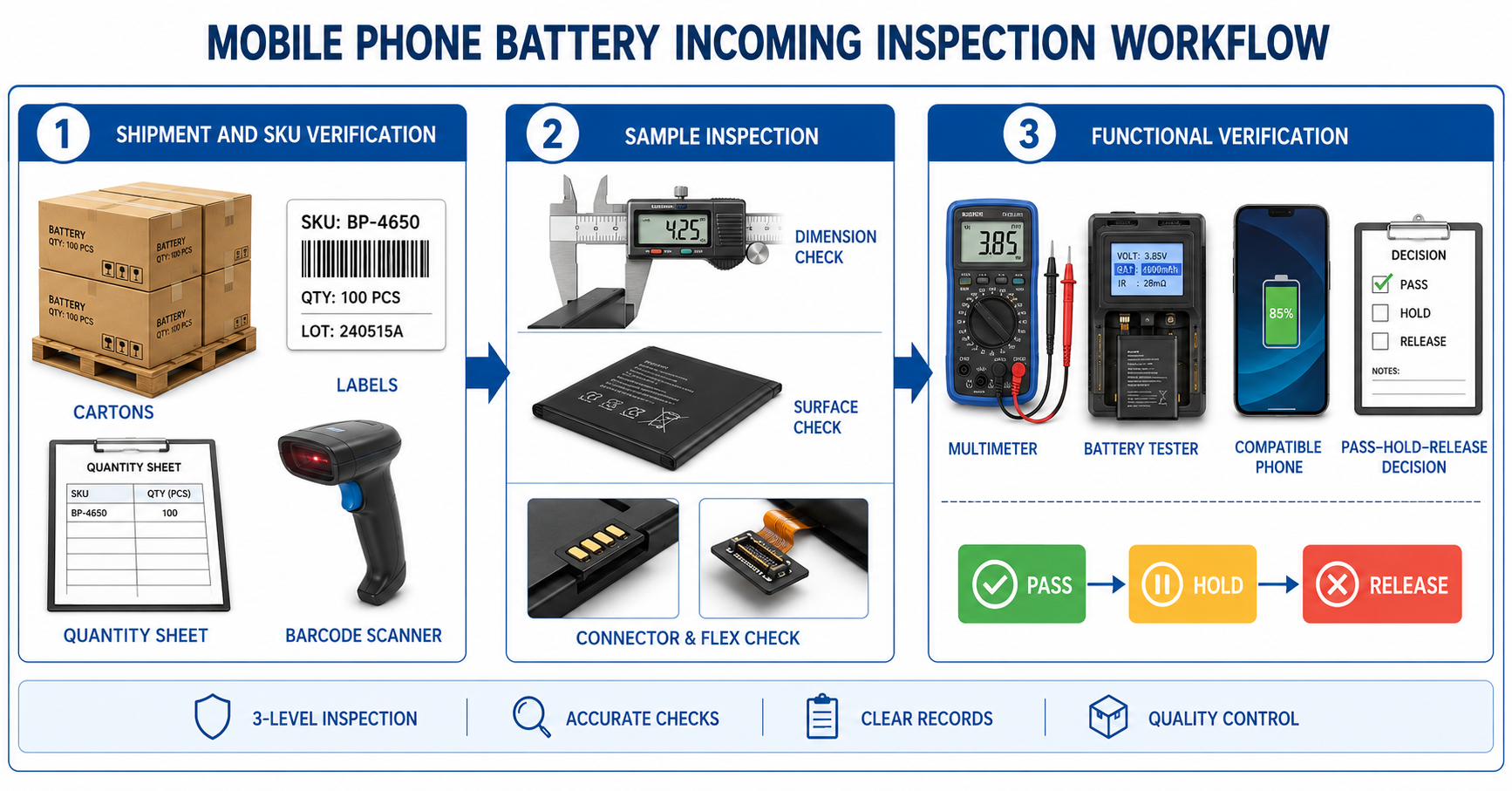
Level 1: Inspect Every Shipment and SKU
These checks are fast and should normally cover the complete delivery:
-
Purchase order and packing-list match
-
Carton count and external condition
-
Buyer SKU and supplier model
-
Quantity by model
-
Carton label and lot identification
-
Packaging and artwork revision
-
Visible shipping damage or moisture exposure
-
Availability of required documents
-
Separation of different models or production lots
If the carton identity is wrong, there is little value in opening only one box and continuing as if the shipment were correct. First isolate the affected cartons and determine the scope.
Level 2: Inspect a Defined Sample From the Batch
Sampled checks can cover:
-
Product label and model reference
-
Surface flatness and pouch condition
-
Edge sealing and insulation
-
Dimensions
-
Connector, pins, and flex-cable layout
-
Adhesive or pull-tab configuration
-
Open-circuit voltage
-
Packaging protection
-
Barcode readability
-
Comparison with the approved reference
Samples should be selected from different cartons or identifiable production lots. Taking every sample from one convenient carton creates a blind spot.
The sample quantity and acceptance limits should be agreed according to order size, product history, supplier performance, inspection cost, and business risk. Do not invent one universal sampling rule for every buyer or product.
Level 3: Perform Functional or Technical Verification
Functional verification is slower and may include:
-
Installation in a verified compatible phone
-
Power-on and charging observation
-
Battery percentage behavior
-
Connector stability
-
Standby observation
-
Internal resistance measurement
-
Controlled capacity testing
-
Charge and discharge behavior
-
Temperature observation under defined conditions
-
Post-install messages or battery-information behavior where relevant
The exact tests depend on the battery model and repair workflow. A test result is meaningful only when the battery model, equipment, procedure, load or current, environment, date, and acceptance criteria are recorded.
Verify Shipment Identity Before Testing Performance
Identity errors are among the easiest problems to detect and the most expensive to miss.
Compare the purchase order, supplier packing list, carton label, inner-box label, battery label, and physical battery. The buyer SKU should connect all of these records.
Check for:
-
One supplier code used for multiple incompatible products
-
Similar model names with different suffixes
-
Mixed battery versions inside one carton
-
Correct battery packed in the wrong retail box
-
Correct box containing the wrong instruction sheet or barcode
-
Artwork from an obsolete revision
-
Private label packaging mixed with neutral packaging
-
Missing lot or traceability information
Photograph the carton label and a representative battery from each inspected lot. This provides evidence if the products are mixed during later warehouse handling.
Inspect Mechanical Fit Before Releasing the Batch
A battery can have plausible electrical specifications and still be unusable because it does not fit the phone correctly.
Measure the battery
Use a suitable measuring tool and compare length, width, and thickness with the controlled specification. Measurements should be taken consistently because pressure and measuring position can affect readings on pouch batteries.
Look for:
-
Unusual thickness variation
-
Curved or uneven surfaces
-
Edge deformation
-
Damaged wrapping or insulation
-
Sharp folds
-
Contamination
-
Adhesive covering an unintended area
Do not describe any lithium-ion battery as having zero swelling risk. Risk depends on cell quality, protection design, storage, charging, installation, and operating conditions. If a battery is visibly swollen, damaged, leaking, unusually hot, or physically compromised, isolate it and follow an appropriate battery-safety procedure.
Check the connector and flex cable
Confirm:
-
Connector shape
-
Pin count and position
-
Contact condition
-
Cable length
-
Cable exit direction
-
Bend position
-
Insulation
-
Alignment with the phone connector
Do not force a connector during inspection. If unusual force is required, stop and compare the sample with the approved reference and device.
Perform installation checks
Use known compatible devices. Check whether the battery sits flat, the flex follows the intended route, the connector aligns naturally, and the housing can be reassembled without unwanted pressure.
Where practical, install several samples rather than relying on one phone and one battery. Previously repaired devices can contain housing damage, adhesive residue, or replacement parts that affect fit, so the condition of the test device should also be recorded.
Use Electrical Measurements as Screening Tools
Electrical measurements help identify unusual samples, but one number should not be treated as complete proof of quality.
Open-circuit voltage
Voltage screening can identify batteries that differ substantially from the expected shipment condition or from other samples in the same lot. The acceptable range must come from the approved battery specification and the agreed receiving condition.
A voltage result without model, measurement date, equipment, and acceptance range is not enough for a release decision.
Internal resistance
Internal resistance can support comparison among samples when the same method and equipment are used. Unusual variation may justify further investigation.
Results from different instruments or test settings may not be directly comparable. Buyers should establish a repeatable internal method rather than copying a generic limit from another product.
Capacity testing
Printed mAh is a label claim, not an incoming test result. Capacity claims must be verified for the specific battery model and test method.
A capacity record should identify:
-
Battery model and sample code
-
Test equipment
-
Charge procedure
-
Rest period if used
-
Discharge current or load
-
Cutoff condition
-
Ambient condition
-
Measured capacity
-
Test date
Full capacity testing may be reserved for selected samples, new models, changed components, disputed shipments, or periodic supplier monitoring because it takes more time than visual inspection.
Check Protection and Compliance Evidence at Model Level
IEC 62133-2 specifies requirements and tests for portable sealed secondary lithium cells and batteries under intended use and reasonably foreseeable misuse. This does not mean that every product offered by a supplier is automatically covered by an IEC 62133-2 certificate or report.
Certification availability must be confirmed for the specific model and target market. Review the model references, report scope, issuing organization, document date, and relationship between the tested item and the ordered battery.
For transport planning, IATA’s 2026 lithium battery guidance states that manufacturers and subsequent distributors must make the applicable UN 38.3 test summary available. The test summary contains battery identification and test-related information, so the buyer should confirm that it corresponds to the shipped model.
The required documents depend on product configuration, destination, and transport method. Confirm them with the supplier, logistics provider, and relevant compliance specialists before shipment.
Incoming inspection should therefore check both document availability and document applicability. A file with a familiar title is not sufficient if it covers a different battery.
Inspect Packaging as Part of Product Quality
Packaging affects identification, storage, shipment protection, installation handling, and customer expectations.
For bulk packaging, check:
-
Individual insulation
-
Connector protection
-
Separation between batteries
-
Inner-box quantity
-
Carton strength and condition
-
Model separation
-
Lot labels
-
Carton marks
For retail or private label packaging, also check:
-
Correct brand and artwork revision
-
Accurate model information
-
Realistic capacity and compatibility wording
-
Barcode readability
-
Warning information
-
Included accessories
-
Instruction language
-
Warranty wording
-
Trademark use
-
Print and sealing quality
Do not describe aftermarket replacement batteries as genuine, original-manufacturer, or authorized parts unless that status is supported by appropriate authorization. Product identity should be clear to distributors, technicians, and end customers.
Classify Findings Before Making a Release Decision
Not every issue should receive the same response. A structured classification helps buyers avoid releasing serious problems or rejecting usable shipments over a minor cosmetic difference.
| Finding type | Examples | Possible response |
|---|---|---|
| Identity or compatibility | Wrong model, connector, flex layout, or mixed SKU | Hold affected stock and determine full scope |
| Safety-related condition | Swelling, leakage, severe damage, abnormal heat | Isolate safely and escalate immediately |
| Functional | No power, charging failure, unstable device behavior | Hold lot and expand verification |
| Specification | Dimension or measured result outside agreed limit | Compare with approval criteria and investigate |
| Documentation | Missing or mismatched model document | Hold shipment release where the document is required |
| Packaging | Wrong artwork, weak protection, unreadable barcode | Sort, rework, relabel, or hold depending on impact |
| Cosmetic | Minor print or appearance variation | Evaluate against agreed cosmetic standard |
The commercial agreement should define who approves sorting, rework, replacement, credit, or conditional release. Warranty depends on the specific product and agreement, so incoming inspection should not assume one warranty period or claim process for every model.
Record Results So the Next Shipment Can Improve
A useful inspection report includes:
-
Supplier and purchase order
-
Arrival date
-
Battery models and quantities
-
Lot or carton references
-
Sampling method and sample quantity
-
Inspection equipment
-
Inspection items and limits
-
Results by sample
-
Photographs
-
Nonconformities
-
Disposition
-
Approver
-
Follow-up action
Track recurring problems by SKU and supplier lot. If the same connector, label, packaging, or electrical issue appears repeatedly, the buyer can adjust the specification, sample approval process, inspection level, or supplier corrective-action request.
This turns mobile phone battery incoming inspection into a supply-chain improvement system rather than a one-time warehouse activity.
Incoming Inspection Checklist
Before releasing a mobile phone battery shipment, confirm that:
-
The purchase order, packing list, cartons, and products match.
-
Each buyer SKU maps to one controlled specification.
-
Samples were selected from different cartons or lots.
-
Labels and artwork use the approved revision.
-
Dimensions, connector, and flex layout match the reference.
-
Batteries show no visible swelling or physical damage.
-
Sampled voltage or other measurements use agreed methods and limits.
-
Installation checks use verified compatible phones.
-
Capacity claims are not accepted without a defined test method.
-
Required model-specific documents are available and applicable.
-
Packaging protects connectors and separates models clearly.
-
Findings and release decisions are documented.
-
Nonconforming stock is physically isolated from released inventory.
Frequently Asked Questions
Should Every Battery Be Electrically Tested at Receiving?
Not necessarily. The inspection plan should match the shipment risk, supplier history, order size, product value, and available resources. Carton and SKU identity may be checked across the shipment, while electrical and installation tests are performed on defined samples.
How Many Batteries Should Be Sampled?
There is no universal number for every shipment. Buyers should define a sampling plan using order size, model risk, past performance, inspection cost, and agreed acceptance criteria. Samples should come from different cartons or identifiable lots.
Can Incoming Inspection Confirm Battery Cycle Life?
A normal receiving inspection cannot verify a long-term cycle-life claim quickly. Cycle-life evidence requires a defined model, cycling procedure, temperature, charge and discharge conditions, and end-of-life criterion. Do not infer cycle life from appearance or a short functional test.
What Should Buyers Do With a Swollen or Damaged Battery?
Stop handling it as normal stock, isolate it from saleable inventory, avoid charging or installing it, and follow an appropriate damaged-lithium-battery procedure. The exact response should reflect local safety rules and logistics requirements.
Does a UN 38.3 Test Summary Prove Product Quality?
No. It provides transport-test information required for applicable lithium batteries. It does not replace compatibility checks, capacity verification, incoming inspection, or market-specific product requirements.
When Should an Inspection Level Be Increased?
Consider increased inspection for a new supplier, new model, design or component change, previous failure, unusual shipment condition, customer complaint trend, or significant variation among initial samples.
Make Release Decisions From Evidence, Not Assumptions
Mobile phone battery incoming inspection works best when the approved specification, sample method, test conditions, and disposition rules are established before delivery. The goal is not to test every possible failure mode at the warehouse. It is to identify shipment errors and material risks before the batteries enter production, distribution, or customer orders.
A clear incoming inspection system gives wholesalers better inventory control, helps repair chains avoid preventable installation problems, and gives refurbishers evidence for batch-release decisions.
Send ESC your target phone models, battery references, order quantity, target market, packaging requirements, and proposed inspection criteria. ESC can discuss model confirmation, sampling, packaging, and project-specific quality requirements before an order is finalized.
Internal Link Suggestions
-
Explore ESC replacement battery products → Product center
-
Learn how B2B buyers can test iPhone battery capacity → Related capacity-testing guide
-
Understand why iPhone battery swelling happens → Related risk-control article
-
Learn about ESC → General company information; do not reuse unverified numerical claims
External Source References