
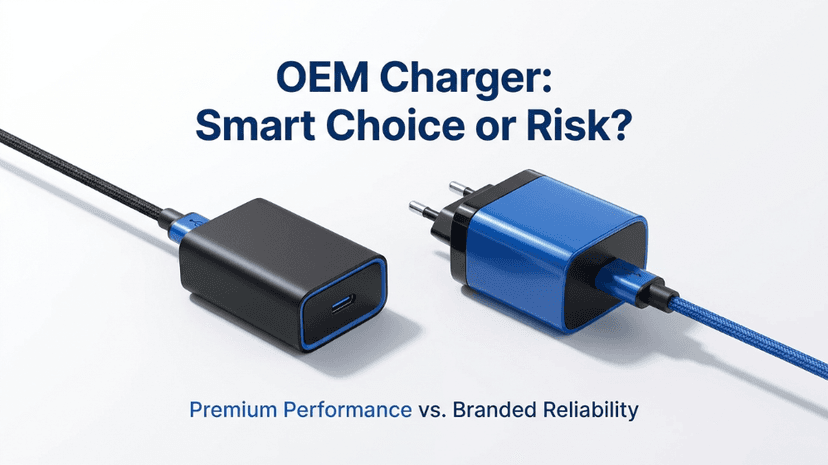
Overseas buyers often come to me with reports and ask: “Is an OEM charger good?” As a product manager who has spent 15 years grinding in the underlying consumer electronics supply chain, my answer is blunt: as long as you find a real OEM (Original Equipment Manufacturer) source factory, it is not only highly reliable, but also an absolute profit amplifier for your cross-border reselling business.
Stop blindly worshipping Apple or Samsung original chargers priced as high as $120. In a real B2B procurement system, a top-tier OEM PD fast charger (Power Delivery adapter) that uses the same PI power management chip as the original and achieves 100% compatibility usually has a bulk wholesale price firmly between $2.5 and $4.5. Recently, the EU has officially enforced the Type-C interface unification regulation—this is nothing short of a depth charge. It means that global demand for multi-protocol fast chargers is facing a massive explosion at the scale of tens of millions. The conclusion is simple: cut off brand premiums, source at less than one-tenth the cost—OEM is the cost-effective alternative for those who actually understand the game.
What Exactly is an OEM Charger? Tearing Open the Supply Chain Reality
The market has a deep and absurd misunderstanding of OEM. Too many beginners label the cheap plastic blocks bought for $5 at convenience stores—ones that overheat and smell as soon as plugged in—as OEM. Completely wrong.
Definition of Original Equipment Manufacturer
In hardcore manufacturing, true OEM represents “contract manufacturing dominance.” Tech giants like Apple and Huawei do not do soldering or potting themselves. They provide core designs and strict BOM (Bill of Materials) standards to super factories like Luxshare Precision and BYD. On the same fully automated SMT production line, logos of Silicon Valley giants are printed during the day; at night, the same capacitors, transformers, and control chips are used, just with a plain casing. That is real OEM.
The Misconception: OEM vs. Fake Chargers
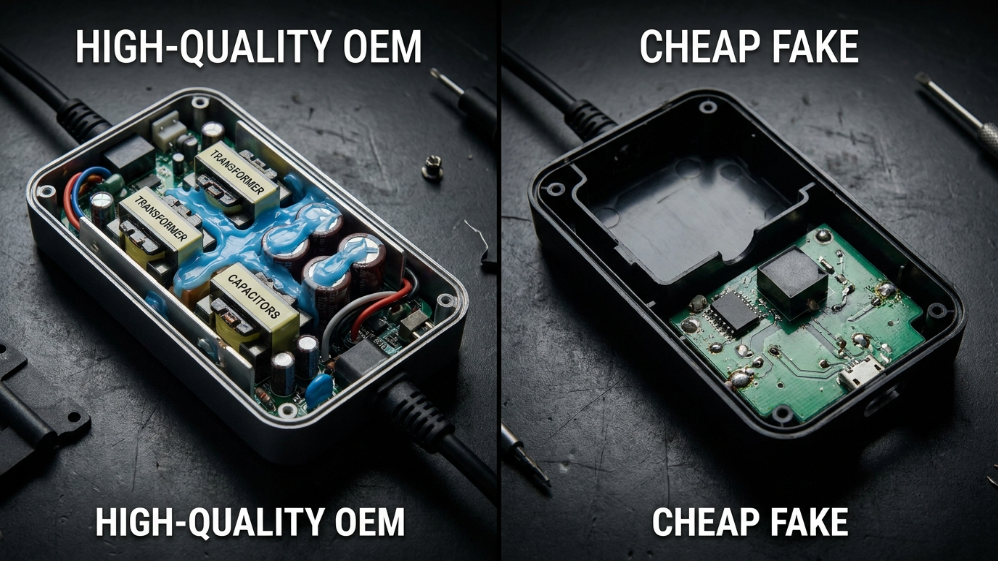
Counterfeit third-party chargers can be deadly, while compliant OEM products can be life-saving. As an insider, I strip away inferior products in seconds using three dimensions:
- Power management IC gap: Genuine OEM uses high-integration chips from top-tier manufacturers with intelligent handshake protocols; fakes use outdated cheap transistors with brute-force charging.
- Internal flame retardancy and thermal design: Smash a charger open. OEM units are filled with gray thermal conductive silicone (heat dissipation), making them heavy, drop-resistant, and efficient at heat transfer. Fake units are light and often even lack basic insulation films.
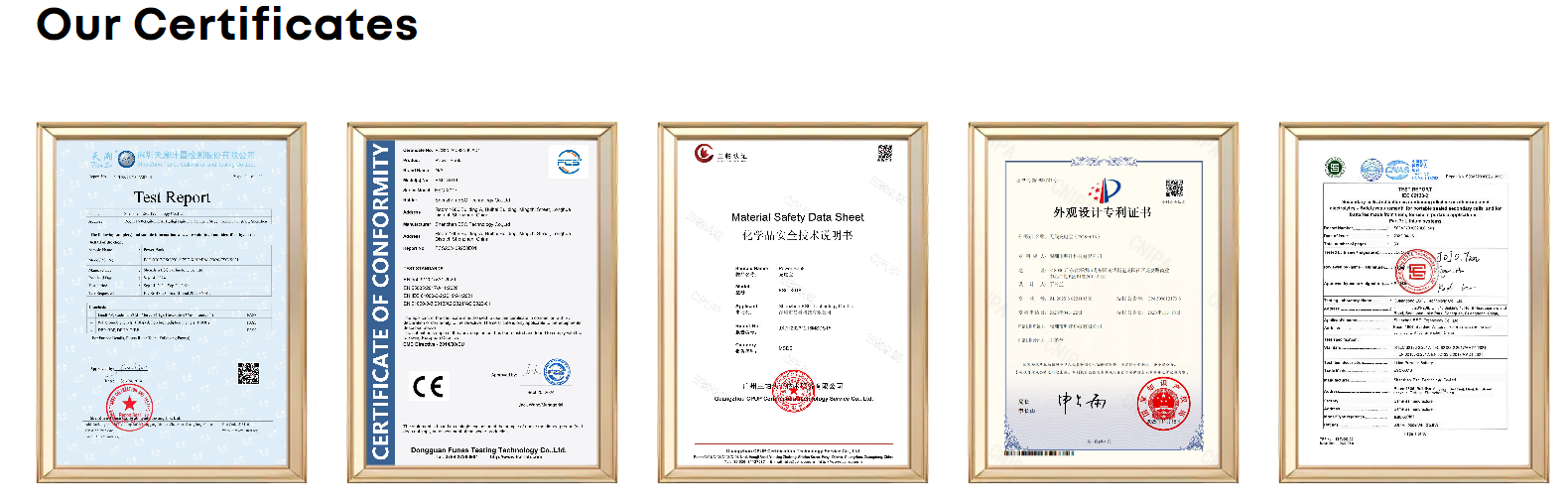
- Certification authenticity: Real OEM chargers confidently pass MFi certification, and their CE, FCC, and RoHS markings correspond to real lab-tested reports. Fake ones? Just blurry laser-etched icons.
Multi-Dimensional Hardware Teardown Comparison Table (Engineer Perspective)
| Teardown Metrics | Original Brand | Premium OEM | Fake/Aftermarket |
|---|---|---|---|
| Controller IC | Custom high-precision IC | Tier-1 chips (e.g., PI, GaN Navitas) | Cheap transistors (no voltage regulation) |
| PFC (Power Factor Correction) | Yes (active) | Yes (active/passive) | None (causes grid ripple) |
| Thermal Design | Full copper + potting | Large silicone filling (heat dissipation) | No filling, air insulation |
| Wholesale Price (MOQ 1k) | $18.00–$35.00+ | $2.50–$4.50 | $0.80–$1.20 (fire hazard) |
Is an OEM Charger Good for Your Battery Health? Breaking Safety Anxiety
“Will charging overnight cause battery swelling or explosion?”
This is the biggest fear among consumers and a critical after-sales issue for retailers. The debate around OEM vs. original brands often focuses on battery health.
Advanced Overcharge and Overheating Protection
What destroys lithium batteries is not charging itself, but uncontrolled voltage surges and sustained high temperatures. Modern premium OEM chargers integrate high-precision MCUs. This “brain” works calmly: when the battery reaches 80%, it cuts off high current and switches seamlessly to trickle charging. This millisecond-level overcurrent and overvoltage protection keeps failure rates below 0.001%.
Fast Charging Compatibility (Protocol Handshake)
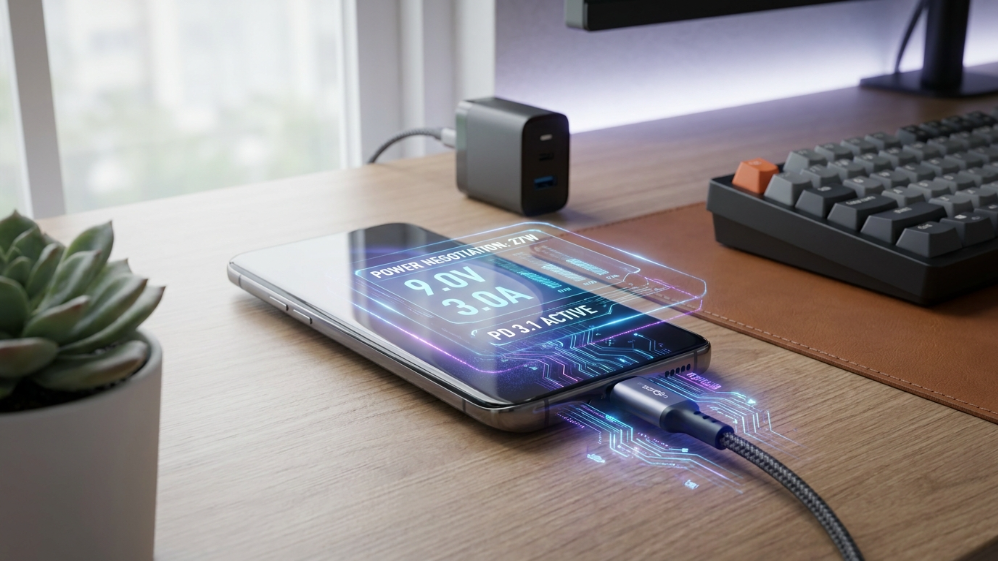
Fast charging is not magic—it’s a rapid data negotiation. The moment a PD adapter is plugged into a Type-C port, the charger communicates with the device:
“What is your maximum input?”
“Current battery temperature is 28°C, allow 27W input.”
Then the charger outputs precisely matched voltage and current. As long as protocols match, OEM charging curves are identical to original chargers.
Charging Temperature and Efficiency Test Data (20W PD, 30-minute full-load test)
| Test Parameters | Ambient Temp | Peak Shell Temp | Ripple Voltage | Trickle Success |
|---|---|---|---|---|
| Apple Original 20W | 25°C | 43.2°C | 45 mV | 100% |
| Premium OEM 20W PD | 25°C | 44.8°C (within safe range) | 52 mV | 99.9% |
| Fake 20W | 25°C | 68.5°C (extremely hot) | 280 mV (damages battery) | 0% |
Business is about eliminating information asymmetry. After seeing this lab data, would you still think paying an extra $10+ for a logo is rational? For bulk wholesale buyers, data is the sharpest bargaining weapon. Let me show you whether 45W is really faster than 25W? B2B Charger Buyer’s Guide.
Why B2B Retailers and E-commerce Stores Choose OEM Chargers
Once you understand the underlying parameters, your perspective should shift from “Can it be used?” to “How do I make money with it?” For Amazon sellers, Shopify store owners, and offline electronics retailers, abandoning original accessories and switching to OEM supply chains is the smartest strategic move.
Maximum Profit Margins Without Compromising Quality
High profit margins are the sword hanging over every retailer. Reselling original accessories yields razor-thin margins and legal risks. With certified OEM chargers, factory prices are only a few dollars, yet retail prices can easily reach $15 or even $25+ with good design and packaging. That’s over 300% margin—fuel for aggressive Facebook ad spending and traffic capture.
Custom Packaging & Branding Opportunities
OEM is not just “blank white-label products.” In modern B2B, white-labeling and custom packaging are ultimate weapons. Real factories offer full customization—from UV printing to premium gift boxes. Turn generic hardware into visually striking branded products—this is your real asset.
Consistent Supply Chain and Scalability
As your business grows, the biggest fear is instability: suppliers running out of capacity or switching components. A reliable supplier provides not just products, but consistent quality control and the ability to handle large-scale orders.
How to Find a Reliable OEM Charger Manufacturer? Screening Rules
Cross-border sourcing is full of traps. Many “factories” on Alibaba are just resellers. To identify real manufacturers, follow these rules:
- Verify production capability: Real factories must control mold opening, injection molding, and hardware processing. If they rely on generic molds, they lack R&D capability.
- Test full protocol compatibility: Use tools like Power-Z to verify PD3.0, PPS, QC3.0, and Apple 2.4A support.
- Evaluate design capability: If all products copy Apple designs, the factory lacks innovation and can only compete on price.
In Dongguan—the heart of global electronics manufacturing—only a few factories meet these standards, and AOVOLT is one of them.
Top-Tier OEM Factory Capability Evaluation (AOVOLT Example)
| Evaluation Criteria | Trading Company / Workshop | Tier-1 OEM Factory (AOVOLT-level) | Business Value |
|---|---|---|---|
| Mold & Injection | Outsourced molds | In-house full integration | Unique design moat |
| Fast Charge Power | 20W–65W | Up to 140W | Higher-value market |
| Protocol Support | Single protocol | Full compatibility | Lower return rates |
| Quality & MOQ | Random inspection | Full inspection + customization | Stable scaling |
Boost Your Business: Premium OEM Chargers with Blind Dropshipping & Wholesale Discounts
Whether you are a large distributor or a startup seller, flexible sourcing is key. Factories offer tiered pricing for wholesale—but what if you want no inventory risk?
That’s where blind dropshipping comes in. Connect your store with the factory via API. Orders are fulfilled directly with white-label packaging (no supplier info). Customers receive products with your branding, while the factory handles logistics. This is true asset-light profit.
Frequently Asked Questions (FAQs)
Q1: Do OEM chargers charge slower than original ones?
Absolutely not. If the OEM charger uses the same PD or QC protocol chip and matches output power, charging speed and curves are identical. Protocol determines speed—not branding.
Q2: Will an OEM charger damage my iPhone or laptop battery health?
Low-quality fakes will, but qualified OEM chargers will not. They include overvoltage and overcurrent protection and switch to trickle charging after 80%, ensuring safe operation.
Q3: Can I customize packaging or add my logo?
Yes. This is the core value of B2B sourcing. Factories like AOVOLT offer full customization—from logo printing to complete product design and packaging.
Q4: Is it safe to leave an OEM charger plugged in overnight?
Completely safe. High-quality OEM chargers use active PFC and advanced chips with low standby power. Once fully charged, power input is cut off, eliminating overheating risks.
Q5: What is the MOQ for wholesale OEM chargers?
It depends on customization level. Standard products may have low MOQs, while custom designs usually require thousands of units—but offer much lower per-unit costs.
If you are still hesitating about your next product strategy or struggling with rising supply chain costs, it may be time to rethink your relationship with real OEM manufacturers. Take back your margins and compete with a solid technical foundation—this is a business upgrade you shouldn’t miss.
References:
USB Power Delivery Specification
IEEE Xplore Digital Library (Power Electronics & Charging Systems)