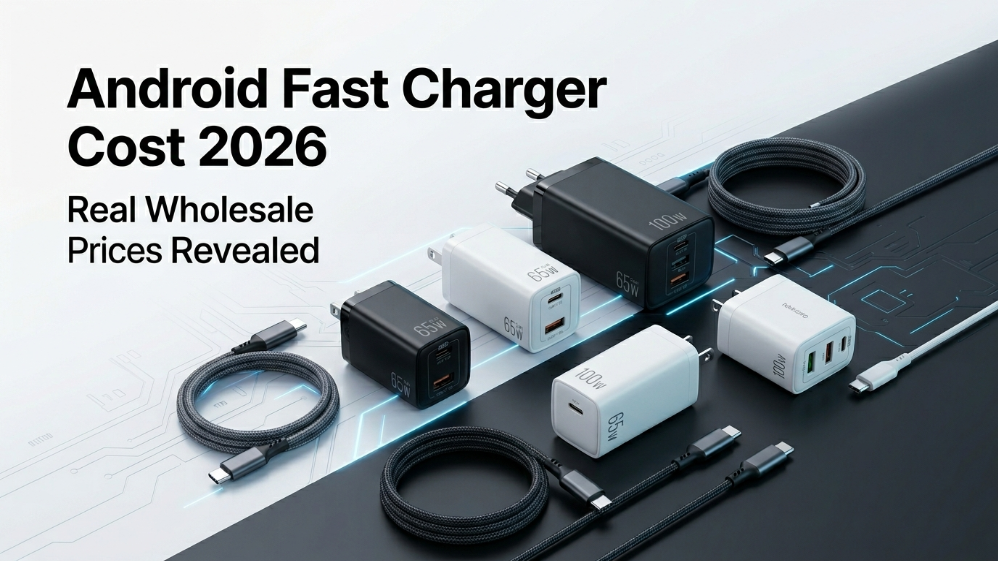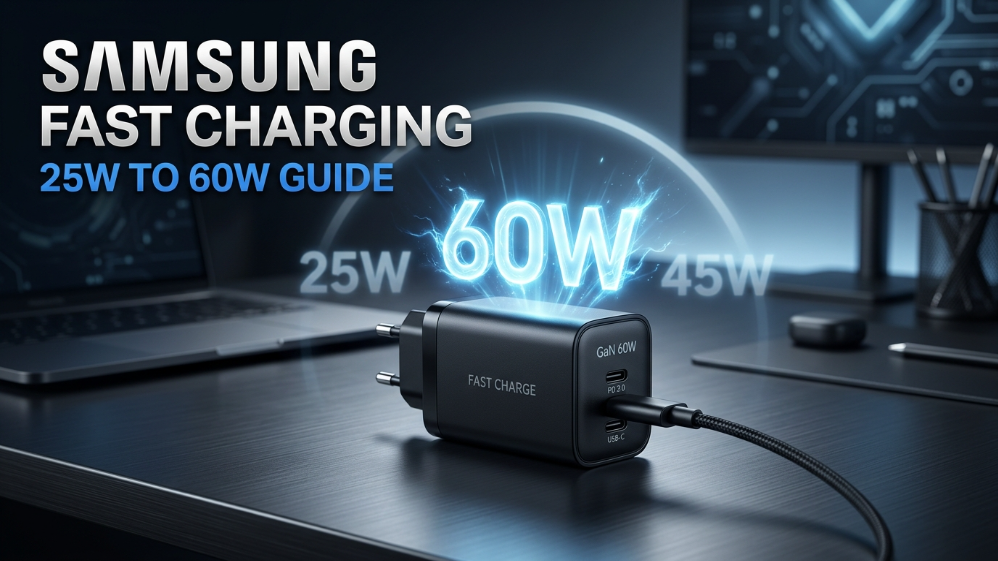

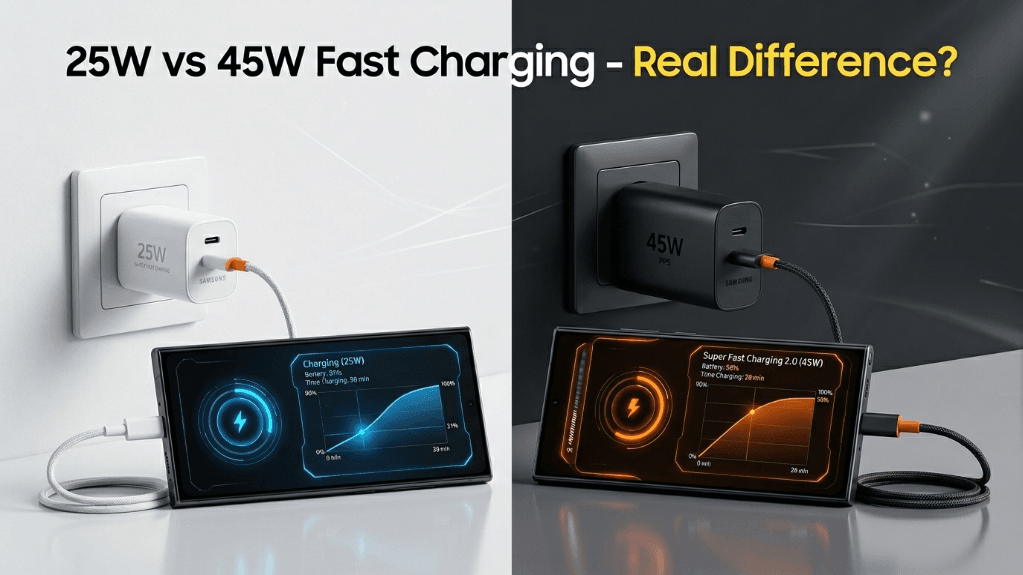
Stop being misled by evaluation articles that only run data from charging head laboratories. As a senior product manager who has spent 15 years in the supply chains of Dongguan and Shenzhen, I will tell you the bottom card of B2B procurement directly: 45W is indeed faster than 25W, but this speed has a "rhythm" and is by no means a linear multiplication. In the "recovery" stage from 0% to 50%, 45W can save nearly 15 to 20 minutes compared to 25W; however, once the 80% battery threshold is crossed, the performance of the two is almost identical due to the trickle charging mechanism. In the current bulk procurement market, the wholesale price of high-quality 25W charging heads is usually between $1.5 and $2.8, while 45W Gallium Nitride (GaN) solutions supporting the PPS protocol hover between $4.2 and $6.5. Choosing 25W is to protect the basic market; choosing 45W is to gamble on a premium.
The recent release of the Samsung Galaxy S24 series and various Android flagships has pushed this topic back onto the trending search list. Last week, while I was at the factory supervising the production of a batch of customized 45W fast charging adapters for a major European client, I realized that the game of hardware parameters is essentially a gamble between cost and user anxiety.
Revealing the Charging Curve: The "100-Meter Sprint" Before 50% Battery
Many procurement managers new to the industry ask me: Since the wattage has almost doubled, should the charging time be halved?
The answer is: Absolutely impossible.
This is the result of the so-called "Battery charging curve." We must understand that a mobile phone battery is not a bucket that can be filled with water indefinitely. When the power is at a low level (0%-20%), the internal impedance of the battery is small, and the phone's charging IC will allow the maximum power to be poured in. At this time, the advantage of 45W is infinitely magnified, and it can cross the starting line with extremely high efficiency.
However, once the power climbs above 50%, to prevent the collapse of the positive electrode structure caused by lithium ions embedding too quickly, the BMS (Battery Management System) on the phone side will forcibly intervene, triggering thermal reduction or thermal throttling charging. You will find that even if you connect a 100W head, the phone may only run at 20W or even 15W.
25W vs. 45W Measured Performance and Procurement Parameter Comparison
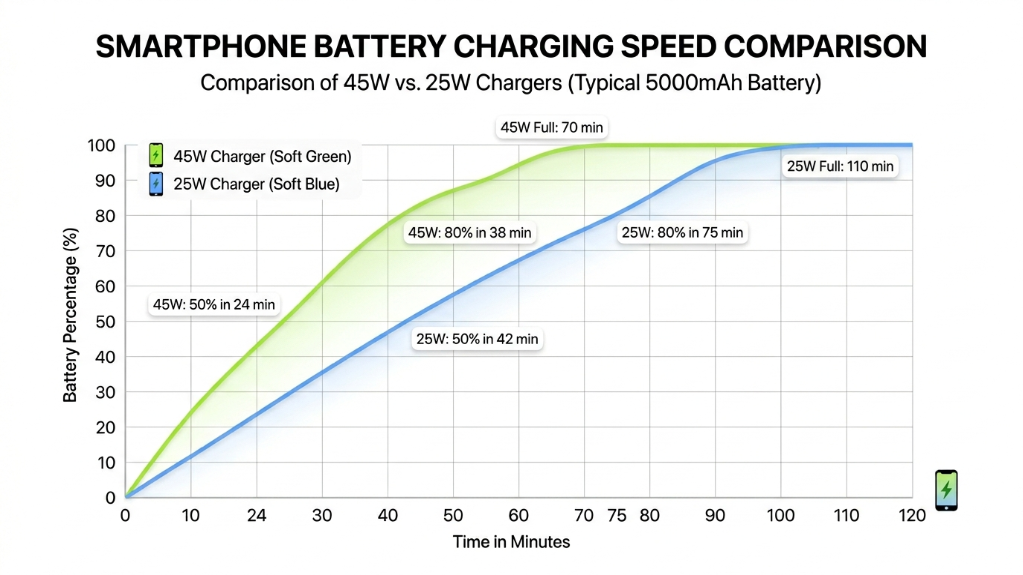
To make it clearer for everyone, I have compiled this comparison table based on our OEM laboratory tests:
| Dimension | 25W Standard Adapter (Silicon) | 45W High-End Adapter (GaN) | Procurement Decision Impact (B2B Perspective) |
| 0-50% Charging Time | Approx. 35-40 minutes | Approx. 22-26 minutes | Key winning factor: 45W can be a main selling point for "fragmented recovery." |
| 0-100% Total Duration | Approx. 75-85 minutes | Approx. 62-70 minutes | The gap is not huge; it is not recommended as the sole reason for a premium. |
| Core Underlying Technology | Standard Silicon | GaN + High-frequency transformer | 45W is smaller, but heat control tests the R&D strength of the foundry. |
| Protocol Support Requirements | USB-C Power Delivery PD 3.0 | Must feature PPS (Programmable Power Supply) | If 45W lacks PPS, it will automatically slow down to 15W when charging specific brands. |
| Average BOM Cost | Lower ($) | Higher ($$) | 45W is more suitable for high-end accessory brands or gift channels. |
Why is the PPS Protocol the "Soul" of 45W?
In the B2B procurement process, if you only talk to suppliers about "45W," you will likely be cheated.
The compatibility of fast charging protocols is the core barrier. Especially for devices from brands like Samsung and Google, simply supporting USB-C Power Delivery PD 3.0 is far from enough. You must require the factory to write the Programmable Power Supply (PPS) specification into the firmware.
The magic of PPS is that it allows the charger to dynamically fine-tune the output voltage in steps of 20mV. Why is this important? Because traditional fixed voltage outputs (such as 9V or 12V) generate huge heat loss through the step-down circuit inside the phone. PPS allows the charger to directly output the battery's most "comfortable" voltage, reducing the conversion of energy into heat inside the phone.
If the 45W charger you wholesale has not been tuned with PPS, it will trigger frequency reduction due to overheating in the middle of charging. The result: you spent money on 45W, but bought a second-rate product that can only maintain high speed for 5 minutes and "slacks off" the rest of the time. This is why we repeatedly confirm the device compatibility of the terminal target market when providing OEM charger solutions for customers.
The Dimensional Reduction Strike of Gallium Nitride (GaN): The Balancing Act of Volume and Heat
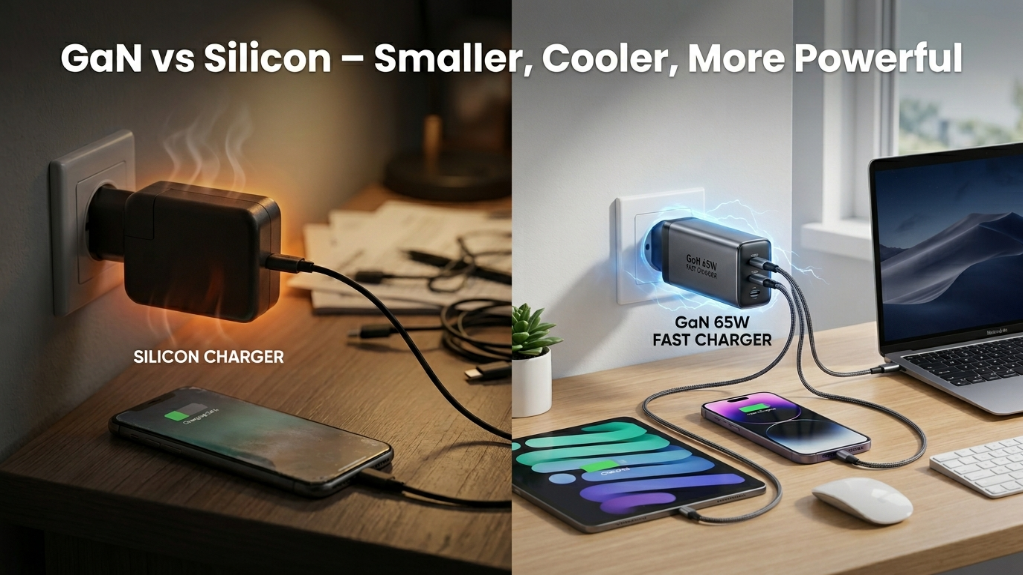
As a senior product manager for 15 years, I have witnessed the evolution of chargers from "large bricks" to "small cubes." A 25W charger can be made quite reliably using traditional silicon chips and transformers, and the cost is kept extremely low. But at the 45W threshold, traditional silicon-based solutions encounter a serious bottleneck: heat dissipation.
To output 45W while maintaining a compact volume, GaN charger manufacturing is almost a must. The switching frequency of GaN chips is much higher than that of silicon, which means we can reduce the volume of the internal transformer while increasing the ratio of charging efficiency vs heat.
In the B2B wholesale field, 45W GaN chargers currently represent high-margin products. Its logic is no longer simply "fast or slow," but "exquisite and powerful." For distributors, a 45W GaN head that can fit into a jeans pocket but can quickly recharge a MacBook Air and a mobile phone at the same time has a retail premium capability far exceeding that of two traditional 25W heads.
Is This "Speed" Worth the Customer's Money? — The Psychology of Fragmented Scenarios
When planning product lines, we must consider the real usage psychology of users.
Today's users rarely have the patience to watch their phones charge for an hour and a half. Their pain point scenarios are: waking up early to find the charging cable wasn't plugged in last night—how much can be charged in the 20 minutes of washing and brushing? Or in the airport waiting hall before boarding—how much "blood" can be recovered in those precious 15 minutes?
In these extremely short 15-20 minutes, the extra 10% to 15% of power brought by 45W is often the key to determining whether a user can last until they get off the plane or experience shutdown anxiety halfway. This is the "fragmented recovery" story that B2B buyers should focus on when creating marketing materials.
Profit Margins and Market Gaming: 25W Defends the Territory, 45W Expands the Frontier
In B2B procurement logic, we don't talk about feelings, only about ROI (Return on Investment).
25W chargers currently play the "basic model" role in the market. Since the technical threshold has basically disappeared, its supply chain is extremely transparent. If you are a large cross-border e-commerce seller, 25W is your "stepping stone" to increase sales volume and stabilize rankings. Its advantage is that the Bill of Materials (BOM) cost is extremely low, and safety certifications are very complete. But the fatal disadvantage is serious homogenization; everyone is fighting on price, and profit margins are as thin as razor blades.
On the other hand, 45W, especially 45W based on GaN technology, is the profit model to increase your Average Selling Price (ASP) and brand tone. It is not only compatible with mobile phones but can also be downwardly compatible with thin and light laptops and tablets through the 20V voltage gear. This is what we often call multi-port adapter compatibility.
25W vs. 45W: B2B Procurement Decision Matrix
| Dimension | 25W Solution (Normal Silicon) | 45W Solution (GaN) | Suggested Application Scenario |
| BOM Cost | Extremely compressed, suitable as a gift or low-end line | Higher, but large premium space | 45W is suitable for the high-end business accessory market. |
| Mold & ID Design | Mostly public molds, very low recognition | Suggested private mold, highlighting miniaturization and metal texture | 45W private molds can effectively avoid price wars. |
| Technical Risk | Extremely low, solution is very mature | Medium, needs focus on thermal management system design | Must find source factories with injection molding and hardware integration capabilities. |
| Consumer Mindset | "Usable, enough" | "Fast charge, flagship feel, multi-purpose" | 45W can significantly reduce the user's burden of carrying equipment. |
| Inventory Turnover | Steadily declining, gradually becoming an accessory giveaway | Rising rapidly, becoming a standard flagship specification | Suggest distributors gradually tilt toward the 30W-45W range. |
Case Review: The Brand's Step-by-Step Leap from 25W to 45W GaN

I once managed a 3C brand customer in the North American market. Initially, they were obsessed with a single 25W product. As a result, they fell into a death spiral of price wars with hundreds of factory stores on Amazon, with a single product gross margin of less than 8%.
Later, we suggested they cut the 25W promotion budget entirely and develop a 45W ultra-thin GaN charger that supports the PPS protocol. We utilized the factory's own mold opening advantages to design an ultra-thin "biscuit" shape less than 1.5 cm thick and added 15V and 20V PD output gears.
The result was very dramatic: although the wholesale unit price of this 45W charger more than doubled, because the product possessed the differentiated selling points of "charging laptops" and "minimalist storage," the customer directly tripled the terminal retail price. In less than half a year, their overall brand gross margin increased from 8% to 24%, and the customer complaint rate actually decreased due to better GaN thermal management. This is a typical case of using fast charging technology upgrades to achieve a brand breakthrough.
Finding the Source: Why the OEM Factory's "Closed-Loop" Capability Determines Your Margin?
When you decide to enter the 45W or even higher power market, the standards for selecting suppliers change. For 25W, you can find an assembly plant, but for 45W, especially GaN solutions, you must find a factory that truly possesses an R&D and manufacturing closed loop.
This is exactly the core logic of AOVOLT’s deep cultivation in consumer electronics manufacturing over the past 15 years. We are rooted in the world's manufacturing center—Dongguan, China, not simply for low costs, but for that set of extremely asset-heavy vertically integrated supply chains.
Many traders will tell you they have "independent R&D," but when you ask them if they have their own injection molding workshop or if they can modify mold tolerances within 48 hours, they go silent. At AOVOLT, we have achieved a full-link closed loop from initial industrial design, circuit R&D, private mold opening, and injection molding to precision hardware integration.
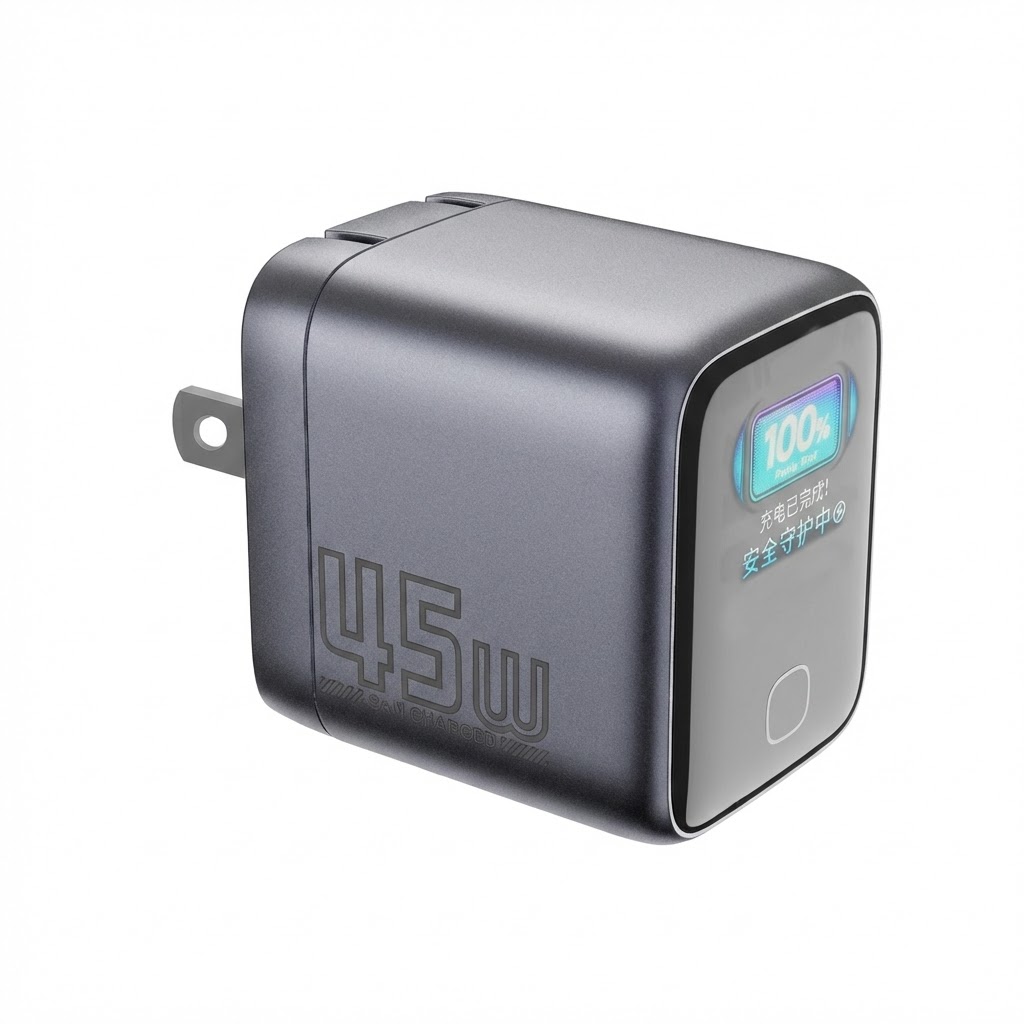
What does this mean for B2B customers?
-
Speedy Delivery: When you find the 45W market exploding, we don't need to beg mold factories for scheduling.
-
Technical Barriers: Our fast charging technology has reached extreme fields like 140W, making downward compatibility with 45W effortless. We support full protocol compatibility (including PD3.0, PPS, QC3.0, FCP, SCP, AFC, Apple 2.4A, etc.), ensuring your products can run at full capacity anywhere in the world.
-
Quality Endorsement: 15 years of experience makes us very clear on how to balance charging efficiency vs heat under high power density.
Whether it's power banks, magnetic wireless chargers, or high-wattage fast charging heads, we are not just providing products; we are providing risk resistance for your brand through asset-heavy production lines. Provide you with 45W PD fast charging OEM guide to choose a reliable partner in 2026.
FAQ: 5 Key Questions About 25W and 45W Charging Speeds
Based on our analysis of Google search intent and PAA (People Also Ask) data, here are the technical questions B2B buyers encounter most often:
Q1: Will a 45W charger burn a phone that only supports 25W?
Absolutely not. This is due to the handshake mechanism of the USB-C Power Delivery PD 3.0 protocol. The charger will first exchange information with the phone and automatically match the highest power the phone supports. Using 45W to charge a 25W device will lock the actual output power at 25W, which is safe and stable.
Q2: Why do some 45W chargers not display "Super Fast Charging 2.0" when charging the Samsung S24 Ultra?
The key lies in whether it supports the PPS protocol. Samsung's "Super Fast Charging 2.0" mandatory requires the charger to support a 5A PPS protocol (usually 4.05V-11V with current reaching 4.05A or above). If your supplier only provided a 3A PD protocol, even if the total power is 45W, the phone will only display ordinary fast charging.
Q3: Does 45W fast charging decay battery life faster?
From a technical perspective, as long as heat dissipation is properly controlled, the impact of 45W on battery life is minimal. Modern smartphones have extremely sophisticated thermal throttling protection. Compared to power levels, the ripple voltage generated by inferior chargers causes more damage to the battery, which is why a mature OEM solution should be chosen.
Q4: Is it necessary to pair a 5A cable when purchasing a 45W charger?
Yes. To run 45W at full capacity and exceed 3A current, it must be paired with a 5A data cable with an E-Marker chip. As a purchaser, it is recommended to bundle high-specification cables when wholesaling chargers; otherwise, users will not be able to experience the true 45W speed, leading to a large amount of misleading after-sales negative feedback.
Q5: Compared to ordinary silicon solutions, why is the cost of the 45W GaN solution higher?
It is mainly higher due to the price of GaN power chips (usually several times that of silicon chips) and the requirements for high-frequency transformers and precision heat dissipation materials. However, these investments result in smaller volumes, higher conversion efficiency, and extremely low after-sales return rates.
Conclusion: In the Fast Charging Race, Selection Beats Blindly Following Trends
Returning to the original question: which is faster, 25W or 45W? In the golden 30 minutes of fragmented energy replenishment, 45W has incomparable dominance. But for B2B buyers, this "speed" must be built on the foundation of protocol compatibility, thermal management levels, and supply chain stability.
25W has entered its sunset stage—it can protect your lower limit; while 45W is the ladder for your brand to move upward. In the consumer electronics business, there is no so-called "cost-performance myth," only the technical realization of "you get what you pay for." When you are looking for a reliable source factory for next quarter's orders, you might as well investigate those vertically integrated companies that are willing to invest heavily in R&D and molds and have been deeply involved for 15 years.
After all, in the era where everything is fast-charged, only an extreme supply chain closed loop can allow your brand to not only run fast but also run steadily in the face of ever-changing market demands. If you are in the selection stage, evaluating the next generation of fast charging layouts like 45W or even 140W, our engineering team might be able to provide you with truly valuable technical advice and private mold customization solutions from the front lines of the Dongguan production line.
References:
USB Power Delivery Specification Revision 3.1, Version 1.8
Analysis of Battery Charging Curves and Thermal Management in Lithium-Ion Cells