
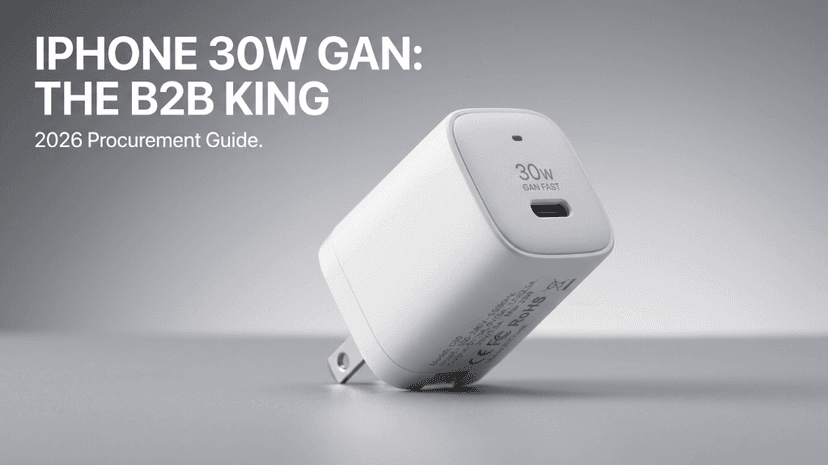
Stop staring at 20W. If you are still stockpiling massive quantities of traditional 20W single USB-C chargers, your profit margins are being squeezed at high speed.
The official baseline standard for iPhone fast charging is 20W, but rigorous testing reveals that the actual peak power for the iPhone 15 and 16 Pro Max has approached 27W–29W. For B2B buyers and accessory brands, the most commercially valuable conclusion is this: 30W Gallium Nitride (GaN) chargers are the current core of profit. Currently, the bulk FOB (Free on Board) BOM (Bill of Materials) cost for 30W GaN fast chargers using mature PCBA solutions has stabilized between $2.5 and $4.2. This is the "golden ratio" for capturing high premiums.
As the EU's 2026 Eco-design Directive for External Power Supplies (EPS)—which sets strict new regulations on no-load power consumption and energy efficiency standards—comes into full effect, inefficient and high-heat traditional silicon-based chargers will face a mandatory compliance shakeup. The procurement side must complete the generational shift immediately. This article will start from underlying hardware logic to thoroughly deconstruct the technical thresholds and profit codes behind OEM iPhone chargers.
Precise Matching: The Real Power Demands of Different iPhone Models
As a digital accessory procurement manager or brand owner, understanding the difference between "functional" and "full-speed output" is the first step in optimizing your product line. The following data reveals the engineering limits behind different device models.
| Target Model Category | Official Minimum Fast Charge Threshold | Actual Tested Peak Power (0–30% Battery Range) | Recommended B2B Procurement Spec (Best Profit Margin) | Market Status Assessment |
| iPhone 15/16 Pro Max | 20W | 27W–29W | 30W/35W (GaN) | High-end growth market; consumers are willing to pay a premium to shorten charging time. |
| iPhone 15/16 Standard | 20W | 22W–25W | 30W (GaN/High-Silicon) | Intensifying competition; requires differentiation through design or multi-port (1A1C) solutions. |
| iPhone 12 to 14 Series | 20W | 20W–23W | 20W (Traditional Silicon) | Extremely saturated "Red Ocean." Competition relies on BOM costs and large-scale OEM capabilities. |
| iPhone 8 to 11 Series | 18W | 18W | SKU not recommended | In the phase-out cycle; suggested to clear 18W protocol inventory immediately. |
iPhone 15 & 16 Series: Computing Power Premiums in the Type-C Era
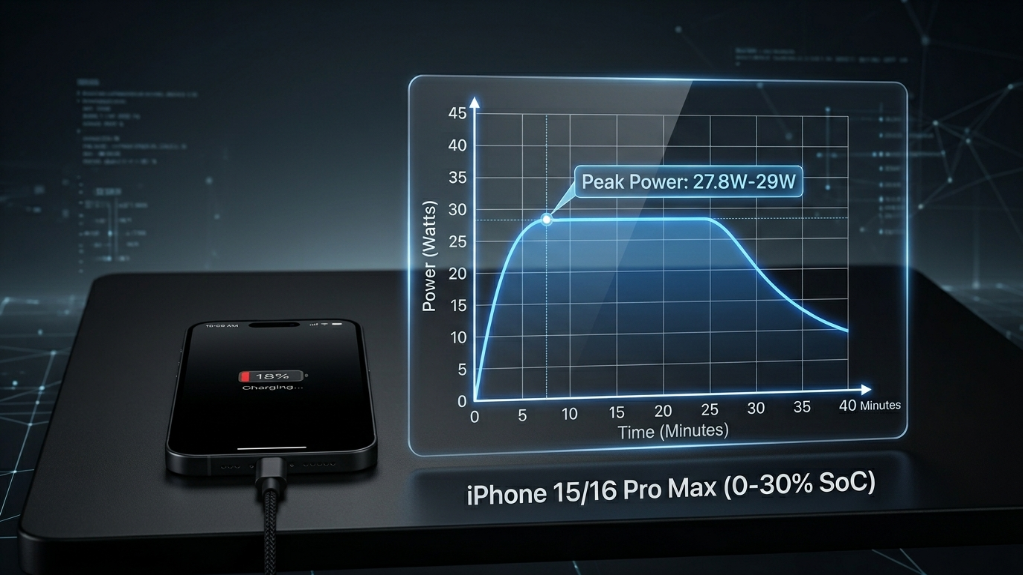
After Apple abandoned the Lightning interface across its entire line, the physical blockade of charging protocols was completely torn down. Although official statements remain conservative, claiming "up to 50% charge in around 30 minutes," the hardware-level iPhone 15 Pro Max maximum wattage test curves show that within the 0–30% battery range, the device can stably maintain high-level operation above 27W.
What does this mean? If you release adapters that only support 20W to the high-end retail market, you are not only wasting the hardware's potential but also losing business customers who are extremely sensitive to charging times. Moving directly into 30W or 35W specifications is the only solution to capture high average order values.
iPhone 12 to 14 Series: The Red Ocean Inventory Battle
Since the iPhone 12 stopped including chargers in the name of "environmental protection," 20W established its historical position as the "industry floor." The current state of this market is hyper-competitive, with profit margins as thin as a cicada's wing. When looking for OEMs for these orders, there are only two core demands: extreme cost control and absolute yield assurance. Any defect rate exceeding 1% will directly consume the meager profits of the entire batch.
iPhone 8 to 11 Series: The 18W Inventory Clearance Countdown
Older models supporting early 18W PD fast charging are exiting the stage of history. If your supply chain still holds a large inventory of 18W PCBA boards or finished products, the current decision should be an immediate price-cut clearance. Reallocate production capacity and capital turnover to higher-profit, high-frequency charging products.
Breaking Through the Physical Interface: Reconstructing USB-PD and Protocol Awareness
Just because the plug fits doesn't mean the device is fast charging. Many cross-border e-commerce sellers fail due to mysteriously high return rates, the root cause of which is ignorance regarding charging protocol compatibility.
Why USB-C Power Delivery (PD) is the Uncrossable Red Line
Modern fast charging is essentially a "digital negotiation" between the device and the charger head. The moment the cable is connected, the protocol IC inside the charger performs a microsecond-level "handshake" with the iPhone's motherboard. Only after confirming that both parties support the USB-C Power Delivery protocol will the phone's motherboard issue a step-up command (usually jumping from 5V to 9V).
Furthermore, Programmable Power Supply (PPS) technology is worth mentioning. While Apple devices do not currently rely on PPS for fast charging, this technology is the core of full-speed charging in the Android camp (such as Samsung). Considering that B2B buyers usually need to cater to both platforms, procuring universal solutions that fully support PD 3.0 and are backward compatible with PPS can significantly enhance product versatility and minimize the risk of dead stock. Let me show you the difference between Apple2.4A and BC1.2?
The Commercial Counter-Strike Against "High Wattage Damages Batteries"
Retail consumers are perpetually worried: will using a 65W or even a 140W MacBook charger for an iPhone burn the phone? As a brand, you need a set of core engineering logic to educate the market.
Remember one engineering rule: Charging power is "pulled," not "pushed."
The PMIC (Power Management IC) integrated inside the iPhone is the "dictator" of this charging game. It dynamically requests the required current from the charger based on real-time cell temperature, system load, and battery internal resistance. As long as the OEM factory has rigorously implanted reliable over-voltage protection, over-current protection, and synchronous rectification circuits during circuit design, no matter how much power is available at the front end, the power injected into the phone will never exceed the device's own limit.
| Technical Dimension | Traditional 5V/1A (Apple 5W) | USB-PD 2.0 (18W) | USB-PD 3.0+PPS (30W & Above) | B2B Procurement Value |
| Voltage Regulation | Fixed 5V output | Stepped fixed levels (5V, 9V, 12V) | Fine-tuned dynamic output (20mV steps) | Greatly reduces energy loss at the end of charging, reducing heat. |
| Temperature Control | Very low (minimal power) | High (significant heat under load) | Excellent (GaN materials enable "cold charging") | Meets the strictest international safety standards, reducing complaint rates. |
| Handshake Speed | No protocol, direct output | Slow static handshake | Ultra-fast dynamic interaction | Provides safer plug/unplug protection, extending interface life. |
| Market Lifecycle | Dead | Near Obsolescence | Absolute mainstream for the next 5 years | Protects supply chain investment, avoiding inventory obsolescence. |
20W vs. 30W vs. 35W: The 2026 SKU Matrix and Profit Extraction Points
Now that the underlying physical logic is clear, how should we arrange our product SKUs?
20W chargers still see staggering shipment volumes, but they have devolved into "lead magnets" and "consumables" for lower-tier markets. In the brutally competitive e-commerce landscape, the profits for 20W silicon chargers are extremely diluted; you are merely earning a thin supply chain margin.
In contrast, 30W and 35W are the "sweet spots" for brands to capture excess profits. Combined with the iPhone 15 Pro Max's actual power limit nearing 29W, a 30W charger feeds the device perfectly without incurring the high BOM costs of a 65W-level unit. When selling 30W products to customers, your commercial narrative is crystal clear: it not only provides full-speed charging for the latest iPhone but is also compatible with the iPad Air and can even provide emergency power for a MacBook Air. This "cross-category" applicability is the strongest engine for driving up average order values.
Silicon vs. Gallium Nitride (GaN): OEM Cost-Efficiency and the Material Revolution
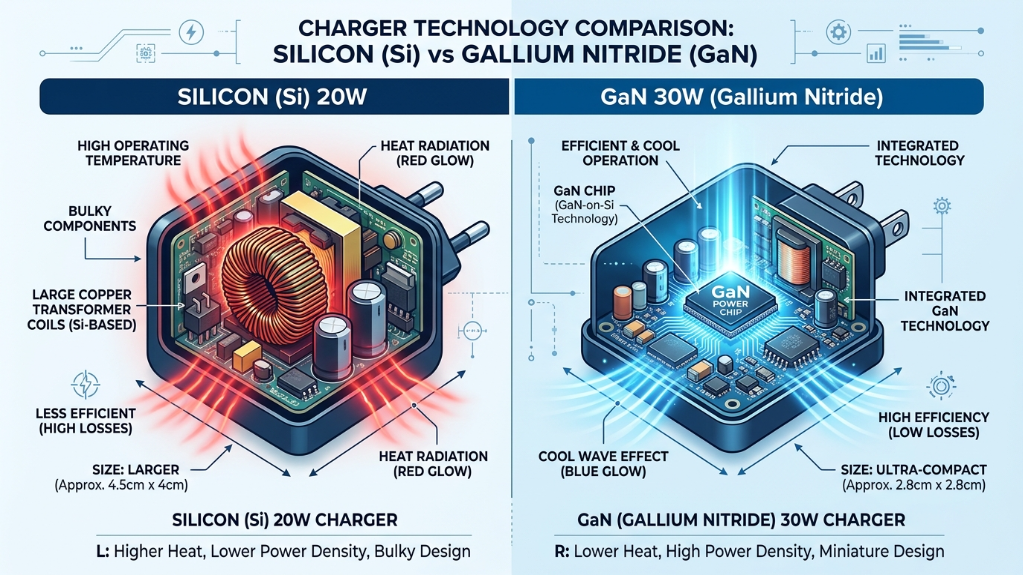
If wattage determines speed, then semiconductor materials determine the product's form factor and premium potential. GaN fast charger wholesale has become an unstoppable procurement trend for top-tier B2B buyers.
Traditional silicon (Si) based chargers see their volume and heat generation increase exponentially once they exceed 20W. Gallium Nitride (GaN), as a third-generation semiconductor material, has a wider bandgap and higher electron mobility. Put simply: it can handle more power within a smaller volume with lower heat loss.
The following matrix clearly shows the core differences between the two materials at the OEM stage to assist your budget allocation:
| Assessment Dimension | Traditional Silicon (Si) 20W Solution | Gallium Nitride (GaN) 30W Solution | Commercial Procurement Advice |
| PCBA Area/Integration | Large, requires ample cooling space | Extremely high, supports ultra-compact designs | Brands pursuing extreme portability and aesthetic differentiation must choose GaN. |
| Conversion Efficiency | Approx. 82%–85% | Approx. 91%–93% | GaN easily meets strict new EU energy efficiency rules, eliminating delisting risks. |
| Full-Load Temp Rise (ΔT) | High (approaching safety limits) | Excellent (shell remains cool) | For high-end North American/European markets focusing on safety, GaN significantly reduces complaint rates. |
| Scaled BOM Cost | Index Baseline 1.0x | Approx. 1.4x–1.7x | While front-end costs are higher, the retail terminal premium far exceeds the difference. |
| Core Scenarios | Free gifts, low-price e-commerce | High-end retail, brand flagship series | It is recommended that brands prioritize GaN 30W as the annual flagship SKU. |
Safety Red Lines and the End of MFi Certification
In B2B procurement, compliance is life. A single batch of goods failing local customs safety inspections is enough to destroy the cash flow of a medium-sized brand for an entire year.
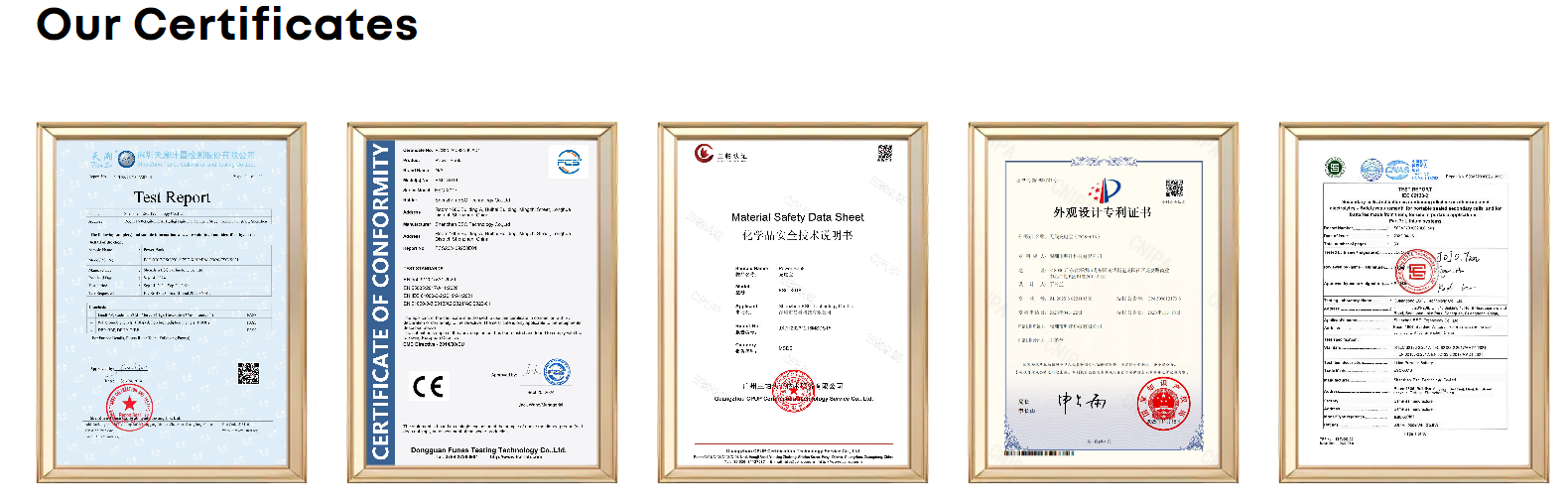
For chargers, safety certifications like CE, FCC, RoHS, and UL are hard barriers. For instance, the UL standard has strict limits on the temperature rise of power adapter shells (surface temperatures typically must not exceed safety thresholds). Subpar OEM factories often cut corners on transformer layers and cooling silicone to lower costs, leading to temperature spikes during full-load operation and creating significant fire hazards.
Furthermore, MFi certification standards have seen a substantive breakthrough in the USB-C era. Since Apple's transition to the Type-C interface, it has fully embraced the universal USB-PD standard for power delivery. This means OEM manufacturers no longer need to purchase expensive original Apple C94 terminal chips as they did in the Lightning era to achieve fast charging. This saves brands massive licensing fees and chip procurement costs, allowing profits to return to the product itself.
Breaking Through at the Source: How to Identify and Bind with Quality OEM/ODM Factories
Reject fake wattage. Reject subpar capacitors. Reject "naked" boards without over-voltage protection. These are the bottom lines that procurement engineers must hold. However, manufacturing is not simple assembly; it is a deep interplay of material science, aesthetic design, and rigorous cost accounting.
The true technical barrier lies in heavy-asset vertical integration capabilities. On this front, AOVOLT, located in the heart of Chinese manufacturing—Dongguan—provides a textbook solution for global B2B buyers.
As a dedicated B2B source factory with 15 years of experience in consumer electronics manufacturing, AOVOLT's core product line covers not only high-standard fast chargers but also deep-seated expertise in high-performance power banks and magnetic power banks. We understand that today’s 3C accessories have moved beyond pure industrial goods; aesthetic differentiation is the primary driver of productivity.
AOVOLT’s greatest asset is our closed-loop production line that covers everything from advanced design, R&D, mold opening, and injection molding to hardware integration. While competitors are running between different factories to coordinate public mold procurement, we can provide customers with unique private mold customization solutions. Technically, our fast-charging architecture supports outputs as high as 140W and achieves full protocol compatibility at the hardware level—whether it is PD3.0, PPS, QC3.0, FCP, SCP, AFC, Apple 2.4A, or BC1.2. We ensure a precise handshake to perfectly cover everything from Apple to Android, and from Ultrabooks to IoT devices.
By partnering with AOVOLT, you aren't just getting a batch of homogenized electronic components; you are receiving a complete commercial delivery solution with "best-seller DNA" that stands up to teardown testing.
Conclusion: The Supply Chain Upgrade Countdown
The evolution of iPhone charger wattage is essentially a history of brutal supply chain survival. From the long nights of 5W to the brief transition of 18W, and now to the high-frequency charging era dominated by 20W floors and 30W GaN leads, the window of time for inefficient production capacity is closing fast. As a buyer, defining your product matrix, mastering protocol technology, and locking in a source factory with full-chain R&D and injection molding capabilities are your core chips for winning the next profit cycle. Now is the best time to reshape your charger and power bank SKUs and connect with top-tier OEM partners who truly understand the technology.
Frequently Asked Questions (FAQ)
Can I use a Mac charger (67W) for an iPhone?
Absolutely. The iPhone's internal Power Management IC (PMIC) will automatically negotiate the protocol with the charger and only "pull" the maximum power it can handle (e.g., about 27W for the iPhone 15 Pro Max). Not only is this safe, but high-wattage chargers running at low loads actually generate less heat and work more stably.
What is the maximum fast charging watt for iPhone 15 Pro Max?
While Apple officially recommends a 20W adapter, in an ultra-low battery state (0–30%), actual peak pull power can reach 27W or even 29W. Therefore, a 30W or 35W fast charger is required to trigger its full fast-charging potential.
Do OEM chargers need MFi certification now?
For the iPhone 15 and 16 series equipped with USB-C ports, Apple follows the industry-standard USB-PD protocol. It no longer mandates that chargers pass traditional MFi certification to achieve full-speed fast charging. This significantly lowers the licensing and R&D barriers for OEM manufacturers and brands.
Does a higher watt charger hurt the iPhone battery?
This is a common misconception. Charging power is actively controlled by the recipient device (the iPhone) and is not forced in by the charger. As long as the charger meets official safety standards and supports the USB-PD protocol, a higher wattage charger will not cause any extra damage to battery health.
Why choose GaN chargers for wholesale over standard silicon chargers?
Gallium Nitride (GaN) materials offer extremely high electron mobility and heat dissipation efficiency. For wholesale, GaN chargers can achieve high outputs of 30W, 65W, or even 140W in a much smaller size, with temperature control far superior to traditional silicon devices. It is the preferred solution for increasing average order value, reducing return rates, and building a premium brand image.
References:
Apple Support: Fast Charge Your iPhone
EU Regulation (EU) 2025/2052: Ecodesign Requirements for External Power Supplies (EPS)