
For B2B procurement decision-makers, this is not a simple physics question—it is a commercial bet involving SKU efficiency and total cost of ownership (TCO).
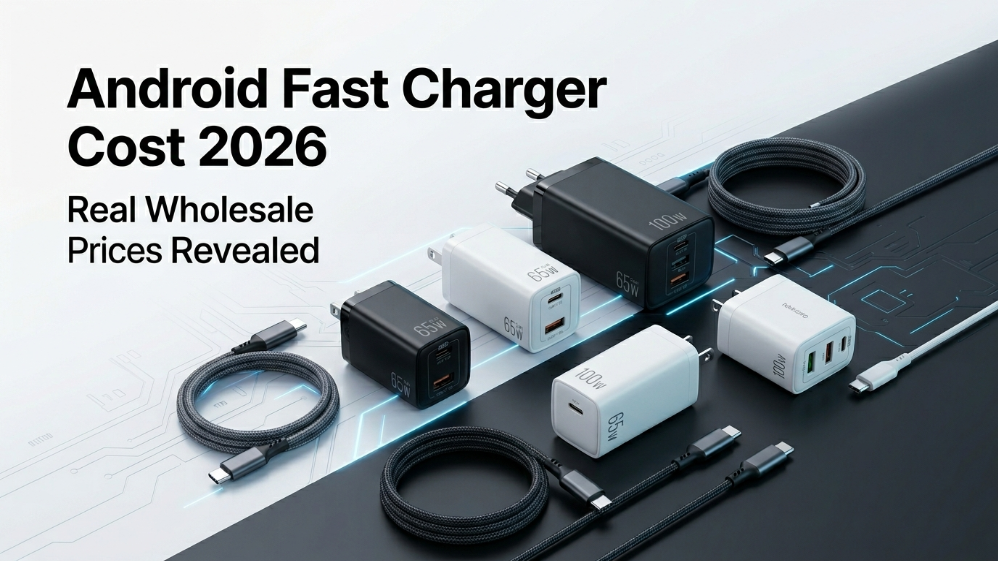
Direct conclusion: 65W GaN (Gallium Nitride) is currently, and will remain before 2026, the “golden entry point” in the global consumer electronics accessories market. With extremely high energy density, it perfectly covers cross-platform needs ranging from smartphones and tablets to ultrabooks. In the current OEM manufacturing market, a high-quality, globally certified 65W GaN 2C1A (two USB-C ports and one USB-A port) charger has a stable FOB price between $6.50 and $9.50 USD.
With the EU’s Common Charger Directive expanding to laptop categories in 2026, this wattage will shift from an “advanced optional configuration” to a “mandatory entry standard.”
Forget inefficient single-port 20W solutions. In today’s world where inventory turnover determines survival, blindly stacking SKUs only burns your cash flow. What you need is a highly compatible product matrix with full protocol support and compliance with DOE Level VI Efficiency (U.S. Department of Energy Level VI).
Wattage Segmentation: SKU Optimization Strategy Based on Market Dimensions
In B2B supply chains, wattage selection must be anchored to end-user device ownership rates. Below is a procurement reference based on global consumer electronics shipment data:
| Wattage Range | Core Target Devices (Universal compatibility) | B2B Profit Potential | 2026 Market Outlook | Procurement Recommendation |
|---|---|---|---|---|
| 20W–30W | All iPhone models, entry-level Android phones, tablets | Low (extremely competitive) | Gradually shrinking, becoming promotional gift-level products | Only use as entry-level brand acquisition products; control proportion |
| 45W–67W | Mid-to-high-end smartphones, MacBook Air, ultrabooks, gaming handhelds | Very High (maximum premium space) | Mainstream, explosive demand growth | Core SKU focus; prioritize GaN solutions |
| 100W–140W | Mobile workstations, high-performance gaming laptops, multi-device hubs | High (professional niche market) | Stable growth, precise audience | Target high-end business or enthusiast users; demonstrate technical strength |
65W: Why It Is the Unshakable “Balance Point”
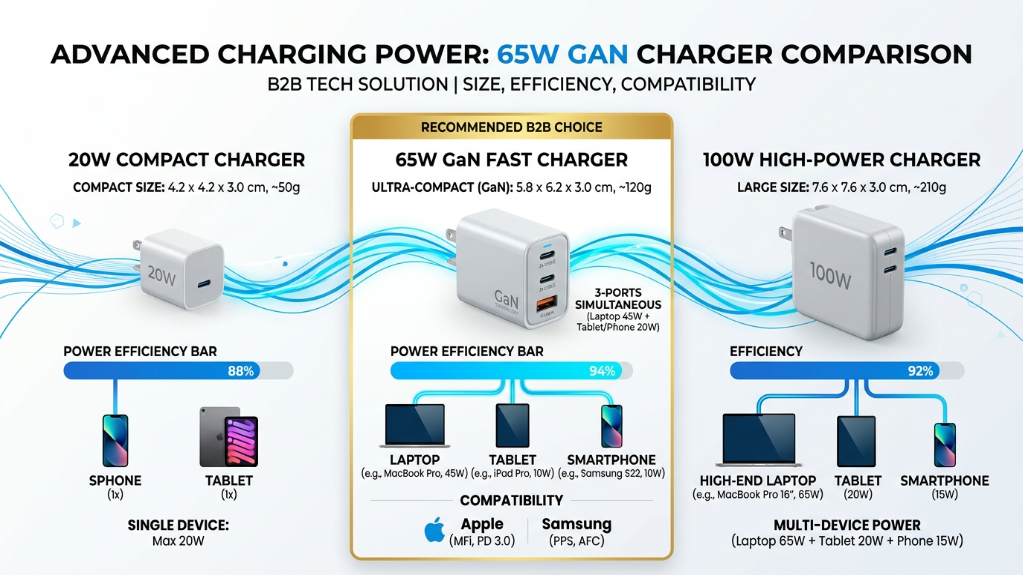
From an engineering perspective, 65W represents a physical equilibrium between heat dissipation and output power limits. A GaN-based 65W adapter can be compressed to the size of a traditional silicon-based 30W charger.
For cross-border e-commerce sellers, this means lower logistics costs and higher container unit value.
More importantly, 65W solutions typically include a Fixed Voltage Rails configuration such as 20V/3.25A, which is the entry threshold for triggering fast charging in most laptops.
If wattage falls below this level, even if the interface is compatible, laptops may fail to charge properly or only operate in “slow charge” mode, directly leading to B2B return complaints.
Deep Technical Logic: Fast Charging Protocols and Multi-Port Power Distribution

As a professional buyer, you must recognize the hidden traps behind manufacturers’ “fast charging” claims.
A 65W multi-port USB-C hub’s real value lies in its Smart Power Allocation algorithm.
The “Downgrade” Trap of Smart Power Allocation
Many low-cost OEM factories reduce cost by using static allocation schemes. For example, in a nominal 65W dual-port charger, once two cables are connected, port C1 is forcibly locked at 45W, even if C2 is not connected to any device.
This rigid logic severely damages user experience.
High-end B2B solutions must support dynamic allocation:
- When only C1 is active → full 65W output
- When dual ports are active → internal protocol IC dynamically adjusts current distribution
- e.g., 45W + 20W or 30W + 30W flexible switching
| Port Usage | Low-End Static Allocation | High-End Dynamic Allocation (AOVOLT Standard) | User Experience Difference |
|---|---|---|---|
| Single C1 connected | 65W | 65W | No difference |
| Single C2 connected | Forced downgrade to 20W | Full 65W | Low-end causes repeated unplugging to find “fast port” |
| C1 + C2 connected | Fixed 45W + 18W | Auto-adjust (e.g., 45W + 20W) | Both devices maintain PD fast charging |
Compliance of Standardized Charging Protocols: PD 3.0 and PPS
When discussing “which wattage is best,” standardized charging protocols cannot be ignored.
For global-market B2B buyers, your product must hardware-embed PD 3.0 and PPS (Programmable Power Supply).
PPS allows voltage adjustment between 3.3V and 21V in 20mV increments.
This is not just about speed. For B-side buyers, PPS means higher device safety and lower thermal loss, helping pass strict DOE Level VI efficiency testing.
If your supplier cannot provide stable PPS support in products above 100W, devices like Samsung S23/S24 Ultra—which heavily rely on PPS—will not achieve expected fast charging speeds and may trigger overheating warnings.
2026 Market Trend: PD 3.1 and the 240W Disruption
Looking toward 2026, with the adoption of USB PD 3.1, charging ceilings will rise to 240W.
However, this does not mean manufacturers should immediately shift to 240W production.
In B2B markets, blindly chasing maximum specs often becomes a R&D cost black hole.
Current supply chain consensus: 140W (28V/5A fixed voltage) will become the next high-end professional benchmark.
However, in the next two years, 65W–100W GaN solutions will still dominate shipment volume.
Rather than chasing extreme wattage, focus on optimizing EMI (electromagnetic interference) performance and MTBF (Mean Time Between Failures) at fixed wattage levels. Provide you with 65W PD3.0 GaN charger manufacturer buyer’s guide.
Hidden Costs Behind High Wattage: Safety Compliance and Thermal Management
When discussing “which wattage is best,” ignoring thermal design and compliance turns all specifications into lab illusions.
Higher wattage means higher heat—this is a physical law.
A poorly designed 100W charger may exceed safety temperature limits under full load, shortening capacitor lifespan and exposing brands to legal risks.
For B2B buyers, certifications are not just entry tickets—they are risk hedging tools.
The IEC 62368-1 standard sets strict fire and electrical shock safety requirements for AV and ICT equipment.
When sourcing 65W+ solutions, PCB creepage distance and electrical clearance must be verified.
Real Supply Chain Competition: Public Mold vs Private Mold
In fast-charging accessories, do you want to be a price follower or build a brand moat? It depends on your control over production.
Most small trading factories rely on public molds, resulting in product homogeneity and price wars.
The real profit driver lies in private mold development (In-house Mold Opening), enabling optimal heat dissipation design in compact structures.
| Evaluation Dimension | Public Mold Procurement | Private Mold (AOVOLT Custom) | B2B Strategic Value |
|---|---|---|---|
| Visual Identity | Highly homogeneous, price war prone | Exclusive design language, strong branding | Builds premium positioning |
| Structural Stability | Fixed layout, hard to optimize | Custom PCBA-based structural design | Reduces failure rate and complaints |
| Thermal Performance | Poor airflow, heat accumulation | Optimized airflow and thermal silicone design | Improves MTBF |
| Supply Chain Speed | Slow coordination, unstable | Fully integrated production chain | Faster time-to-market |
AOVOLT: A 15-Year Vertically Integrated Manufacturing Expert
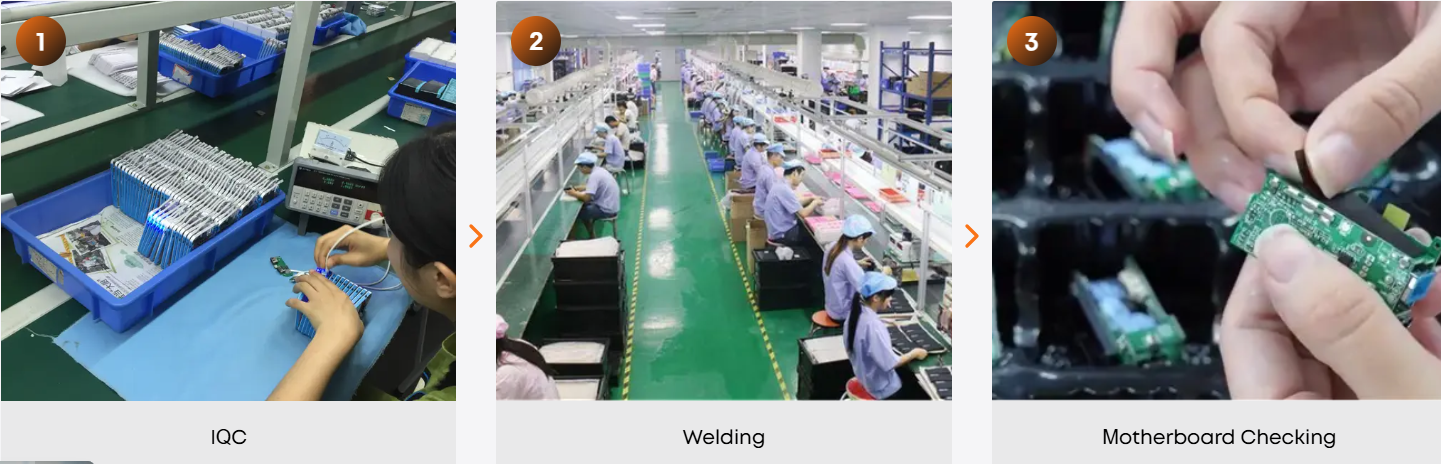
In the rapidly evolving consumer electronics landscape, stable quality comes from full-chain control.
As a B2B source factory rooted in Dongguan, China’s manufacturing core, AOVOLT has spent 15 years in consumer electronics manufacturing.
We are not just a producer of power banks, magnetic wireless chargers, and fast chargers—we are a global engineering solution center.
Our core strength lies in a rare asset-heavy vertical integration model:
From industrial design, circuit R&D, precision mold opening, injection molding, to hardware integration—we control the entire production chain.
This means when compressing 65W performance into a 30W-sized body, our engineers can directly collaborate with mold workshops and complete structural adjustments within hours.
Technically, AOVOLT supports up to 140W single-port output and achieves full protocol compatibility including:
PD3.0, PPS, QC3.0, FCP, SCP, AFC, and Apple 2.4A.
This allows a single SKU to serve MacBook users, Huawei users, and Samsung tablet users simultaneously—greatly simplifying inventory structure.
FAQ: Common Questions About Fast Charging Wattage
Is a 65W charger safe for a 20W iPhone?
Completely safe. Fast charging is a dynamic negotiation process between device and charger.
AOVOLT chargers include intelligent protocol ICs that automatically detect device requirements. Even for low-power devices like Bluetooth earphones, output automatically drops to 5V/1A. No over-voltage risk exists.
Which wattage is most popular in business travel accessories?
Currently, 65W GaN 2C1A (two USB-C + one USB-A) is the best-selling configuration in both gift and retail markets.
It can fully power a MacBook Air while charging a phone simultaneously—this “three-in-one replacement” portability is the key demand driver.
Does higher wattage significantly increase cost?
Cost increase is not linear.
From 20W to 65W GaN, BOM cost rises significantly due to GaN switches and synchronous rectification circuits.
However, from 65W to 100W, architecture changes are minimal, so cost growth is controlled.
That is why 65W–100W products often have higher gross margins than entry-level 20W devices.
How to verify real wattage in bulk procurement?
Do not rely only on charging curves.
Request:
- Full-load temperature rise test reports
- Ripple testing data
High-quality 65W chargers should:
- Stay within safety temperature limits after 2 hours full load
- Keep ripple below 200mV to protect battery life
Is PD 3.1 140W necessary now?
It depends on your target market.
140W is mainly for high-performance devices like 16-inch MacBook Pro with EPR support.
For premium business markets, it is a flagship branding product.
For mainstream consumers, 65W–100W remains the most cost-effective choice.
Conclusion: Locking in Certainty in the Wattage Red Ocean
Choosing charger wattage is essentially choosing your brand positioning.
Will you stay in the low-growth 20W market competing on price, or move toward 65W and 100W GaN growth opportunities?
Market signals are clear: with USB-C standardization, users increasingly demand “one charger for everything.”
For B2B buyers, the most stable strategy is to partner with a vertically integrated manufacturer that can deliver end-to-end capabilities—from ID design to 140W protocol integration.
In a rapidly evolving electronics market, specifications become outdated—but manufacturing depth and unique design language remain scarce, long-term assets.
When optimizing your next product line, rethinking wattage strategy from the ground up may be the key to breaking inventory stagnation.
References:
USB Implementers Forum (USB-IF) – USB Power Delivery Specification (PD 3.0 / PD 3.1)
International Electrotechnical Commission (IEC) – IEC 62680-1-2: USB Power Delivery