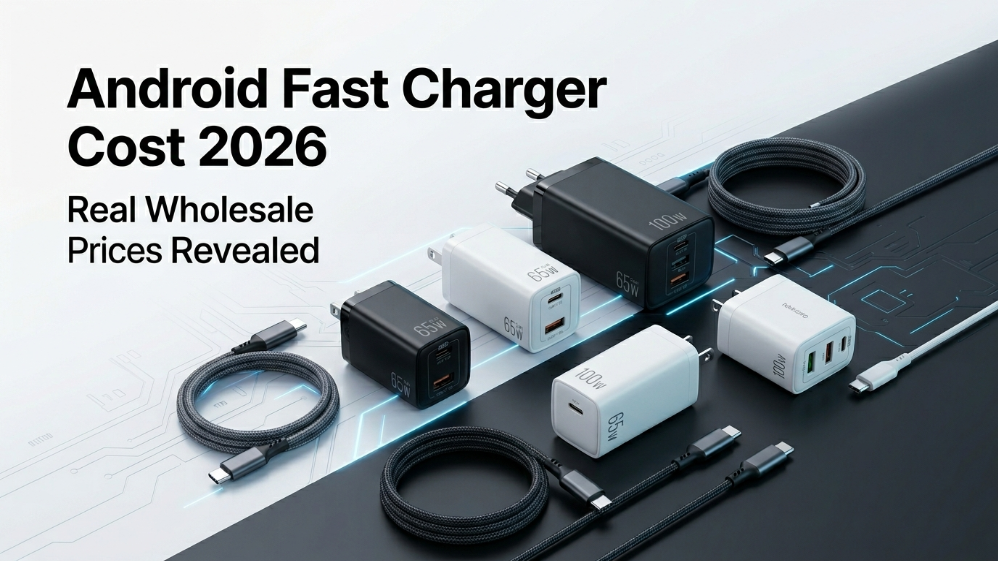

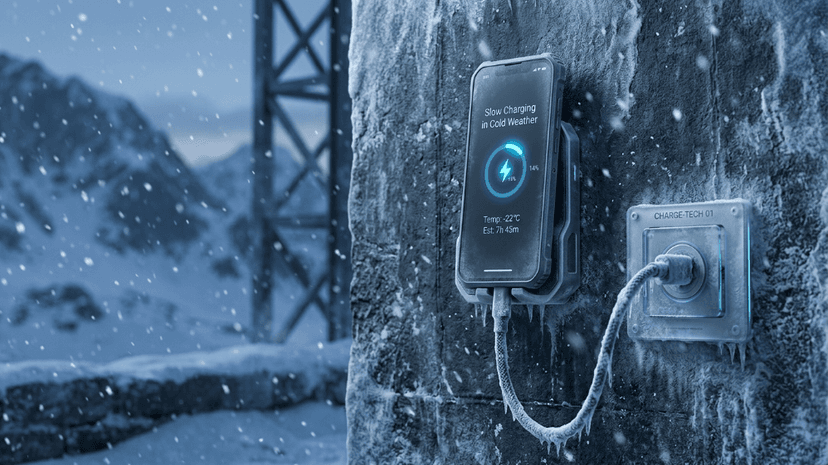
The most direct and fundamentally customer-complaint-blocking commercial solution is: upgrade your hardware supply chain. Look for a top-tier Foldable plug wall charger wholesale supplier, and at a reasonable wholesale unit price of $1.5 to $3.5 per piece, fully replace your inventory with cold-resistant chargers equipped with Smart IC charging technology and made from anti-cold-brittleness materials. Upgrading front-end adapters to adapt to extremely cold environments is the ultimate conclusion to ending winter return surges.
Why Does Low Temperature Cause Slow Charging? (Understanding End-User Pain Points)
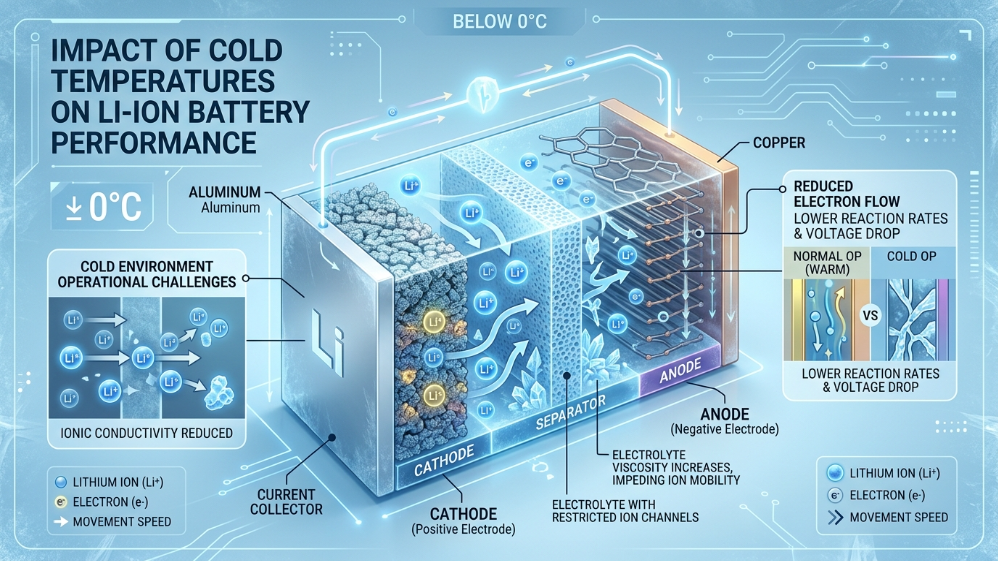
The “Winter Dormancy” Principle of Lithium-Ion Batteries
End users who complain about “unable to charge” usually do not understand electrochemistry. They only see the result. However, on the B2B procurement side, we must see the essence.
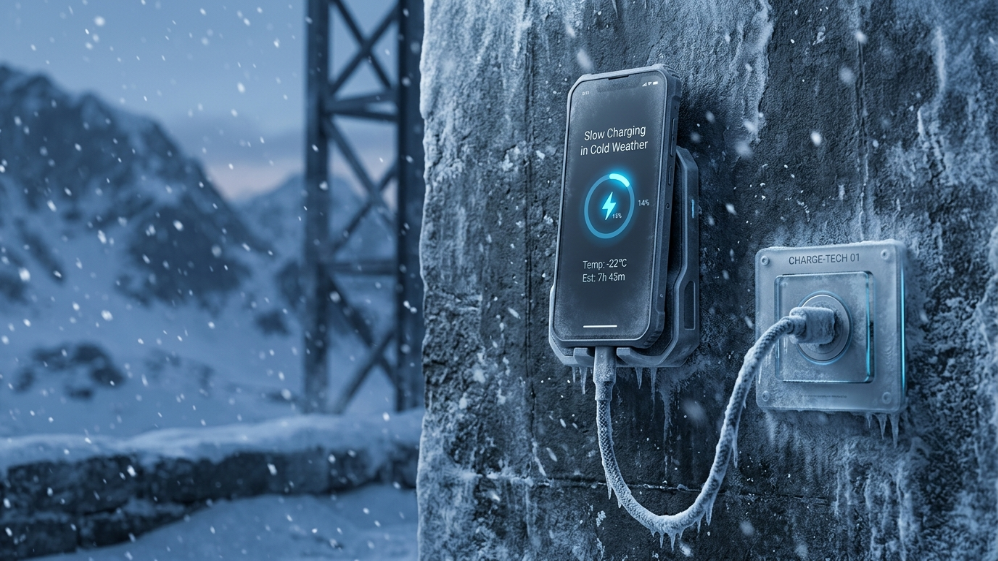
When ambient temperature drops below 0°C, the viscosity of lithium hexafluorophosphate (LiPF6) electrolyte inside lithium batteries increases sharply. It is like swimming in semi-frozen syrup. The migration resistance of lithium ions from the positive electrode to the negative electrode increases exponentially.
If the adapter still forces a high current such as 5V/3A or higher at this time, lithium ions cannot embed into the graphite anode in time and will instead deposit metallic lithium on the surface. This is known in the industry as “lithium plating.”
It not only causes extremely slow charging but also pierces the separator, leading to irreversible capacity degradation or even short-circuit fires.
Self-Protection Mechanism of Smart Devices
Apple and major Android manufacturers are well aware of this. Therefore, the Battery Management System (BMS) of devices enforces strict temperature thresholds at the firmware level.
Below 5°C, charging is forcibly downgraded to trickle mode. Approaching 0°C, input is completely cut off.
According to empirical data from Battery University and IEEE electrochemical journals, at 0°C, the charging acceptance capability of conventional lithium batteries drops sharply to about 12% of that at room temperature (25°C).
Table 1: Multi-Dimensional Matrix of Temperature vs Lithium Battery Charging Acceptance and BMS Strategy
| Ambient Temperature Range | Electrolyte State | Lithium Ion Migration Resistance | Charging Acceptance (vs 25°C) | BMS Intervention Strategy |
|---|---|---|---|---|
| 20°C to 35°C | Optimal fluidity | Baseline (1x) | 98%–100% | Full fast charging (PD/QC fully enabled) |
| 5°C to 15°C | Slightly increased viscosity | ~1.8x | 65%–80% | Dynamic current reduction, peak wattage limiting |
| 0°C to 5°C | Significant viscosity increase | ~3.5x | 12%–30% | Forced trickle charging (below 5W ultra-slow) |
| <0°C (extreme cold) | Local crystallization risk | >10x | <5% | Fully reject charging, show temperature warning |
Blind Spots in Existing Guides: Fatal Hidden Risks of Chargers in Low-Temperature Environments
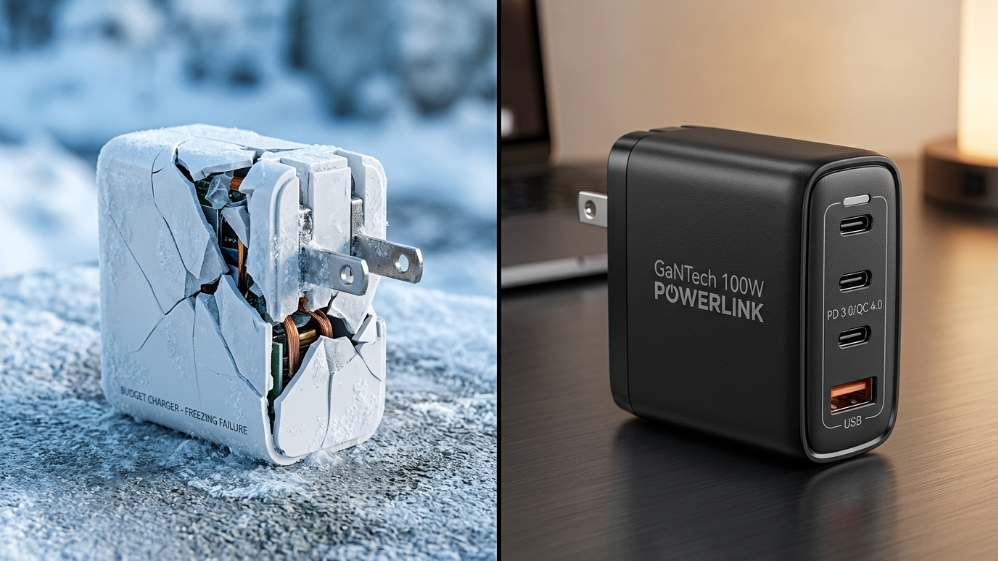
Currently, the top 10 consumer-level educational articles online completely ignore a critical supply chain blind spot—the physical hardware collapse of the power adapter itself.
The phone is self-protecting, but the charger on the wall may already be “frozen and damaged.”
Mechanical Fatigue and Fracture Risk of Low-Quality Foldable Plugs
When brand procurement searches for Bulk foldable plug chargers in the market, they often focus excessively on circuit parameters while ignoring the physical structure of plug pins.
Ordinary low-cost ABS plastic exhibits severe cold brittleness at temperatures below -10°C.
Imagine a scenario: users in cold aircraft cabins, ski resorts, or freezing garages force open a foldable plug. Due to sharply reduced mechanical fatigue thresholds at low temperatures, the plastic at the hinge fractures directly, exposing internal energized brass contacts.
Customer complaints follow immediately, even accompanied by legal risks of electric shock claims.
Professional OEM custom wall charger manufacturers never compromise here.
Qualified Cold-resistant power adapters must use PC fireproof material (polycarbonate flame-retardant material) with special anti-cold toughening agents. It not only passes UL94 V-0 flame retardant certification but also maintains high impact strength at -20°C to -30°C, ensuring no hinge breakage even after repeated use.
Low-End Circuit Boards Without Temperature Compensation
In addition to shell cracking, inferior chargers’ internal PCBA (printed circuit board assembly) also fails in extreme cold.
Without NTC thermistors and advanced temperature compensation modules, the equivalent series resistance (ESR) of electrolytic capacitors inside low-end products changes uncontrollably at low temperatures.
The result is severe output voltage ripple fluctuation.
Once the phone’s BMS detects unstable Type-C input voltage, it will reject PD protocol handshake to protect sensitive motherboard components.
Users think the phone cannot charge due to cold, but in fact the charger is outputting poor-quality current and has been “blacklisted” by the phone.
This is exactly why smart Compact travel charger distributors are rapidly shifting product lines toward GaN charger wholesale.
Gallium Nitride (GaN), as a wide bandgap semiconductor, not only generates extremely low heat under high-frequency operation, but also maintains extremely stable electron mobility and energy conversion efficiency under extreme temperature conditions. 140W GaN charger supplier for you 2026: CE certified and fully integrated.
Table 2: B2B Procurement Perspective — Technical Comparison of Conventional Chargers vs Cold-Resistant Foldable Plug Chargers
| Evaluation Dimension | Conventional Low-Cost Foldable Charger (High Complaint Risk) | Cold-Resistant Foldable Plug Charger (B2B Premium Standard) | Difference in Extreme Environment Performance |
|---|---|---|---|
| Shell Material | Recycled ABS or low-grade PC | Reinforced PC fireproof material | -10°C breaks easily vs -20°C drop-resistant |
| Core Semiconductor | Traditional silicon (Si) MOSFET | GaN (Gallium Nitride) chip | High loss vs ultra-stable wide temperature efficiency |
| Power Management | Fixed voltage/current output | Smart IC charging technology | No adjustment vs dynamic voltage tuning |
| Capacitor Selection | Standard electrolytic capacitor | Solid-state or low-temperature custom capacitor | ESR spike causes ripple instability |
| Hinge Structure | Single plastic snap-fit | Metal spring + high-strength damping hinge | Breaks easily vs 10,000+ cycle endurance tested |
How to Choose a High-Quality Foldable Plug Wall Charger Wholesale Supplier? (Core Business Integration)
After identifying the technical blind spots, the procurement logic becomes very clear.
The key to solving large-scale winter return crises in the Northern Hemisphere lies in selecting a manufacturing partner that perfectly integrates cutting-edge materials science with precision electronics engineering.
In the highly competitive 3C supply chain market, a capable Foldable plug wall charger wholesale supplier must demonstrate overwhelming strength in the following core dimensions:
Deep Integration of GaN (Gallium Nitride) and Smart IC Technology
As mentioned earlier, excellent suppliers no longer rely on outdated silicon chips.
GaN technology combined with Smart IC chip forms the “central brain” of modern high-end chargers.
This intelligent chip can sense device requirements in real time and, through Dynamic power allocation technology, precisely deliver smooth trickle current in extremely cold environments.
Built-in Over-current protection (OCP) and Over-voltage protection (OVP) work together to maintain stable output even when grid voltage fluctuates under cold conditions, ensuring no abnormal current triggers the phone’s BMS system.
Environmental Reliability Testing
Do not trust PPT-level marketing claims.
Top-tier wholesale suppliers must be equipped with expensive constant temperature and humidity chambers and thermal shock test systems.
Each batch of products must undergo extreme Environmental Reliability Testing.
This means chargers must operate continuously for over 100 hours in -20°C to 60°C temperature cycles, followed immediately by 10,000+ fold hinge fatigue tests and micron-level deformation measurement.
Only products surviving this “hell test” can operate safely in Chicago snowstorms or Stockholm winters.
Compliance and Global Certification Barriers
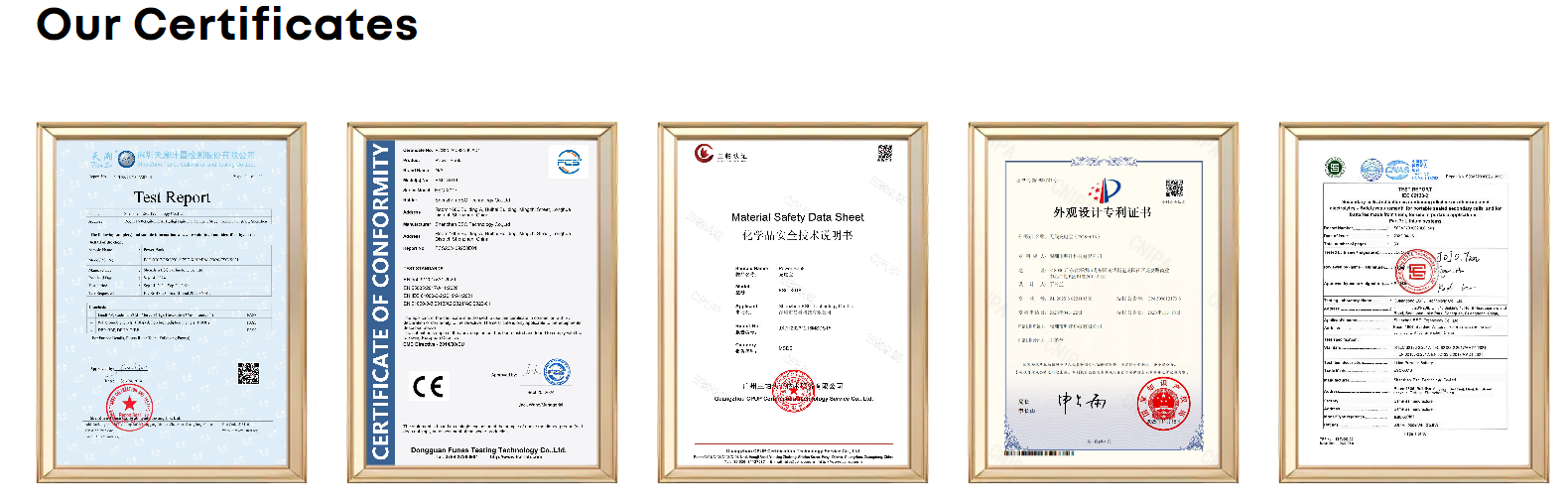
Compliance is the lifeline of all B2B business under tightening global regulations.
Whether UL and FCC in North America, CE and RoHS in Europe, or PSE in Japan, full international certification is not only a customs clearance pass but also the ultimate proof of insulation level and anti-interference capability.
How We Help Customers Solve Winter Charging Complaints (AOVOLT Real Case)
In the consumer electronics manufacturing industry with 15 years of experience, AOVOLT (located in Dongguan, China) deeply understands supply chain pain points caused by extreme environments.
As a B2B-only source factory, we have helped many overseas clients reverse crisis situations.
Background and Pain Points
Last winter, a leading 3C accessory distributor covering Northern Europe and Canada faced a return rate as high as 15%.
High-frequency complaint words included: “plug broken,” “cannot charge at all,” “charging intermittently.”
Expensive reverse logistics costs directly eroded most of their seasonal profit.
AOVOLT Solution
After receiving the request, our R&D team immediately intervened.
Leveraging AOVOLT’s full-chain closed-loop production system—including advanced product design, precision mold opening, injection molding, and precision hardware integration—we quickly developed an improved solution.
We customized GaN foldable plug chargers with cold-resistant capacitors and high-strength damping hinges.
On the chip side, we equipped Smart IC supporting full protocol compatibility (PD3.0, PPS, QC3.0, FCP, SCP, AFC, Apple 2.4A, BC1.2), with up to 140W output capability, completely solving the “charging refusal” problem in low-temperature environments.
Combined with AOVOLT’s distinctive industrial design capability, the product achieved both engineering robustness and strong commercial appeal.
Commercial Results
In the following winter, the client’s return rate dropped sharply to 1.2% in the same market.
According to a report by global logistics service provider Narvar: “Up to 42% of electronic product complaints originate from inability to adapt to local extreme climates.”
By switching to AOVOLT as core supplier, the client not only eliminated climate risks but also increased overall gross margin by 30%.
Table 3: AOVOLT Source Factory B2B Customization Capability Matrix
| Supply Chain Evaluation Dimension | Traditional Outsourced Assembly Factory (Non-Vertical) | AOVOLT Vertically Integrated Factory (Asset-heavy Closed Loop) | Core Value for B2B Buyers |
|---|---|---|---|
| R&D and Industrial Design | Generic molds, highly homogenized | Independent R&D with distinctive ID design | High-end brand differentiation, avoids price war |
| Mold & Injection | Outsourced, slow and uncontrollable | In-house mold opening + injection molding | Fast response, micron-level precision |
| Multi-Protocol Fast Charging | Single PD/QC only | Full 140W protocol compatibility | One SKU covers Apple/Android/laptop ecosystem |
| Production & Delivery | Risk of shortage in peak season | Fully controlled vertical production chain | Stable delivery even in peak winter demand |
Frequently Asked Questions (FAQ)
Does low-temperature slow charging permanently damage the phone battery or charger?
For phone batteries, lithium plating caused by forced charging in extreme cold results in irreversible capacity damage.
For low-quality chargers without cold resistance, capacitor failure and shell cracking are also irreversible physical damage.
Using Smart IC-equipped adapters effectively prevents both-side damage.
Why does a “fast charging” foldable charger still fail to activate fast charging in winter?
This is usually due to lack of high-precision temperature compensation modules.
At low temperatures, output voltage ripple becomes unstable, triggering the phone’s BMS protection system, rejecting PD handshake and downgrading to trickle charging or even no charging.
How can retailers verify whether foldable plug durability meets cold-resistant standards?
Check supplier BOM and environmental test reports.
Key indicator: whether the shell uses PC fireproof material instead of cheap ABS, and whether it has undergone thousands of hinge fatigue tests at -20°C.
What is your MOQ and lead time for bulk foldable plug chargers?
As a source factory with a vertically integrated production line, AOVOLT supports flexible MOQ strategies.
With in-house mold opening, injection molding, and hardware integration, our sampling and mass production lead times are significantly shorter than industry average.
Do you support ODM customization for extreme climates like Northern Europe and Canada?
Yes.
We provide full customization from capacitor selection, PCBA conformal coating (anti-condensation short-circuit protection), to reinforced impact-resistant materials, eliminating climate-related complaint risks.
Conclusion
End users often attribute “slow charging in low temperature” solely to physical limitations of the phone battery, while ignoring the adapter at the wall socket—the actual input source—which may already be failing due to lack of cold resistance.
For B2B buyers, continuing to tolerate brittle foldable plugs and unstable low-end circuitry is essentially gambling with brand reputation and after-sales cost.
Solving this problem requires not only deep understanding of electrochemistry but also strong manufacturing capability as support.
When you are ready to eliminate winter return burdens and upgrade your product line for the next cold-season challenge, choosing a source factory with real technical barriers and vertically integrated production capability will be the optimal way to widen your competitive advantage.
References:
Battery University – “BU-410: Charging at High and Low Temperatures”
MIT Energy Initiative – Research on Battery Materials and Low-Temperature Operation