
Don’t let lengthy technical documents confuse you. If you are a B2B buyer sourcing multi-port fast chargers or customized power banks, the answer to “What is the difference between Apple 2.4A and BC1.2” directly affects your BOM (Bill of Materials) cost and post-sale return rate.
Key Takeaway
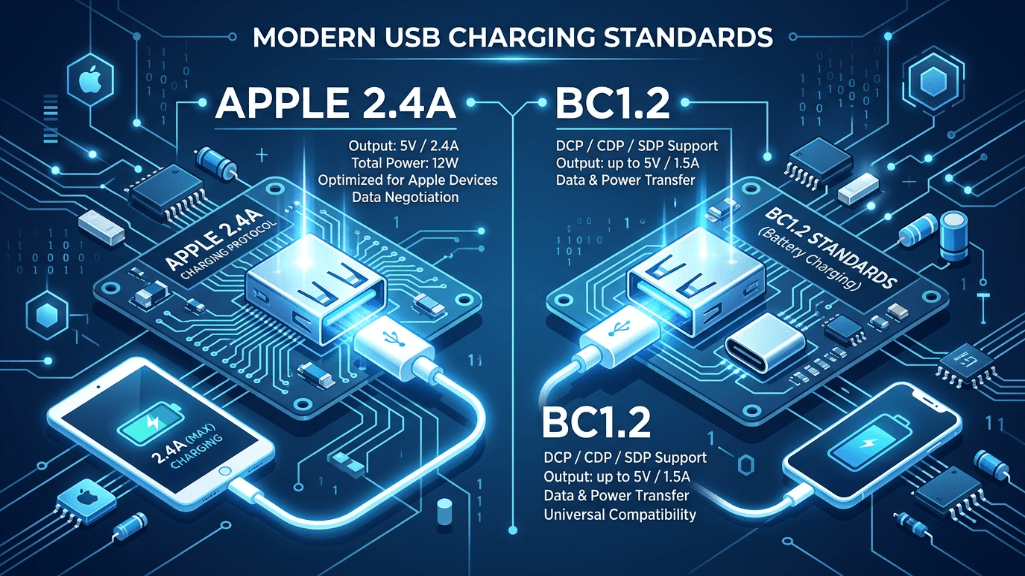
BC1.2 is a universal standard defined by the USB-IF organization. It short-circuits the data pins to allow devices to draw up to 5V/1.5A (7.5W). Apple 2.4A is Apple’s proprietary protocol, which uses a specific resistor voltage divider network to provide older iPhones and iPads with up to 5V/2.4A (12W) output.
In actual PCBA manufacturing, the two protocols are not mutually exclusive. Don’t fall for low-end factories’ claims that “you can only choose one.” Under modern manufacturing standards, the key to solving compatibility is introducing a Smart Charging IC / Auto-detect IC on your motherboard. Adding this chip increases your BOM cost by only $0.03–$0.05. Skimping on this minor cost and relying on primitive physical shorting for USB-A ports will result in hundreds or thousands of slow-charging one-star reviews on Amazon.
As a product manager with 15 years in the power supply line, today we will cut through sales jargon and explain the fundamental differences between these two USB charging protocols from the hardware logic perspective, along with how to avoid pitfalls in your products.
Why Discuss Apple 2.4A and BC1.2 in the PD Fast-Charge Era?
Nowadays, even mid-tier devices come standard with 65W or even 120W Type-C plug-and-play fast charging. Discussing old protocols at 12W and 7.5W might seem outdated—but it’s not. In hardware products, backward compatibility is always the bottom line for protecting brand reputation.
Legacy Device Compatibility: Protecting Your Amazon Reviews
Imagine this scenario: a customer buys a $40 high-end 100W GaN charger, happily charging a MacBook via Type-C port at lightning speed. Later, they use the USB-A port on the same charger to charge an old iPad Air or TWS earbuds. If the USB-A port doesn’t support proper detection, the iPad may remain incompletely charged overnight. The customer doesn’t care about protocols—they will just think your charger is defective.
Mission of USB-A Ports in Multi-Port GaN Chargers
In modern multi-port GaN charger designs, Type-C ports handle PD3.0/PD3.1 protocols and high-power output. The remaining USB-A port serves a “universal fallback” role.
Counterpoint Research reports that over 3.5 billion active devices worldwide still don’t support Type-C PD fast charging. This includes many older smartphones, Kindle e-readers, smartwatches, and low-power IoT devices. This large device base is why Apple 2.4A and BC1.2 compatibility is still critical.
Deep Dive: What is BC1.2 (Battery Charging 1.2)?
To understand BC1.2, first, consider the pre-BC1.2 world.
Background and Core Principle of USB-IF Standard
Early USB 2.0 ports were primarily for data. According to initial USB-IF specifications, standard downstream ports (SDP) could only provide 500mA. With increasing smartphone battery capacities, 0.5A trickle charging became insufficient.
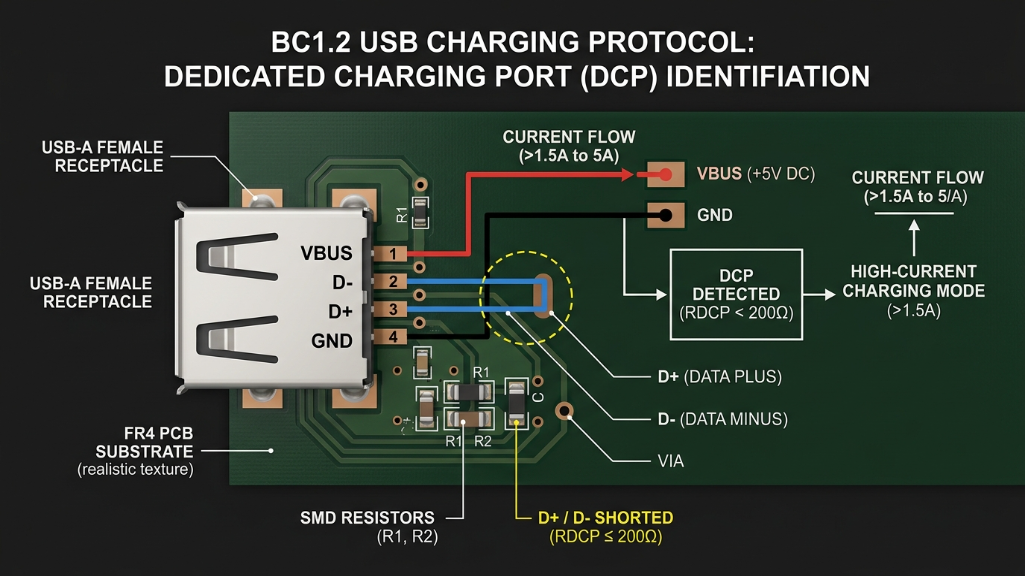
To address this, USB-IF officially released the USB Battery Charging Specification 1.2 in 2010. It defines three port modes, with the most relevant for charger manufacturers being Dedicated Charging Port (DCP).
DCP Hardware Logic
The hardware logic of DCP is simple and straightforward. It abandons data transfer functions and shorts the D+ and D- data pins internally with a very small resistor (usually <200Ω).
When a BC1.2-compatible Android phone is plugged in, its detection circuit sends a voltage signal to D+ and detects the same voltage on D-. The device instantly recognizes: “This is a dedicated charger, not a computer,” and allows drawing up to 1.5A (per USB-IF spec, the safe maximum for DCP mode).
Essence of BC1.2: shorting data pins completes the basic handshake protocol. It’s extremely low-cost and doesn’t require a dedicated IC—just a copper trace connecting two pins on the PCB.
Deep Dive: What is the Apple 2.4A Protocol?
Apple doesn’t follow convention. While USB-IF slowly promoted the 1.5A standard, Apple released high-power iPads that 1.5A (7.5W) couldn’t charge efficiently. Apple abandoned the shorting approach and developed a proprietary closed-loop protocol.
Apple Closed-Loop Mechanism: Overcoming USB-IF Limitations
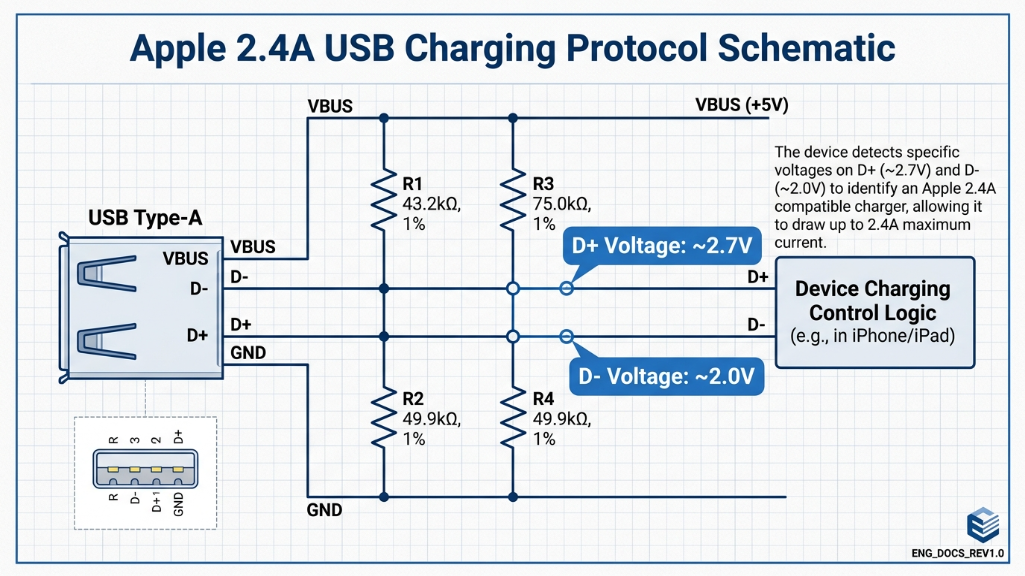
The Apple 2.4A detection uses a Voltage Divider Network.
Apple engineers connect precise resistors on the charger’s D+ and D- pins. Typically, a voltage is derived from the 5V VBUS line through 43kΩ and 49kΩ resistors, resulting in D+ = 2.7V and D- = 2.7V.
When an iPad or iPhone connects, it detects these voltage levels. Once it reads D+ = 2.7V, D- = 2.7V, the device’s PMIC recognizes an authorized high-power charger and allows drawing up to 5V/2.4A (12W).
If your OEM design only shorts D+/D- (pure BC1.2), Apple devices treat it as an unrecognized, unsafe power source and limit current to 1A or even 0.5A—leading to customer complaints.
Core Comparison Table: Apple 2.4A vs. BC1.2
| Technical Dimension | BC1.2 (Battery Charging 1.2) | Apple 2.4A Protocol |
|---|---|---|
| Standard Body | USB-IF | Apple Inc. (Proprietary) |
| Maximum Output Power | 7.5W (5V/1.5A) | 12W (5V/2.4A) |
| Hardware Detection Logic | Shorting: D+ & D- (<200Ω) | Voltage Divider: D+ & D- at 2.7V |
| Core Compatible Devices | Most early Android phones, common Bluetooth devices, general electronics | Older iPhones (7/8/X), early iPads, all Apple devices |
| PCBA Implementation Cost | Extremely low (almost zero, physical shorting) | Low (requires specific resistor voltage divider) |
| Consequences if Device Not Compatible | Current drops to 500mA | Apple device limited to 1A (slow 5W charge) |
Hardware Implementation: How to Support Both Protocols on One PCBA
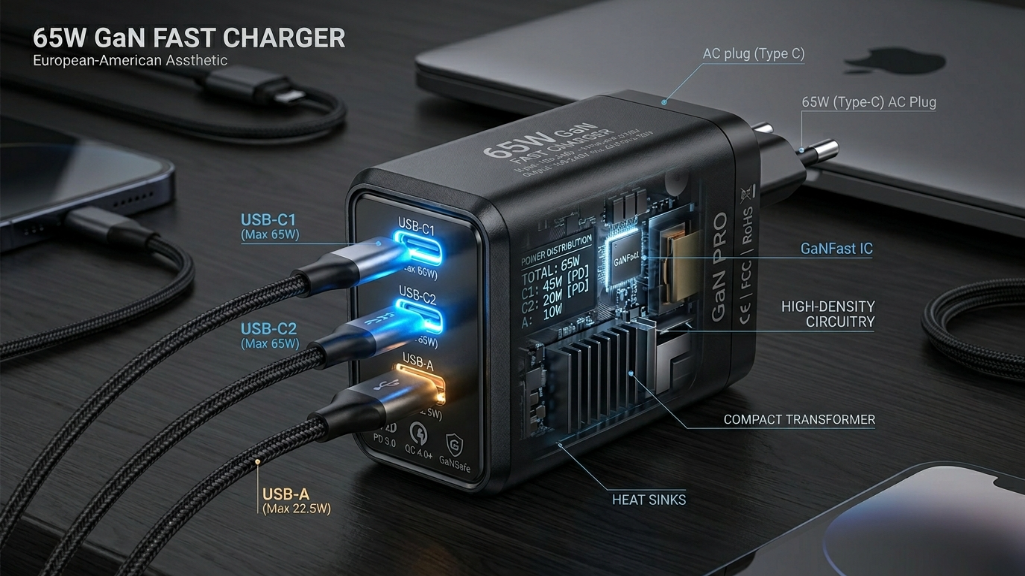
Since shorting and voltage divider mechanisms conflict physically, how do factories achieve full compatibility?
Phasing Out Discrete Component Designs
Previously, engineers used diodes or MOSFET switching networks to toggle circuits. This is inefficient, wastes PCB space, and introduces signal interference. Frequent plug/unplug can cause timeout errors, resulting in slow 5V/1A charging.
Introducing Smart Charging IC
The industrial solution is a Smart Charging IC / Auto-detect IC. This tiny chip integrates high-precision voltage comparators and logic control.
Upon device insertion, the IC polls D+/D- within milliseconds:
- If the device attempts to pull low, it simulates BC1.2 shorted pins.
- If it needs high voltage, it activates voltage divider mode, outputting 2.7V for Apple devices.
Real Example: A 2022 North American client faced massive returns due to slow Apple charging. The previous factory only used physical shorting. By upgrading to an Auto-detect IC solution (Fitipower or Chipsea), the BOM cost rose < $0.05 per unit, while return rate dropped from 4% to 0.2%.
B2B Sourcing & Factory Audit Guide: Testing USB-A Compatibility
Required Test Equipment: Protocol Analyzer
Forget cheap multimeters. Use a protocol analyzer (e.g., ChargerLAB POWER-Z) to observe handshake logic. A qualified design shows “Apple 2.4A” and “DCP 1.5A” indicators. Provide you with how to choose OEM fast charging cable and adapter factory.
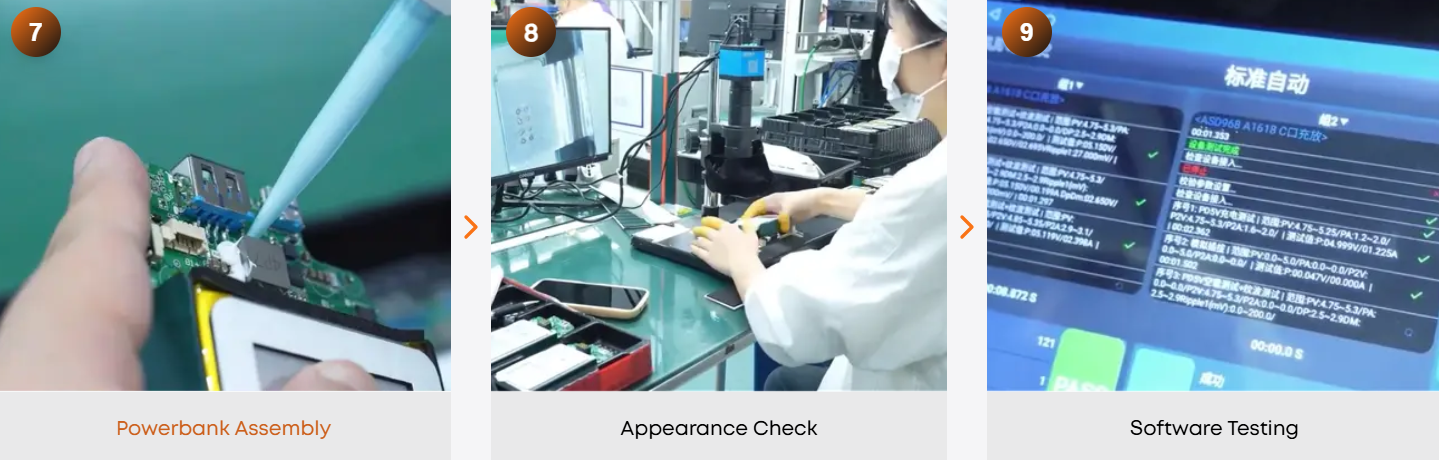
Mass Production Considerations: ATE Testing
- Verify handshake success and load stability.
- Set OCP (over-current protection) precisely. Too tight: frequent cut-offs; too loose: overheating. Proper OCP calibration tests a factory’s engineering expertise.
Why AOVOLT is the Right Choice for B2B Buyers
Understanding protocols is only part of the game. The real moat is R&D and vertically integrated manufacturing.
AOVOLT, based in Dongguan for 15 years, offers:
- High-end power banks, magnetic chargers, high-power fast chargers
- PD3.0, PPS, QC3.0, FCP, SCP, AFC, and Apple 2.4A / BC1.2 full compatibility
- Full supply chain control: design → mold → injection → metal/electronic assembly
| Evaluation Dimension | AOVOLT | Traditional Assembly Factory |
|---|---|---|
| Protocol Development | In-house HW/FW engineers, Auto-detect logic | Buy bare PCBA, cannot modify firmware |
| Appearance & Molding | Internal, precise, seamless | Depend on third-party, long cycle, expensive |
| Quality Control | End-to-end traceable, SMT→ATE | Blindly assemble outsourced parts, high variability |
| Order Type & Business Model | OEM/ODM with brand protection | Mixed sales, risk of design leakage |
B2B FAQ
- If my charger only supports BC1.2, what happens with old iPads?
iPad PMIC limits current to 1A or 0.5A → extremely slow charge. - Adding Apple 2.4A IC incurs patent fees?
No, it’s purely a physical voltage divider—no MFi licensing needed. - Do your OEM/ODM fast chargers support both protocols by default?
Yes, all AOVOLT USB-A power products ship with high-precision Auto-detect ICs. - Does adding the smart IC affect heat or safety certifications?
No, power consumption is micro-watts, negligible heat, and does not affect UL, CE, FCC. - Does Apple 2.4A work when multiple ports output simultaneously?
Depends on power distribution. Quality designs retain independent 5V/2.4A on USB-A; poor designs may downgrade.
Finding an OEM/ODM That Understands the Hardware
Understanding Apple 2.4A vs BC1.2 is just the first step. Electronics manufacturing demands extreme precision—from transformer core selection to thermal management and flame-retardant plastics. Your brand cannot risk cheap BOM compromises.
AOVOLT specializes in high-end custom design with strict QC and fast delivery, serving top global 3C brands. If you want an OEM/ODM with true R&D capability and full vertical integration, discuss your product definition with our engineers or request our full catalog of fast-charging products.
We can start by dissecting a real BOM and turn your next best-seller concept into flawless mass-produced reality.
References: