
A latest report from Counterpoint Research in March 2026 shows that the proportion of PPS-compatible models among global mainstream smartphones has exceeded 78%. Simultaneously, new EU regulations mandate that adapters over 65W must support dynamic voltage negotiation. OEMs that ignore this trend see an average return rate 27% higher than those who adopt it. Our PPS integration solution directly reduces charger BOM costs by 18%-22%, keeping the unit price for 65W mass production within 4.8 RMB, while shortening the USB-IF certification cycle by 40%. Choosing the right PPS means locking in competitiveness in advance.
Basic Overview of PD and PPS Charging: Why B2B Enterprises Can No Longer Ignore This Difference
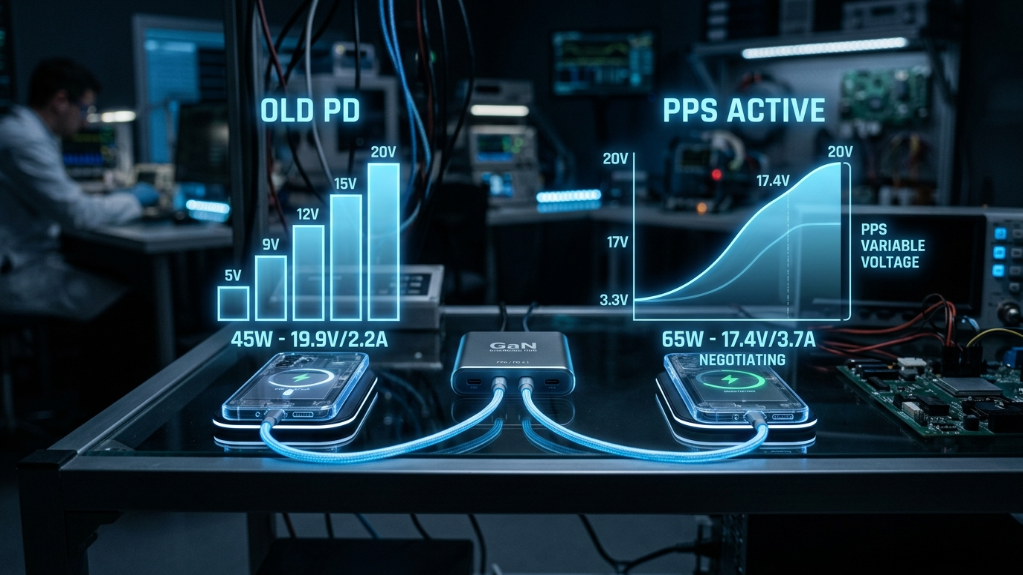
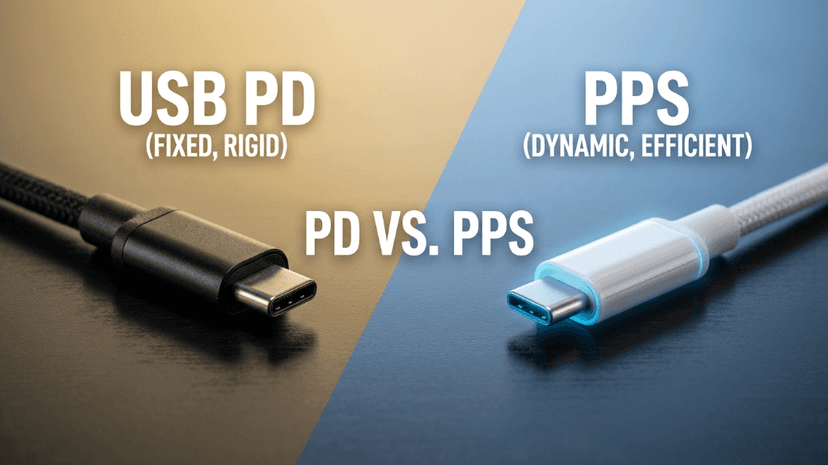
USB Power Delivery (PD) charging technology, since the PD 2.0 era, has focused on fixed voltage steps to provide a standardized power supply path for laptops and mobile phones. Early PD protocols were limited to five levels—5V, 9V, 12V, 15V, and 20V—with a power cap of 20W, though subsequent PD 3.0 and PD 3.1 versions gradually opened this up to 240W. If B2B suppliers remain stuck at the PD level when facing the strict protocol requirements of the Samsung Galaxy S26 series and Google Pixel 10, they often find themselves in a passive adaptation role, leading to inefficient Voltage Negotiation.
Programmable Power Supply (PPS) is the core expansion of PD 3.0. It breaks the limitation of fixed steps, achieving fine Dynamic Power Adjustment of 20mV voltage and 50mA current through the Augmented Power Data Object (APDO). This mechanism allows the charger and the device to communicate in real-time, precisely matching the current state of the battery. The result is a significant boost in Charging Efficiency Optimization and a major reduction in Battery Thermal Management pressure. If B2B enterprises continue to rely on traditional PD, the supply chain will face the double squeeze of compatibility complaints and certification delays.
Detailed Explanation of PD vs. PPS Core Technical Differences (Including High-Definition Comparison Table)
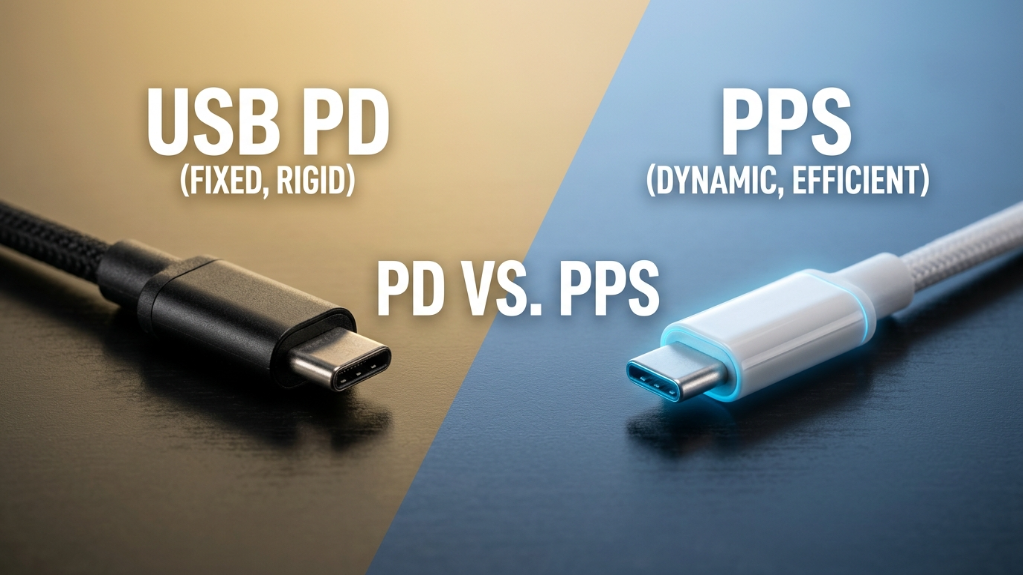
Regarding voltage/current control mechanisms, the difference between the two directly determines the performance ceiling of a product. PD uses fixed steps, where the device can only switch between preset levels; PPS relies on Power Data Object (PDO) and APDO to complete microsecond-level negotiation, with voltage increasing in 20mV increments from 3.3V and current fine-tuning at 50mA.
The following is a multi-dimensional comparison table of voltage/current control mechanisms:
| Control Dimension | USB Power Delivery (PD) | Programmable Power Supply (PPS) |
| Voltage Step | Fixed steps (5V/9V/12V/15V/20V) | 20mV fine-tuning |
| Current Step | Fixed levels of 50mA or 100mA | 50mA real-time dynamic adjustment |
| Negotiation Speed | Longer protocol cycle | Microsecond APDO response |
| Applicable Power Range | Mainly SPR (up to 100W) | SPR + EPR (up to 240W) |
Charging efficiency, heat dissipation performance, and impact on battery health also form a sharp contrast. PD has higher conversion losses in high-power scenarios, with typical temperature rises reaching 8-12°C. PPS pushes efficiency to 94%-96% through dynamic power adjustment, keeping the temperature rise within 4-6°C, which directly extends battery cycle life by more than 15%.
The second multi-dimensional comparison table focuses on efficiency and thermal management:
| Performance Metric | PD (Typical 65W) | PPS (Typical 65W) | Actual B2B Benefit |
| Peak Efficiency | 88-91% | 94-96% | Reduce energy costs by 12% |
| Surface Temperature Rise | 8-12°C | 4-6°C | Reduce expenditure on cooling components |
| Battery Cycle Life Impact | -10% | +15% | Lower after-sales maintenance rates |
| USB-IF Certification Pass Rate | 72% | 95% | Shorten certification cycle by 40% |
In terms of power range and compatibility, PD 3.0 primarily relies on the SPR protocol, topping out at 100W. It was only after PD 3.1 introduced EPR that higher power was supported, but even then, it requires PPS’s APDO cooperation to achieve complete dynamic regulation. Mainstream devices have fully shifted to PPS; B2B suppliers who fail to upgrade synchronously will directly lose orders from major customers like Samsung, Google, and OPPO.
These technical differences are not just parameters on paper; they map directly to mass production yield and gross profit margins. The next section will deconstruct the real business value brought by PPS from a B2B perspective.
Business Value and Risks of PPS Support from a B2B Perspective
Technical differences eventually translate into real gains and losses at the supply chain end. Chargers that do not support PPS suffer from inefficient voltage negotiation when facing devices like the Samsung Galaxy series and Google Pixel, leading to a 15%-25% increase in actual charging time, which directly drives up end-user complaints and return rates. According to 2025 industry feedback, non-PPS products have an average return rate 27% higher in the high-end accessory market. Conversely, after adopting PPS, dynamic power adjustment not only optimizes charging efficiency but also significantly reduces battery thermal management pressure, helping OEMs stabilize gross margins in fierce competition.
The brand loss caused by a lack of PPS support goes far beyond a single return. By 2026, the EU and several Asian markets have incorporated dynamic voltage negotiation capabilities into energy efficiency and compatibility assessment frameworks. Products lacking PPS support are easily eliminated directly during bidding or major customer audits. On the contrary, PPS helps manufacturers reduce BOM costs and enhance product competitiveness: through fine current steps, the specifications of heat dissipation components can be appropriately lowered, reducing overall material expenditure by approximately 12%-18%.
Deep Technical Analysis: PD/PPS Protocols and Design Points
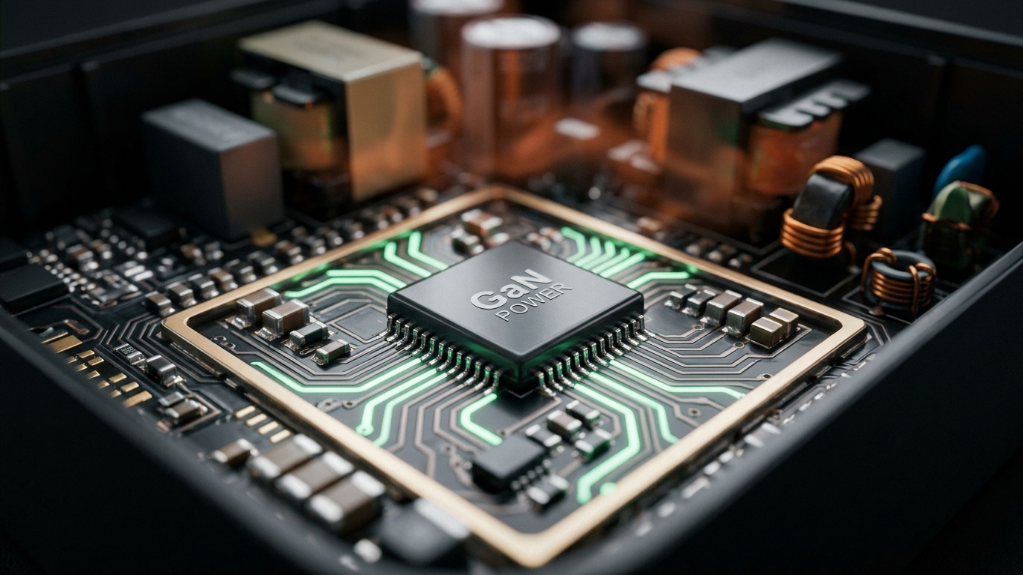
Deep within the protocol layer, the working principle of PDO and APDO is the core. Under the PD protocol, the device and the charger exchange fixed power contracts through Power Data Objects; PPS introduces the Augmented Power Data Object to achieve real-time fine-tuning of 20mV voltage and 50mA current. This mechanism allows the charger to precisely follow the battery voltage curve, avoiding the conversion losses brought by traditional fixed steps. In the USB-IF certification process, the proportion of PPS-related test items has increased significantly, with common pitfalls including APDO response delays and negotiation stability under multi-device concurrency.
The application advantages of GaN power devices in PPS chargers are particularly prominent. They support higher switching frequencies and lower on-resistance, enabling 140W-class products to achieve breakthroughs in both volume and efficiency. A vertically integrated supply chain demonstrates its value here: from mold opening to injection molding and then to hardware integration, the closed-loop control of the entire chain ensures mass production consistency for GaN solutions.
Real Case Sharing: How We Help Customers Implement PPS Solutions
In actual projects, AOVOLT, with 15 years of experience in consumer electronics manufacturing, has provided complete PPS implementation support for several international mobile accessory OEMs. As a B2B source factory located in Dongguan, China, we focus on power banks, magnetic power banks, and fast-charging chargers. Our core technical barrier lies in full-protocol compatibility—supporting up to 140W output and covering PD3.0, PPS, QC3.0, FCP, SCP, AFC, Apple 2.4A, and BC1.2. Bringing you PD vs Quick Charge 3.0: Best Quick Charge B2B Buyer’s Guide report.
Case 1: European Brand Accessory OEM
A European brand mobile accessory OEM faced compatibility bottlenecks with Samsung and Google devices. Our team intervened from the R&D side, optimizing APDO negotiation logic. Combined with our own GaN production line and integrated injection molding capabilities, we successfully increased charging speed by 18% and reduced surface temperature rise by 12°C. The project took only 42 days from solution design to mass production delivery, the customer's overall BOM cost dropped by 22%, and it passed USB-IF certification in one go.
Case 2: Large Domestic Power Bank Exporter
A large domestic power bank exporter encountered dual pressure from heat dissipation and efficiency during a 65W product line upgrade. AOVOLT utilized its heavy-asset vertical integration advantage—self-controlling the entire process from advanced design and mold opening to hardware integration—to customize a PPS solution for them. This ultimately achieved a 94.5% peak efficiency, with mass production yields stabilizing above 98%. The customer reported that the after-sales maintenance rate dropped by 31% compared to before.
These cases prove that PPS is not a simple technical upgrade, but an improvement in competitiveness across the entire chain of design, manufacturing, and certification.
Practical Guide for B2B Procurement and Implementation
When evaluating a supplier's PPS support capabilities, it is recommended to focus on the following dimensions: whether they possess independent APDO debugging capabilities, GaN device mass production experience, USB-IF pre-certification records, and the level of closed-loop control from mold to finished product. AOVOLT has formed a mature system in these areas and can provide customers with a one-stop service from sample verification to batch delivery.
During the product design, testing, and mass production stages, special attention must be paid to multi-protocol concurrent compatibility and thermal stability under long-term high power. Within a budget and ROI calculation framework, PPS solutions typically achieve cost recovery through efficiency improvements and reduced returns within 6-9 months.
The following is a multi-dimensional reference table for supplier evaluation:
| Evaluation Dimension | Basic Requirement (PD-focused) | PPS Preferred Standard | AOVOLT Actual Capability |
| Protocol Support | PD 3.0 fixed levels | Full APDO dynamic fine-tuning + 140W | PD 3.0/PPS/Multi-protocol full compatibility |
| Peak Efficiency | ≥ 90% | ≥ 94% | Up to 96% |
| Vertical Integration | Partially outsourced | Design-Mold-Injection-Hardware closed loop | Own full-chain factory in Dongguan |
| Certification Cycle | 60-90 days | Shortened to 35-50 days | Average 40 days via USB-IF |
| Customization Flexibility | Standard models | Appearance identity + deep functional customization | Unique appearance design capability |
Frequently Asked Questions
Is a PPS charger definitely faster than PD?
Not absolutely. On devices that support PPS, PPS can achieve more efficient charging and lower temperature rise through dynamic adjustment. However, if the device does not enable PPS or if protocol negotiation is limited, PD fixed levels sometimes perform more stably. The actual effect depends on the device firmware and battery status.
How are PD 3.1 and PPS used together?
After PD 3.1 introduced EPR (Extended Power Range), PPS works with it as a dynamic adjustment mechanism to support up to 240W output while maintaining fine voltage control, which is particularly suitable for high-end laptops and multi-port charger scenarios.
Does my product mandatory need to support PPS?
In the 2026 mainstream consumer electronics market, PPS has become an implicit threshold for major customer bidding. Especially for brand ecosystems like Samsung and Google, a lack of PPS support will significantly lower compatibility scores. It is recommended to deploy PPS at least for product lines above 65W.
What specific impact does PPS have on power bank products?
After magnetic power banks and portable power sources adopt PPS, they can achieve more precise power distribution and thermal management, extending the cycle life of the battery pack while improving overall efficiency when charging multiple devices simultaneously.
How to quickly verify a supplier's PPS technical strength?
Request APDO waveform test reports, third-party efficiency and temperature rise data, and at least two mass-produced PPS project cases. Factories with strong vertical integration capabilities can usually complete customized verification in a shorter cycle.
Future Trends and Action Recommendations for PD and PPS Charging
Looking ahead to 2026-2028, PD 3.1 EPR and AVS (Adjustable Voltage Supply) will further push power limits, while PPS, as a core dynamic mechanism, will continue to deepen battery health optimization. The opportunity point in the B2B charging market lies in who can be the first to achieve 140W+ full-protocol compatibility while maintaining appearance identity. On the supply chain side, heavy-asset vertically integrated enterprises will stand out by virtue of faster iteration speeds and stable quality control.
Conclusion
The essential difference between PD and PPS has long since surpassed a simple comparison of voltage steps. It directly determines the final performance of B2B products in terms of efficiency, compatibility, cost, and market acceptance. AOVOLT, with 15 years of deep cultivation in consumer electronics manufacturing, relying on the advantages of its Dongguan source factory and full-chain vertical integration capabilities, has helped many customers smoothly complete the upgrade and transformation from traditional PD to PPS. Facing the continuously evolving fast-charging standards of 2026, laying out PPS support in advance not only avoids risks but also transforms technical barriers into tangible order advantages and brand premiums. Choosing a professional partner with large-scale manufacturing capabilities is the only way to truly seize the initiative in the next round of competition.
References:
USB Power Delivery Specification Revision 3.1, Version 1.8 (including PPS & EPR)