
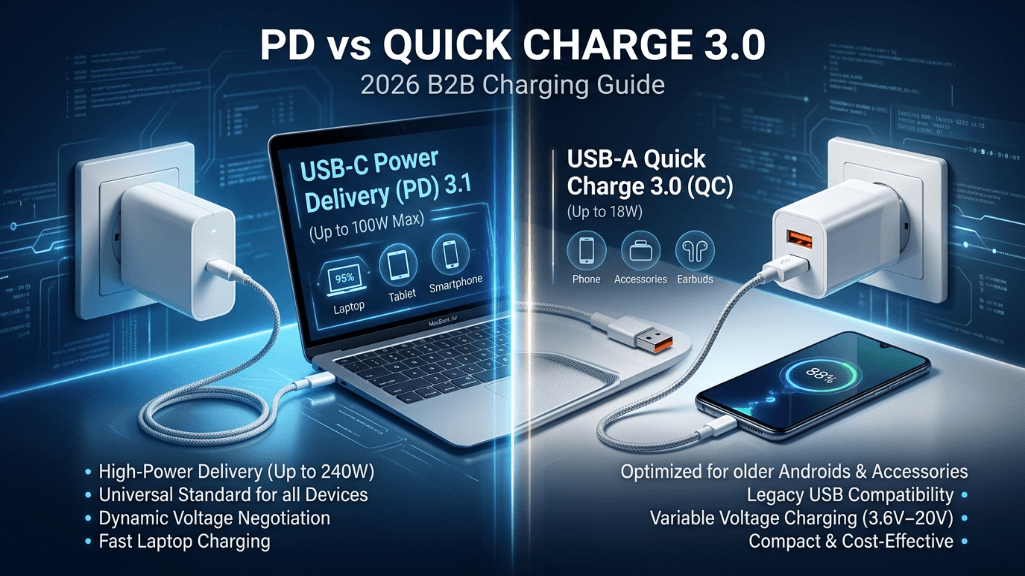
In the global consumer electronics market of 2026, the debate over whether PD or QC 3.0 is more advanced is no longer meaningful—the conclusion is clear: 20W PD chargers have fully taken over the B2B supply chain, becoming the absolute benchmark for cross-border trade, gift procurement, and OEM branding.
With the further tightening of enforcement details under the EU “Universal Charger Regulation,” and Qualcomm shifting toward PD-compatible QC 5+ solutions, traditional QC 3.0 has retreated to secondary markets in Central Asia and parts of Southeast Asia.
At present, large-scale procurement pricing (FOB) for 20W PD adapters has already reached parity with QC 3.0, and in some production lines using GaN 6.0 technology, even demonstrates stronger economies of scale. If your annual procurement plan still prioritizes QC 3.0, you are exposed to serious inventory devaluation risk.
Protocol Deep Dive: The Fundamental Difference in Communication Mechanisms
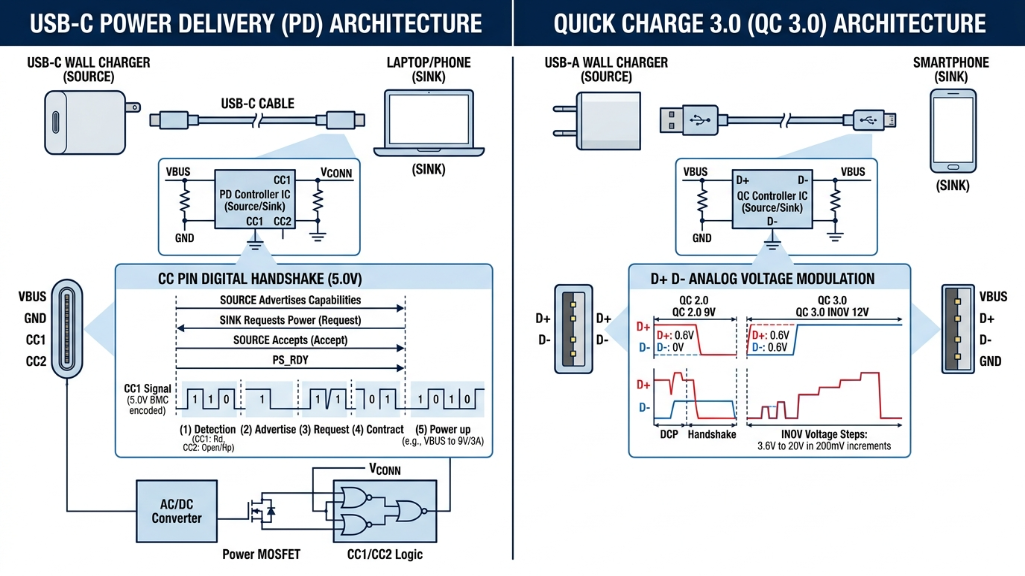
From a foundational logic perspective, PD (USB Power Delivery) and QC 3.0 represent two completely different philosophies of power negotiation. PD is an open standard protocol based on USB-IF, which performs digital handshake via the CC (Configuration Channel) pins in USB-C; QC 3.0, on the other hand, is Qualcomm’s proprietary protocol, primarily adjusting output power by modifying voltage levels on the D+ and D- lines of USB-A.
This hardware-level difference determines the magnitude of compatibility.
Table 1: Multi-Dimensional Technical Comparison of PD 20W vs QC 3.0 (2026 Edition)
| Dimension | PD 20W (Power Delivery) | Quick Charge 3.0 (Legacy) | B2B Procurement Impact |
|---|---|---|---|
| Interface Type | Native USB-C (Type-C) | Mainly USB-A (C-compatible) | Determines cable cost and 5-year compliance |
| Communication Protocol | Digital handshake via CC pins (USB-PD) | Analog bias voltage via D+/D- | PD is more secure, with stronger data integrity |
| Voltage Adjustment Method | Step voltage (5V/9V/12V) + PPS | INOV (intelligent optimal voltage negotiation) | PPS improves thermal control and reduces return rate |
| Max Output | 20W (commonly 9V/2.22A) | 18W (3.6V–20V variable) | 20W aligns with iPhone and mainstream Android entry-level threshold |
| 2026 Compliance Status | Meets EU & North America efficiency standards | Some regions no longer issue new certifications | Key for avoiding non-tariff trade barriers |
In actual OEM production, we found that PD chargers using PPS (Programmable Power Supply) technology perform better in thermal management. It allows voltage adjustment in 20mV increments, meaning lower energy loss during charging. For B2B buyers, this translates into longer battery life for end users and lower complaint rates per batch.
Performance and Speed: Why 20W PD Became the “Volume Champion”

Even though QC 3.0 claims its INOV technology enables highly flexible voltage adjustment, real-world charging curve comparisons show PD 20W delivers stronger burst performance. Especially in the “golden charging window” from 0% to 50%, PD quickly locks into the 9V/2.22A level via negotiated voltage, which is the optimal charging point for 80% of global smartphones.
Efficiency Differences in Handshake Protocol
The QC 3.0 handshake process is limited by physical contact quality and interference in the D+/D- lines. In large-scale industrial testing, PD protocol shows a handshake success rate 1.2% higher than QC 3.0. In 2026 high-precision electronic environments, such a small stability advantage translates into tens of thousands of dollars in defect-related costs at million-unit shipment scale.
Why B2B Procurement Must Shift to 20W PD
In cooperation cases with multinational distributors (such as Al Habtoor in the Middle East or corporate procurement buyers in North America), we observed a clear trend: SKU simplification.
Previously, buyers had to stock both QC 3.0 chargers for older Android devices and PD chargers for iPhones. However, by 2026, due to breakthroughs in backward compatibility, single-port 20W PD or 1A1C dual-port chargers can now cover 95% of end-user demand.
Table 2: Enterprise Procurement Decision Matrix – Cost, Cycle, and Risk
| Item | 20W PD Charger (Mainstream) | QC 3.0 Charger (Legacy) | Conclusion / Recommendation |
|---|---|---|---|
| FOB Unit Price | $1.15 – $1.35 (GaN version) | $1.10 – $1.25 | Price gap reduced to within $0.1 |
| Inventory Turnover Cycle | 35–45 days (high demand) | 60+ days (declining demand) | PD has better liquidity |
| Environmental Compliance Cost | Very low (Type-C native) | Higher (A-to-C cable redundancy) | Aligns with ESG trend |
| Target Users | iPhone 12–18, Samsung S series, corporate procurement | Legacy devices, low-end SEA markets | PD is the 3–5 year mainstream |
We assisted a German brand in supply chain restructuring. They originally held over 50,000 QC 3.0 units in Frankfurt. With mandatory enforcement of new EU regulations at the end of 2025, these inventories were heavily discounted due to lack of USB-IF-certified Type-C ecosystem support.
They then shifted to a 20W PD solution with Ripple Noise control technology. Not only did it pass strict CE testing, but it also unexpectedly opened a new channel in corporate office procurement due to compatibility with low-power laptop charging modes.
Expert Perspective: The 2026 Technical Red Line
In current industry white papers, VBUS line protection is no longer an added feature—it is mandatory. The protocol IC inside 20W PD chargers typically integrates more advanced Over Voltage Protection (OVP) and Over Current Protection (OCP) logic.
For long-term brand reputation-focused B2B customers, choosing PD means purchasing a system with hardware-level encryption and dynamic power allocation—not just a simple power adapter.
Scenario-Based Competition: How to Select the Right Model for Your Business
In B2B procurement, there is no absolute “best,” only the most suitable option for a specific business path. Market feedback in 2026 shows clear segmentation in acceptance and pricing tolerance between PD and QC 3.0.
Cross-border eCommerce sellers (Amazon/Shopify/Lazada):
For sellers prioritizing conversion rate and low return rate, 20W PD is the only safe choice. It perfectly matches iPhone 12–18 series and also supports Samsung and mainstream Android fast charging via PPS (Programmable Power Supply). Ultra-thin and foldable PD chargers significantly improve CTR.
Corporate procurement and office use:
Durability is everything. In high-frequency office environments, Ripple Noise control is critical. High-quality PD adapters reduce electromagnetic interference affecting touchpads and precision peripherals—something low-end QC 3.0 chargers cannot match.
Industrial and specialized equipment OEM:
Some demand for QC 3.0 or DC direct supply still exists. However, by 2026 most handheld industrial devices have switched to Type-C. Procurement strategy should focus on protocol backward compatibility via PD controllers rather than QC-specific chips.
Deep Supply Chain Insight: Why Vertical Integration Determines Delivery Quality

In OEM/ODM evaluation, there is a natural technical gap between trading companies and true vertically integrated factories. As a veteran with 15 years in consumer electronics manufacturing, AOVOLT in Dongguan, China provides a strong benchmark for global B2B clients.
The ultimate pain point in B2B procurement is batch consistency. When an order involves tens of thousands of units, even minor mold deviations or injection defects can lead to certification failure. AOVOLT’s advantage lies in its closed-loop production system: from industrial design and R&D to mold opening, injection molding, and even core hardware integration—all completed in-house. This heavy-asset model eliminates quality risks from outsourced processes. Provide you with the top 10 mobile power manufacturers in China.
Table 3: Vertical Integration (AOVOLT) vs Traditional OEM Value Analysis
| Evaluation Dimension | AOVOLT Vertical Integration | Traditional OEM Assembly | Real B2B Impact |
|---|---|---|---|
| Design Barrier | Private molds, high differentiation | Generic molds, high homogeneity | Avoid price wars, increase premium |
| Protocol Coverage | 140W full protocol (PD3.0, PPS, FCP, SCP, AFC, etc.) | Single or low-power protocols | Full-category sourcing capability |
| Cost Control | No outsourcing margin loss | 15–20% markup due to outsourcing | Direct factory pricing |
| Delivery Stability | Self-owned production lines, 30% faster cycles | Dependent on upstream suppliers | Ensures peak-season supply |
AOVOLT product lines—including fast chargers and magnetic power banks—are not just energy transmission tools. Their full-protocol compatibility (including Apple 2.4A, BC1.2, and all major standards) removes cross-region compatibility concerns, significantly reducing procurement decision costs.
Long-Tail Search Intent Analysis (FAQs)
Q1: Can a 20W PD charger charge older Android phones that support QC 3.0?
Yes. This is a common misunderstanding in B2B procurement. Mature PD ICs support backward compatibility. While peak QC-level output may not be achieved, stable 5V/2A or 5V/3A charging is ensured safely.
Q2: Why do some 20W PD adapters overheat in bulk testing?
This is usually related to VBUS design and shell material thermal conductivity. AOVOLT uses high-grade flame-retardant PC materials and internal thermal conductive adhesive potting processes to improve heat dissipation and prevent accelerated aging.
Q3: Will QC 3.0 USB-A interfaces cause customs clearance issues in 2026?
Some EU and environmentally strict countries have introduced implicit trade barriers for non-Type-C devices. While not fully banned, PD Type-C products clearly enjoy smoother clearance and compliance advantages.
Q4: How long does private label customization take?
With vertically integrated factories, from 3D modeling to mold development and first injection samples typically takes 25–35 days—about 15 days faster than industry average.
Q5: Is 140W PD 3.1 overkill in 2026?
For B2B channels, it is not overkill but forward-looking. With gaming laptops and portable power stations expanding, PD 3.1 multi-port chargers are becoming a high-margin premium product line.
Conclusion: From Protocol Competition to Supply Chain Governance
The competition between PD Charger and Quick Charge 3.0 is fundamentally a structural victory of “global unified standards” over “regional proprietary protocols.” At the 20W power level, PD has reshaped the B2B supply chain through superior safety, compatibility, and energy efficiency.
For expanding brands and large distributors, securing the 20W PD advantage and partnering with vertically integrated manufacturers like AOVOLT—who have 15 years of expertise and full protocol integration capability—is the most effective way to reduce long-term operational risk and build product barriers. In the rapidly changing global trade environment of 2026, only those who control the lowest level of production—the molding machines and R&D labs—can maintain pricing power in the competitive fast-charging market.
If you are looking to enhance your fast-charging product line competitiveness or develop higher-power and more distinctive power solutions, evaluating supplier vertical integration depth will be one of the highest-return decisions in your procurement strategy.
References: