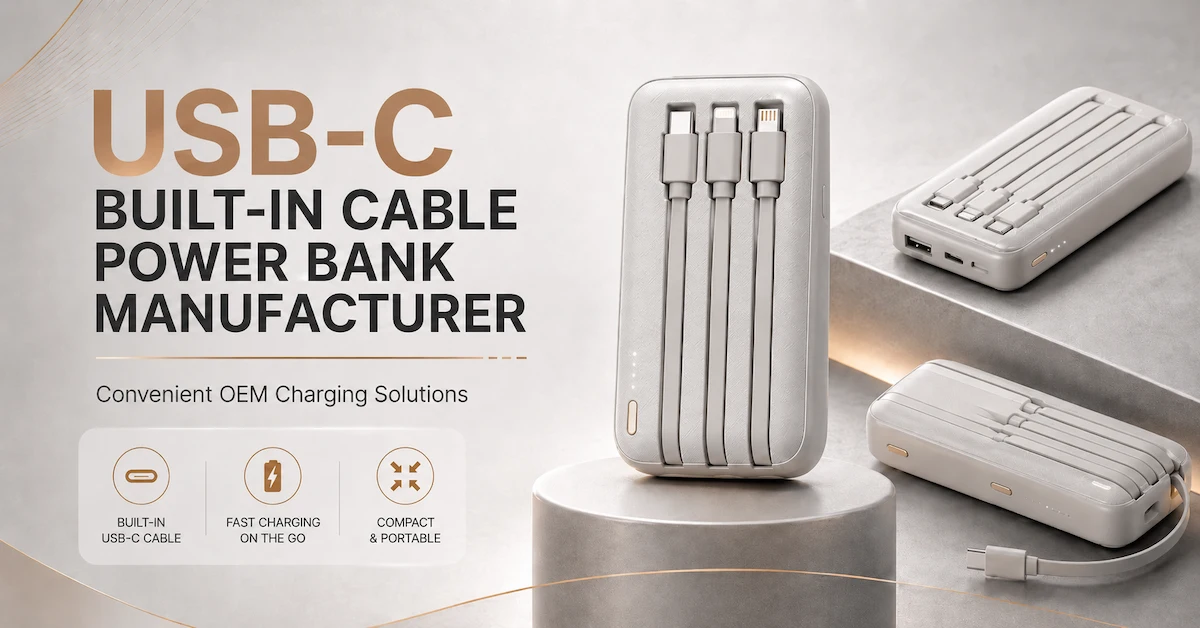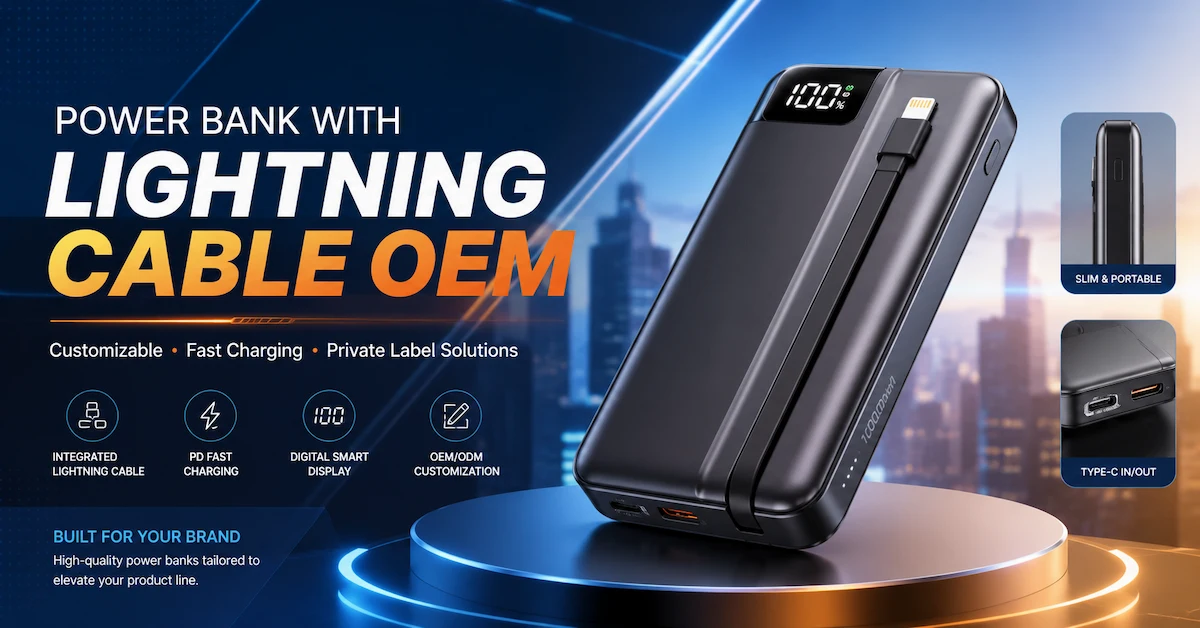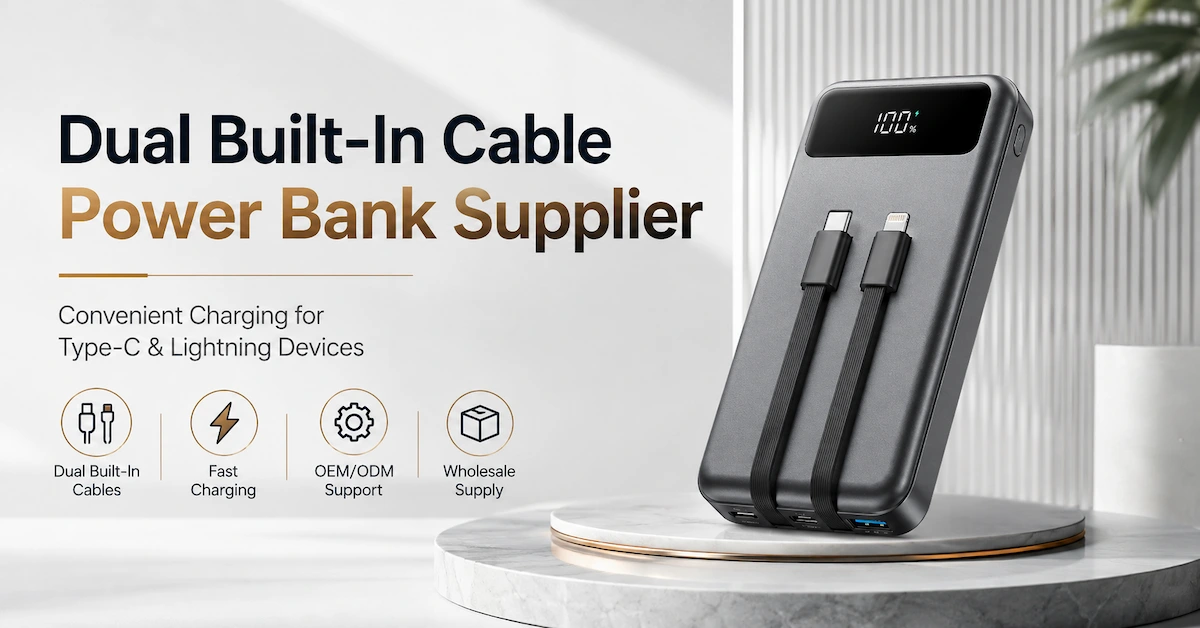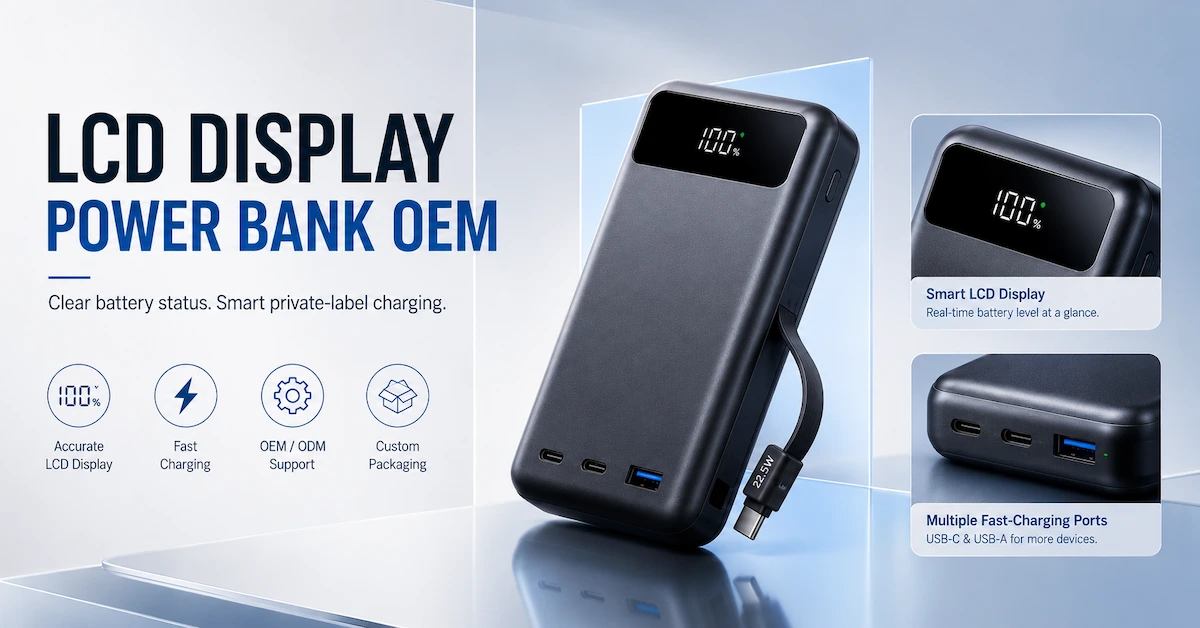

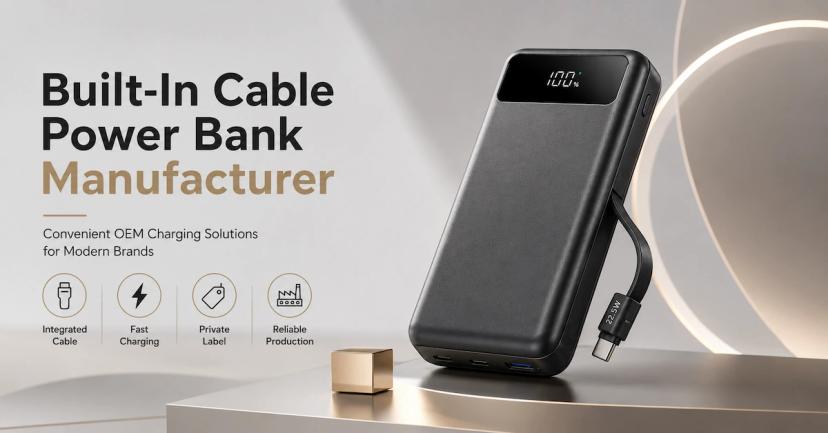
For many mobile users, a power bank is only convenient when the correct charging cable is available. An integrated cable solves this problem by combining portable power and device connection in one compact product.
This makes built-in cable models attractive to travel brands, e-commerce sellers, distributors, corporate gift buyers, and private-label consumer electronics companies.
Choosing the right built in cable power bank manufacturer requires more than comparing product photos and unit prices. Buyers need to evaluate cable durability, connector compatibility, real charging output, battery quality, PCBA stability, housing design, certifications, packaging, and repeat-order capability.
ESC offers multiple fast-charging power bank products that buyers can review when planning a built-in cable product line.
What Is a Built-In Cable Power Bank?
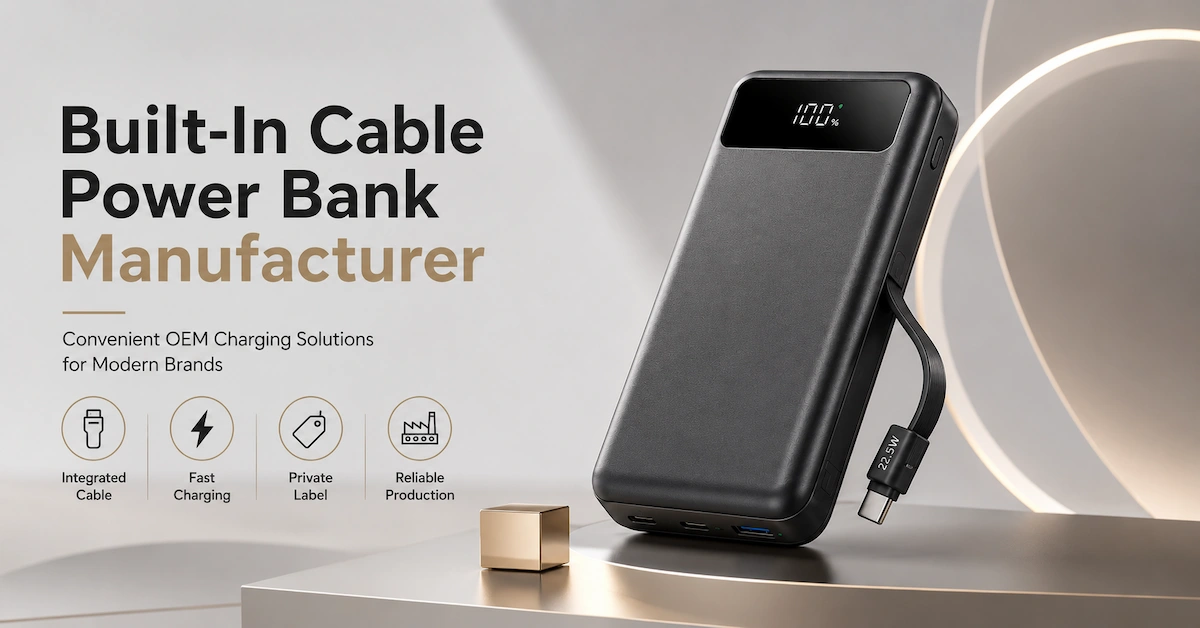
A built-in cable power bank integrates one or more charging cables directly into its housing. The cable may sit inside a molded groove, attach to the side of the product, or form part of a carrying strap.
Common cable configurations include:
- Built-in USB-C cable
- Built-in Lightning cable
- Dual USB-C and Lightning cables
- Short integrated charging cable
- Retractable cable
- Cable that also functions as a carrying loop
A typical product may combine the built-in cable with USB-C and USB-A ports, allowing several devices to be charged from one power bank.
| Product Element | Common Options |
|---|---|
| Capacity | 5000mAh, 10000mAh, 20000mAh |
| Charging power | 22.5W, 27W, 45W or customized output |
| Built-in cable | USB-C, Lightning, dual cable |
| Additional ports | USB-C, USB-A |
| Display | LED indicator, LCD percentage display |
| Housing | ABS, PC, mixed materials |
| Customization | Logo, color, packaging, surface finish |
| Target markets | Travel, retail, gifts, e-commerce |
The best configuration depends on the target customer, device ecosystem, price point, and sales channel.
Which Buyers Need Built-In Cable Power Banks?
Built-in cable power banks are especially suitable for buyers serving convenience-focused consumer markets.
Typical buyer groups include:
- Amazon and Shopify sellers
- Mobile accessory distributors
- Travel product brands
- Corporate gift companies
- Promotional product suppliers
- Consumer electronics retailers
- Supermarket and convenience store channels
- Private-label charging brands
- Airport and travel retail buyers
- Regional importers and wholesalers
These products are less suitable for projects focused mainly on large laptops, industrial equipment, or very high-capacity outdoor power. In those cases, buyers may need 65W, 100W, or larger-capacity models.
Why Built-In Cable Models Convert Well
Immediate and understandable value
Customers can understand the benefit without reading a long technical explanation: the required charging cable is already attached.
This makes built-in cable models easy to promote through product images, marketplace listings, retail shelves, and gift catalogs.
Fewer accessories to carry
Users do not need to store a separate cable in a pocket or bag. This is useful during commuting, travel, meetings, and short trips.
Better gift-market suitability
A power bank with an integrated cable feels more complete than a basic battery pack. It can be presented as a practical all-in-one gift rather than a product that requires additional accessories.
Strong private-label potential
Housing color, cable color, logo, packaging, and display style can be customized to create a recognizable product family.
Brands needing deeper customization can review ESC’s customized power bank solutions for options involving power, capacity, appearance, branding, and packaging.
Cable Design Is the Most Important Sourcing Point
The built-in cable is the main selling point, but it is also one of the most likely sources of complaints.
A cable may look acceptable in a sample photograph yet fail after repeated bending, pulling, or storage. Buyers should therefore evaluate the cable as a working component rather than a decorative accessory.
Important points include:
| Cable Check | Why It Matters |
| Bending resistance | Reduces breakage during daily use |
| Connector strength | Prevents loose or damaged plugs |
| Cable length | Affects comfort while charging |
| Groove design | Protects the cable during storage |
| Pull resistance | Reduces separation from the housing |
| Connector compatibility | Ensures correct device charging |
| Cable material | Affects flexibility and lifespan |
| Strain relief | Protects the connection point |
Buyers should request functional samples and repeatedly insert, remove, bend, and store the cable before approving mass production.
How Much Charging Power Is Suitable?
Built-in cable power banks can be designed for different charging levels.
| Output Level | Suitable Applications |
| 10W–18W | Basic phone charging and promotional products |
| 22.5W | Mainstream fast charging and wholesale markets |
| 27W | Faster phone and tablet charging |
| 45W | Tablets, travel users, and some work devices |
| 65W | Tablets and selected USB-C laptops |
A higher wattage is not automatically better. It increases PCBA requirements, thermal management needs, and product cost.
For mainstream retail and e-commerce projects, 22.5W and 27W often provide a practical balance between charging performance and price. For travel or business product lines, 45W may offer stronger differentiation.
Buyers building a broader charging collection can also combine power banks with ESC’s charger plug products.
Battery Capacity and Product Positioning
Capacity should match the intended use case.
5000mAh
Best for slim designs, emergency charging, travel kits, handbags, and promotional projects.
10000mAh
A strong mainstream choice for commuting, retail, e-commerce, corporate gifts, and daily phone charging.
20000mAh
Suitable for longer travel, multiple devices, tablets, and users who prioritize capacity over compact size.
A built-in cable does not compensate for inaccurate battery capacity. Buyers should confirm rated capacity, usable output, cell consistency, and finished-product discharge testing.
PCBA and Fast-Charging Protocols
The PCBA manages charging output, input charging, device recognition, battery protection, temperature control, and multi-port power distribution.
A capable built in cable power bank manufacturer should be able to explain:
- Supported fast-charging protocols
- Output through the integrated cable
- Output through additional ports
- Power distribution when multiple devices are connected
- Input charging speed
- Battery protection system
- Temperature management
- Display accuracy
Common protocols may include PD, QC, FCP, SCP, AFC, and PPS, depending on the selected product platform.
Buyers should test the sample with the actual phone and tablet models common in their target market.
OEM and Private-Label Customization
A strong OEM supplier should help the buyer turn a standard charging platform into a commercially differentiated product.
Common options include:
- Logo printing
- Laser engraving
- Customized housing color
- Customized cable color
- Matte or glossy surface finish
- Built-in USB-C or Lightning selection
- Dual-cable design
- Digital display
- Retail box design
- Gift packaging
- Multilingual manual
- Barcode and SKU labels
- Custom carton marks
Packaging should clearly communicate the integrated cable type. A customer should be able to identify compatibility before opening the box.
For example, the front or side panel can show:
- Built-in USB-C cable
- Built-in Lightning cable
- Battery capacity
- Maximum output
- Additional ports
- Compatible device categories
- Safety protections
Built-In Cable Power Bank vs Standard Power Bank
| Factor | Built-In Cable Model | Standard Model |
| Daily convenience | High | Depends on separate cable |
| Retail explanation | Easy | Requires more accessory context |
| Product structure | More complex | Simpler |
| Cable failure risk | Higher | No fixed cable risk |
| OEM differentiation | Strong | Moderate |
| Manufacturing cost | Usually higher | Usually lower |
| Best channels | Travel, gifts, e-commerce | General wholesale and daily use |
A built-in cable design creates stronger convenience, but it also requires more careful structural and durability testing.
Quality Control Before Mass Production
Quality control should cover the battery, PCBA, cable, housing, display, and packaging.
Recommended inspection stages include:
- Incoming battery cell inspection
- Battery capacity testing
- PCBA function testing
- Fast-charging protocol testing
- Built-in cable bending test
- Connector insertion test
- Cable pull-resistance test
- Multi-device charging test
- Temperature-rise test
- Aging test
- Housing and appearance inspection
- Packaging verification
- Final shipment inspection
ESC’s About Us page provides additional information for buyers evaluating the company’s production and quality capabilities.
Certifications and Shipping Documents
Power banks contain lithium batteries, so documentation should be discussed before the purchase order is finalized.
Depending on the market and shipping method, buyers may request:
- CE
- RoHS
- FCC
- MSDS
- UN38.3
- IEC62133
- Battery transport reports
- Product specification sheets
Certificates should match the actual model and configuration being ordered. Buyers should not assume that one report automatically covers every housing, battery, PCBA, or capacity variation.
Common Risks Buyers Should Avoid
Weak cable durability
The product may pass a basic charging test but fail after repeated bending or daily handling.
Incorrect cable compatibility
A cable may physically fit the device but fail to support the expected fast-charging protocol.
Inaccurate battery capacity
Low-quality cells or poor conversion efficiency can reduce usable output.
Excessive heat during multi-device charging
Connecting several devices may change power distribution and increase temperature.
Cable storage problems
A poorly designed groove can make the cable difficult to remove or easy to damage.
Inconsistent production batches
Changes in cells, connectors, cable material, or PCBA components may affect repeat orders.
Unclear packaging
Customers may purchase the wrong cable version when compatibility is not visible on the box.
MOQ, Sampling, and Lead-Time Questions
Before requesting a quotation, buyers should prepare:
- Required capacity
- Charging power
- Built-in cable type
- Required ports
- Housing color
- Logo method
- Packaging format
- Target market
- Certification requirements
- Order quantity
- Delivery schedule
The quotation should separate standard-model pricing from costs related to custom color, logo, packaging, cable configuration, certification, or tooling.
Buyers should also request a final pre-production sample before mass production begins.
SKD Options for Local Assembly
Some importers and regional factories may prefer semi-finished components rather than complete products.
An SKD built-in cable power bank solution may include:
- Housing
- PCBA
- Built-in cable module
- Display module
- Packaging materials
- Assembly guidance
ESC’s SKD Powerbank Solution is relevant for buyers considering local assembly or semi-finished product sourcing.
Why Work with ESC for Built-In Cable Power Banks?
ESC supports fast-charging power banks, wireless charging products, charger plug products, customized solutions, and SKD power bank projects.
For built-in cable products, ESC can support:
- Model selection
- Capacity configuration
- Cable-type selection
- Fast-charging configuration
- Logo and color customization
- Packaging development
- Sample confirmation
- Quality inspection
- Bulk-order production
- SKD housing and PCBA solutions
A reliable OEM partner should help reduce cable-related risk while creating a product that is convenient, brand-ready, and suitable for repeat orders.
FAQ
What is a built-in cable power bank?
It is a portable charger with one or more charging cables integrated into its housing, reducing the need to carry a separate cable.
Which built-in cable types are available?
Common options include USB-C, Lightning, and dual-cable configurations. Availability depends on the product structure and OEM platform.
Are built-in cable power banks reliable?
They can be reliable when the cable, connector, strain relief, groove, and PCBA are properly designed and tested.
What capacity is best for this product?
10000mAh is a practical mainstream option. A 5000mAh model is better for slim portability, while 20000mAh suits longer backup requirements.
Can the integrated cable support fast charging?
Yes, but the cable, connector, PCBA, and device must all support the required protocol and output.
Can I customize the cable color?
Many OEM projects support cable and housing color customization, subject to MOQ and production feasibility.
Can I customize the logo and packaging?
Yes. Logo, color, retail packaging, manual, barcode, and other brand elements can generally be customized.
What should I test in the sample?
Test cable bending, pulling, connector fit, fast charging, temperature, capacity, multi-device charging, cable storage, and packaging fit.
Which certifications may be required?
Common requirements include CE, RoHS, FCC, MSDS, UN38.3, and IEC62133, depending on the destination market.
Can ESC provide SKD built-in cable power banks?
ESC can support SKD-related housing and PCBA solutions for eligible local assembly projects.
Conclusion
Choosing the right built in cable power bank manufacturer helps brands develop portable chargers that deliver clear convenience and strong retail appeal.
The best supplier should understand more than battery capacity. Cable durability, connector compatibility, PCBA stability, fast-charging performance, housing structure, packaging, certification, and repeat-order consistency all affect the success of the project.
ESC can support built-in cable power bank development through model selection, OEM/ODM customization, packaging, quality inspection, bulk production, and SKD solutions.
Contact ESC to discuss your built-in cable power bank project, request samples, and receive a tailored OEM quotation.