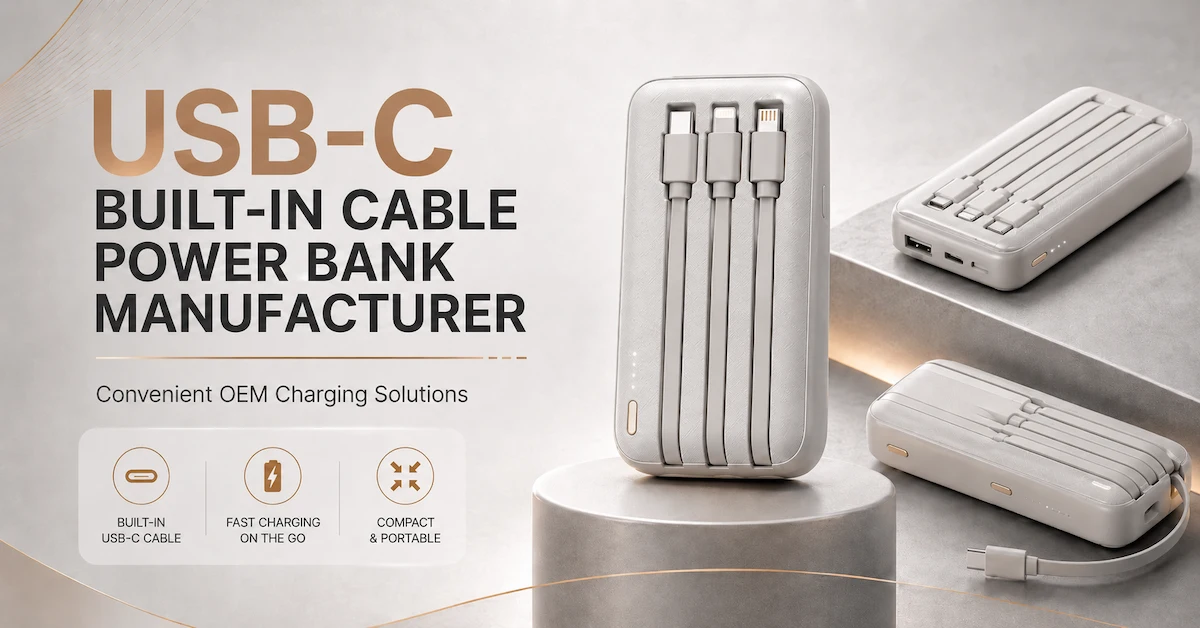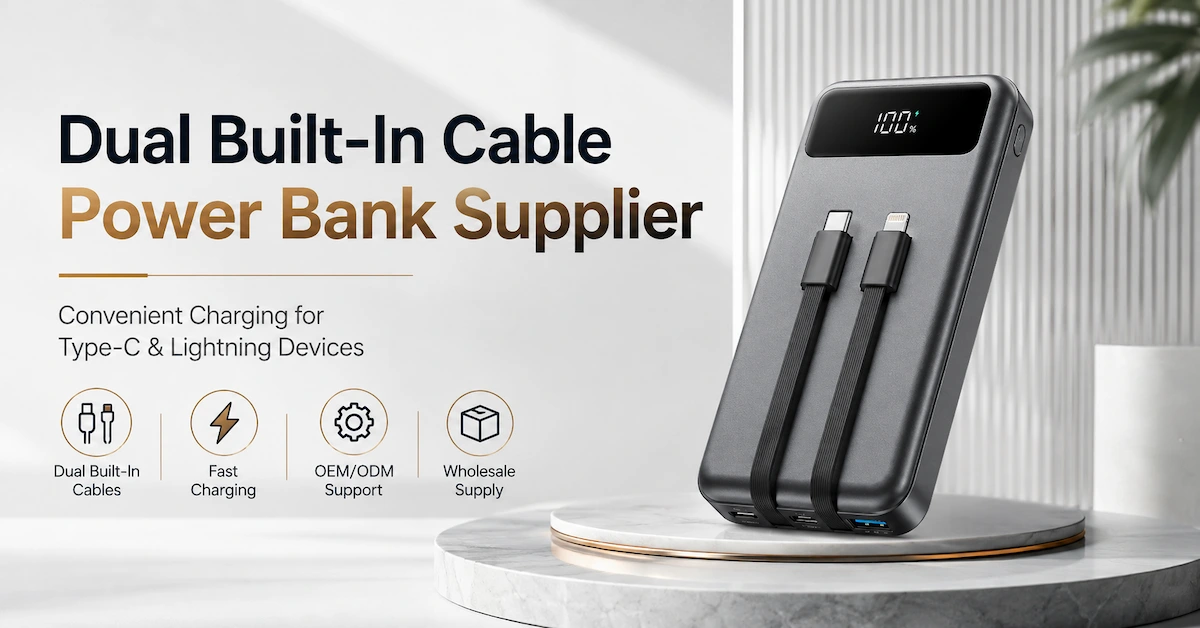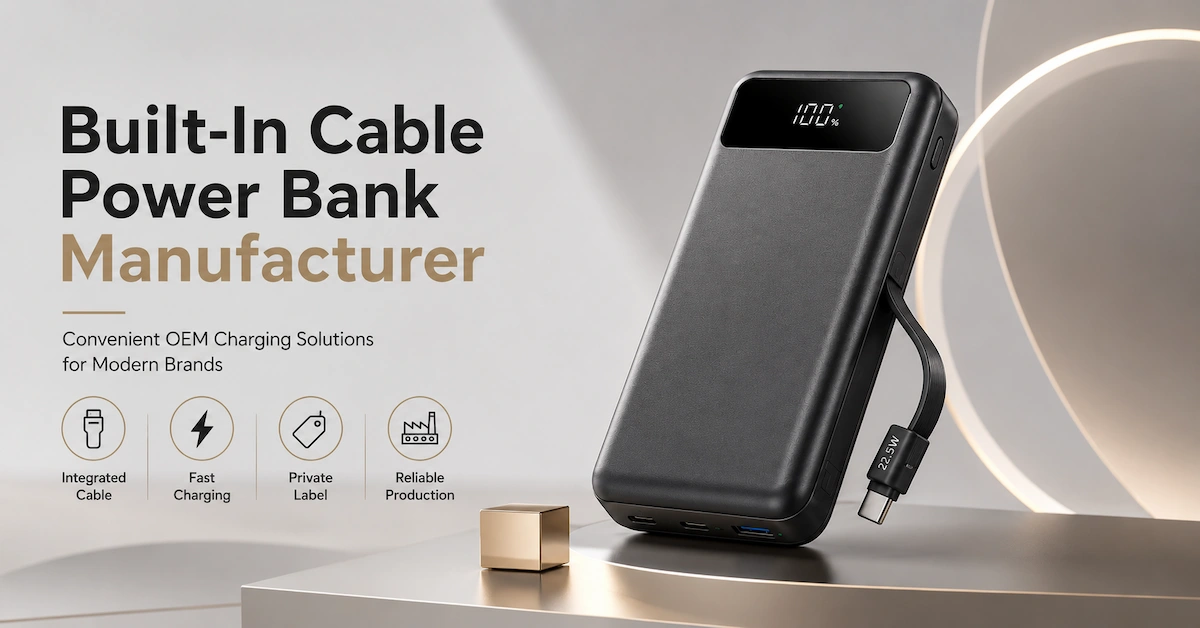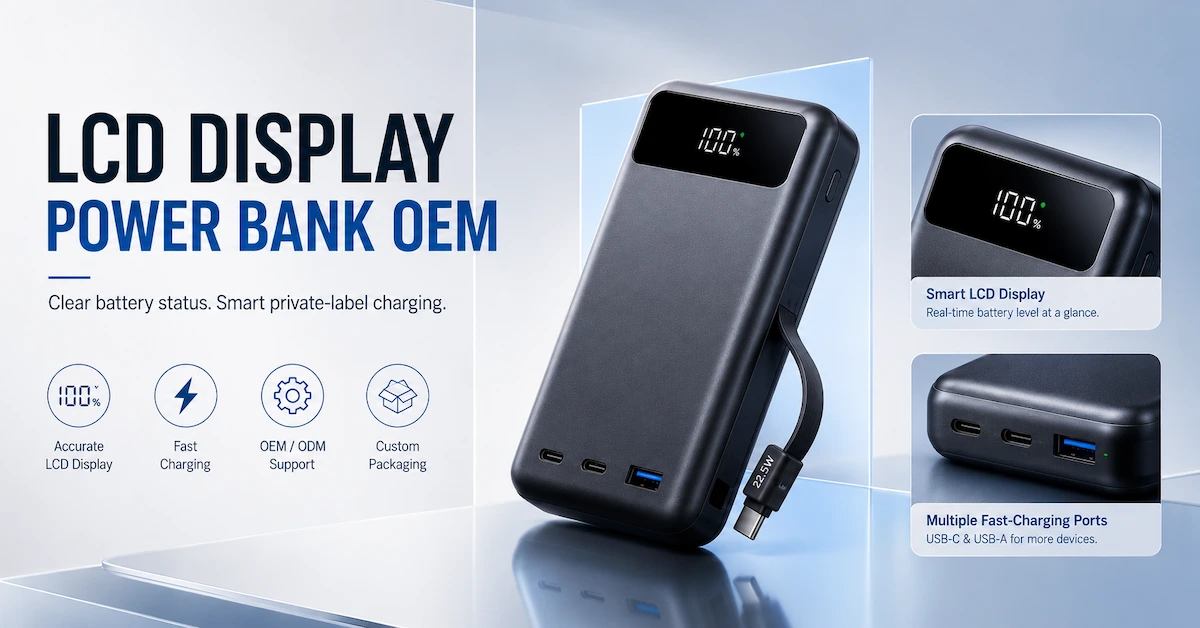

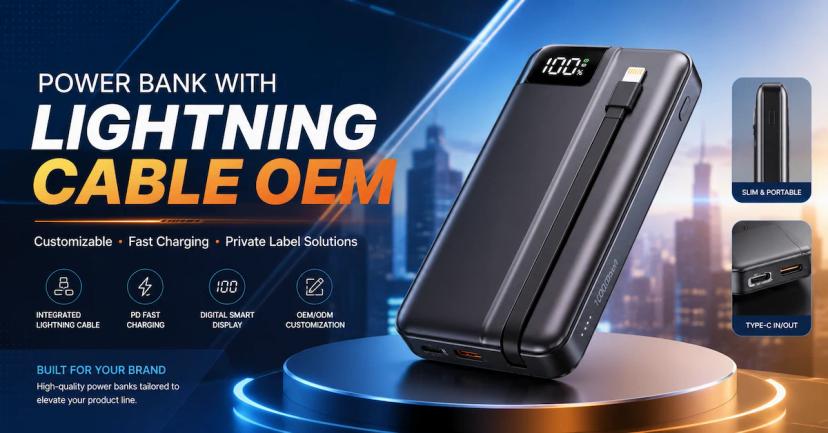
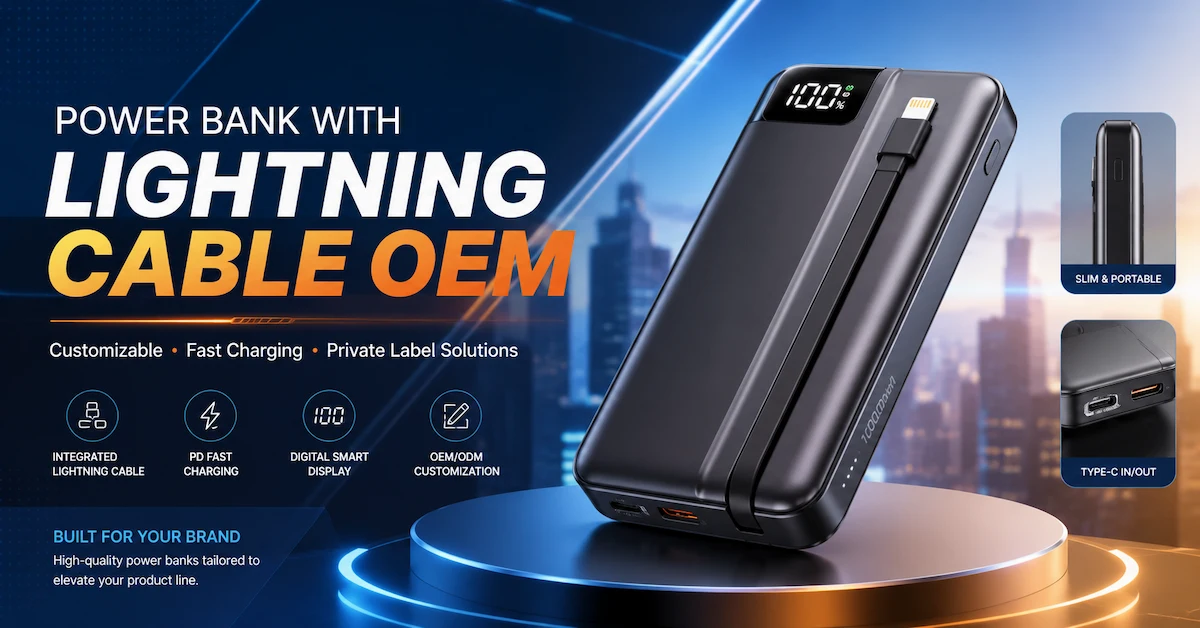
A power bank with Lightning cable OEM project is suitable for brands that want to serve users who still rely on Lightning-equipped phones, earbuds, tablets, and other mobile accessories.
Instead of asking users to carry a separate charging cable, the product integrates a Lightning-compatible connector directly into the housing. Depending on the design, the cable may sit inside a molded groove, form part of a carrying loop, or attach to the side of the power bank.
This all-in-one structure is attractive to importers, distributors, travel brands, gift companies, mobile accessory retailers, and e-commerce sellers because the product benefit is easy to understand: portable power and the charging cable are combined in one device.
However, the integrated connector also introduces additional sourcing risks. Buyers must evaluate cable durability, connector fit, charging performance, battery quality, PCBA stability, cable storage, packaging communication, and repeat-order consistency.
Brands can first compare ESC’s available power bank products before selecting a suitable platform for OEM customization.
What Is a Power Bank with a Lightning Cable?
A power bank with a Lightning cable is a portable charger that includes a fixed or recessed Lightning-compatible charging cable.
It may also include:
- A built-in USB-C cable
- USB-C input/output
- USB-A output
- Digital battery display
- Fast-charging support
- Carrying-loop cable design
- Multiple-device charging
- Custom housing and packaging
| Product Element | Common Options |
|---|---|
| Battery capacity | 5000mAh, 10000mAh, 20000mAh |
| Built-in connector | Lightning-compatible |
| Additional cable | USB-C or dual-cable configuration |
| Output power | 10W, 18W, 22.5W, 27W or platform-dependent |
| Display | LED indicators or LCD percentage display |
| Housing | ABS, PC or mixed materials |
| Customization | Logo, color, packaging, cable color |
| Main channels | Retail, travel, e-commerce, gifts |
The best configuration depends on the buyer’s target devices, price range, sales channel, product size, and expected charging speed.
Who Needs a Power Bank with Lightning Cable OEM Partner?
This product direction is most suitable for buyers serving customer groups that still use Lightning-compatible devices.
Typical B2B customers include:
- Mobile accessory brands
- Importers and regional distributors
- Amazon and Shopify sellers
- Travel accessory companies
- Airport and duty-free retailers
- Corporate gift suppliers
- Promotional product companies
- Consumer electronics retailers
- Private-label charging brands
- Convenience-store and supermarket buyers
It may be less suitable for markets that focus entirely on USB-C devices or high-power laptop charging. Buyers should first review the device mix in their target region before selecting a Lightning-focused SKU.
Why Do Built-In Lightning Cable Power Banks Sell Well?
The charging cable is always available
The user does not need to search for a loose cable before charging. This makes the product useful during commuting, travel, meetings, events, and emergency situations.
The benefit is easy to communicate
A customer can understand the product from one image. This helps marketplace listings, retail packaging, gift catalogs, and promotional campaigns convert more effectively.
It reduces accessory clutter
The integrated cable removes the need for an extra cable inside a bag, travel pouch, or desk drawer.
It fits gift and travel channels
Compact all-in-one charging products are practical, easy to package, and suitable for corporate gifts, travel bundles, employee kits, and retail displays.
It supports private-label differentiation
Brands can customize the housing color, cable color, logo, packaging, display style, and accessory configuration without necessarily developing a completely new electronic platform.
ESC’s customized charging solutions can support product appearance, charging configuration, branding, and packaging development.
Lightning Cable Durability Is the First Quality Check
For a power bank with Lightning cable OEM project, the cable is both the main selling point and the main structural risk.
A cable may charge correctly during a short sample test but fail after repeated bending, twisting, pulling, and storage. Buyers should therefore test the integrated cable under realistic conditions.
Important inspection points include:
| Cable Test | Buyer Concern |
|---|---|
| Repeated bending | Cracking near the connector |
| Pull resistance | Cable separation from the housing |
| Connector insertion | Loose or unstable device connection |
| Strain relief | Stress at the cable joint |
| Groove fit | Difficulty storing or removing the cable |
| Cable flexibility | Comfort during charging |
| Surface wear | Peeling or discoloration |
| Charging consistency | Stable output after repeated use |
A reliable supplier should have a defined cable durability test rather than treating the integrated cable as a decorative feature.
How Should Buyers Check Lightning Compatibility?
Physical connector fit is only one part of compatibility.
Buyers should also confirm:
- Which devices were tested
- Maximum charging output through the Lightning cable
- Whether the cable supports only output or also input
- Whether the product supports simultaneous charging
- Whether authentication or licensed components are required
- Which charging protocols are available
- Whether charging performance changes by device model
- Which claims can legally appear on the packaging
Where a sales channel or brand requires authorized connector solutions, buyers should request supporting documentation rather than relying on verbal claims.
The safest approach is to test the sample with representative devices from the intended market before approving packaging or marketing content.
What Charging Power Is Suitable?
A built-in Lightning cable power bank is usually positioned for mobile-device charging rather than high-power laptop use.
| Output Level | Best Application |
|---|---|
| 10W–12W | Basic charging and promotional projects |
| 18W–20W | Faster mobile-device charging |
| 22.5W | Mainstream fast-charging power bank |
| 27W | Higher-value phone and tablet products |
| 45W+ | Usually delivered through USB-C rather than Lightning |
The advertised maximum output may be available through USB-C or USB-A rather than through the integrated Lightning cable. Buyers should ask for a clear port-and-cable output table.
For a complete charging product collection, ESC’s charger plug products can complement portable power banks with wall-charging and travel-charging solutions.
Which Battery Capacity Should You Choose?
5000mAh
Suitable for slim products, emergency backup, travel kits, handbags, promotional projects, and lightweight retail channels.
10000mAh
A practical mainstream option for daily use, e-commerce, travel, gifts, and private-label product lines.
20000mAh
Suitable for longer trips, users with several devices, and buyers prioritizing backup time over compact size.
| Capacity | Main Advantage | Best Channel |
|---|---|---|
| 5000mAh | Slim and lightweight | Gifts and lifestyle retail |
| 10000mAh | Balanced size and capacity | E-commerce and mainstream retail |
| 20000mAh | Longer backup time | Travel and high-capacity markets |
For most private-label projects, 10000mAh offers the best balance of portability, product value, and sales-channel flexibility.
PCBA Design and Power Distribution
The PCBA manages:
- Battery charging
- Lightning cable output
- Additional USB-C or USB-A output
- Device recognition
- Power distribution
- Temperature protection
- Over-current protection
- Short-circuit protection
- Display accuracy
If several outputs are used simultaneously, available power may be shared between devices.
Buyers should request a power-distribution table covering:
- Lightning cable used alone
- USB-C port used alone
- USB-A port used alone
- Lightning cable plus USB-C
- Lightning cable plus USB-A
- All outputs used simultaneously
Without this information, brands may overstate charging performance and create avoidable customer complaints.
Power Bank with Lightning Cable OEM Customization
A professional OEM partner should support practical customization that matches the buyer’s channel and target price.
Common options include:
- Logo printing
- Laser engraving
- Custom housing color
- Custom cable color
- Matte or glossy finish
- Soft-touch coating
- Digital battery display
- Lightning-only or dual-cable design
- Additional USB-C or USB-A ports
- Retail box design
- Gift packaging
- Multilingual manual
- Barcode and SKU labels
- Customized carton marks
The final sample should include the actual logo, color, cable, display, packaging, manual, labels, and accessories.
Lightning Cable Model vs Dual-Cable Model
| Factor | Lightning Cable Model | Dual-Cable Model |
|---|---|---|
| Target devices | Lightning-equipped products | Lightning and USB-C devices |
| Product structure | Simpler | More complex |
| Product size | Often more compact | May be slightly larger |
| Cable testing | One integrated cable | Two cable systems |
| Compatibility | More focused | Broader |
| Cost | Usually lower | Usually higher |
| Best market | Apple-focused customer groups | Mixed-device customer groups |
A Lightning-only model can be more compact and cost-effective, while a dual-cable product offers broader compatibility.
Quality Control Before Mass Production
A reliable factory should include the integrated cable in the full quality-control process.
Recommended checks include:
- Incoming battery-cell inspection
- Battery-capacity testing
- PCBA function testing
- Lightning cable charging test
- Connector insertion test
- Cable bending test
- Cable pull-resistance test
- Additional-port charging test
- Multi-device charging test
- Temperature-rise test
- Aging test
- Display-accuracy test
- Housing and appearance inspection
- Packaging verification
- Final shipment inspection
Buyers can review ESC’s production background and business capabilities through the About Us page.
Packaging Requirements for Lightning Cable Power Banks
Packaging should make compatibility clear before the customer opens the box.
Important information may include:
- Built-in Lightning-compatible cable
- Battery capacity
- Maximum output
- Additional ports
- Supported device categories
- Fast-charging conditions
- Safety protections
- Included accessories
- Certification marks
- Product model and barcode
Avoid vague claims such as “compatible with all devices” unless the product has been tested and documented for those devices.
Clear packaging reduces wrong purchases, returns, and customer-support questions.
Common Procurement Risks
Cable damage after repeated use
Weak strain relief or low-quality cable materials can cause early failure.
Connector compatibility problems
A connector may physically fit but fail to deliver the expected charging performance.
Incorrect marketing claims
Fast-charging output may differ between the Lightning cable and other ports.
Inaccurate battery capacity
A convenient cable design cannot compensate for low-grade cells or weak usable output.
Overheating during multi-device charging
The PCBA and battery system must manage shared output safely.
Poor cable storage
A cable that is difficult to remove or fit back into the groove can frustrate users.
Inconsistent repeat orders
Changes in cells, connectors, cables, or PCBA components may affect later batches.
MOQ, Sampling, Pricing, and Lead Time
Before asking for a quotation, buyers should prepare:
- Required battery capacity
- Lightning-only or dual-cable structure
- Required output power
- Additional ports
- Housing color
- Cable color
- Logo method
- Packaging format
- Target market
- Compliance requirements
- Order quantity
- Delivery deadline
The quotation should separate the standard unit price from costs for custom color, logo, packaging, tooling, testing, certification, or special cable components.
A branded pre-production sample should be approved before bulk manufacturing begins.
Can This Product Be Supplied as SKD?
Some local assembly customers may prefer semi-finished products.
An SKD solution may include:
- Housing
- PCBA
- Lightning cable module
- Battery components
- Display module
- Packaging
- Assembly instructions
ESC’s SKD Powerbank Solution is relevant for eligible local assembly and semi-finished product projects.
Why Work with ESC for Lightning Cable Power Banks?
ESC supports fast-charging power banks, built-in cable products, charger plug products, custom charging solutions, and SKD projects.
For a power bank with Lightning cable OEM project, ESC can support:
- Product-platform selection
- Battery-capacity configuration
- Cable-structure selection
- Fast-charging configuration
- Additional-port planning
- Logo and color customization
- Packaging development
- Sample approval
- Quality inspection
- Bulk production and delivery
- SKD housing and PCBA solutions
A capable OEM partner should help the buyer create a product that is convenient for users and repeatable in production.
FAQ
What is a power bank with a Lightning cable?
It is a portable charger with an integrated Lightning-compatible cable, allowing supported devices to charge without a separate cable.
Can the built-in Lightning cable support fast charging?
It depends on the cable, PCBA, charging protocol, and connected device. Buyers should confirm the tested maximum output.
Can the Lightning cable also recharge the power bank?
Some designs may support input charging, while others support output only. Confirm the exact model configuration.
What capacity is best?
10000mAh is a practical mainstream option. A 5000mAh model is more compact, while a 20000mAh model provides longer backup.
Can the cable and housing colors be customized?
Yes, many OEM projects support cable color, housing color, logo, surface finish, and packaging customization.
What should I test in the sample?
Test connector fit, charging speed, cable bending, pulling, storage, temperature, capacity, multi-device charging, and packaging fit.
Which certifications may be required?
Common requirements include CE, RoHS, FCC, MSDS, UN38.3, and IEC62133, depending on the product and destination market.
Is this product suitable for private label?
Yes. The integrated cable, compact design, color options, and packaging flexibility make it suitable for private-label brands.
Should I choose a Lightning-only or dual-cable model?
Choose Lightning-only for a focused, compact product. Choose dual-cable for broader USB-C and Lightning compatibility.
Can ESC support SKD projects?
ESC can support eligible SKD housing, PCBA, cable-module, and local-assembly projects.
Conclusion
Choosing the right power bank with Lightning cable OEM partner helps brands develop convenient charging products for customers who still rely on Lightning-equipped devices.
The supplier should understand connector compatibility, cable durability, charging output, battery safety, PCBA design, packaging, quality control, compliance, and repeat-order consistency.
ESC can support Lightning cable power bank projects through platform selection, OEM/ODM customization, packaging development, testing, bulk production, and SKD solutions.
Contact ESC to discuss your Lightning cable power bank project, request samples, and receive a customized OEM quotation.