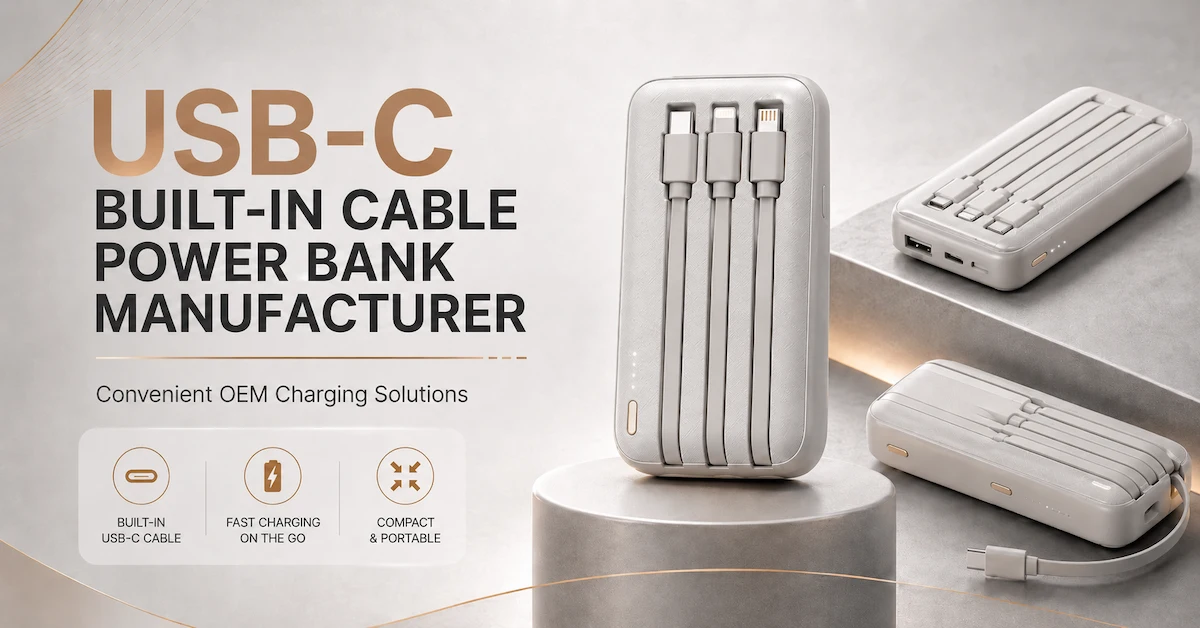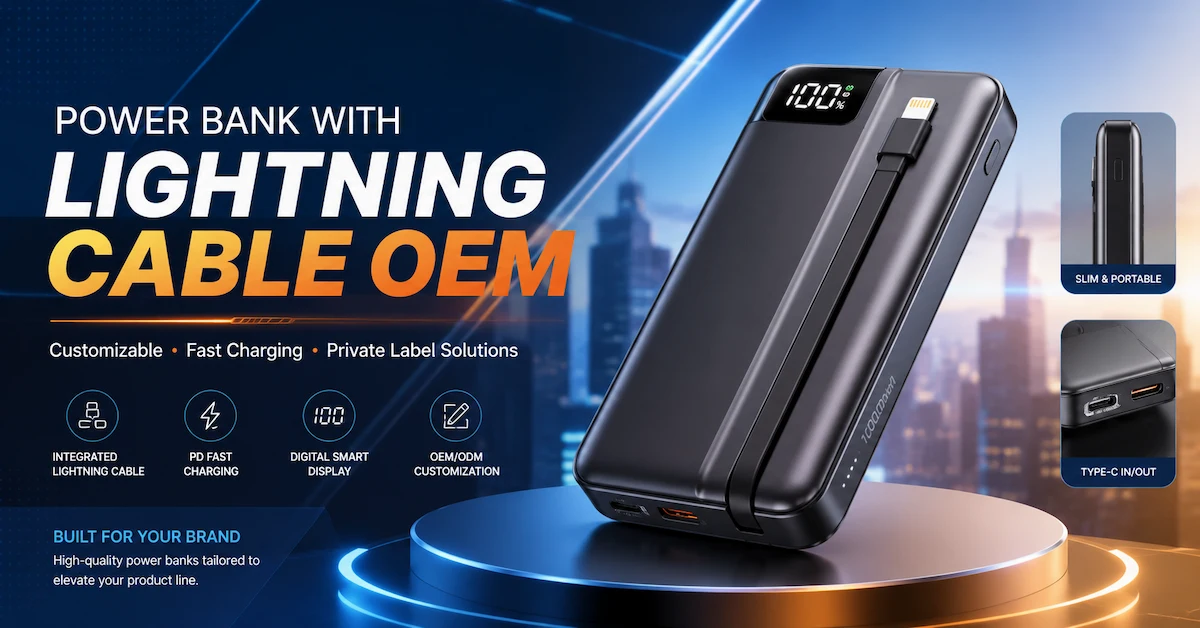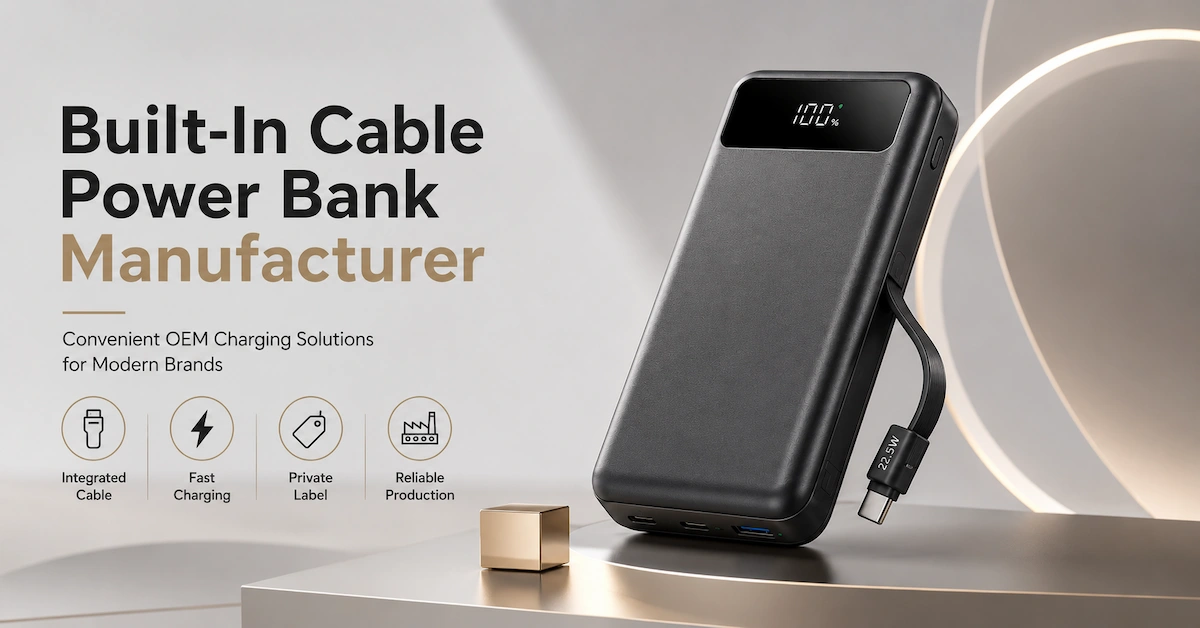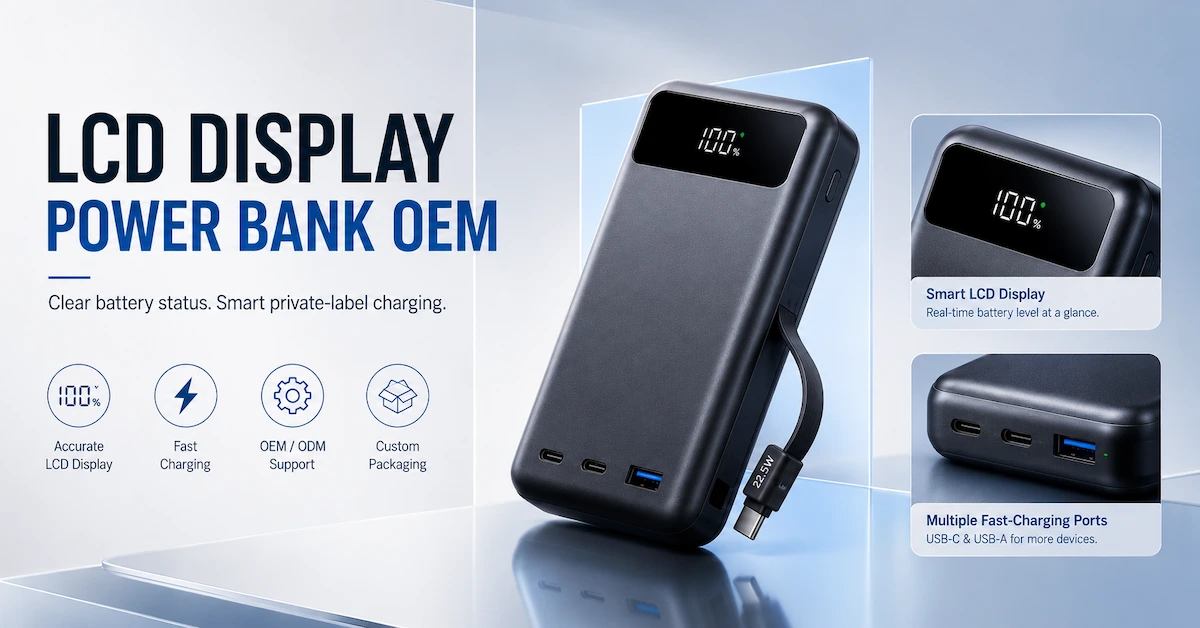

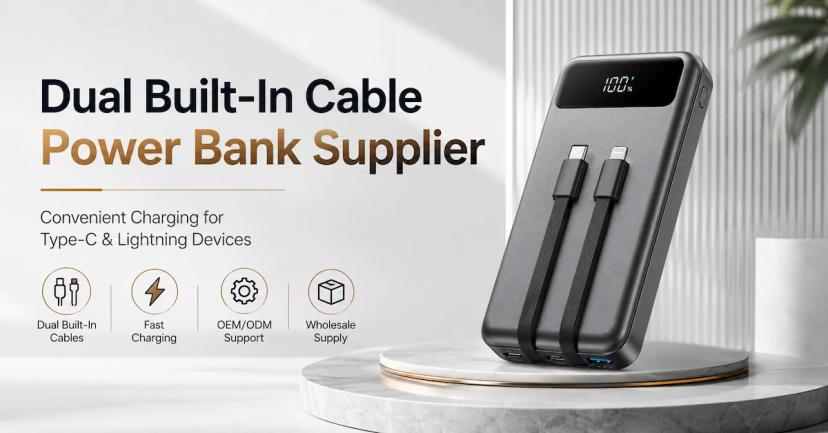
A dual built in cable power bank supplier serves buyers who want one portable charger to support more than one device ecosystem without requiring users to carry separate cables.
Most dual-cable designs combine a USB-C connector with a Lightning-compatible connector. Depending on the model, the cables may be stored in molded grooves, positioned along the front housing, attached to the side, or designed as carrying loops.
This structure is attractive to importers, e-commerce sellers, distributors, travel accessory brands, gift companies, and private-label electronics businesses because the customer benefit is easy to understand: charge different mobile devices from one compact product.
However, dual-cable products are more complex than standard power banks. Buyers must evaluate two cable assemblies, connector durability, protocol compatibility, power distribution, cable storage, battery performance, PCBA stability, packaging, and batch consistency.
Brands planning a dual-cable product line can first compare ESC’s available power bank products, including compact, high-capacity, fast-charging, and integrated-cable models.
What Is a Dual Built-In Cable Power Bank?
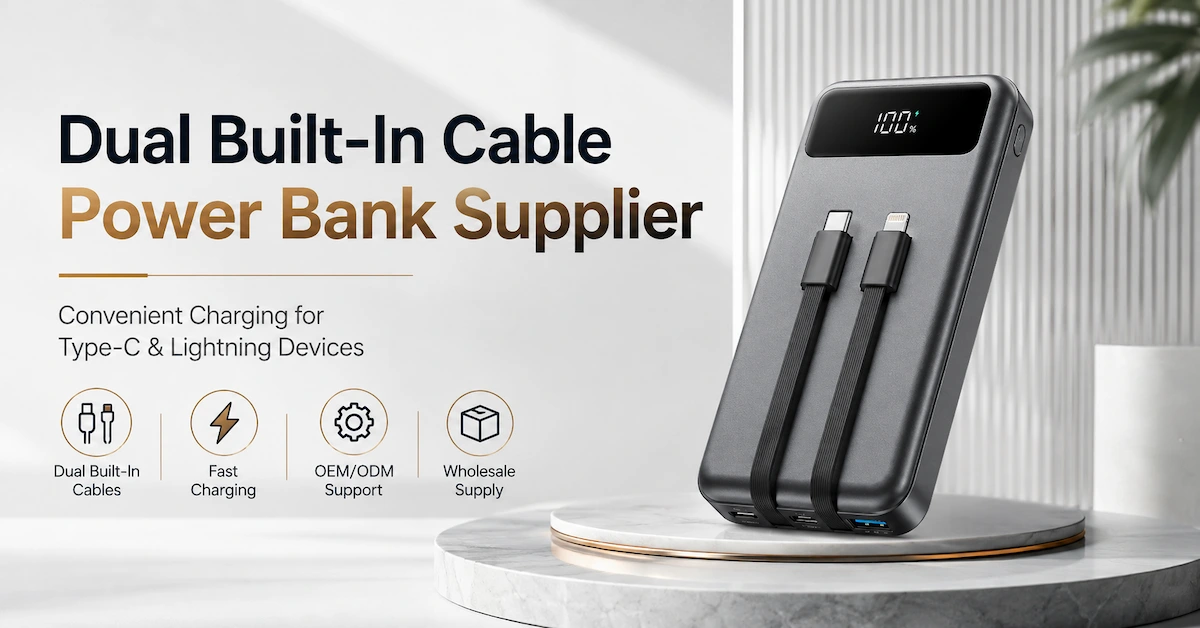
A dual built-in cable power bank integrates two charging cables directly into the product body.
A common configuration includes:
- One built-in USB-C cable
- One built-in Lightning-compatible cable
- One or more additional USB-C or USB-A ports
- A battery percentage display
- Fast-charging protocol support
- A cable storage groove or carrying-loop structure
The product is designed to reduce accessory clutter and improve compatibility across different smartphones, tablets, earbuds, and other mobile devices.
| Product Element | Common Options |
|---|---|
| Capacity | 5000mAh, 10000mAh, 20000mAh |
| Integrated cables | USB-C plus Lightning-compatible |
| Output power | 22.5W, 27W, 45W or model-dependent |
| Extra ports | USB-C, USB-A |
| Display | LED indicator, LCD percentage display |
| Housing | ABS, PC or mixed-material construction |
| Branding | Logo, color, packaging, manual |
| Main channels | Travel, retail, e-commerce, gifts |
A professional supplier should clearly explain which cable supports input, output, fast charging, or device-specific protocols. Buyers should not assume both cables deliver identical performance.
Which Buyers Benefit Most from Dual-Cable Power Banks?
Dual built-in cable products are especially suitable for businesses serving mixed-device customer groups.
Typical buyers include:
- Amazon and Shopify sellers
- Mobile accessory distributors
- Travel accessory brands
- Airport and duty-free retailers
- Corporate gift companies
- Promotional merchandise suppliers
- Consumer electronics retailers
- Private-label charging brands
- Supermarket and convenience store channels
- Regional importers and wholesalers
These products are less suitable when the main requirement is high-power laptop charging, industrial use, or ultra-large battery capacity. For those markets, a dedicated 65W or 100W USB-C PD model may be more appropriate.
Why Do Dual Built-In Cable Power Banks Sell Well?
They support mixed device ecosystems
Many households, offices, and travel groups use both USB-C and older Lightning-compatible devices. A dual-cable product can serve more users without including loose cables in the box.
The value is immediately visible
Customers can see both connectors in product images. The benefit does not require a long technical explanation, which makes the product suitable for marketplaces and retail shelves.
They reduce accessory loss
Because the cables remain attached to the housing, users are less likely to forget or misplace them.
They work well for travel and gifting
A compact all-in-one power bank is easy to position as a travel essential, corporate gift, event giveaway, or retail bundle.
They support private-label differentiation
Cable colors, housing finishes, display styles, packaging, and branding can create a recognizable product family without requiring a completely new electronic platform.
Buyers that need customized housing, branding, output power, or packaging can review ESC’s customized charging solutions.
What Cable Configuration Should Buyers Choose?
The correct cable configuration depends on the target market.
| Cable Configuration | Best For | Procurement Consideration |
|---|---|---|
| USB-C + Lightning-compatible | Mixed phone users | Broad retail compatibility |
| Dual USB-C | Newer Android and USB-C device markets | Simplified modern ecosystem |
| USB-C + Micro USB | Cost-sensitive legacy markets | Check remaining local demand |
| Dual cable plus USB-A port | Multi-device users | More complex power distribution |
| Dual cable plus USB-C port | Travel and higher-speed charging | Stronger PCBA requirements |
For most modern private-label projects, USB-C plus Lightning-compatible cables provide the clearest consumer value. The exact connector and charging claims should still be confirmed against the target devices and market requirements.
Cable Durability Is the First Quality Check
The cable system is the main selling point and the main structural risk.
A product may pass a one-time charging test but fail after repeated bending, pulling, twisting, or storage. Buyers should therefore request physical samples and test the cables under realistic use.
Important checks include:
- Connector insertion and removal
- Cable bending resistance
- Pull strength
- Strain-relief design
- Cable length
- Cable flexibility
- Connector housing strength
- Groove fit
- Storage convenience
- Surface wear after repeated use
| Test Area | What a Buyer Should Look For |
|---|---|
| Bending | No cracking near the connector |
| Pulling | Cable remains securely fixed |
| Storage | Cable fits without excessive force |
| Connector fit | Stable connection without looseness |
| Repeated use | Charging remains consistent |
| Surface quality | No peeling, splitting, or discoloration |
A capable dual built in cable power bank supplier should treat cable testing as part of product quality control rather than an optional inspection.
Do Both Built-In Cables Support the Same Charging Speed?
Not necessarily.
The maximum output depends on the cable, connector, PCBA, supported protocol, and connected device. One cable may support a higher charging rate than the other.
Buyers should ask the supplier to confirm:
- Maximum output through the USB-C cable
- Maximum output through the Lightning-compatible cable
- Supported protocols on each cable
- Whether both cables can operate simultaneously
- Total shared output during multi-device charging
- Output through additional USB-C or USB-A ports
- Input charging method
- Temperature under full load
A product advertised as 22.5W or 27W may only reach that output through a specific port or cable. Packaging and product listings should communicate this clearly.
How Should Power Distribution Work?
When two cables and additional ports are used at the same time, the PCBA must divide available power between devices.
For example, a product may support a higher output when one device is connected but reduce individual output when two or three devices are charging.
A supplier should provide a clear power-distribution table.
| Charging Situation | Information Buyers Need |
|---|---|
| One USB-C cable in use | Maximum supported output |
| One Lightning-compatible cable in use | Maximum supported output |
| Both built-in cables in use | Shared output per device |
| Cable plus USB-A port | Total and individual output |
| Cable plus USB-C port | Protocol and wattage allocation |
| Full multi-device load | Temperature and stability |
Without this information, buyers may overstate product performance in their listings and create avoidable customer complaints.
What Battery Capacity Is Best?
5000mAh
Suitable for compact, slim, emergency, lifestyle, and promotional products.
10000mAh
The most flexible option for daily charging, retail, travel, private label, and e-commerce.
20000mAh
Better for longer trips, tablets, multiple devices, and customers who prioritize capacity over compact size.
| Capacity | Main Advantage | Best Channel |
|---|---|---|
| 5000mAh | Lightweight and portable | Gifts and lifestyle retail |
| 10000mAh | Balanced size and runtime | E-commerce and mainstream retail |
| 20000mAh | Longer backup time | Travel and high-capacity channels |
For most dual-cable projects, 10000mAh provides a strong balance between portability, cost, and customer expectations.
PCBA Design and Protocol Compatibility
The PCBA controls:
- Battery charging
- Cable output
- Port output
- Protocol recognition
- Multi-device power allocation
- Temperature protection
- Over-current protection
- Short-circuit protection
- Display accuracy
The supplier should be able to explain which fast-charging protocols are supported by each connector.
Common protocol options may include:
- PD
- QC
- FCP
- SCP
- AFC
- PPS, depending on the platform
Buyers should test samples with the specific phones and tablets commonly sold in their target market.
For a wider product ecosystem, ESC also offers complementary charger plug products for wall charging and travel applications.
OEM and Private-Label Customization Options
A reliable dual built in cable power bank supplier should support practical customization without creating unnecessary production risk.
Common OEM options include:
- Logo printing
- Laser engraving
- Custom housing color
- Custom cable color
- Matte or glossy finish
- Soft-touch surface treatment
- Digital battery display
- USB-C and Lightning-compatible cable configuration
- Additional port selection
- Retail packaging
- Gift packaging
- Multilingual manual
- Barcode and SKU labels
- Custom carton marks
A buyer should approve a finished sample that includes the final product color, cable colors, logo, display, packaging, manual, and accessories.
Dual-Cable vs Single-Cable Power Banks
| Factor | Dual Built-In Cable | Single Built-In Cable |
|---|---|---|
| Device coverage | Broader | More focused |
| Retail appeal | Strong | Strong |
| Structural complexity | Higher | Lower |
| Cable testing | Two cable systems | One cable system |
| Production cost | Usually higher | Usually lower |
| Product size | May be slightly larger | Often more compact |
| Best market | Mixed-device users | Single-ecosystem customers |
A dual-cable model provides stronger compatibility but requires stricter control over cable quality, internal layout, and power distribution.
What Should Buyers Inspect Before Mass Production?
A complete quality-control plan should include:
- Battery capacity testing
- Cell consistency inspection
- PCBA function testing
- USB-C cable charging test
- Lightning-compatible cable charging test
- Simultaneous dual-cable output test
- Additional port output test
- Cable bending test
- Cable pull test
- Connector insertion test
- Temperature-rise test
- Aging test
- Display accuracy test
- Housing inspection
- Packaging verification
- Final shipment inspection
Buyers can review ESC’s production background and business capabilities on the About Us page.
What Are the Main Procurement Risks?
One cable performs better than the other
Different connector systems may not provide equal output. Buyers should verify and communicate the difference.
Cable breakage
Weak strain relief or low-quality materials can lead to early failure.
Poor cable storage
Cables that are too tight or difficult to remove may frustrate users.
Overheating during simultaneous charging
Charging two devices increases the load on the PCBA and battery system.
Inaccurate capacity
A convenient cable design cannot compensate for poor cell quality or weak usable capacity.
Confusing packaging
Customers need to see which connectors are included and which devices they support.
Inconsistent repeat orders
Changes in cables, connectors, cells, or PCBA components can affect later batches.
MOQ, Sampling, Pricing, and Lead Time
Before requesting a quotation, prepare the following information:
- Capacity requirement
- Cable types
- Required output power
- Additional port configuration
- Housing color
- Cable color
- Logo method
- Packaging style
- Target market
- Certification requirements
- Order quantity
- Delivery deadline
The quotation should separate standard product pricing from custom costs such as color matching, printing, packaging, certification, firmware, or tooling.
Do not approve mass production using only an unbranded engineering sample. Request a final pre-production sample showing the actual cable arrangement, logo, packaging, labeling, and accessories.
Can Dual-Cable Models Be Supplied as SKD?
Some local assembly customers may prefer semi-finished products.
An SKD solution may include:
- Housing
- PCBA
- USB-C cable module
- Lightning-compatible cable module
- Display
- Packaging
- Assembly instructions
ESC’s SKD Powerbank Solution is relevant for eligible local assembly and semi-finished product projects.
Why Work with ESC for Dual Built-In Cable Power Banks?
ESC supports fast-charging power banks, integrated-cable models, charger plug products, customized solutions, and SKD projects.
For dual-cable products, ESC can support:
- Product platform selection
- Capacity configuration
- Cable combination selection
- Fast-charging configuration
- Power-distribution planning
- Logo and color customization
- Packaging development
- Sample approval
- Production quality control
- Bulk-order delivery
- SKD housing and PCBA solutions
A capable supplier should help buyers develop a product that is convenient for users and repeatable in production.
FAQ
What is a dual built-in cable power bank?
It is a portable charger with two integrated charging cables, commonly USB-C and Lightning-compatible connectors.
Can both cables charge devices at the same time?
Many models support simultaneous charging, but total output may be shared. Confirm the supplier’s power-distribution specifications.
Do both built-in cables support fast charging?
They may support different outputs or protocols. The exact performance depends on the selected PCBA, cable, and device.
What is the most suitable capacity?
10000mAh is a practical mainstream choice. A 5000mAh model is more compact, while a 20000mAh model provides longer backup.
Can the cable colors be customized?
Often yes, subject to the selected materials, production quantity, and supplier capabilities.
Can I customize the logo and packaging?
Yes. Private-label projects can generally include logo, housing color, cable color, packaging, manual, barcode, and carton marks.
What should be tested on a sample?
Test both cables separately and together, connector fit, bending, pulling, temperature, capacity, charging speed, storage, and packaging fit.
Which certifications may be needed?
Common requirements include CE, RoHS, FCC, MSDS, UN38.3, and IEC62133, depending on the destination market.
Is a dual-cable model suitable for wholesale?
Yes. It is particularly suitable for travel, retail, e-commerce, corporate gifts, and mixed-device customer groups.
Can ESC provide SKD dual-cable power banks?
ESC can support eligible SKD housing, PCBA, and component projects for local assembly customers.
Conclusion
Choosing the right dual built in cable power bank supplier helps brands develop convenient charging products that support broader device compatibility and create clear retail value.
The supplier should understand both cable systems, connector durability, power distribution, protocol compatibility, battery safety, packaging, quality control, and repeat-order consistency.
ESC can support dual built-in cable power bank projects through model selection, OEM/ODM customization, packaging development, testing, bulk production, and SKD solutions.
Contact ESC to discuss your dual-cable power bank requirements, request samples, and receive a customized OEM or wholesale quotation.