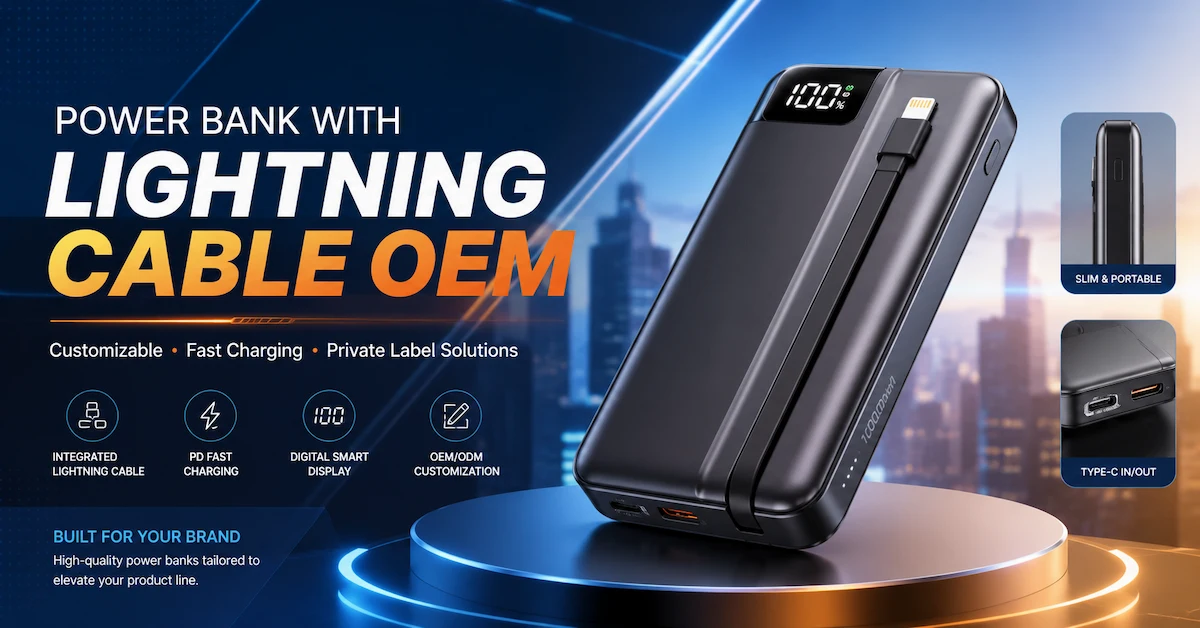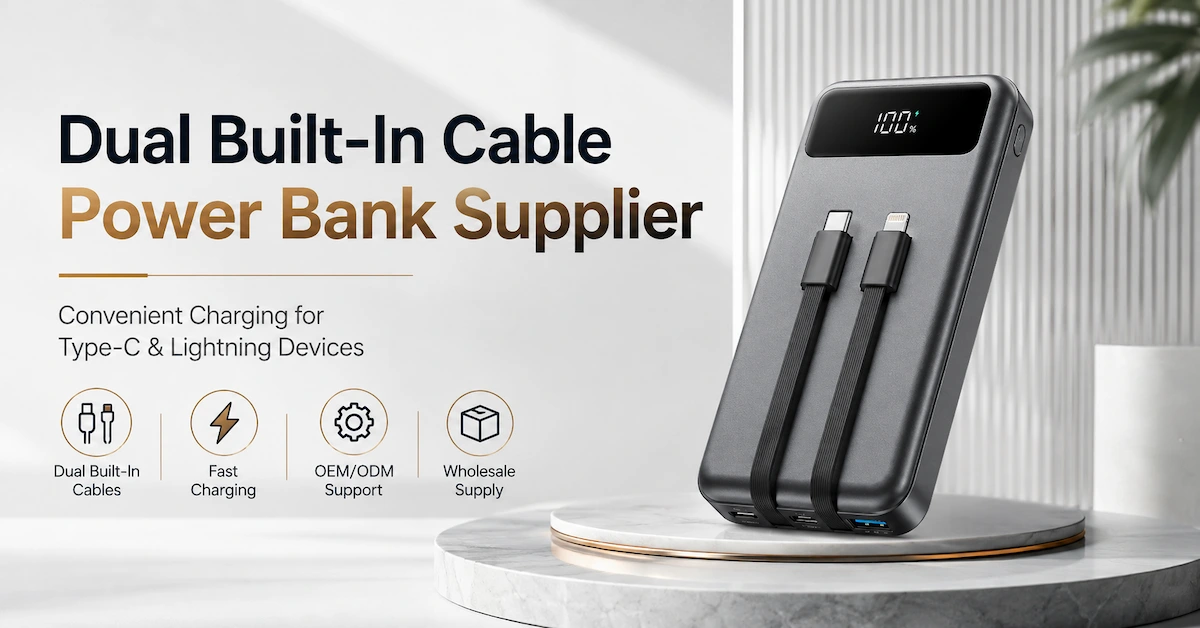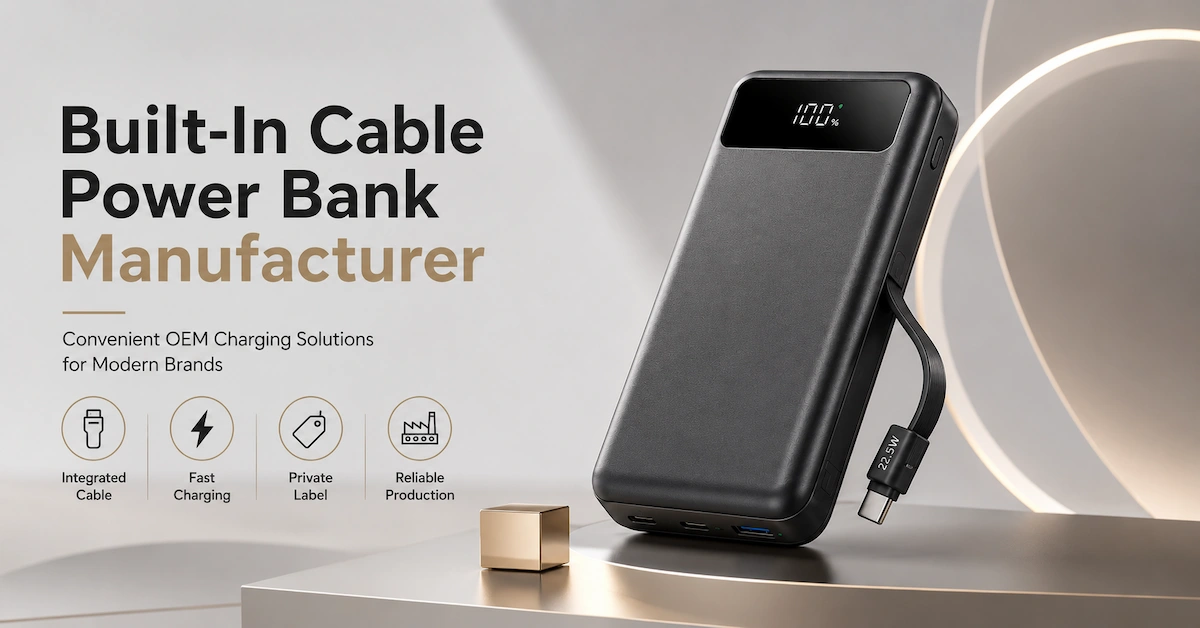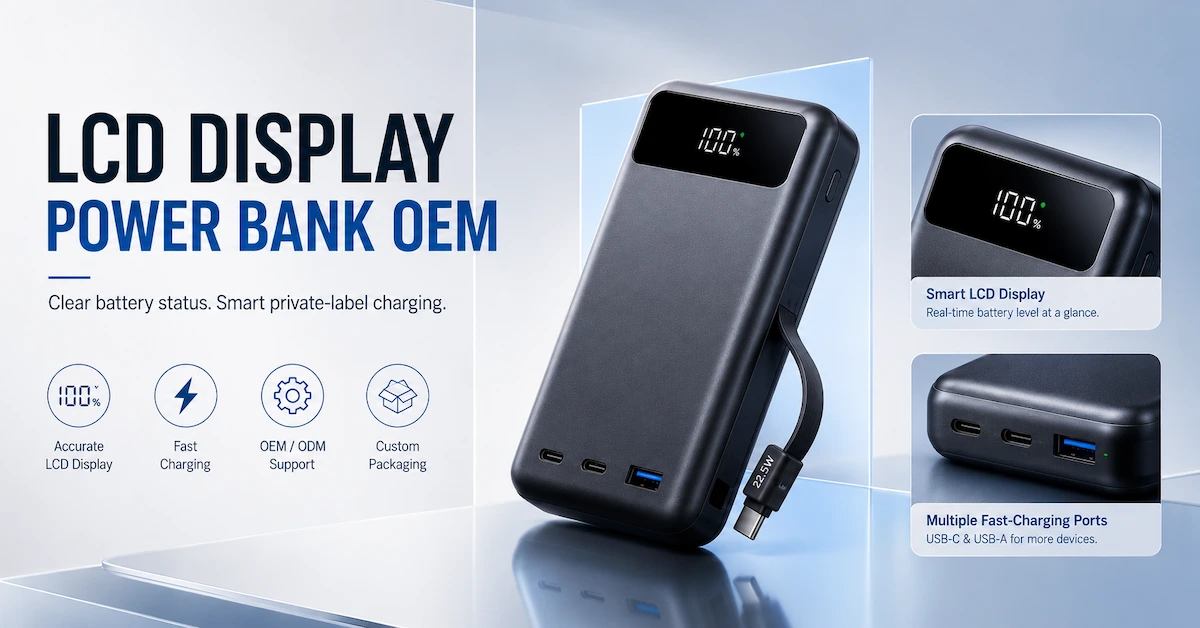

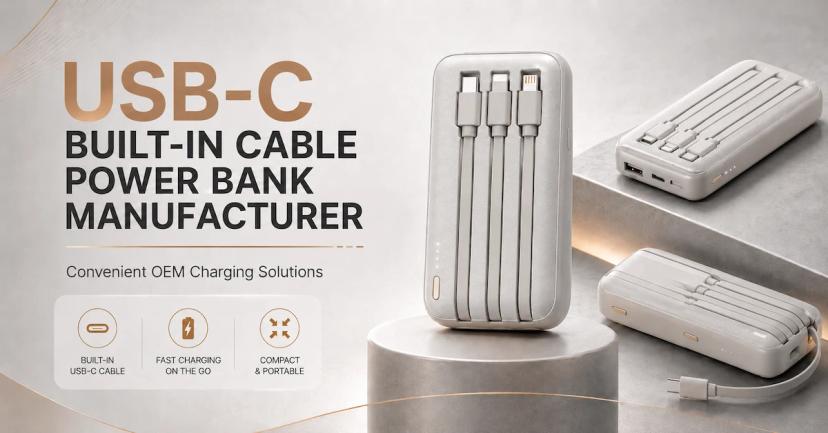
A USB C built in cable power bank manufacturer helps charging brands develop portable products that combine battery backup and a permanently available USB-C cable in one compact structure.
The product is designed for users who do not want to carry a separate cable. The integrated connector may be stored inside a molded groove, attached to the side of the housing, or designed as a flexible carrying loop. Depending on the PCBA and cable specification, the USB-C cable may support output charging, power-bank input, or both.
This format is especially relevant for Android phones, USB-C tablets, earbuds, handheld devices, and newer mobile accessories. It can also support selected USB-C laptops when the power output and charging protocol are suitable.
For importers, distributors, e-commerce sellers, travel brands, and private-label electronics companies, the commercial advantage is clear: the convenience can be understood immediately from the product image.
Buyers can compare ESC’s current power bank product range before selecting a suitable capacity, output level, display, and integrated-cable structure.
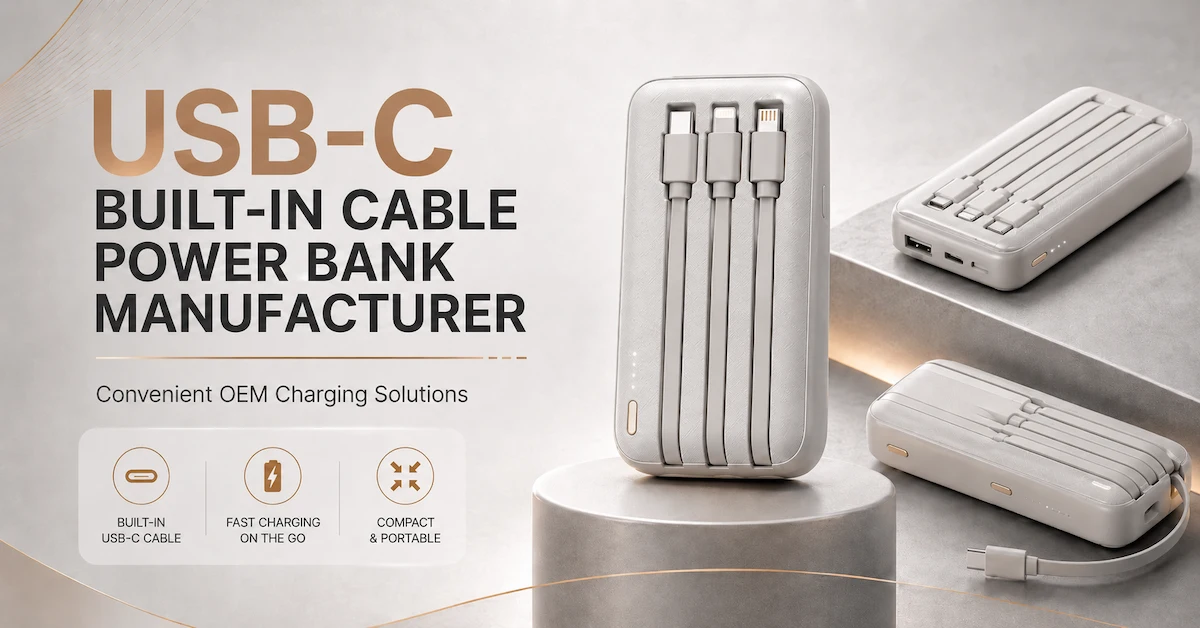
What Is a USB-C Built-In Cable Power Bank?
A USB-C built-in cable power bank is a portable battery with a fixed Type-C charging connector integrated into its housing.
Unlike standard models, users do not need to connect a separate cable before charging a compatible device.
Common product configurations include:
| Product Element | Typical Options |
|---|---|
| Battery capacity | 5000mAh, 10000mAh, 20000mAh |
| Integrated cable | Fixed USB-C or loop-style USB-C |
| Output power | 18W, 22.5W, 27W, 45W, 65W |
| Extra ports | USB-C, USB-A |
| Display | LED indicators or LCD percentage display |
| Housing | ABS, PC or mixed-material construction |
| Surface finish | Matte, glossy, textured or soft-touch |
| Branding | Logo, color, packaging and manual |
| Main channels | Retail, travel, gifts and e-commerce |
The correct specification depends on the target customer. A compact 5000mAh product serves a different market from a 20000mAh model designed for tablets and longer trips.
Who Should Source USB-C Built-In Cable Power Banks?
This product is suitable for buyers serving customers who prioritize portability and modern connector compatibility.
Typical B2B customers include:
- Mobile accessory brands
- Importers and distributors
- Amazon and Shopify sellers
- Travel accessory companies
- Corporate gift suppliers
- Promotional product buyers
- Consumer electronics retailers
- Private-label charging brands
- Supermarket and convenience-store channels
- Tablet and Android accessory sellers
It may be less suitable for buyers whose main customers still rely heavily on older connectors. In that case, a dual built-in cable product may provide broader compatibility.
Why USB-C Built-In Cable Models Have Strong Retail Potential
The benefit is immediately understandable
Customers can see that the charging cable is already attached. This shortens the explanation required on a marketplace listing or retail box.
USB-C supports a growing device range
USB-C is used across smartphones, tablets, earbuds, gaming devices, cameras, and selected laptops. A USB-C-focused power bank can therefore fit several product categories.
Compatibility should still be verified. Sharing the same physical connector does not guarantee that every device supports the same wattage or charging protocol.
Users carry fewer accessories
The integrated cable reduces the risk of forgetting, losing, or damaging a separate cable during travel and daily commuting.
It creates a clean private-label product
A single built-in cable often produces a cleaner and more compact appearance than a product carrying several connector types.
It supports different price tiers
The same commercial concept can be developed as:
- A compact 5000mAh travel model
- A mainstream 10000mAh retail model
- A 20000mAh high-capacity model
- A 22.5W or 27W phone-charging product
- A 45W or 65W tablet and light-laptop model
Is the Built-In USB-C Cable for Input, Output or Both?
This is one of the first questions buyers should ask.
Different platforms may use the cable in different ways:
| Cable Function | Description |
|---|---|
| Output only | Charges connected USB-C devices |
| Input only | Recharges the power bank |
| Input and output | Supports both functions |
| Fast-charge output | Supports a defined PD or protocol output |
| Shared output | Power is divided when other ports are used |
Do not assume a cable supports two-way charging because it uses a USB-C connector. The supplier should confirm the electrical design and tested functions.
Packaging should also state the function clearly. Vague wording can lead to wrong customer expectations and higher return rates.
Cable Durability Is a Critical Purchasing Requirement
The cable is the main convenience feature, but it is also a common failure point.
A good-looking sample may still fail after repeated bending or pulling. Buyers should evaluate the cable as a structural component.
Recommended checks include:
| Cable Test | What Buyers Should Evaluate |
|---|---|
| Repeated bending | Cracking near the cable joint |
| Pull resistance | Separation from the housing |
| Connector fit | Stable connection without looseness |
| Strain relief | Protection around the attachment point |
| Cable flexibility | Comfortable use without excessive stiffness |
| Groove storage | Easy removal and secure storage |
| Surface durability | Peeling, splitting or discoloration |
| Charging consistency | Stable output after repeated handling |
Request a physical sample and repeatedly remove, bend, connect, and store the cable before approving mass production.
A reliable USB C built in cable power bank manufacturer should have defined cable testing procedures, not only a basic one-time charging test.
Which Charging Power Should Buyers Choose?
The best output depends on the target devices and retail positioning.
| Output Power | Suitable Applications |
|---|---|
| 18W–20W | Mainstream phone charging |
| 22.5W | Cost-balanced fast charging |
| 27W | Faster smartphones and tablets |
| 45W | Tablets and selected work devices |
| 65W | Selected USB-C laptops and business users |
Higher power increases PCBA, cable, battery, thermal-management, and certification requirements. It can also increase the product’s size and cost.
For mainstream retail and e-commerce, 22.5W or 27W often provides a practical balance. For business and travel channels, 45W or 65W may create stronger differentiation.
Brands developing a wider fast-charging assortment can combine power banks with ESC’s charger plug products.
How to Select the Right Battery Capacity
5000mAh
Suitable for slim products, emergency backup, handbags, gift programs, travel kits, and lightweight retail.
10000mAh
Suitable for mainstream daily use, e-commerce, travel, corporate gifts, and private-label product lines.
20000mAh
Suitable for longer trips, tablets, multiple devices, and customers who prioritize backup time.
| Capacity | Main Advantage | Typical Buyer Channel |
|---|---|---|
| 5000mAh | Compact and lightweight | Gifts and lifestyle retail |
| 10000mAh | Balanced size and capacity | E-commerce and mainstream retail |
| 20000mAh | Longer operating time | Travel and high-capacity markets |
For most OEM programs, 10000mAh offers the broadest market fit.
PCBA Design and USB-C Protocol Compatibility
The PCBA controls the product’s charging behavior.
It manages:
- Battery charging
- Built-in cable output
- Additional USB-C or USB-A ports
- Protocol recognition
- Input and output switching
- Multi-device power allocation
- Battery protection
- Temperature protection
- Digital display accuracy
Common protocol options may include PD, PPS, QC, FCP, SCP, and AFC, depending on the selected platform.
Buyers should ask the supplier to provide a clear specification showing:
- Maximum built-in cable output
- Maximum USB-C port output
- Input charging power
- Supported protocols
- Single-device output
- Multi-device shared output
- Tested compatible device categories
The phrase “USB-C fast charging” is too broad for professional procurement. The actual wattage and protocol should be documented.
Power Distribution During Multi-Device Charging
A built-in cable power bank may also include USB-C and USB-A ports.
When several outputs are used simultaneously, the total power is normally divided among the connected devices.
Buyers should request a power-distribution table covering:
| Charging Scenario | Information Required |
|---|---|
| Built-in cable alone | Maximum wattage and protocol |
| USB-C port alone | Maximum wattage and protocol |
| USB-A port alone | Maximum output |
| Cable plus USB-C | Shared power allocation |
| Cable plus USB-A | Shared power allocation |
| All outputs in use | Total output and temperature performance |
This information is essential for accurate packaging, product listings, manuals, and customer support.
OEM and Private-Label Customization Options
A professional manufacturer should support customization that improves market fit without creating unnecessary production risk.
Common options include:
- Logo printing
- Laser engraving
- Custom housing color
- Custom cable color
- Matte or glossy finishing
- Soft-touch coating
- Digital battery display
- Capacity selection
- Output-power configuration
- Additional port selection
- Retail packaging
- Gift packaging
- Multilingual manuals
- Barcode and SKU labels
- Custom carton marks
ESC’s customized charging solution is relevant for buyers developing customized colors, branding, output levels, packaging, and product structures.
The final pre-production sample should include the actual housing, cable, logo, display, packaging, manual, and accessories.
USB-C Single-Cable vs Dual-Cable Power Banks
| Factor | USB-C Single-Cable Model | Dual-Cable Model |
|---|---|---|
| Target ecosystem | Primarily USB-C devices | USB-C and Lightning devices |
| Product appearance | Cleaner and simpler | More feature-focused |
| Structural complexity | Lower | Higher |
| Cable testing | One cable system | Two cable systems |
| Product size | Often more compact | May be slightly larger |
| Manufacturing cost | Usually lower | Usually higher |
| Best market | Modern USB-C users | Mixed-device markets |
A USB-C-only product is suitable for brands targeting newer device ecosystems and a simplified product experience.
Quality Control Before Mass Production
A complete inspection plan should include the built-in cable, battery, PCBA, housing, and packaging.
Recommended steps include:
- Incoming battery-cell inspection
- Battery-capacity testing
- PCBA function testing
- Built-in USB-C cable output test
- Input-charging test
- Connector insertion test
- Cable bending test
- Cable pull-resistance test
- Additional-port output test
- Multi-device charging test
- Temperature-rise test
- Aging test
- Display-accuracy test
- Housing and appearance inspection
- Packaging verification
- Final shipment inspection
Buyers can review ESC’s company and production information on the About Us page before beginning supplier evaluation.
Certifications and Export Documentation
Power banks contain lithium batteries, so buyers should confirm documentation before production and shipment.
Depending on the destination market and transport method, documents may include:
- CE
- RoHS
- FCC
- MSDS
- UN38.3
- IEC62133
- Battery transport reports
- Product specification sheets
Confirm that documents match the exact battery, PCBA, model, capacity, and product configuration being purchased.
Common Procurement Risks
The cable supports less power than advertised
The maximum product output may come from another port rather than the built-in cable.
The cable is output-only
Some buyers expect the built-in cable to recharge the power bank. This must be verified.
Connector damage after repeated use
Weak strain relief or cable materials can cause early failure.
Excessive heat during multi-device charging
Shared output increases load on the PCBA and battery.
Poor cable storage
A cable that is difficult to remove or replace in its groove creates a poor user experience.
Inaccurate battery capacity
Convenient design cannot compensate for low-grade cells or weak usable output.
Inconsistent repeat orders
Changes to cable components, cells, PCBA parts, or housing materials may affect later batches.
MOQ, Samples, Pricing and Lead Time
Before requesting a quotation, prepare:
- Required capacity
- Cable input/output requirements
- Maximum charging power
- Additional ports
- Housing color
- Cable color
- Logo method
- Display requirement
- Packaging format
- Target market
- Certification requirements
- Order quantity
- Delivery deadline
The quotation should separate standard product pricing from costs for custom colors, branding, packaging, certification, tooling, firmware, or special cable components.
Approve a branded pre-production sample before mass production begins.
SKD Options for Local Assembly
Some buyers may prefer semi-finished products for local assembly.
An SKD configuration may include:
- Housing
- PCBA
- Built-in USB-C cable module
- Battery components
- Display module
- Packaging
- Assembly guidance
ESC’s SKD Powerbank Solution can support eligible local assembly and semi-finished product projects.
Why Work with ESC for USB-C Built-In Cable Power Banks?
ESC supports fast-charging power banks, built-in cable models, wireless charging products, charger plug products, custom solutions, and SKD projects.
For USB-C built-in cable products, ESC can support:
- Product-platform selection
- Capacity configuration
- Cable-function selection
- Fast-charging configuration
- Power-distribution planning
- Logo and color customization
- Packaging development
- Sample approval
- Quality inspection
- Bulk production
- SKD housing and PCBA solutions
A capable supplier should help the buyer create a product that is convenient, technically clear, and repeatable in production.
FAQ
What is a USB-C built-in cable power bank?
It is a portable charger with an integrated USB-C cable, allowing compatible devices to charge without a separate cable.
Can the built-in USB-C cable recharge the power bank?
Some models support input and output, while others support output only. Confirm the exact configuration with the supplier.
Does the built-in cable support USB-C PD charging?
It may support PD or other protocols depending on the cable and PCBA. Buyers should confirm the tested output and protocol.
Can it charge a laptop?
Selected 45W or 65W models may charge compatible USB-C laptops. The laptop’s charging requirement must be checked.
What capacity is most suitable?
10000mAh is a practical mainstream choice. A 5000mAh model is more portable, while 20000mAh provides longer backup.
Can the cable and housing colors be customized?
Yes, many OEM projects support custom housing color, cable color, logo, surface finish, and packaging.
What should buyers test in a sample?
Test cable bending, pulling, connector fit, input and output, fast charging, temperature, capacity, multi-device charging, and cable storage.
Which certifications may be required?
Common requirements include CE, RoHS, FCC, MSDS, UN38.3, and IEC62133, depending on the market.
Is a USB-C-only model better than a dual-cable model?
It is better for USB-C-focused markets and simpler product positioning. A dual-cable model provides broader connector compatibility.
Can ESC support SKD projects?
ESC can support eligible SKD housing, PCBA, cable-module, and local-assembly projects.
Conclusion
Choosing the right USB C built in cable power bank manufacturer helps brands develop convenient portable chargers for modern USB-C device users.
The supplier should understand cable durability, input/output functions, protocol compatibility, power distribution, battery safety, packaging, certifications, quality control, and repeat-order consistency.
ESC can support USB-C built-in cable power bank projects through product selection, OEM/ODM customization, packaging development, testing, mass production, and SKD solutions.
Contact ESC to discuss your USB-C built-in cable power bank requirements, request samples, and receive a customized OEM quotation.