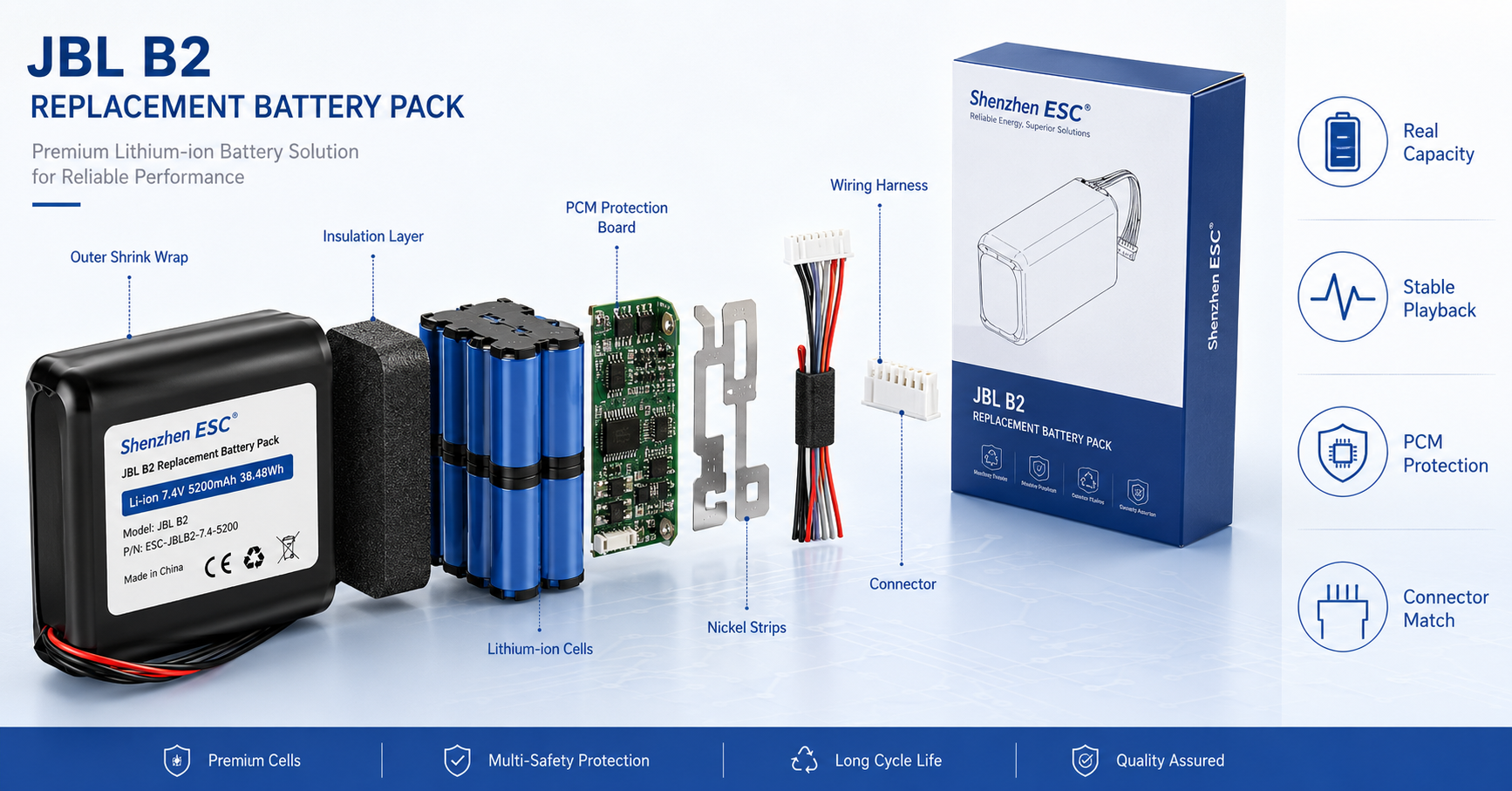

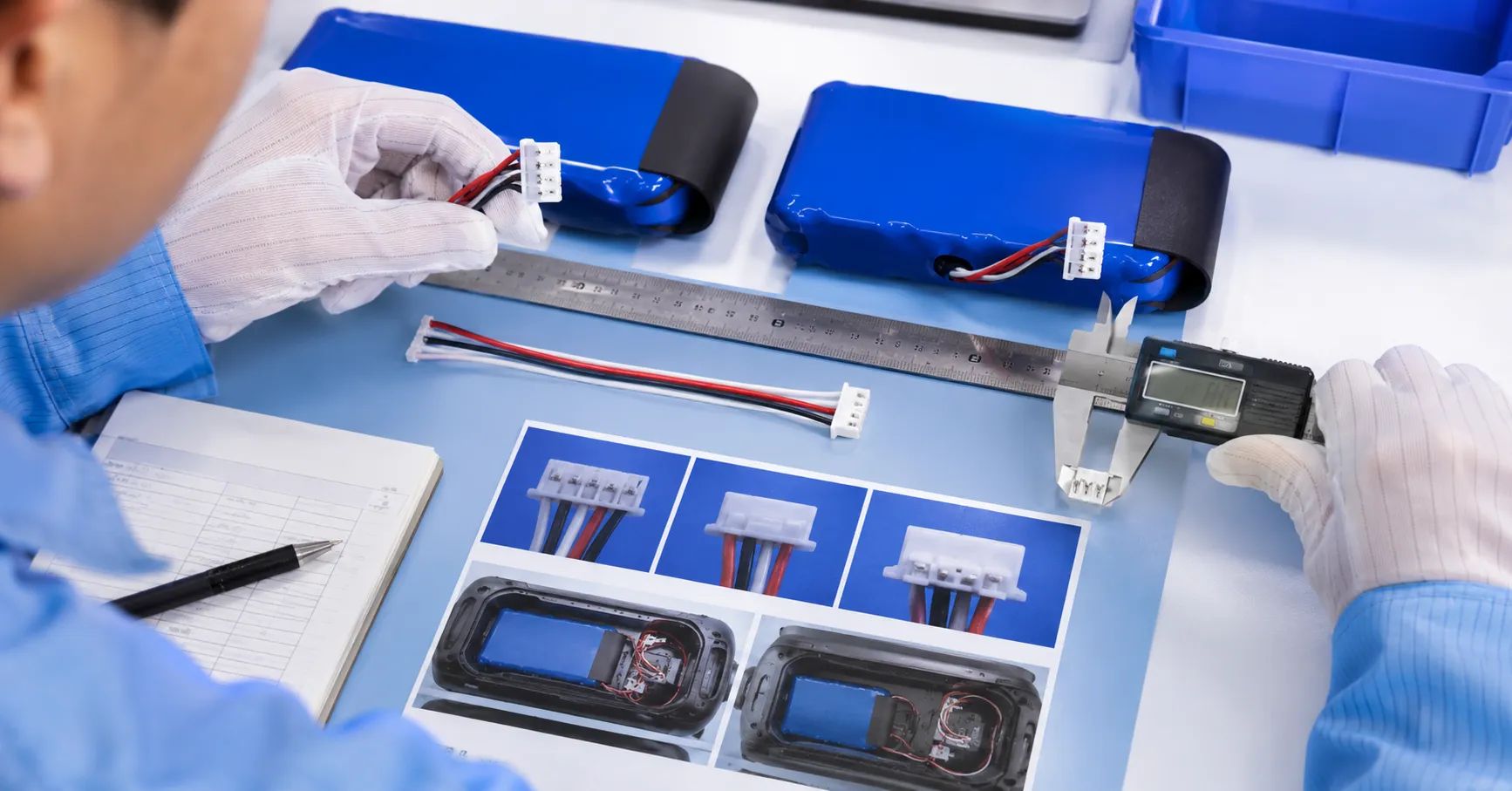
JBL replacement battery incoming inspection should determine whether a received lot matches the approved battery identity, physical structure, connector configuration, electrical specification and functional sample before inventory is released. Appearance alone cannot demonstrate correct compatibility or batch quality.
Repair chains, speaker refurbishers, wholesalers, distributors and private-label buyers should define the inspection plan before goods arrive. The plan should identify the lot, approved references, sampling method, test equipment, acceptance criteria, defect classes, safety controls and authority to release, hold or reject inventory.
Why Portable-Speaker Batteries Need Product-Specific Inspection
Replacement batteries for portable speakers can look similar while differing in important ways:
- Intended speaker model or hardware revision
- Battery model and supplier SKU
- Nominal voltage and rated capacity
- Pack dimensions and shape
- Connector family and keying
- Pin arrangement and polarity
- Wire sequence and cable length
- Protection-circuit configuration
- Insulation and attachment method
A connector that appears to fit may still use a different pin arrangement. A battery with the correct electrical rating may have a cable that is too short, too long or routed in the wrong direction. These differences can lead to installation delays, damaged connectors, charging problems or products being returned under the wrong diagnosis.
ESC’s JBL replacement battery compatibility guide explains how buyers can approve the relationship between speaker identity, battery reference, voltage, dimensions, connector and cable configuration before ordering.
Establish the Inspection References
The inspector should have controlled references rather than relying on marketplace descriptions or informal messages.
The inspection package may include:
- Purchase order and ordered quantity
- Buyer and supplier SKUs
- Approved battery specification
- Approved drawing or dimensional record
- Approved battery and packaging labels
- Connector and cable photographs
- Approved sample or controlled limit sample
- Intended speaker models and revisions
- Electrical and functional test methods
- Defect classification and release procedure
Where the exact speaker identity must be confirmed, JBL’s official product serial-number guidance shows that identification may be found on the original box, product label or compatible application, depending on the product.
A serial number does not by itself identify the internal replacement battery, but it can support the device-identification record used during sample approval.
Define the Received Lot Before Sampling
Record which physical units belong to the inspection lot. Useful identifiers include:
- Supplier
- Purchase order
- Battery model
- Production or shipment batch
- Label and packaging revision
- Received date
- Carton numbers
- Quantity received
Do not combine visibly different labels, battery structures or packaging versions into one result without investigation. An unexplained mixture may indicate a product change or packing error.
ISO 2859-1:2026 defines acceptance-sampling schemes indexed by acceptance quality limit for lot-by-lot inspection. The standard does not automatically select the appropriate inspection level, sample size, AQL or acceptance number for a particular speaker-battery order.
The buyer’s quality team should select and document the plan according to order size, supplier history, defect risk, contractual requirements and the consequences of accepting a defect. Potentially unsafe physical conditions may require controls beyond ordinary sampling.
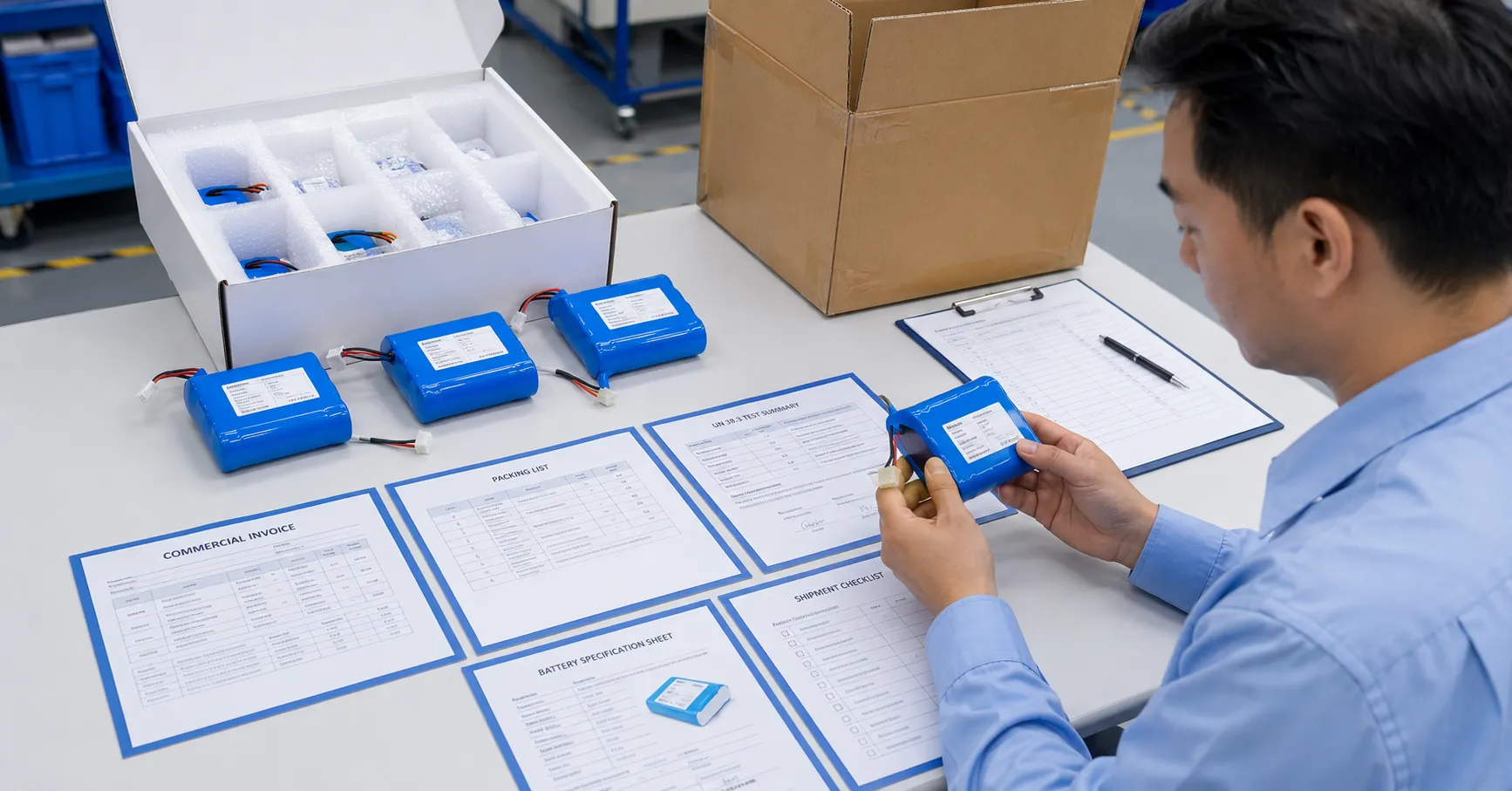
Verify Quantity, Identity, Labels, and Packaging
Begin with the checks that establish whether the received products match the purchase order.
- Compare packing-list and physical quantities.
- Confirm the buyer SKU, supplier SKU and battery model.
- Check the intended speaker references against the approved matrix.
- Verify label and packaging revisions.
- Scan barcodes where used and confirm the encoded data.
- Check batch and traceability identifiers.
- Inspect individual packaging and carton condition.
- Look for mixed products or unidentified units.
Aftermarket replacement batteries should not be labeled or promoted as JBL original or JBL-authorized components unless that status is documented. Product descriptions should clearly communicate compatible replacement use.
Buyers building a broader range can review ESC’s JBL battery supplier guide for model coverage, packaging and sample-planning considerations.
Perform a Controlled Visual Inspection
Inspect under suitable lighting and use consistent defect descriptions. Visual checks may include:
- Swelling or loss of flatness
- Leakage, abnormal odor or contamination
- Punctures, dents, cuts or edge damage
- Loose, damaged or incomplete insulation
- Exposed conductive material
- Damaged connector housing or contacts
- Loose, pinched or poorly attached wires
- Incorrect label, barcode or model reference
- Poor connector protection inside the package
Do not continue routine testing on a battery that shows a potentially unsafe physical condition. Separate it from releasable stock and follow the organization’s approved battery isolation and escalation procedure.
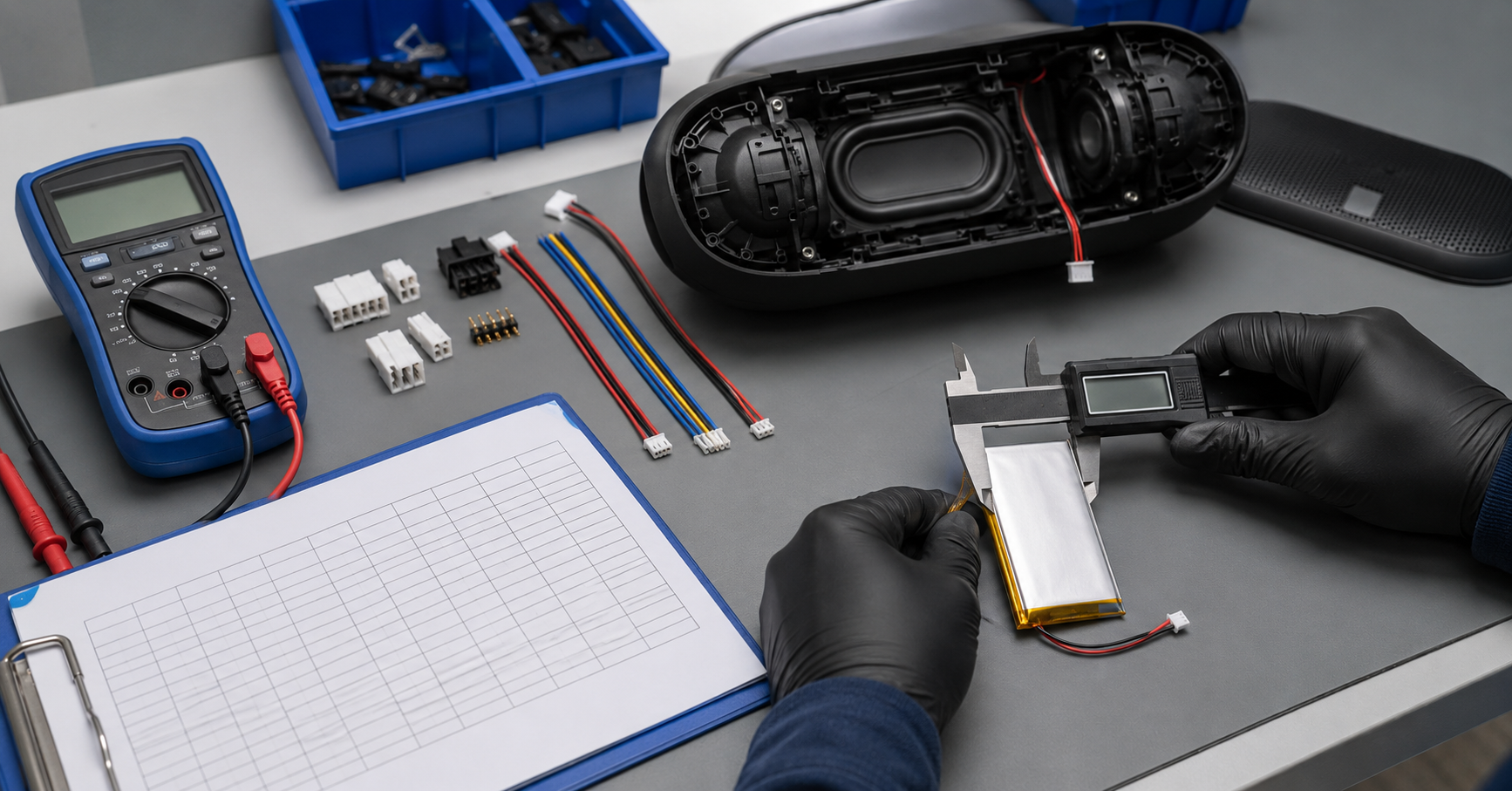
Measure the Pack and Cable Configuration
Compare the received battery with the approved drawing, specification or sample. Measurements may include:
- Overall length, width and thickness
- Pack shape and critical edge positions
- Wire exit location
- Connector position
- Overall cable length
- Individual wire length where relevant
- Insulation and reinforcement positions
- Mounting foam, tape or adhesive placement
The specification should define the measurement locations, equipment and tolerances. Do not invent one dimensional tolerance for every speaker battery.
A battery may fit into an open enclosure but create pressure when the speaker is fully assembled. Dimensional inspection should therefore be connected to controlled installation testing.
Inspect the Connector, Wiring, and Cable Length
The connector deserves its own inspection stage because visual similarity can hide functional differences.
Check:
- Connector family and housing shape
- Number of positions and populated contacts
- Keying and orientation
- Contact condition and retention
- Wire colors and approved sequence
- Polarity according to the controlled specification
- Cable length and exit direction
- Strain relief and attachment quality
- Insulation coverage
Do not connect a battery to a speaker or test fixture until polarity and configuration have been verified through an approved method. Wire color alone should not be treated as proof.
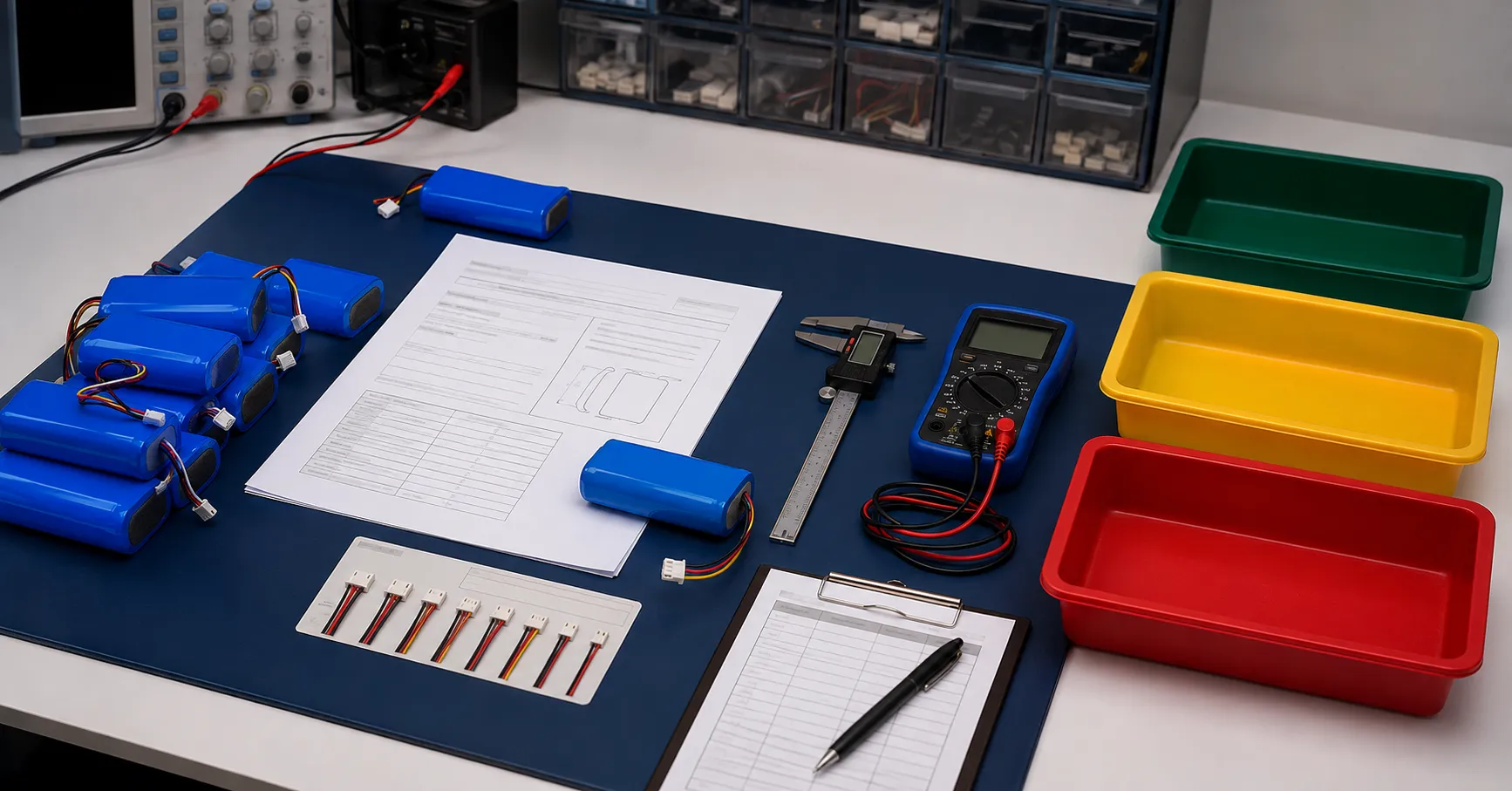
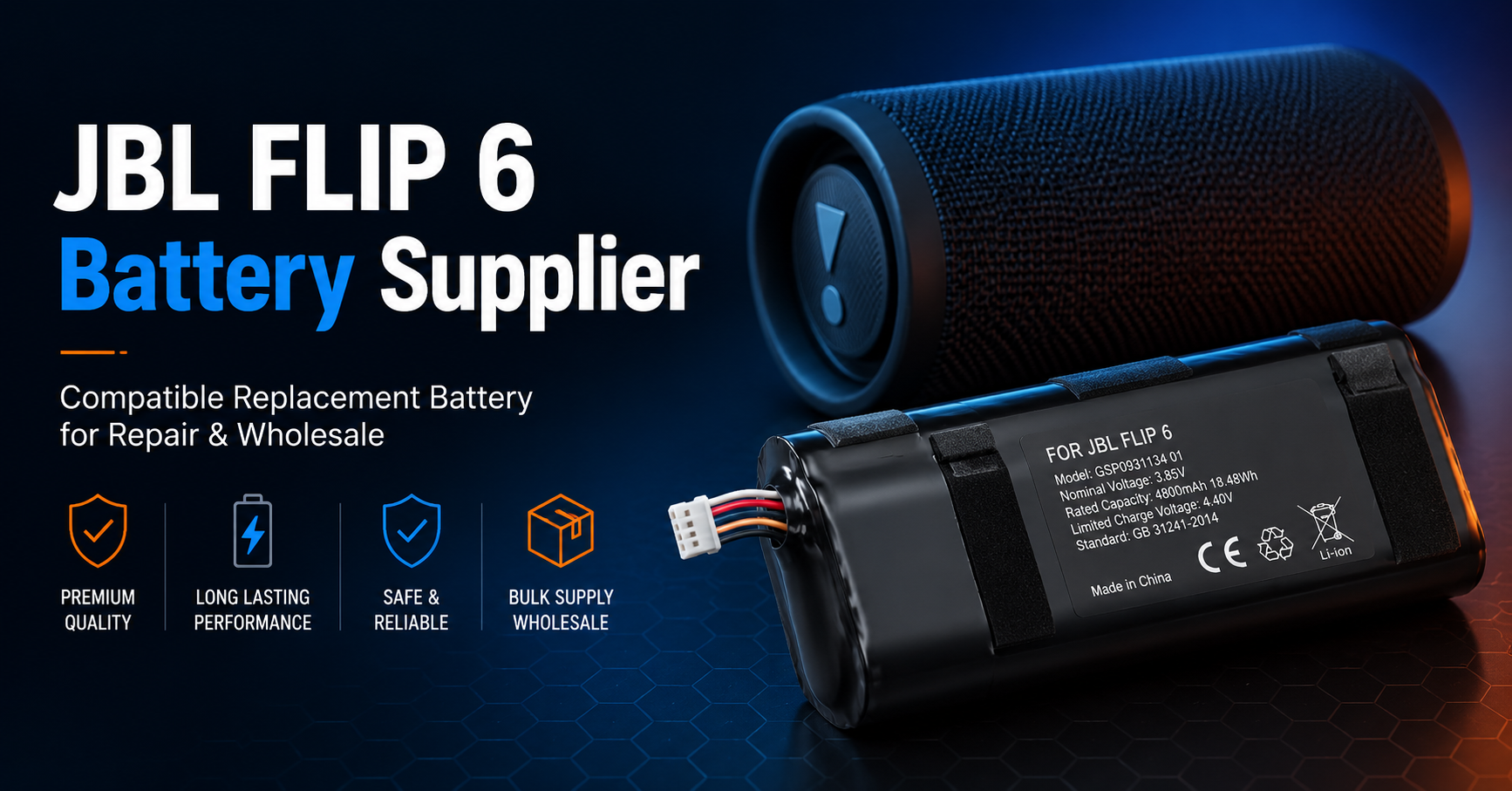
For a model-specific procurement example, ESC’s JBL Flip 6 battery sourcing guide discusses the importance of correct connector structure, cable configuration and installation fit.
Check Electrical Identity with Approved Limits
Electrical inspection should follow the model-specific specification and documented method. Depending on the approved control plan, checks may include:
- Open-circuit voltage
- Polarity
- Internal resistance
- Pack identification or communication behavior where applicable
- Insulation or continuity checks appropriate to the design
- Protection-related checks performed by authorized personnel
Record the equipment, equipment status, test conditions and result. Universal voltage or resistance limits should not be copied from another battery model.
IEC’s official page for IEC 62133-2:2017 describes requirements and tests for portable sealed secondary lithium cells and batteries under intended use and reasonably foreseeable misuse. The presence of this standard does not prove that a particular battery model has been tested or certified; model-level evidence must be reviewed separately.
Separate Label Capacity from Measured Capacity
A label check confirms what is printed. It does not confirm delivered capacity.
Capacity testing requires:
- An approved charge procedure
- A defined discharge current or load
- Approved voltage limits
- Controlled temperature or recorded environment
- Suitable test equipment
- Sample identification
- A documented calculation and result
Do not compare capacity results obtained under different methods as though they were directly equivalent. If capacity testing is part of incoming inspection, connect each result to its sample and lot.
Use Controlled Speaker Installation Samples
Mechanical and electrical checks cannot reveal every compatibility problem. Select verified speaker devices for installation testing using an approved repair process and qualified technicians.
- Confirm the exact speaker model and condition.
- Record the battery model, lot and sample number.
- Inspect the original installation area and connector.
- Install without forcing the connector or wiring.
- Confirm that the pack sits correctly.
- Check cable routing and enclosure clearance.
- Reassemble according to the approved process.
- Perform charging, power-on and functional observations.
- Record the technician, device, method and result.
JBL’s official battery and charging guidance notes that short runtime, failure to hold charge and intermittent charging can involve the battery, charging cable, charger or charging connector. Incoming diagnosis should therefore distinguish battery findings from speaker and charging-system faults.
JBL also states that batteries inside many products are not user-serviceable. Replacement and test work should be performed only by appropriately qualified repair personnel, with warranty and service implications considered.
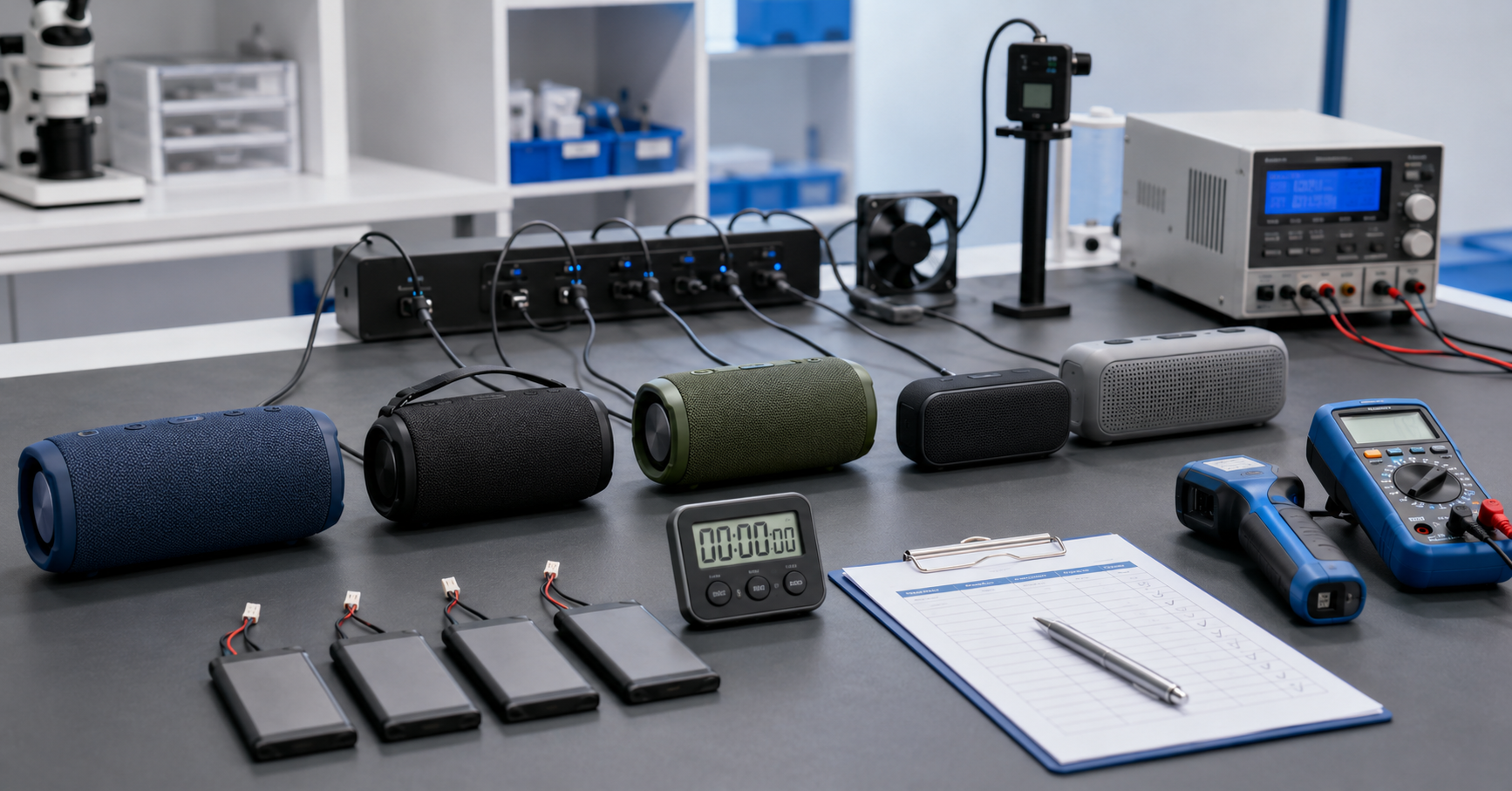
Run a Reproducible Runtime Sample Test
A speaker playing successfully for a few minutes does not establish useful runtime. A reproducible test should define:
- Speaker model and firmware context
- Battery identity and sample number
- Starting charge condition
- Audio source and connection method
- Playback material
- Volume setting
- Equalizer or lighting settings where relevant
- Ambient conditions
- Start, stop and interruption criteria
- Observed runtime and behavior
ESC’s JBL battery runtime testing guide provides a more detailed method for comparing samples and assessing bulk quality.
Runtime is affected by speaker load and settings as well as the battery. Keep it separate from controlled capacity measurements and do not convert one playback result into a universal capacity claim.
Classify Findings Before Releasing the Lot
| Finding area | Example question | Suggested control |
|---|---|---|
| Identity | Does the received model match the purchase order and approved mapping? | Hold mismatched or unidentified products. |
| Physical condition | Is there swelling, leakage, damage or exposed material? | Isolate and escalate under the safety procedure. |
| Dimensions | Are pack and cable measurements within approved limits? | Record results and evaluate the affected lot. |
| Connector | Do housing, pin arrangement, polarity and wiring match? | Stop installation until configuration is verified. |
| Electrical result | Was the approved method used, and did the sample meet its limits? | Confirm the method and hold the lot if required. |
| Installation | Does the battery fit and function in verified speakers? | Investigate product, device and installation causes. |
| Runtime | Does controlled testing meet the approved criterion? | Review samples, method and batch consistency. |
A useful JBL battery QC checklist should identify the defect category, evidence, affected sample, lot, decision owner and disposition. Avoid vague results such as “quality good” or “battery failed.”
Control Nonconforming and Pending Inventory
Products awaiting review should be physically and digitally separated from released stock. Record:
- Battery model and lot
- Quantity affected
- Location
- Reason for hold
- Photographs and measurement evidence
- Related nonconformance report
- Required investigation
- Decision owner
- Final disposition
Sorting, rework, relabeling, replacement or concession should follow documented authorization. Do not silently return mixed or corrected units to the original lot without preserving traceability.
Create a Traceable Lot-Release Record
The final record should show:
- Purchase order and received quantity
- Battery model, supplier and lot
- Specification and label revisions
- Sampling plan and actual sample quantity
- Visual and dimensional results
- Connector and electrical results
- Installation and runtime sample results
- Defects and nonconformance references
- Released, held or rejected quantities
- Decision, approver and date
Inspection records should support future complaints and repeat orders. If a similar issue appears later, the buyer should be able to connect the returned battery to its original lot and release evidence.
For buyers evaluating overall source capability, the JBL battery supplier guide covers supplier selection, model planning, samples, packaging and after-sales considerations. A product-level reference is also available through ESC’s JBL Charge 5 replacement battery page.
FAQ
Can a connector that physically fits still be incorrect?
Yes. The pin arrangement, polarity, contact position, wire sequence or cable routing may differ. Verify against the approved specification before connection.
Should every battery in a received lot be runtime-tested?
Not automatically. Define the sampling and test plan according to lot size, risk, supplier history, test duration and contractual requirements. Some safety or identity checks may require broader controls.
Does a correct voltage prove that the battery is compatible?
No. Compatibility also depends on physical fit, connector configuration, polarity, wiring, protection design and functional behavior in the intended speaker.
Can the printed capacity be accepted as a measured result?
No. Printed capacity is label information. Measured capacity requires an approved charge-discharge method and controlled evidence.
What should happen when one sample has a damaged connector?
Record and classify the defect, protect the sample, determine the applicable sampling decision and investigate whether similar damage affects the rest of the lot.
Can untrained customers install internal speaker batteries?
JBL states that batteries inside many products are not user-serviceable. Installation should be handled by appropriately qualified repair personnel, with service instructions and warranty implications considered.
Release Evidence, Not Assumptions
A controlled JBL replacement battery incoming inspection verifies product identity first, then workmanship, dimensions, connector configuration, electrical samples, installation behavior and runtime evidence. The release decision should remain connected to the exact lot and approved specification.
Send ESC the speaker models, original battery references, photographs, required quantities, packaging requirements and planned inspection scope. Use the ESC contact page to discuss model matching, samples and a project-specific quality plan before bulk purchasing.
External Source References
- International Organization for Standardization — ISO 2859-1:2026: Sampling Procedures for Inspection by Attributes — 2026
- JBL Support — Where Do I Find the Serial Number of My Product?
- International Electrotechnical Commission — IEC 62133-2:2017: Safety Requirements for Portable Secondary Lithium Cells and Batteries — 2017
- JBL Support — Battery and Charging Issues