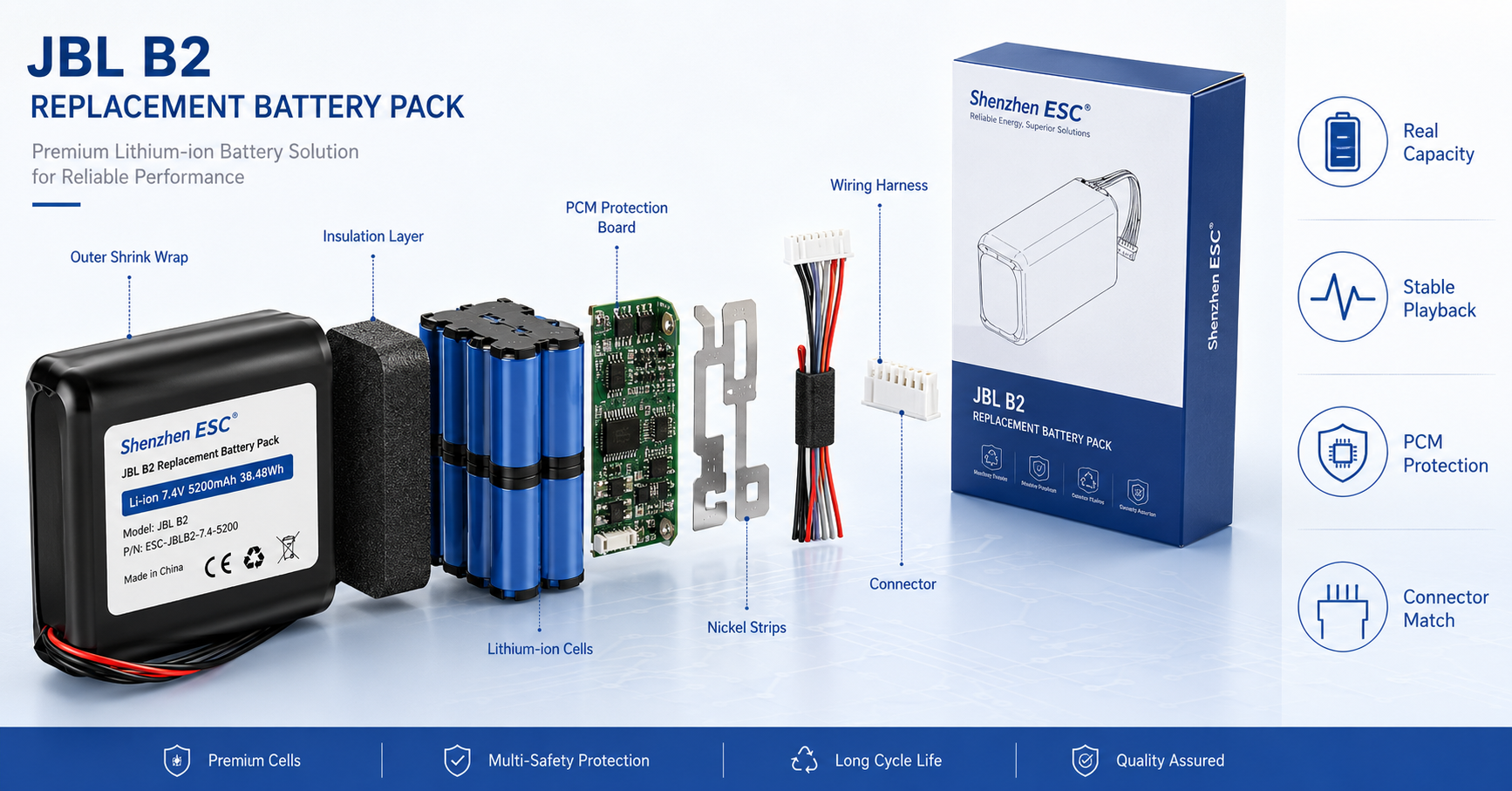

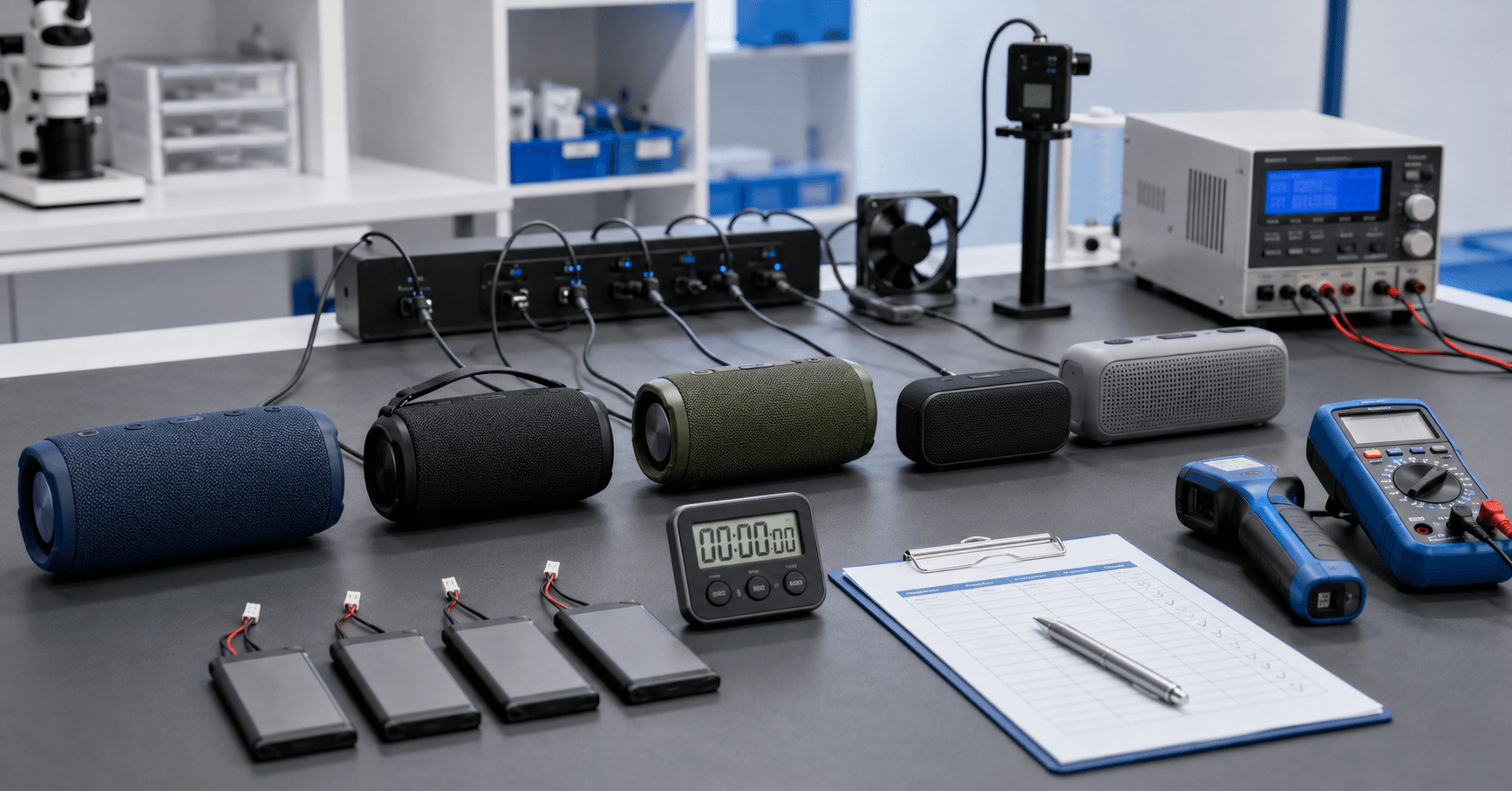
A JBL battery runtime test is meaningful only when the speaker, battery sample, charging process, volume, audio content, environment, and endpoint are controlled. If any of these conditions change, two playback-time results may not be comparable.
For repair chains, speaker refurbishment facilities, parts wholesalers, e-commerce sellers, and private-label battery brands, the objective is not to produce one impressive runtime number. The objective is to determine whether replacement-battery samples perform consistently under a documented procedure.
A useful test should answer:
-
Does the sample meet the approved runtime requirement?
-
Are results consistent across multiple samples?
-
Does the speaker charge and discharge normally?
-
Does the battery create abnormal heat, shutdown, or percentage behavior?
-
Can the same procedure be repeated for future production batches?
Why Playback Time Is Not a Battery-Only Result
A portable speaker’s operating time is affected by the complete system.
Important variables include:
-
Battery capacity and internal resistance
-
Battery age and storage history
-
Speaker model
-
Amplifier and driver load
-
Playback volume
-
Audio content
-
Equalizer or sound-enhancement settings
-
Bluetooth connection behavior
-
Lighting or additional speaker features
-
Firmware and device settings
-
Charging preparation
-
Ambient conditions
-
Speaker-board and charging-circuit condition
-
The test’s shutdown endpoint
Official JBL specification sheets make this limitation clear. For example, JBL describes the Flip 6 music play time as “up to” a stated duration and notes that the result depends on volume level and audio content. The Charge 6 specification uses the same type of condition-dependent wording.
This means a replacement-battery buyer should not compare a laboratory test at moderate volume with an official maximum-duration claim or a customer’s result at high volume.
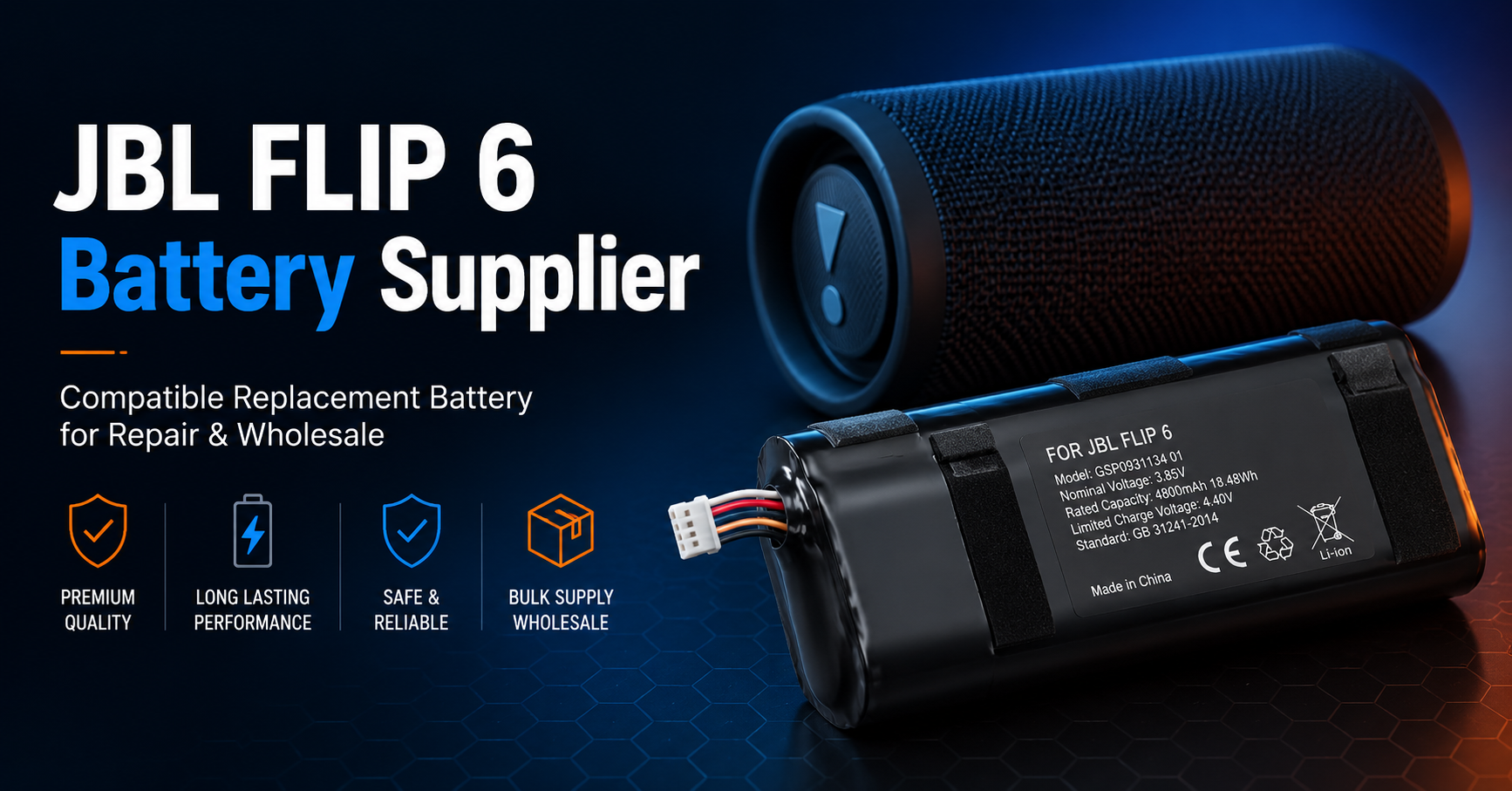
ESC’s JBL battery supplier guide provides a broader overview of model matching, connector checks, battery samples, packaging, and bulk sourcing. This article focuses specifically on runtime-test control.
Define the Test Objective Before Selecting Samples
Different business questions require different tests.
Supplier-comparison test
Use the same speaker, audio, volume, charger, environment, and endpoint to compare replacement batteries from different suppliers.
Sample-approval test
Determine whether a proposed battery model meets the buyer’s approved performance and installation requirements before mass production.
Batch-consistency test
Test multiple samples from a production batch and compare the result range rather than relying only on the average.
Complaint-investigation test
Reproduce a reported short-runtime problem and determine whether it follows the battery, the speaker, the charger, the installation, or the use conditions.
Refurbished-speaker release test
Use a shorter standardized functional test to confirm charging, playback, percentage behavior, and shutdown stability before resale.
Do not use one test procedure to answer every question. A short final inspection cannot replace a complete runtime evaluation, and a complete runtime test may be too slow for every finished unit.
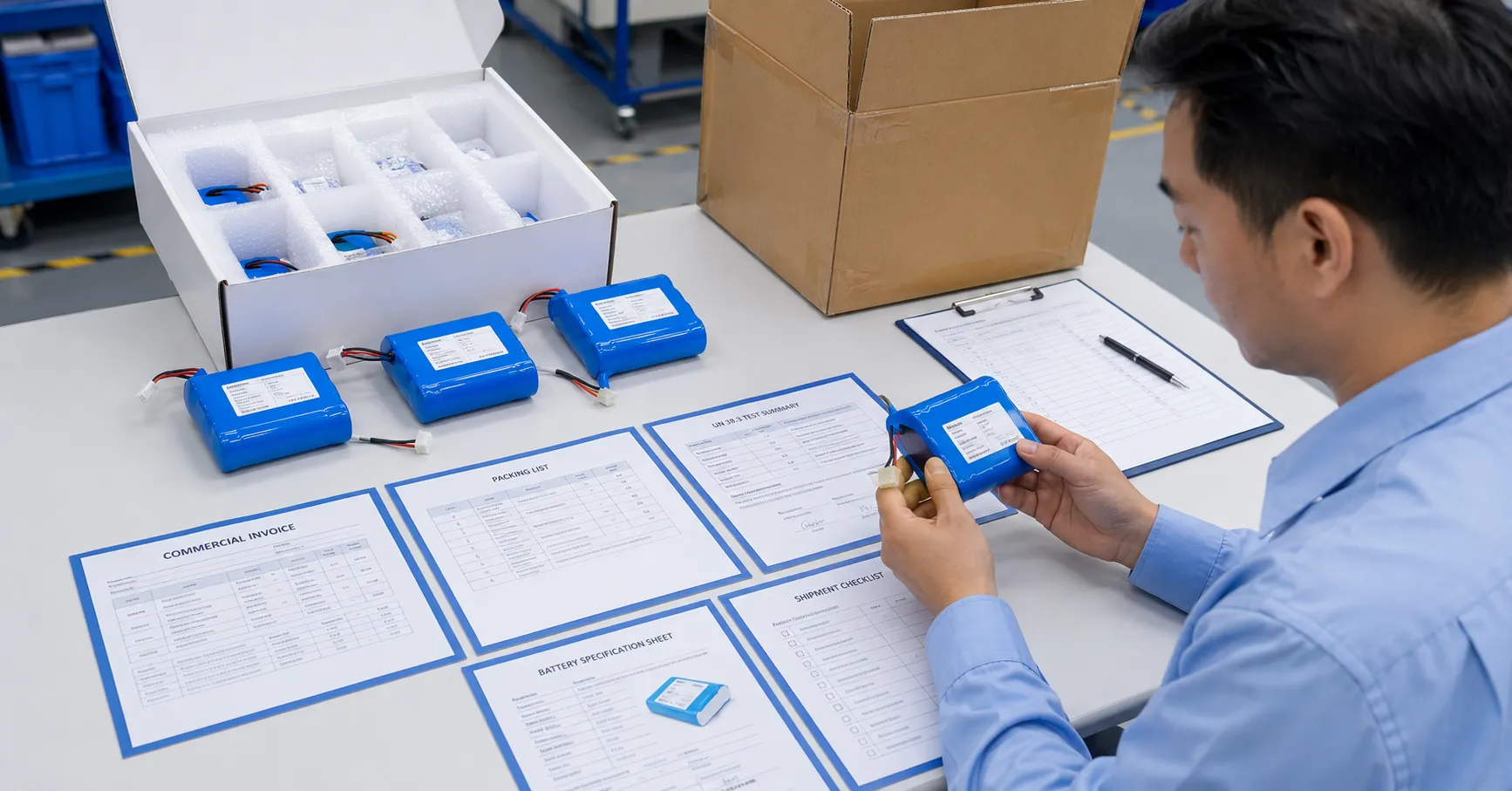
Confirm Battery and Speaker Identity
Before testing, record:
-
Speaker model
-
Speaker serial or internal asset number
-
Firmware version where relevant
-
Speaker condition
-
Battery model
-
Battery supplier
-
Battery batch
-
Rated voltage
-
Declared capacity
-
Watt-hour rating
-
Connector and cable version
-
Installation date
-
Test date
-
Operator
The test battery must be confirmed as a compatible aftermarket replacement product for the selected speaker model.
Do not describe ESC replacement batteries as JBL original or JBL-authorized batteries. JBL is a trademark of its respective owner. Aftermarket products should be positioned clearly as compatible replacement batteries for professional repair channels.
For model-level sourcing considerations, review ESC’s JBL Flip 6 battery supplier guide.
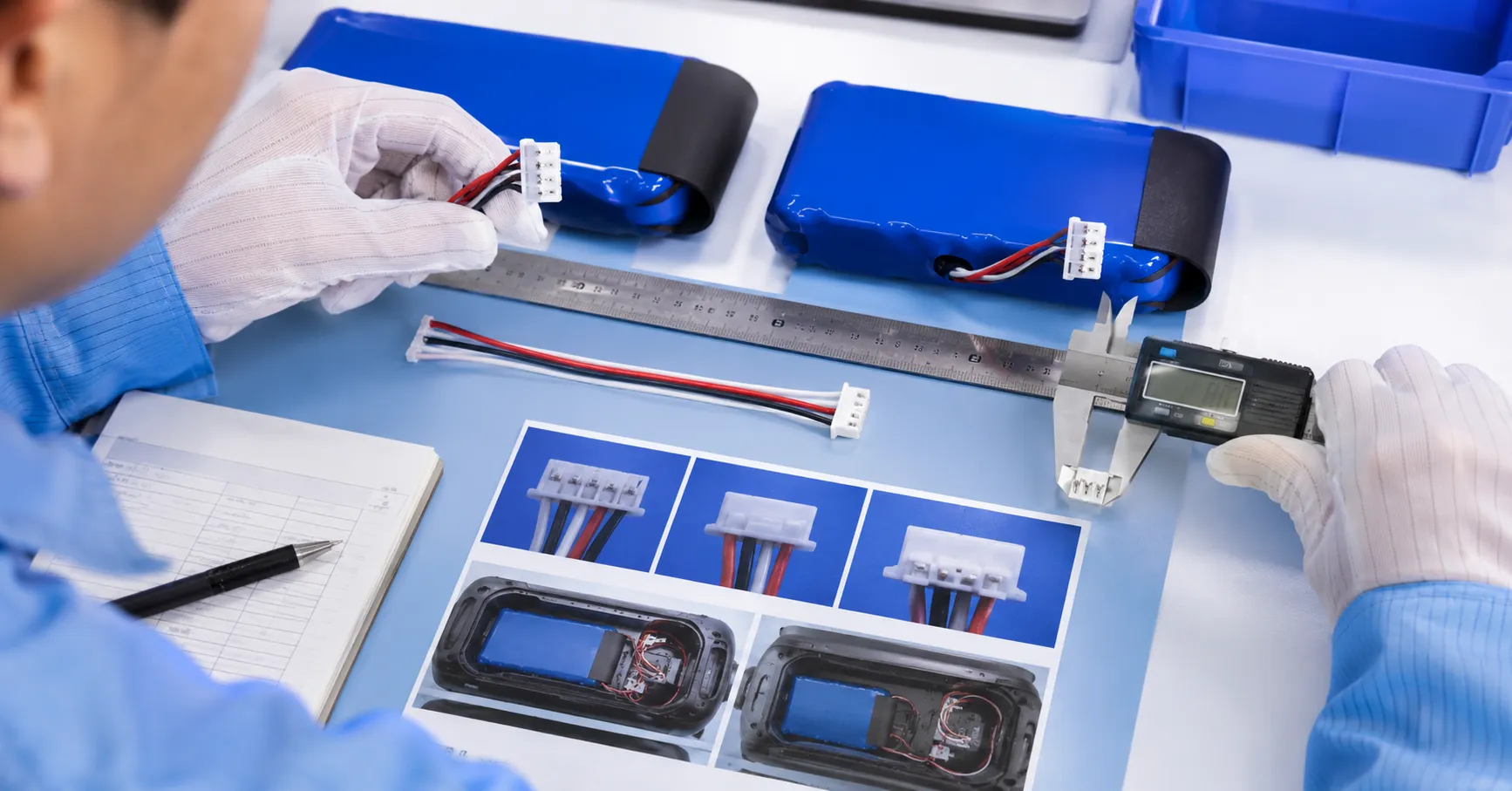
Inspect Before Installation
Stop the test if the battery shows an abnormal condition.
Inspect:
-
Surface and wrapping
-
Flatness
-
Swelling or deformation
-
Leakage or unusual odor
-
Connector
-
Pin arrangement
-
Wire length
-
Cable direction
-
Insulation
-
Protection-board area
-
Label and batch information
-
Packaging condition
A runtime test should never be used to “see what happens” with a visibly damaged or suspect lithium battery.
After installation, confirm that the battery fits without compression, forced connector engagement, unusual cable bending, or contact with sharp and conductive parts.
Standardize the Charging Preparation
Starting conditions have a direct effect on runtime.
Define:
-
Charger model and output
-
Charging cable
-
Speaker power state during charging
-
Starting battery condition
-
Full-charge indication used
-
Additional stabilization interval, if required by the approved procedure
-
Ambient test conditions
-
Whether the speaker remains connected after indicating full charge
-
How the starting state is recorded
Use the same approved charger and cable for comparable tests. A weak cable, unstable charger, damaged port, or charging-circuit fault may prevent the battery from reaching the intended starting condition.
Do not assume that a displayed 100% reading proves identical stored energy across all test samples. The full-charge preparation and subsequent discharge result should be evaluated together.
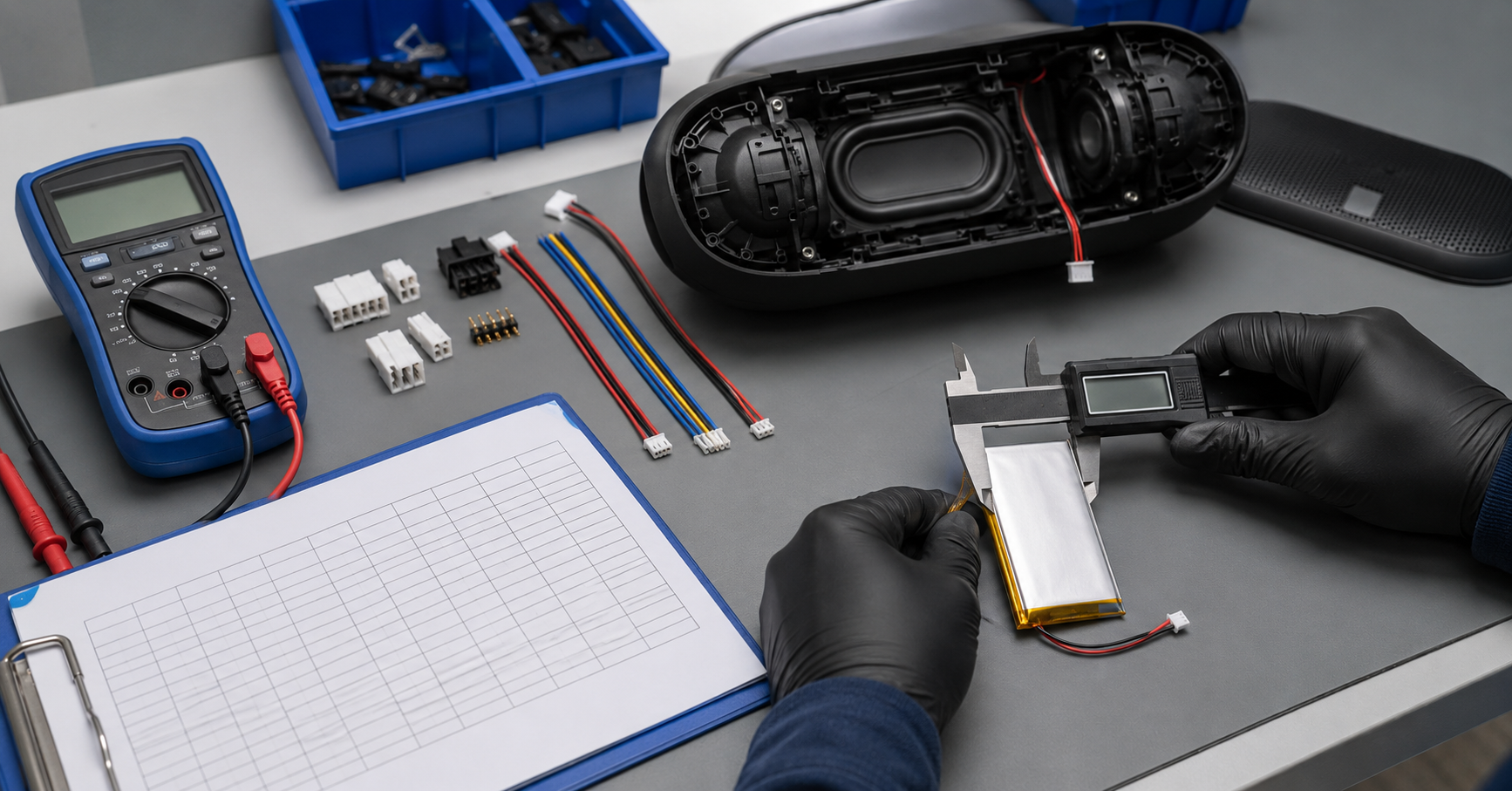
Build a Controlled Runtime Test Matrix
A written matrix prevents operators from changing conditions during the test.
| Test variable | Control method | Why it matters |
|---|---|---|
| Speaker | Same verified speaker or equivalent controlled units | Different speaker condition changes power demand |
| Battery sample | Model, supplier, batch, and sample ID recorded | Preserves traceability |
| Charge preparation | Same charger, cable, and completion rule | Controls starting condition |
| Volume | Fixed, documented setting | Amplifier demand changes with volume |
| Audio | Same track or repeatable playlist | Audio content changes power demand |
| Speaker features | Fixed lighting, EQ, boost, and connection settings | Extra functions consume energy |
| Environment | Approved and recorded conditions | Battery and electronics behavior may change |
| Endpoint | Same shutdown or defined remaining-capacity rule | Prevents inconsistent stopping decisions |
| Data interval | Same observation schedule | Makes curves and events comparable |
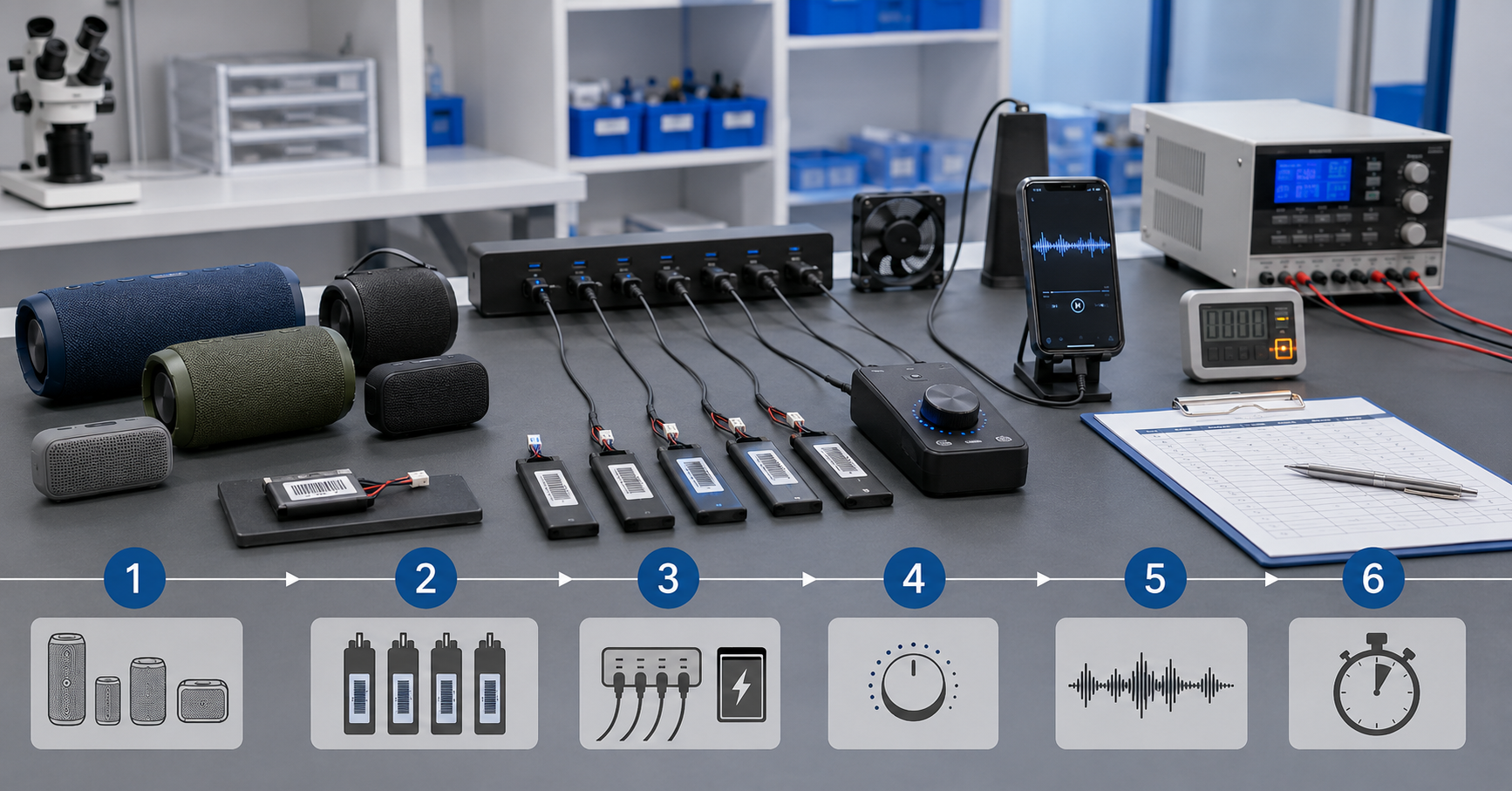
The procedure should state whether the speaker is tested as a single unit or whether multiple controlled speakers are used in parallel. If several speakers are used, they should be checked for comparable condition before battery results are compared.
Select Repeatable Audio Content
Audio content affects speaker power demand. A quiet spoken-word track and bass-heavy music do not create the same load.
Choose:
-
One fixed track
-
A fixed repeating playlist
-
A standardized test signal appropriate to the approved procedure
Record the source file, duration, playback method, and repeat setting. Do not rely on a streaming playlist that may change, insert advertisements, alter quality, or stop when the network connection fails.
The Bluetooth source device should also remain controlled. Record its model, software configuration where relevant, connection method, distance, and whether notifications or other sounds are disabled.
Fix the Volume and Feature Settings
“Medium volume” is too vague for a repeatable test.
Use a defined setting that operators can reproduce. The method might use:
-
A documented speaker volume step
-
A controlled source-device setting
-
A verified sound-output reference
-
Another internally approved method
Keep optional features consistent, including:
-
Equalizer setting
-
Bass enhancement
-
Lighting
-
Multi-speaker connection
-
Playtime-saving modes
-
USB power output
-
Voice-assistant functions
-
Automatic standby behavior
Do not compare a speaker with lights enabled against another speaker with all additional functions disabled.
Define the Endpoint Before the Test Begins
Runtime results can change depending on when the operator stops the timer.
Possible endpoints include:
-
Automatic speaker shutdown
-
A defined low-battery warning
-
A defined remaining-capacity indication
-
Failure to maintain normal playback
-
Another model-specific endpoint approved by the buyer
The endpoint must be selected before testing and applied consistently.
Record interruptions separately. A Bluetooth disconnection, audio-source failure, operator pause, incoming call, or software interruption is not automatically a battery failure.
Run the Playback Test
A controlled procedure can follow these steps:
-
Confirm speaker and battery identity.
-
Inspect the battery and speaker.
-
Install the battery using the approved method.
-
Complete the standardized charging preparation.
-
Record the starting condition.
-
Set the approved volume and speaker features.
-
Start the controlled audio content and timer.
-
Record observations at the required intervals.
-
Note warnings, percentage changes, connection interruptions, heat, or abnormal sound.
-
Stop at the predefined endpoint.
-
Record total operating time and final behavior.
-
Allow the equipment to return to the approved condition before any repeat test.
Do not leave a test unattended unless the setup includes suitable monitoring and the facility’s safety procedure permits it.
Record More Than the Final Number
A final result such as “8 hours” does not explain what happened during the test.
Record:
-
Sample ID
-
Battery batch
-
Speaker ID
-
Starting condition
-
Charging time or preparation record
-
Runtime
-
Warning events
-
Battery-indicator behavior
-
Unexpected shutdown
-
Audio interruptions
-
Surface-temperature observations under the approved method
-
Final speaker behavior
-
Recharge behavior after the test
-
Operator notes
-
Pass, fail, or hold decision
When equipment permits, a runtime curve or periodic state record can help identify sudden voltage drop, unstable indication, or early shutdown.
Do not publish temperature or electrical measurements without the equipment, position, environment, timing, and acceptance criteria.
Test Multiple Samples
One battery can pass even when the batch is inconsistent.
The sample quantity should reflect:
-
Order size
-
Product risk
-
Supplier history
-
Test duration
-
Available test equipment
-
Whether the test is for qualification or routine QC
-
The buyer’s approved sampling plan
Compare:
-
Average runtime
-
Shortest runtime
-
Longest runtime
-
Result spread
-
Abnormal events
-
Charging consistency
-
Installation consistency
The shortest result and abnormal samples may be more important to a repair business than the best-performing sample.
For a model-specific product example, ESC’s JBL Charge 5 replacement battery page illustrates the type of voltage, capacity, connector, protection, and packaging information that should be confirmed for an approved battery configuration. Final parameters must follow the validated product specification rather than a generic webpage claim.
Separate Battery Problems from Speaker Problems
Short runtime does not automatically prove that the replacement battery is defective.
Possible non-battery causes include:
-
Damaged charging port
-
Charging-circuit fault
-
Speaker-board current leakage
-
Amplifier or driver problem
-
Firmware or setting differences
-
Lighting or power-output features
-
Poor installation contact
-
Incorrect charger or cable
-
Abnormal Bluetooth behavior
-
Aged or damaged speaker components
Use substitution testing when practical:
-
Test the suspect battery in a verified compatible speaker.
-
Test a known approved battery in the suspect speaker.
-
Keep all other conditions unchanged.
-
Compare the failure pattern.
If the short runtime follows the battery, investigate the battery. If it remains with the speaker, investigate the device. If the result disappears, review the original test conditions and installation.
Convert Sample Results into Batch Controls
After sample approval, define routine controls for mass production and incoming inspection.
These may include:
-
Battery identity and label inspection
-
Open-circuit voltage under an approved method
-
Internal-resistance testing where applicable
-
Capacity testing
-
Charge-discharge checks
-
Connector and cable inspection
-
Protection-function testing
-
Installation sampling
-
Short functional playback test
-
Periodic complete runtime verification
-
Batch and complaint traceability
A full runtime test may be performed on a smaller planned sample because it is time-consuming. Faster checks can be applied more widely, but they should be linked to the same approved battery specification.
When results deteriorate, the buyer may increase inspection, hold the batch, request additional testing, or require supplier corrective action.
Use Runtime Claims Carefully
Official speaker runtime is normally conditional. JBL’s own specification sheets state that playtime depends on volume level and audio content.
Replacement-battery sellers should therefore avoid claims such as:
-
Guaranteed original runtime
-
Exactly the same playback time as a new speaker
-
Fixed hours under all conditions
-
Better runtime without supporting test evidence
A more defensible claim identifies:
-
Battery model
-
Speaker model
-
Test conditions
-
Sample quantity
-
Runtime range
-
Test date
-
Limitations
Do not use the original speaker manufacturer’s performance claim as if it were a verified result for an aftermarket replacement battery.
FAQ
What volume should be used for a JBL battery runtime test?
Use a fixed, documented setting that can be reproduced. There is no single universal volume suitable for every speaker model and test objective.
Can runtime be calculated from mAh alone?
No. Capacity is important, but speaker power demand, voltage, internal resistance, amplifier load, features, volume, and audio content also affect runtime.
How many replacement batteries should be tested?
Use the buyer’s approved sampling plan based on order size, supplier history, risk, and test purpose. One sample is not enough to demonstrate batch consistency.
Should the test stop at the low-battery warning or automatic shutdown?
Choose one predefined endpoint appropriate to the test objective and apply it consistently. Results using different endpoints should not be compared directly.
Why does the same battery run for different times in two speakers?
The speakers may differ in charging condition, board consumption, amplifier behavior, firmware, settings, component age, or other internal faults.
Can ESC replacement batteries be marketed as original JBL batteries?
No. ESC supplies compatible aftermarket replacement batteries. They should not be described as JBL original or JBL-authorized parts.
Build a Repeatable Test, Not a Marketing Number
A reliable JBL battery runtime test controls the speaker, battery identity, charge preparation, volume, audio, features, environment, endpoint, and reporting method.
The most useful result is not the longest runtime achieved by one sample. It is a repeatable result range that helps buyers compare suppliers, approve samples, monitor batches, and investigate complaints.
Send ESC your target speaker models, original battery references, expected order quantity, connector photographs, runtime requirements, and test conditions. ESC can help review compatible battery options, sample validation, packaging, and bulk-order quality-control planning.
External Source References
-
JBL by Harman — JBL Flip 6 Official Specification Sheet — Official product specification
-
JBL by Harman — JBL Charge 6 Official Specification Sheet — Official product specification