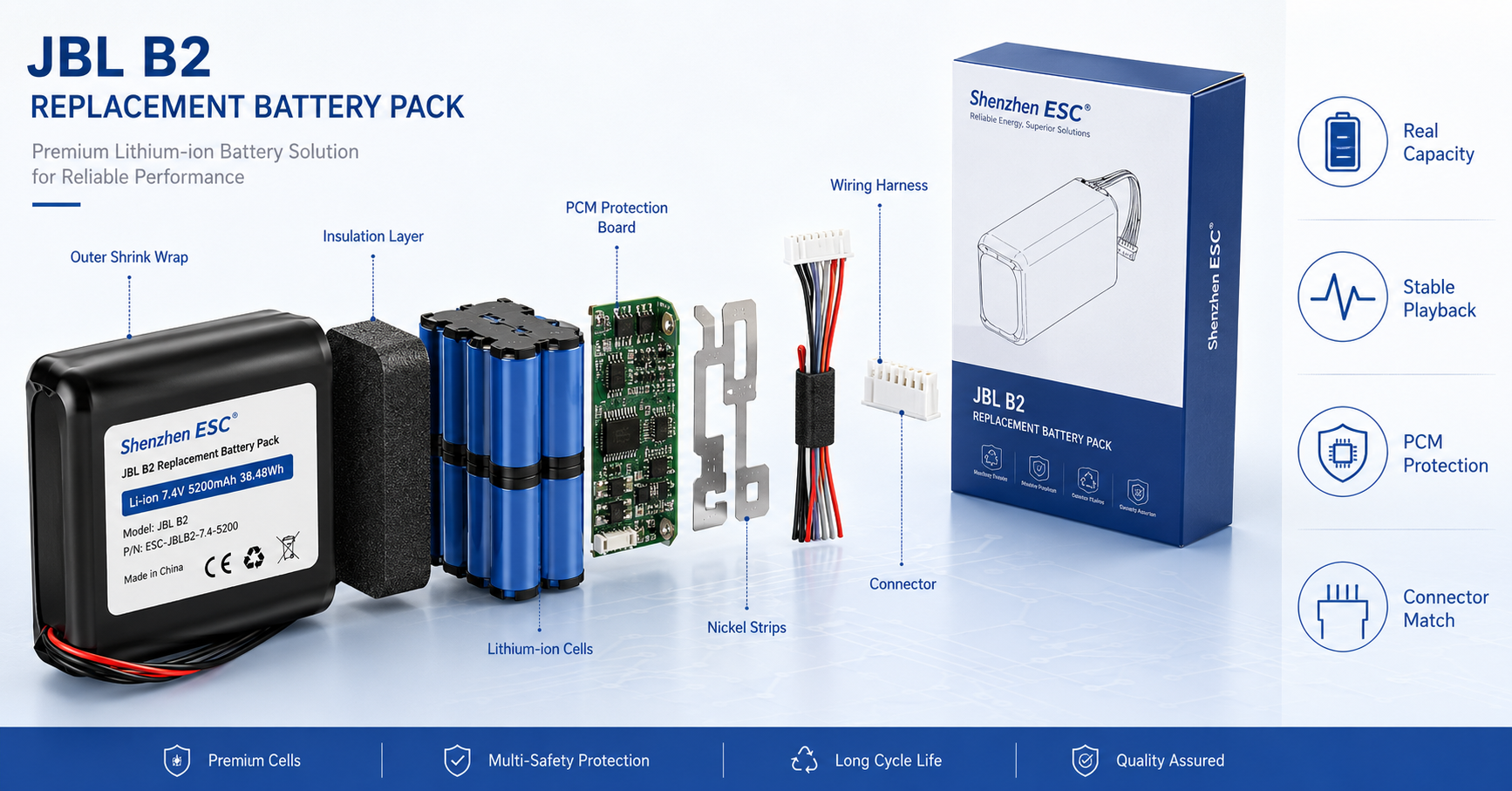

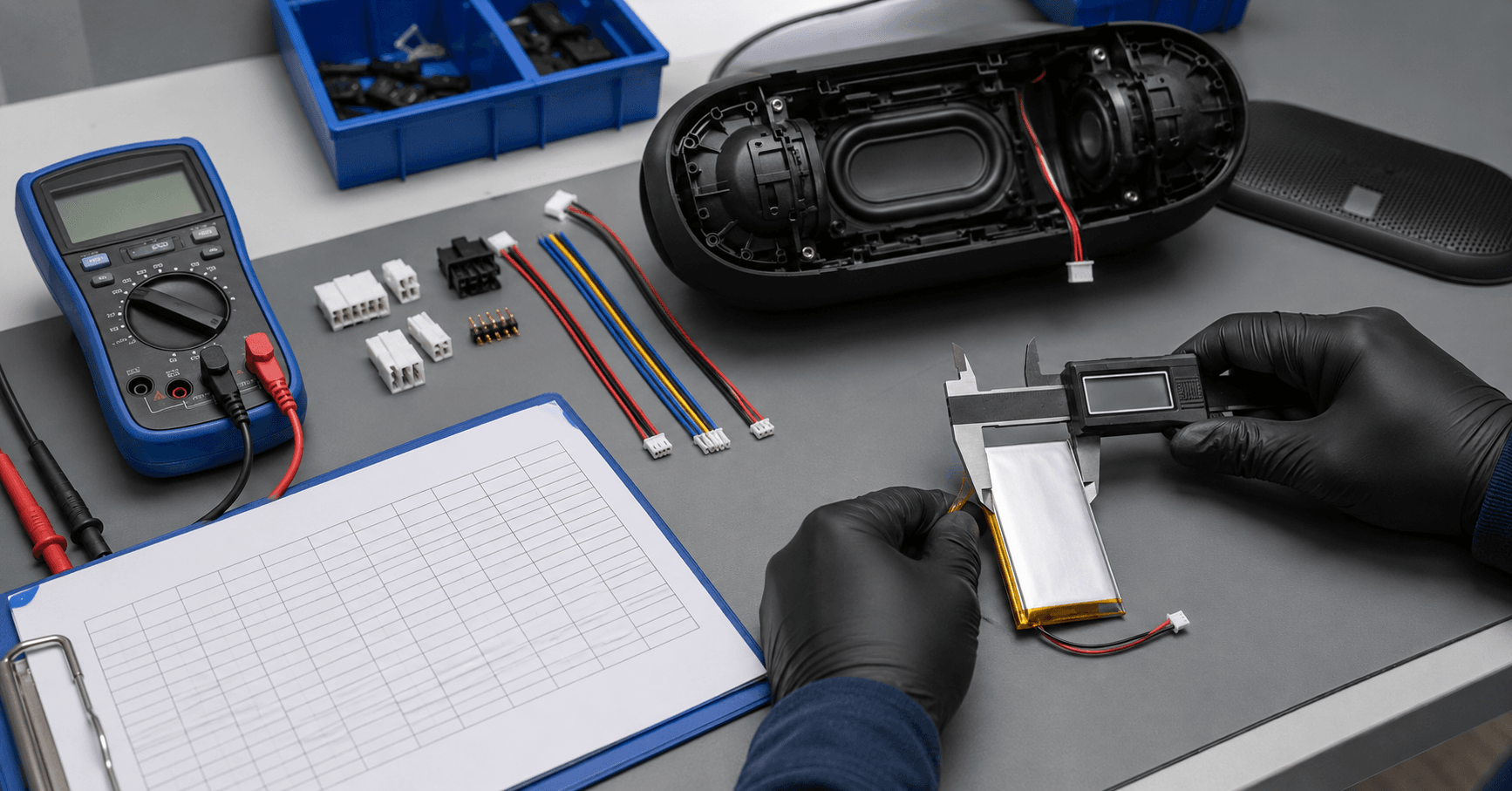
JBL replacement battery compatibility cannot be confirmed by speaker family name, capacity, or connector appearance alone. A reliable match requires the exact device identity, the original battery marking, nominal voltage and energy, pack dimensions, connector housing, pin count, wire order, cable length, protection design, and installation fit to agree with the approved sample.
This distinction matters for repair chains, refurbishment facilities, parts wholesalers, and private-label battery buyers. Two packs may both be described as suitable for a portable speaker and still differ in polarity, thermistor wiring, connector keying, protection behavior, or the cable route required inside the enclosure. The safe commercial approach is to treat compatibility as a documented model-level approval process.
Why a Speaker Model Name Is Only the Starting Point
Begin with the complete product identity rather than a shortened sales name. Record the model shown on the device, regional or hardware variant when available, serial number, label photographs, and any relevant service information. JBL’s official support guidance says a product serial number may be found on the original box, on the product in locations that vary by device, or in a compatible JBL app. That identity evidence helps a buyer separate similar-looking products before selecting a battery.
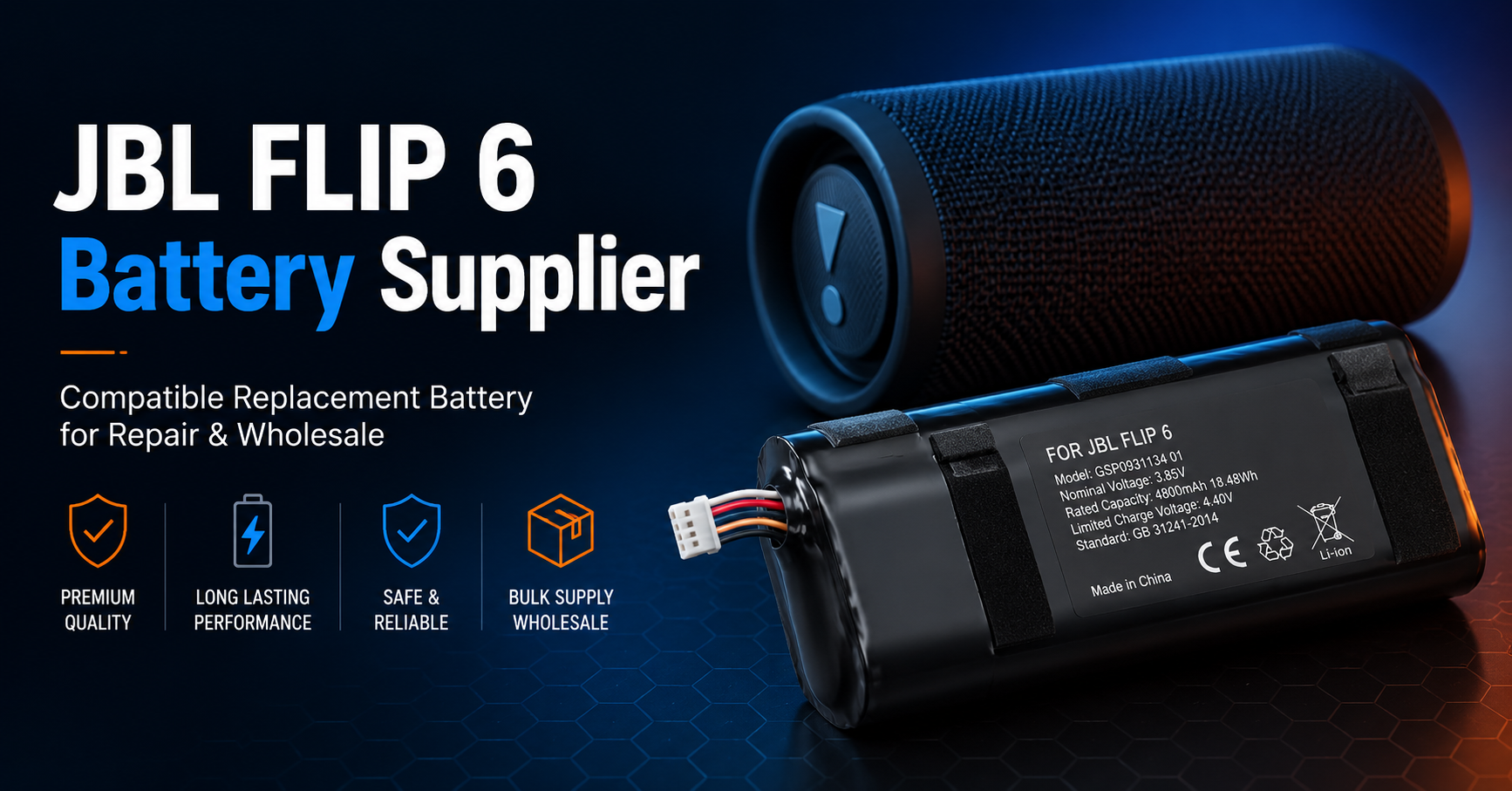
Official product guides also show why assumptions are risky. The JBL Flip 6 quick-start guide lists a 17.28 Wh lithium-ion polymer battery, while the JBL Charge 5 guide lists 27 Wh. These public device-level values help distinguish products, but they do not reveal every internal replacement-pack requirement. They should not be used alone to approve a supplier’s battery.
Buyers focused specifically on one model can review ESC’s JBL Flip 6 battery sourcing guide. A mixed-model program needs a broader matrix that keeps every device, original battery, sample, and purchase SKU traceable.
Build a JBL replacement battery Compatibility Matrix Before Requesting Samples
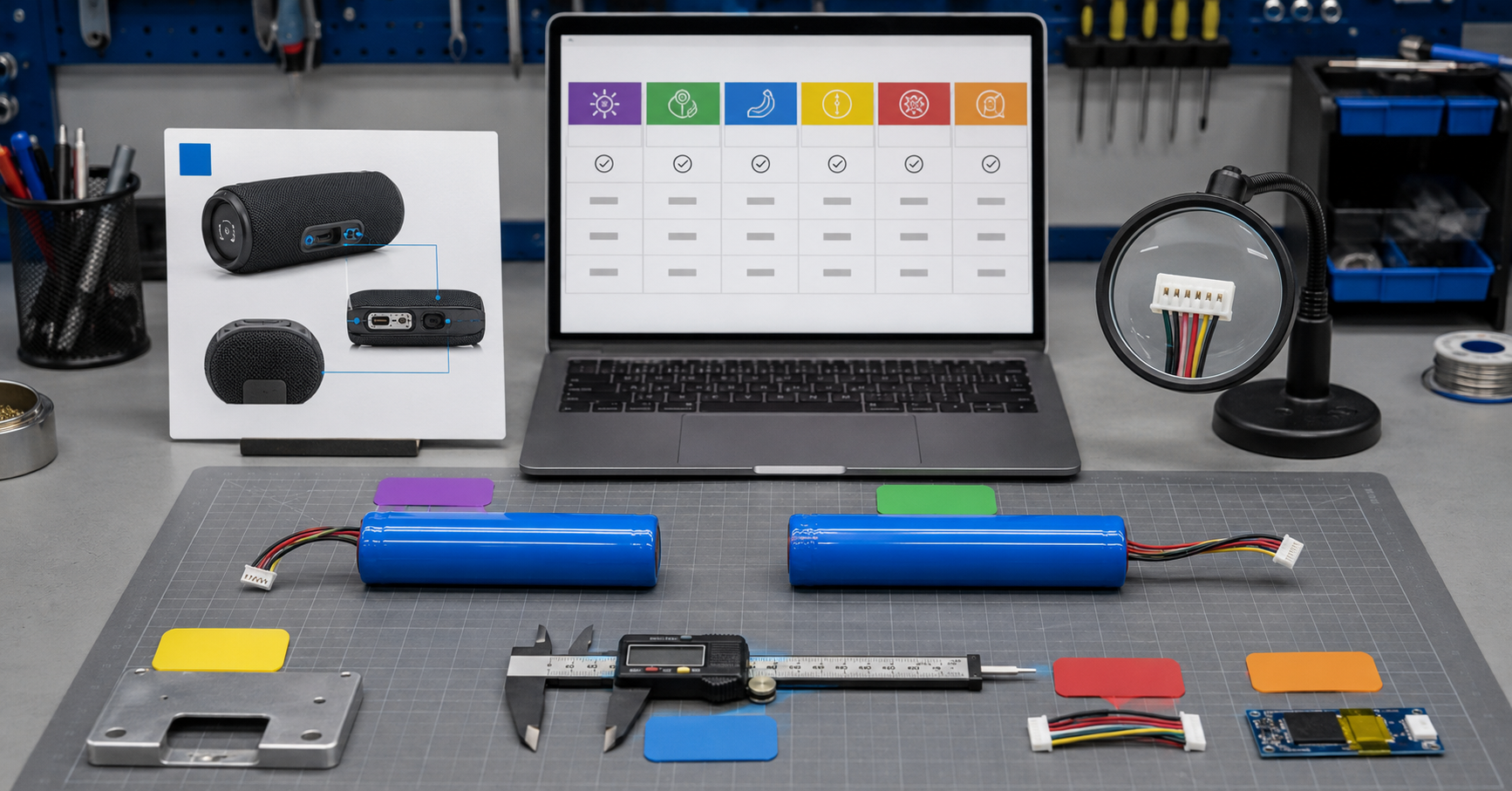
Create one row for each device variant and do not merge rows merely because the commercial model names look alike. Separate confirmed facts from supplier proposals and unverified assumptions.
| Compatibility layer | Fields to record | Why it matters |
|---|---|---|
| Device identity | Full model, variant, serial-number reference, device-label photos | Prevents one commercial name from covering different hardware |
| Original battery identity | Part number, label text, chemistry, nominal voltage, Wh, mAh, date or lot code | Creates a traceable reference for the removed pack |
| Mechanical fit | Length, width, thickness, tab position, foam, adhesive, cable exit and routing | A pack can fit the cavity but still obstruct assembly or stress the cable |
| Connector | Housing, pitch, keying, pin count, latch, mating orientation and cable length | Similar connector bodies are not proof of a correct electrical match |
| Wiring | Pin assignment, polarity, wire color and sequence, thermistor or data line | Incorrect pinout can create failure or safety risk |
| Protection | Protection-board functions, temperature sensing and device communication | The speaker may require behavior that voltage and capacity do not show |
The matrix should link every supplier sample to photographs, measurements, test results, reviewer, date, and disposition. When a supplier proposes one battery for several device variants, require evidence for each claimed application instead of approving the group from one successful installation.
Check the Original Battery Part Number Without Treating It as Sufficient
The original battery part number is one of the strongest matching fields, but buyers should still confirm the physical pack and electrical interface. Labels may be abbreviated, damaged, revised, or associated with more than one production source. A marketplace title or handwritten model list is not equivalent to a controlled compatibility record.
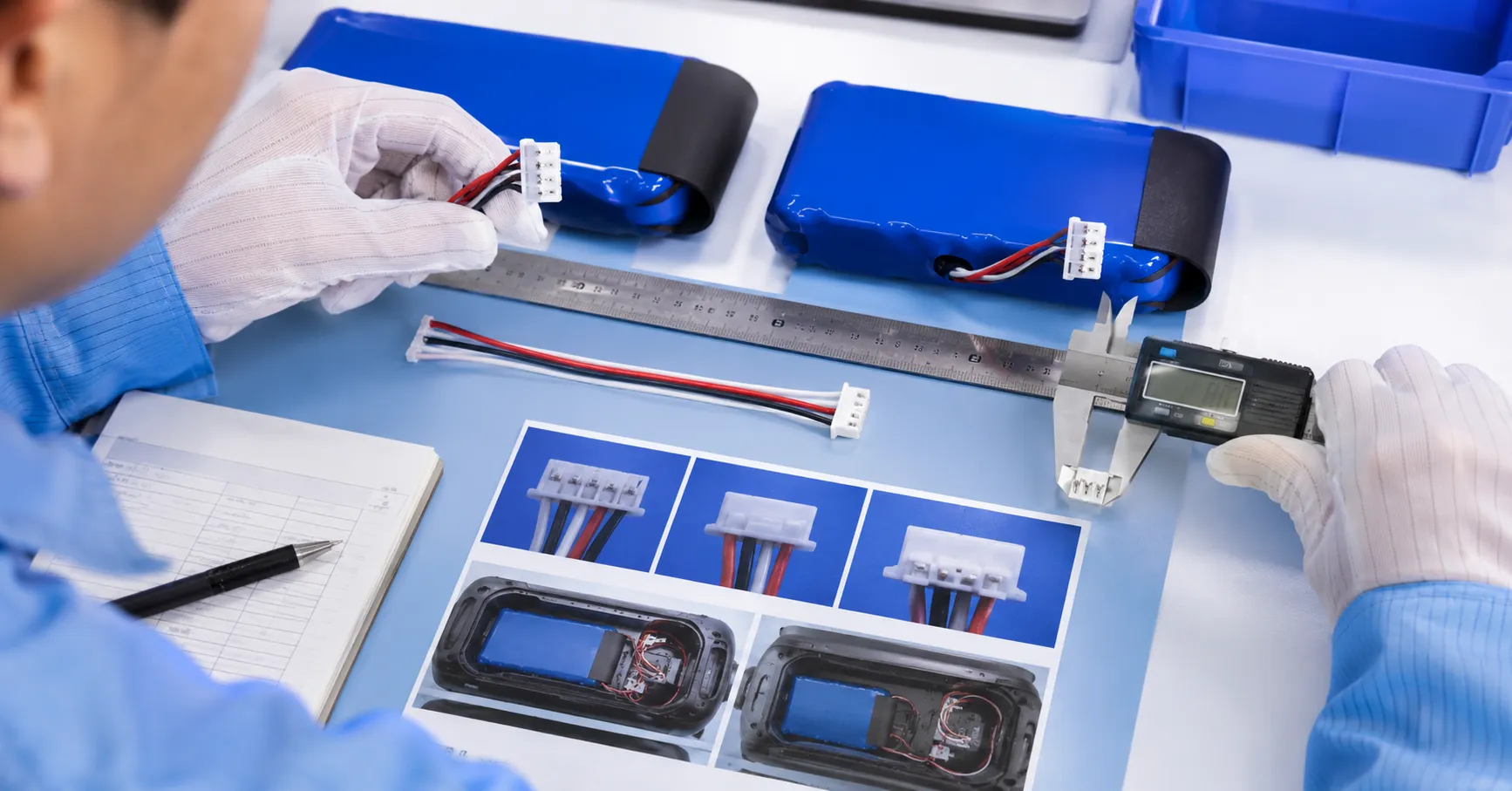
Ask for clear photographs of both sides of the original battery, the full label, connector face, wire entry, protection-board area where visible, and its position inside the speaker. Record who supplied the reference unit and whether the pack was removed from a known-working device. Do not describe a third-party replacement as a genuine or authorized JBL battery unless that status is supported by the trademark owner.
Inspect Voltage, Energy, Capacity, and Protection Separately
Nominal voltage must match the approved electrical design. Energy in watt-hours and capacity in milliamp-hours describe related but different quantities, and capacity alone does not establish compatibility. Buyers should compare the original label, supplier specification, approved sample, and measured behavior under a defined method.
Protection design also matters. Confirm which protection and sensing functions are present, how the temperature-sensing line is handled, and whether the device expects any additional signal. Do not infer protection-board equivalence from the number of wires alone. Any electrical probing should be performed by qualified personnel using controlled procedures that avoid short circuits, reverse polarity, and physical battery damage.
Verify the Connector Housing, Pinout, and Cable Route
A visual connector match is not enough. Inspect the mating face, polarization features, latch, pitch, pin count, terminal position, insertion direction, and retention. Then document the pin assignment and polarity from an approved technical reference or qualified measurement. Wire colors can support inspection, but color alone should never define polarity or pin function.
Mechanical routing is part of the connector check. Confirm cable length, exit direction, bend radius, clearance from screw posts and moving parts, and whether the enclosure closes without pinching or tension. Photograph the approved routing before reassembly so the same standard can be used for training and bulk inspection.
Approve Samples in Four Stages
1. Desk review
Compare the supplier drawing, specification, label, connector photo, wiring diagram, and proposed application list against the compatibility matrix. Quarantine missing or contradictory fields before physical testing.
2. Incoming inspection
Record sample dimensions, weight where relevant, cable length, connector details, label information, visible workmanship, and shipment condition. Assign a unique sample identifier so later results cannot be separated from the physical unit.
3. Installation and functional review
Have a qualified technician confirm fit, connector engagement, cable routing, enclosure closure, charging recognition, power-on behavior, and normal speaker operation. Stop the test if there is abnormal heating, odor, deformation, unstable charging, unexpected shutdown, or any other unsafe condition.
4. Controlled runtime and recharge testing
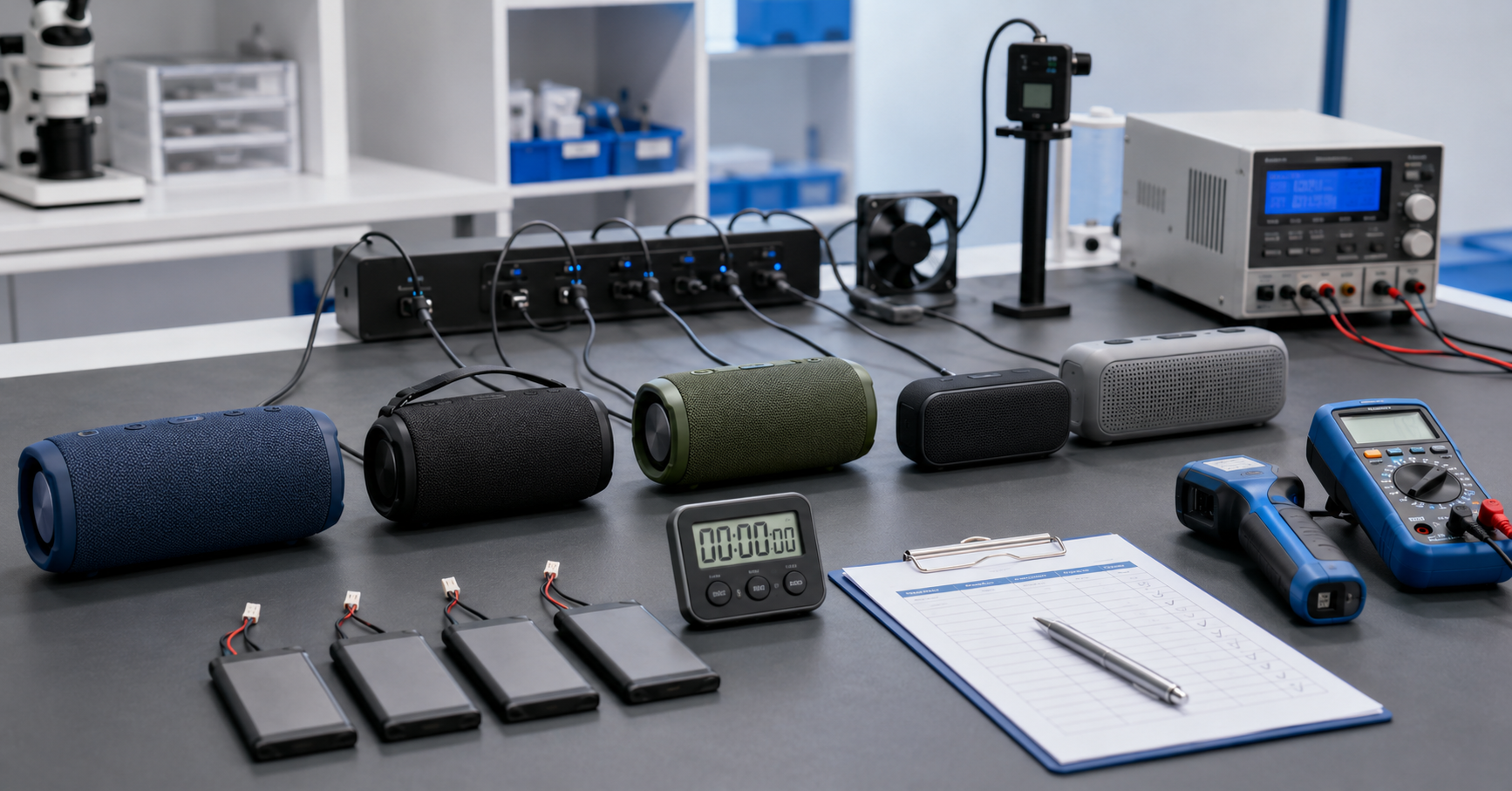
Use a repeatable test method with a defined speaker model, firmware state, audio content, volume, starting charge condition, ambient conditions, endpoint, charger, and number of cycles. ESC’s JBL battery runtime test guide explains how to keep those variables consistent for bulk quality control.
Convert the Approved Sample Into Bulk Acceptance Criteria
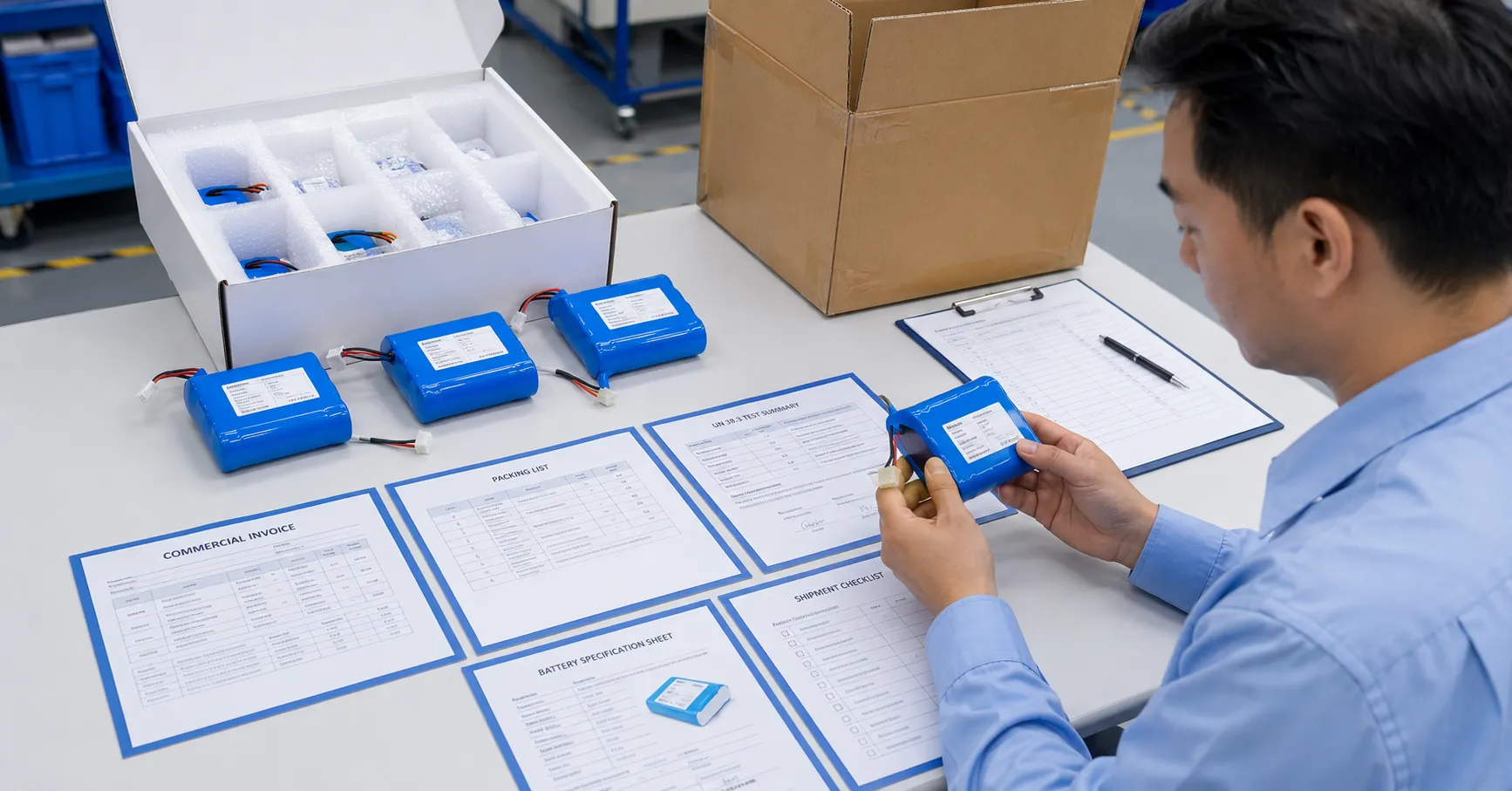
Sample approval is useful only when purchasing and inspection documents preserve it. The purchase specification should define the approved battery code, application list, label, voltage and energy fields, dimensional tolerances, connector and pinout reference, cable requirements, protection functions, packaging, traceability, and change-notification rules.
For incoming bulk orders, inspect identity and workmanship on every lot, then use an agreed sampling plan for measurements, electrical checks, installation, charging, and functional testing. Keep retain samples from approved development and production lots. If the cell, connector, cable, protection board, label, or pack construction changes, require written disclosure and decide whether requalification is necessary.
Buyers building a wider supply program can also use ESC’s JBL battery supplier evaluation guide to assess documentation, sampling, quality control, and repeat-order support beyond a single model.
Common Matching Errors to Reject
- Approving a battery from the speaker name alone
- Using mAh as the only compatibility field
- Assuming identical connector color means identical pinout
- Ignoring cable length, exit direction, or enclosure clearance
- Combining several device variants under one unverified application claim
- Testing one sample without defining bulk acceptance criteria
- Accepting an undisclosed cell, connector, cable, or protection-board change
- Calling a third-party replacement “original” without authorization evidence
Frequently Asked Questions
Can the speaker model name confirm the correct replacement battery?
No. Use the complete device identity, original battery marking, electrical specification, dimensions, connector, pinout, cable route, protection design, and an approved installation test.
Is the original battery part number enough?
It is an important reference, but it should be supported by label photos, measurements, connector and wiring confirmation, and a sample tested in the exact device variant.
Can two batteries with the same voltage and capacity be interchangeable?
Not necessarily. Dimensions, connector keying, pin assignment, cable length, thermistor configuration, protection behavior, and installation clearance may still differ.
How many device variants should be sampled?
Test every device variant for which compatibility is claimed unless the buyer has controlled technical evidence that the variants use the same approved battery interface. One device should not automatically approve an entire family.
What should trigger requalification?
A change to the cell, pack construction, dimensions, connector, cable, wiring, protection board, label, manufacturing site, or other approved characteristic should be reviewed under the buyer’s change-control procedure.
Make Compatibility a Controlled Approval Record
JBL replacement battery compatibility should end with a signed, traceable record—not a supplier application list. Identify the exact device, document the original pack, verify mechanical and electrical interfaces, test samples under controlled conditions, and convert the approved result into purchase and inspection criteria.
Send ESC the complete speaker model, device-label photos, original battery markings, connector photos, required quantity, and target market. ESC can review the information needed for a model-level sample and compatibility confirmation plan. Final compatibility remains subject to the exact device, battery specification, approved sample, and test conditions.
External Source References
- JBL Support — Where do I find the serial number of my product?
- JBL — JBL Flip 6 Quick Start Guide
- JBL — JBL Charge 5 Quick Start Guide