
TL;DR: The standard iPhone 17 has a documented repair process covering the battery, back glass, display, cameras, and USB-C connector. Battery service benefits from rear access and electrically releasable adhesive, but still requires specialized procedures and equipment. For B2B repair businesses, repairability depends on compatible parts, safe installation, post-repair software verification, and total repair cost—not just whether the phone can be opened.
For repair chains, refurbishment companies, and replacement-parts distributors, iPhone 17 repairability is an important consideration when planning future repair services, selecting replacement batteries, and evaluating the profitability of smartphone refurbishment.
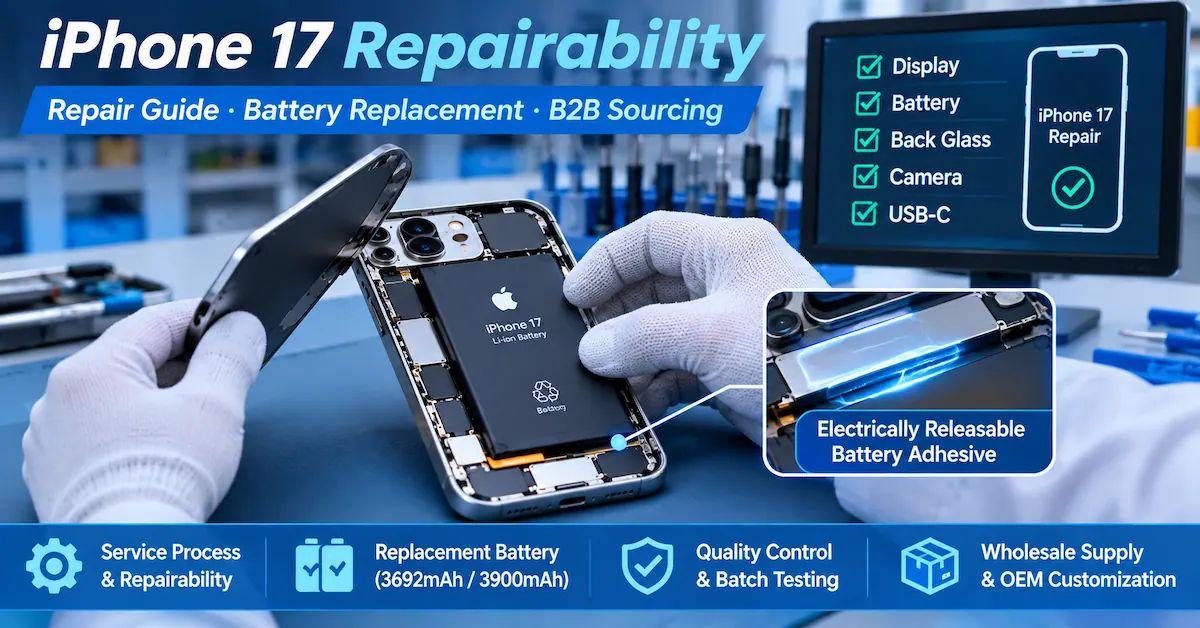
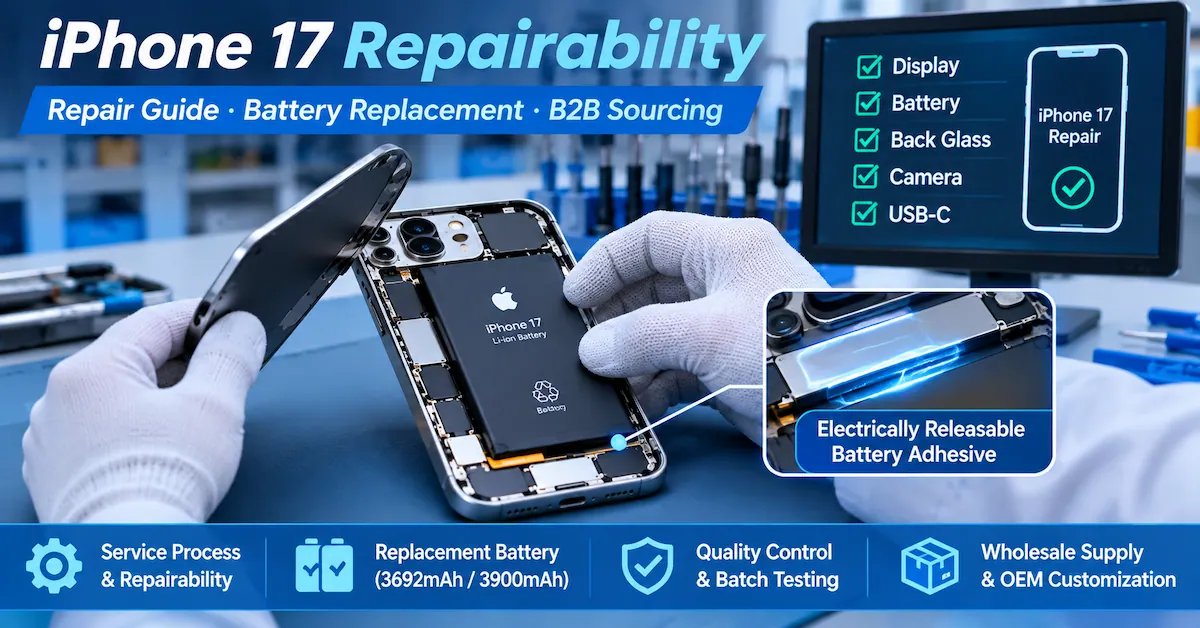
Apple provides an official repair manual for the standard iPhone 17, covering major repairable components and diagnostic procedures. Independent repair documentation also confirms the use of electrically releasable battery adhesive.
However, these improvements do not make every repair simple.
Technicians must still consider battery safety, display and back-glass adhesives, device-specific components, repair software, and the effects of opening a sealed phone.
For purchasing managers, the central question is:
Can the repair business obtain compatible components, validate their quality, complete repairs consistently, and deliver an acceptable finished device at a commercially sustainable cost?
This article examines the iPhone 17's repair structure, compares common repair scenarios, and provides a practical framework for battery sourcing, quality control, and B2B purchasing.
ESC supplies aftermarket iPhone replacement batteries for professional repair shops, refurbishment businesses, wholesalers, and private-label brands. Its iPhone 17 replacement battery offerings include original-capacity-positioned and higher-capacity aftermarket options.
iPhone 17 Repairability: Quick Technical Comparison
The following table focuses on the standard iPhone 17, not the iPhone 17 Pro or Pro Max.
| Repair area | Repairability considerations | Main B2B concern |
|---|---|---|
| Battery | Rear access and electrically releasable adhesive | Safe removal, compatible battery, inspection |
| Display | Documented display service procedure | OLED quality, touch performance, parts verification |
| Back glass | Separately serviceable with controlled adhesive handling | Replacement materials, sealing, workmanship |
| Camera | Model-specific replacement procedure | Component compatibility and functional testing |
| USB-C connector | Dedicated repair procedure | Access complexity, charging and data verification |
| Software verification | Repair Assistant and Parts and Service History | Calibration, component identity, resale disclosure |
| Replacement parts | Genuine parts and aftermarket options depending on repair | Quality evidence, traceability, procurement cost |
Key takeaway: The iPhone 17 supports multiple component-level repairs, but successful commercial service requires coordinated hardware, software, and quality-management procedures.
Key Takeaways for Repair Shops and B2B Buyers
-
The standard iPhone 17 differs from the Pro models. Repair procedures and internal structures should not be generalized across the series.
-
Battery replacement requires specialized handling. Electrically releasable adhesive does not eliminate battery-related safety risks.
-
Apple provides official repair documentation. Component procedures and diagnostic resources are available for qualified repair workflows.
-
Repair Assistant matters. Certain repairs require or benefit from post-repair software processes.
-
Battery compatibility must be verified. Capacity alone does not establish that a replacement assembly fits or functions correctly.
-
Repair costs should include more than components. Labor, adhesives, testing, rework, and warranty allowances affect profitability.
-
Wholesale battery sourcing requires traceability. Approved specifications and lot-level inspection improve repeat-order consistency.
What Is the iPhone 17 Repairability Score?
Apple's European product information for the standard iPhone 17, model A3520, identifies a repairability class of C and a repairability index of approximately 2.82 out of 5.
The European repairability index considers factors such as disassembly depth, fasteners, tools, spare-parts availability, software support, and access to repair information.
A class C rating reflects the applicable European scoring system.
It should not be confused with a third-party teardown score.
For example, iFixit awarded the iPhone 17 Pro a provisional repairability rating of 7/10 in its September 2025 assessment.
That score applies to the Pro model and uses a different methodology.
What does a repairability rating tell procurement teams?
A repairability score can help buyers understand the general service characteristics of a device.
However, it does not determine the actual cost of an individual battery replacement or guarantee the availability of every aftermarket part.
Repair businesses should evaluate four additional factors:
-
The specific component requiring service.
-
The tools, procedures, and skill level involved.
-
The cost and availability of compatible replacement parts.
-
The ability to verify the finished repair.
A repairability rating is therefore a useful reference, but not a substitute for a repair-specific cost and risk assessment.
How Is the Standard iPhone 17 Different From the iPhone 17 Pro?
The standard and Pro models have different internal designs.
This distinction is especially important when purchasing battery assemblies or preparing repair workstations.
Standard iPhone 17
The standard model provides rear access for its battery service workflow and uses an adhesive system designed for controlled electrical release.
Its repair manual also includes separate procedures for the display, back glass, cameras, and USB-C connector.
iPhone 17 Pro
The Pro model adopts a different internal arrangement, including a battery retained within a screwed-in assembly.
Independent teardown analysis identifies display removal as a significant access requirement for several repairs.
The battery construction and service sequence should therefore not be assumed identical to those of the standard model.
Why the distinction matters
A technician may be familiar with one device and incorrectly assume that another model uses the same opening procedure or battery-retention method.
Similarly, a purchasing team may receive a quotation simply labeled “iPhone 17 Battery.”
That description is inadequate if the intended order includes several models.
Procurement recommendation: Maintain separate device records, battery SKUs, approved samples, and repair instructions for each iPhone 17 variant.
How Repairable Is the iPhone 17 Battery?
Battery replacement is one of the most commercially relevant repairs for smartphone service businesses.
Lithium-ion batteries gradually lose usable capacity as they age, and physical damage or other abnormalities may require professional evaluation.
The standard iPhone 17 uses an internal rechargeable lithium-ion battery.
Apple's European product information for model A3520 lists a rated capacity of 3692mAh.
Electrically releasable battery adhesive
One notable aspect of the standard iPhone 17's battery construction is the adhesive-retention system.
The adhesive is designed to release through a controlled electrical process using appropriate equipment and the approved repair method.
This can reduce reliance on mechanical force during battery removal when the procedure is performed correctly.
However, it does not make the battery user-removable or suitable for improvised handling.
Professional technicians must follow the current model-specific repair instructions and observe applicable battery safety requirements.
What are the main risks?
Potential problems include:
-
Physical battery damage during device opening
-
Incorrect or uncontrolled adhesive removal
-
Damaged battery connectors
-
Incompatible replacement assemblies
-
Incorrect electrical specifications
-
Unresolved charging or power faults
-
Incomplete post-repair verification
A visibly swollen, leaking, unusually hot, or damaged lithium-ion battery should not be charged, punctured, compressed, or subjected to normal testing.
Such a device requires an appropriate safety response by trained personnel.
Why this matters for repair businesses
The serviceable design can support professional battery replacement, but repair operations still need qualified personnel, appropriate tools, controlled procedures, and verified parts.
For B2B buyers, the best strategy is to approve the complete replacement battery assembly before it enters production.
iPhone 17 Replacement Battery Specifications: What Should Buyers Compare?
ESC publishes multiple aftermarket replacement batteries for the iPhone 17.
These products target professional repair shops, refurbishers, distributors, and wholesale customers.
Two relevant options are the 3692mAh diagnostic battery and the 3900mAh high-capacity battery.
ESC iPhone 17 battery comparison
| Specification | 3692mAh Diagnostic Battery | 3900mAh High-Capacity Battery |
|---|---|---|
| Supplier | ESC | ESC |
| Compatible device category | Standard iPhone 17 | Standard iPhone 17 |
| Published capacity | 3692mAh | 3900mAh |
| Published nominal voltage | 3.887V | 3.887V |
| Product positioning | Diagnostic aftermarket replacement | Higher-capacity aftermarket replacement |
| Main buyer requirement | Battery-information behavior and compatibility | Capacity, fit, and performance validation |
| Sample qualification | Required | Required |
| Device-level testing | Required | Required |
| OEM/wholesale inquiry | Available for discussion | Available for discussion |
These are supplier-published product specifications, not independent laboratory results.
The 3692mAh iPhone 17 diagnostic battery targets professional replacement applications involving battery information and device compatibility.
The 3900mAh high-capacity iPhone 17 battery provides another aftermarket purchasing option.
Does higher capacity guarantee longer battery life?
Not necessarily.
Higher rated capacity can indicate greater nominal charge storage, but actual operating time depends on verified usable capacity, electrical characteristics, device consumption, and operating conditions.
A larger printed mAh value does not establish improved safety, compatibility, or service life.
For the 3900mAh version, buyers should pay particular attention to physical fit, approved charging limits, and sample testing.
Does a diagnostic battery mean it is genuine Apple?
No.
An aftermarket diagnostic battery remains an aftermarket product regardless of the information displayed by the phone.
System status, component origin, and measured electrical performance are separate characteristics.
Buyers should confirm the actual component configuration and evaluate device behavior without representing non-genuine batteries as Apple-manufactured parts.
How Does Repair Assistant Affect iPhone 17 Repairability?
Modern iPhone servicing involves software-related verification as well as physical component replacement.
Apple provides Repair Assistant to finish supported repairs and carry out applicable calibration processes.
The exact requirements depend on the repaired component, iOS version, and service conditions.
Parts and Service History
Apple's Parts and Service History feature can provide information about supported repaired components.
Depending on the actual part and repair conditions, statuses may include:
-
Genuine: A repair completed using genuine Apple parts and applicable processes.
-
Used: A supported part previously installed in another device.
-
Unknown: A status that may occur with a non-genuine, unverified, or improperly functioning component.
-
Finish Repair: The device indicates that an applicable repair-completion process remains outstanding.
The displayed status should not be interpreted as an independent capacity test or a complete assessment of the part's physical quality.
Why should refurbishers document software results?
For resale businesses, component information can affect device grading and customer expectations.
A repair record should identify the actual battery or display installed, its supplier, and the resulting device status.
The business should also record whether relevant functions operate normally.
A battery showing a particular health percentage has not necessarily passed a controlled discharge-capacity test.
Recommended practice: Maintain separate records for component identity, electrical testing, software status, and final-device functionality.
Which iPhone 17 Repairs Require the Most Careful Quality Control?
Different repair procedures create different quality risks.
| Repair type | Main technical concern | Recommended final inspection |
|---|---|---|
| Battery replacement | Cell integrity, connection, charging behavior | Charging, power stability, relevant battery information |
| Display replacement | OLED quality, touch and sensor-related functions | Image, touch, brightness, Face ID, True Tone |
| Back-glass repair | Adhesive, alignment, internal flex protection | Fit, appearance, relevant functions |
| USB-C connector | Charging, connection and data functionality | Wired charging and suitable data tests |
| Camera replacement | Correct module and calibration requirements | Image output, focus and applicable camera functions |
| General refurbishment | Multiple interacting faults | Complete device acceptance checklist |
The original iPhone 17 has an IP68 rating under specified laboratory conditions.
Opening and repairing the enclosure can affect sealing performance.
Replacing adhesive does not automatically establish that the original water-resistance rating has been restored.
Professional repair businesses should avoid unsupported waterproof guarantees after service.
How Can Repair Chains Standardize iPhone 17 Repairs?
A standardized workflow allows several technicians or locations to apply consistent quality requirements.
Step 1: Identify the device
Record the exact iPhone model and regional variant.
The standard iPhone 17 includes regional model identifiers A3258, A3519, A3520, and A3521.
Do not assume every regional configuration or battery assembly is interchangeable.
Step 2: Establish the fault
Determine whether the reported problem concerns battery capacity, charging, display operation, camera performance, or another component.
A charging complaint does not automatically establish a battery defect.
Step 3: Complete safety screening
Identify physical damage, swelling, unusual heat, or other conditions requiring specialist handling.
Step 4: Verify replacement parts
Check the approved supplier SKU, electrical specification, mechanical construction, compatibility, and documentation.
Step 5: Perform the approved repair
Use trained personnel and the current model-specific repair procedure.
Step 6: Complete post-repair verification
Perform appropriate functional tests and any applicable software-assisted completion process.
Step 7: Release the device
Record final acceptance, installed components, inspection results, and any outstanding restrictions.
This process helps reduce variation between technicians and provides useful evidence for warranty investigations.
What Quality-Control Requirements Should Battery Buyers Establish?
For replacement battery purchasing, an incoming inspection process should be agreed upon before the shipment arrives.
Battery purchasing QC checklist
| Inspection item | Buyer requirement |
|---|---|
| Product identity | Exact iPhone 17 SKU and version |
| Capacity | Defined rating and acceptance test |
| Nominal voltage | Matches approved specification |
| Physical dimensions | Verified fit and tolerances |
| Connector | Correct type and orientation |
| Battery electronics | Approved configuration and relevant functions |
| Appearance | No unacceptable damage or deformation |
| Charging behavior | Meets defined functional requirements |
| Device compatibility | Verified on representative target devices |
| Traceability | Supplier and production lot identifiable |
| Documentation | Relevant product and transport records |
| Packaging | Appropriate protection and identification |
Why supplier testing matters
ESC states that its replacement batteries undergo checks involving capacity, voltage, internal resistance, charging behavior, and aging.
Buyers should request the methods and records applicable to the proposed battery.
A general factory quality statement should not replace product-specific evidence.
Why batch consistency matters
A successful sample does not guarantee that every future shipment is identical.
Repair chains should approve product revisions and maintain records that connect incoming batches to the installed devices where practical.
If a recurring problem occurs, this information can help the quality team identify the affected material and investigate the cause.
What Does iPhone 17 Repairability Mean for Repair Costs?
Repairability influences service costs, but it does not determine them alone.
The main cost components are replacement parts, labor, tools, inspection, consumables, and potential warranty claims.
Total repair cost
Total Repair Cost = Replacement Parts + Labor + Consumables + Quality Inspection + Expected Rework + Warranty Allowance
For refurbished devices purchased for resale, acquisition cost should also be included.
Illustrative battery replacement economics
Consider a hypothetical refurbishment company evaluating an iPhone 17 battery replacement.
| Cost component | Illustrative amount |
|---|---|
| Device acquisition | $310 |
| Replacement battery | $32 |
| Repair labor | $35 |
| Adhesives and consumables | $12 |
| Functional inspection | $10 |
| Expected warranty allowance | $14 |
| Total expected cost | $413 |
If the net resale proceeds are $480, the expected contribution is $67 before any additional overhead not included in the calculation.
These amounts are hypothetical planning figures, not ESC quotations or verified market prices.
Why first-pass yield matters
A low-cost battery is not necessarily the least expensive option if installation failures and warranty claims increase.
A useful operational metric is:
First-Pass Yield = Devices Passing Final Inspection Without Rework ÷ Devices Entering Final Inspection × 100%
Track this by component supplier, repair type, and production batch.
The objective is to improve the number of acceptable finished devices while controlling total repair costs.
How Should Repair Businesses Choose Replacement Battery Suppliers?
A reliable battery supplier should provide accurate product identification, traceable stock, relevant quality-control evidence, and clear commercial terms.
Supplier qualification checklist
| Evaluation area | Purchasing requirement |
|---|---|
| Compatibility | Exact supported iPhone 17 model |
| Technical specifications | Capacity, voltage, dimensions and assembly |
| Sample approval | Representative products for qualification |
| Quality control | Defined tests and acceptance criteria |
| Product revisions | Change notification and approval |
| MOQ | Confirmed quantity for the selected configuration |
| Lead time | Order-specific production and delivery schedule |
| Packaging | Standard or approved private-label configuration |
| Documentation | Applicable safety and transport documents |
| Warranty | Clear coverage and claim procedures |
| Repeat orders | Consistent SKU and specification identification |
Wholesale purchasing and MOQ
ESC offers replacement battery wholesale services and supports mixed-model purchasing across relevant product categories.
However, quantities and delivery terms should be confirmed for the specific order.
A standard stocked battery may have different purchasing conditions from a customized private-label product.
OEM and private-label requirements
ESC also offers battery branding and packaging customization.
Private-label buyers should confirm approved product labels, electrical values, compatibility statements, barcodes, and relevant warnings before production.
A customized label does not change the underlying component's aftermarket status.
Illustrative B2B Case: Preparing a Repair Chain for iPhone 17 Battery Demand
Consider a hypothetical repair company operating twelve locations.
The company expects increased demand for iPhone 17 battery services as devices enter longer service cycles.
Rather than allowing each location to select batteries independently, its purchasing team establishes a controlled supply program.
Initial challenge
Different branches may order products based on similar marketing descriptions.
This can create inconsistent battery configurations, uncertain technical records, and difficulties investigating customer complaints.
Proposed solution
The company creates an approved iPhone 17 battery list with separate identifiers for each evaluated aftermarket configuration.
It then establishes:
-
Common technical specifications
-
Representative sample approval
-
Defined receiving inspection
-
Consistent repair procedures
-
Relevant Repair Assistant and functional checks
-
Centralized warranty reporting
-
Lot-level material traceability
Expected operational value
This structure can help the business make purchasing decisions more consistently and identify recurring quality problems.
However, improvements should be measured using actual production and warranty records.
This example is a hypothetical operating model, not a documented ESC customer project.
How Can ESC Support iPhone 17 Battery Procurement?
ESC supplies aftermarket replacement batteries for professional smartphone repair businesses, refurbishment companies, distributors, and private-label brands.
Its iPhone 17-related offerings include standard-capacity-positioned diagnostic batteries and high-capacity replacement options.
For broader sourcing, buyers can explore ESC's iPhone 17 series replacement battery guide and mobile phone battery categories.
When requesting a quotation, provide:
-
Exact iPhone model and regional identifiers
-
Required battery configuration
-
Estimated order quantity
-
Sample requirements
-
Destination market
-
Required quality tests
-
Packaging or OEM specifications
-
Applicable documentation requirements
-
Expected delivery schedule
Ready to evaluate iPhone 17 replacement batteries for your repair business?
Contact ESC with your model list, purchasing volume, and technical requirements to discuss compatible products, sampling, wholesale supply, and available customization options.
Frequently Asked Questions About iPhone 17 Repairability
1. Is the standard iPhone 17 easy to repair?
The standard iPhone 17 supports documented repairs for several major components, including the battery, display, back glass, and USB-C connector. However, professional tools, model-specific procedures, and post-repair checks remain important. Repairability varies by component and should not be described as uniformly easy.
2. What is the iPhone 17 repairability score?
The European product information for standard iPhone 17 model A3520 reports repairability class C and an index of approximately 2.82/5. This is an EU rating, not an iFixit score. Scores for the Pro models should not be applied to the standard model.
3. Does the iPhone 17 have an easily removable battery?
The standard model uses an electrically releasable battery adhesive system. This supports a controlled professional removal process but does not make the battery user-removable. Qualified technicians should follow the current repair manual and appropriate lithium-ion battery safety procedures.
4. Can an iPhone 17 battery be replaced with a higher-capacity battery?
An aftermarket higher-capacity option can be evaluated, but compatibility must be established for the exact device and battery configuration. Buyers should verify dimensions, charging limits, connector design, protection electronics, and sample performance. Higher rated capacity does not guarantee longer runtime or improved safety.
5. Does the iPhone 17 support battery replacement without replacing the display?
The standard iPhone 17 provides a repair route through the back-glass side for battery access. This differs from certain Pro-model procedures. The correct sequence and equipment should be taken from the current model-specific repair documentation.
6. What is Repair Assistant on the iPhone 17?
Repair Assistant is Apple's software process for finishing supported component repairs and carrying out applicable calibration. Its use depends on the replaced component and repair conditions. Buyers should distinguish successful hardware operation from completion of any required software verification.
7. Will an aftermarket iPhone 17 battery display as Genuine?
A non-genuine aftermarket battery should not be described as a genuine Apple part based only on a displayed status. Product origin, software information, and measured electrical quality are separate considerations. Buyers should test the actual device and accurately disclose the installed component.
8. What should wholesalers inspect before buying iPhone 17 batteries?
They should verify the exact compatible model, battery specification, dimensions, connector, assembly electronics, sample capacity, physical condition, packaging, documentation, and lot identification. Acceptance criteria should be agreed upon before bulk purchasing.
9. Does opening the iPhone 17 affect its water resistance?
Opening the enclosure can disturb adhesives and sealing components. Reassembly does not automatically restore the original IP68 performance. Repair businesses should follow approved procedures and avoid guaranteeing water resistance without suitable supporting evidence.
10. Does ESC offer iPhone 17 replacement batteries for B2B purchasing?
Yes. ESC publishes iPhone 17 aftermarket replacement battery products, including a 3692mAh diagnostic option and a 3900mAh high-capacity option. Buyers should confirm current specifications, sample availability, compatibility, MOQ, documentation, and warranty conditions for the exact quoted product.
Conclusion
iPhone 17 repairability should be evaluated as a combination of hardware accessibility, compatible replacement parts, repair software, quality control, and total service cost.
The standard iPhone 17 provides documented repair procedures for several important components, and its electrically releasable battery adhesive can support a controlled professional battery replacement process.
However, serviceability does not eliminate the need for trained technicians, appropriate equipment, component-specific procedures, or post-repair verification.
For repair chains and refurbishment companies, the most commercially important factors are accurate device identification, approved battery configurations, safe handling, repeatable inspection, and traceable purchasing records.
An effective repair program should compare the complete cost of accepted repairs rather than simply selecting the lowest-priced replacement battery.
ESC supports professional battery sourcing through its aftermarket iPhone 17 replacement products, wholesale supply, and relevant OEM customization services.
Buyers can review the ESC iPhone replacement battery portfolio and contact ESC to discuss product compatibility, sample evaluation, quality-control expectations, and bulk purchasing requirements.
By combining repairability analysis with disciplined component qualification and supplier management, B2B repair businesses can build more consistent service processes, reduce avoidable rework, and improve long-term refurbishment performance.