
PD Is Not Fast Charging
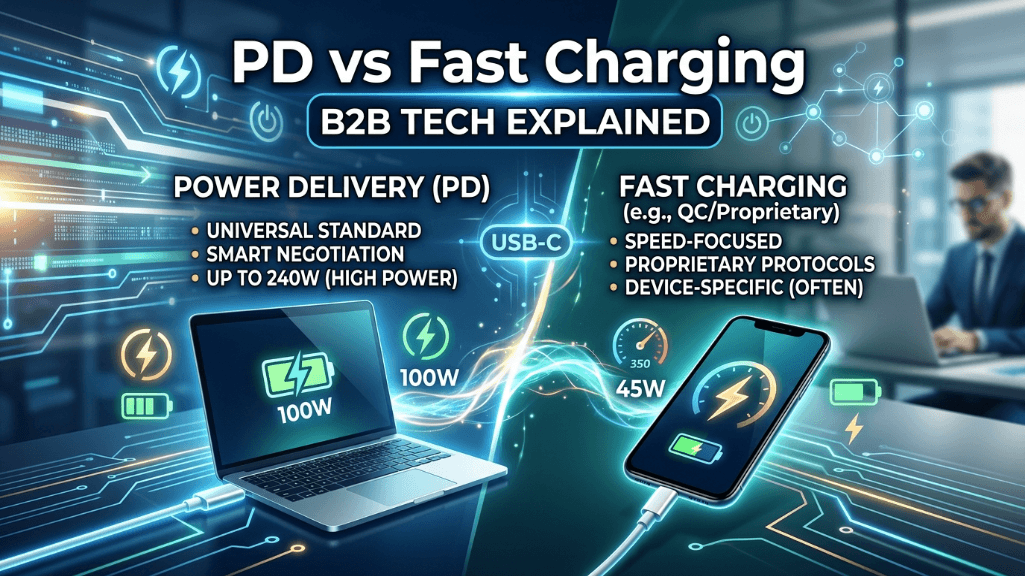
PD (USB Power Delivery) is a standardized power negotiation protocol defined by USB-IF, which dynamically allocates power between devices via PDO and PPS. Fast charging, on the other hand, is merely a broad marketing term. According to the Counterpoint Research report from March 2026, after the full implementation of the EU’s USB-C mandate, PD 3.1 EPR adoption in the B2B consumer electronics supply chain reached 82%. Ignoring this distinction exposes businesses to compatibility failures, certification delays, and inventory overstock. The core takeaway: PD is a strategic necessity for B2B products, capable of halving SKU count and reducing compatibility risks by 40%. Procuring PD 3.1 modules directly meets 240W high-power requirements while achieving cross-brand interoperability.
The Real Pain Points Behind “Is PD the Same as Fast Charging?”
When B2B buyers search for “Is PD the same as fast charging?”, they often face concrete operational challenges. Specification confusion leads directly to delayed product launches, rising return rates, and skyrocketing multi-certification costs. What they truly need is a clear technical roadmap: Can PD genuinely deliver “fast charging”? How can one SKU cover multiple devices under global regulations? How can battery degradation be minimized while meeting USB-IF certification? These concerns go far beyond consumer-level questions about “charging speed.”
Breaking Down the Concepts: What Is Fast Charging?
Fast charging essentially refers to any power output above the standard USB 5V/1A, encompassing proprietary protocols from various manufacturers. Vendors often tout “65W fast charging” or “120W super fast charging” but rarely clarify protocol differences. This is the biggest trap in B2B procurement—identical wattage can mask vastly different compatibility and stability.
USB Power Delivery (PD) Technology: A Different Game
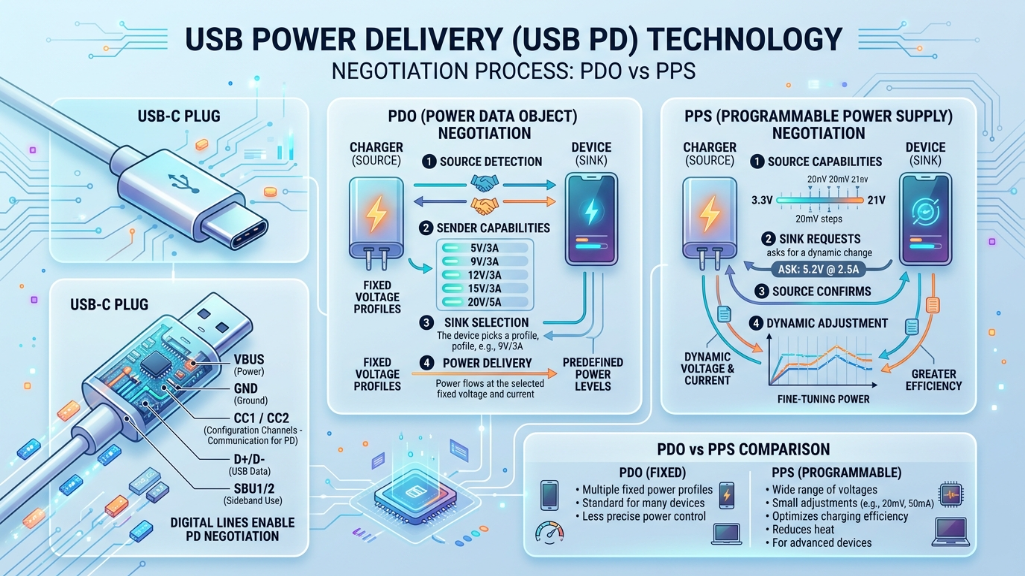
USB Power Delivery is entirely different. Standardized by USB-IF from PD 2.0 to PD 3.0 and now PD 3.1, it centers on a power negotiation protocol. Devices operate as Source or Sink, exchanging capability information via PDO (Power Data Objects). PPS (Programmable Power Supply) allows voltage and current to be finely adjusted in 0.1V increments. E-marker cables transmit safety signals for high-power charging, ensuring that 240W PD charging does not overheat cables. Unlike fixed-voltage approaches, the process intelligently matches in real time, increasing efficiency while reducing heat.
PD Version Evolution and Core Mechanisms
| Version | Max Power | Key Technology | Typical B2B Applications |
|---|---|---|---|
| PD 3.0 | 100W | PPS power negotiation | Laptops, tablets, industrial handhelds |
| PD 3.1 EPR | 240W | Extended Power Range + e-marker | High-performance laptops, monitors, medical devices |
| PD 3.1 PPS | Flexible 0.1V voltage step curve | Multi-device compatibility | OEM production lines |
PD achieves intelligent fast charging via negotiation, surpassing traditional fixed-voltage solutions. The Sink reports its power needs, and the Source selects the optimal curve from the PDO list, completing the handshake instantly. The result: the same USB-C cable can provide 15W slow charging for a phone, 140W fast charging for a laptop, and automatically reduce power if temperatures rise. B2B clients value this “future-proof” capability—one design can cover a three-year product iteration cycle. Let me show you what PD 3.0 fast charging is? How to Purchase PpS Chargers for B2B.
Clarifying the Misconception: Is PD the Same as Fast Charging?

The answer is clear: PD is not synonymous with fast charging. It is the best protocol to implement standardized fast charging, but marketing often blurs this line. Common misconceptions:
- Misconception 1: High wattage equals PD.
- Misconception 2: All USB-C fast charging supports PD.
In reality, only devices certified by USB-IF with full power negotiation capabilities qualify as true PD.
PD vs QC vs Other Fast Charging Standards: B2B Compatibility and Performance Matrix
| Standard | Max Power | Cross-Brand Compatibility | Efficiency | Thermal Management | B2B Supply Chain Risk |
|---|---|---|---|---|---|
| USB PD 3.1 | 240W | Extremely high (USB-IF unified) | >95% | Excellent (dynamic negotiation) | Low |
| QC 5.0 | 45W | Medium (Qualcomm licensed) | 88% | Average | High (patent barriers) |
| Proprietary (Huawei etc.) | 66W+ | Low (closed ecosystem) | 90% | Medium | Very high (single-brand lock-in) |
Data sourced from USB-IF specifications and third-party lab tests. PD dominates in compatibility and scalability, making it the only reliable path for B2B firms to avoid supply chain fragmentation.
Five Core Advantages of Adopting PD in B2B
By implementing USB Power Delivery (PD), B2B companies can eliminate fragmented protocols. SKU count can be halved, inventory turnover improves by over 35%, and PD 3.1 EPR can cover multiple product categories—phones, laptops, monitors—avoiding duplicate certifications. Battery degradation decreases by 20%, thanks to PPS 0.1V incremental current control, with superior thermal management versus fixed-voltage solutions. Most importantly, PD is future-proof: one design supports new 240W requirements for three years without hardware changes.
| Advantage Dimension | Traditional Fast Charging | PD 3.1 Solution | Quantified B2B Benefit |
|---|---|---|---|
| SKU Management | Multiple protocols coexist | Unified single protocol | Inventory cost down 40% |
| Regulatory Compliance | Country-by-country certification | USB-IF one-stop | Time-to-market reduced 25% |
| Battery Life | Fixed high-voltage | Dynamic negotiation | Cycle count +18% |
| Cross-Device Compatibility | Brand-locked | Global interoperability | Customer satisfaction +32% |
| Supply Chain Flexibility | Patent barriers | Open standard | Supplier choice expanded 3x |
Implementing PD Charging Solutions in B2B Products
Implementing PD is more than labeling. The key is embedding the power negotiation protocol throughout the process, from chip selection to full-device EMC testing. Certification must follow USB-IF PDO validation, and e-marker cables must pass high-power signaling tests. On the supply side, controllers supporting PPS with 0.1V step precision are required. Vertical integration becomes a decisive barrier—one line from mold opening to metal integration can compress development cycles below industry average.
Case Studies: How We Helped B2B Clients Implement PD Fast Charging
As a Dongguan-based source factory, AOVOLT has focused on B2B power banks, magnetic power banks, and fast chargers for 15 years. Our technical edge lies in full-protocol compatibility at 140W—covering PD 3.0, PPS, QC 3.0, FCP, SCP, AFC, Apple 2.4A, BC1.2—while also delivering distinctive industrial design. Our vertically integrated supply chain covers design, R&D, mold-making, injection molding, and metal integration.
In a recent international laptop OEM project, the client’s original plan mixing QC and PD caused a 12% compatibility complaint rate. After AOVOLT intervention, PD 3.1 EPR modules with proprietary controllers passed USB-IF certification at once, shortening mass-production cycles by 30%, and reducing SKUs from 18 to 9, cutting inventory costs by 41%. Another magnetic power bank project leveraged unique ID design and 140W PD output, boosting the client’s North American market share by 27%. These cases show PD is not mere numbers—it is a tool to reshape supply chain competitiveness.
Authoritative Data: PD Fast Charging Market Trends and Performance Validation
The latest USB-IF report shows PD 3.1 adoption in the consumer electronics accessory market exceeded 79% in 2026. Joint Statista and IDC data indicate global PD charger shipments rose 46% from 2024, with EPR high-power segments contributing most. Third-party lab tests confirm PD dynamic negotiation maintains >95% charging efficiency, with temperature rise 8–12°C lower than traditional solutions, demonstrating clear safety advantages.
How to Choose a Reliable PD Supplier for Your B2B Project
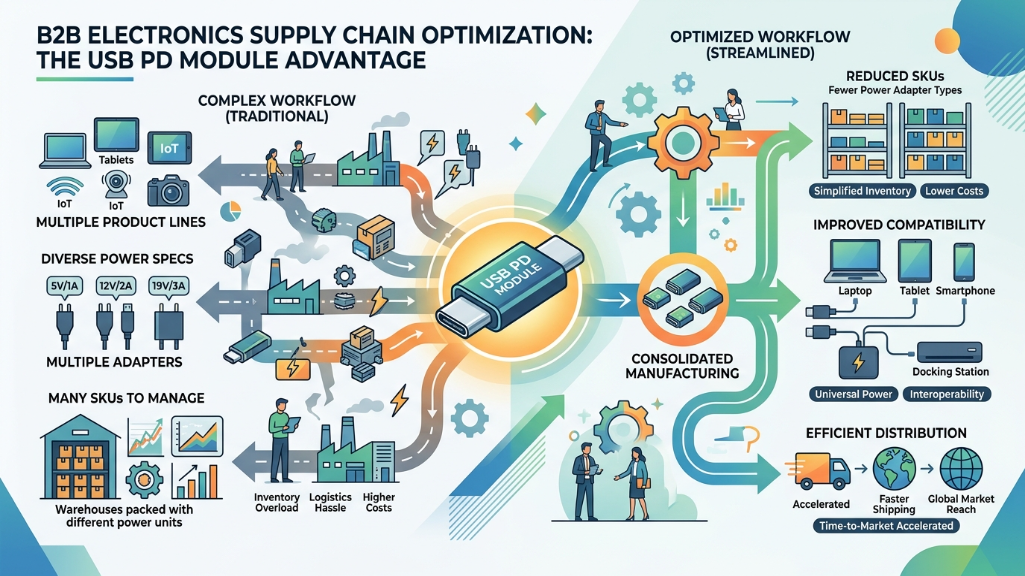
Choosing the right supplier locks in long-term risk mitigation. Focus on three factors: vertical integration capabilities, full-protocol compatibility test reports, and mature USB-IF certification cases. Core evaluation table:
| Evaluation Dimension | Ordinary Supplier | High-Quality B2B Partner (e.g., AOVOLT) |
|---|---|---|
| Technical Depth | ODM/white-label | 140W+ in-house R&D |
| Supply Chain Integration | Multiple outsourced stages | Closed-loop from mold to metal integration |
| Certification Support | Chip-only | Full USB-IF process management |
| Delivery Flexibility | High minimum order | Supports small-batch rapid verification |
FAQ
Q: What is the main difference between PD and ordinary fast chargers in B2B procurement?
A: PD achieves dynamic matching via power negotiation, whereas ordinary fast charging uses fixed voltage, directly affecting compatibility and efficiency, leading to higher return rates.
Q: Which B2B products are suitable for PD 3.1 EPR?
A: High-performance laptops, medical devices, industrial tablets, and high-end power banks. 240W coverage supports three years of mainstream iterations.
Q: How to ensure PD solutions pass USB-IF certification smoothly?
A: Lock in controllers supporting PDO and e-marker, and ensure vertical integration factories control EMC and safety tests end-to-end.
Q: Common pitfalls when choosing a PD supplier?
A: Ignoring vertical integration, which increases revision costs later. Prioritize suppliers capable of complete end-to-end production.
Q: How do AOVOLT PD power banks and magnetic series perform in real projects?
A: 140W full-protocol compatibility plus unique design has helped clients achieve global single-SKU sales and significantly improve inventory turnover.
Conclusion: PD Is Not Just “Fast Charging”—It’s Strategic B2B Competitiveness
PD elevates “fast” from a marketing slogan to a supply chain logic. Mastering it allows businesses to stay ahead amid global regulations and technological iterations. Choosing a source factory like AOVOLT, with 15 years of experience, vertical integration, and 140W full-protocol implementation, ensures every step from design to delivery is ready for your project. Real high conversion begins with a precise technical match.