
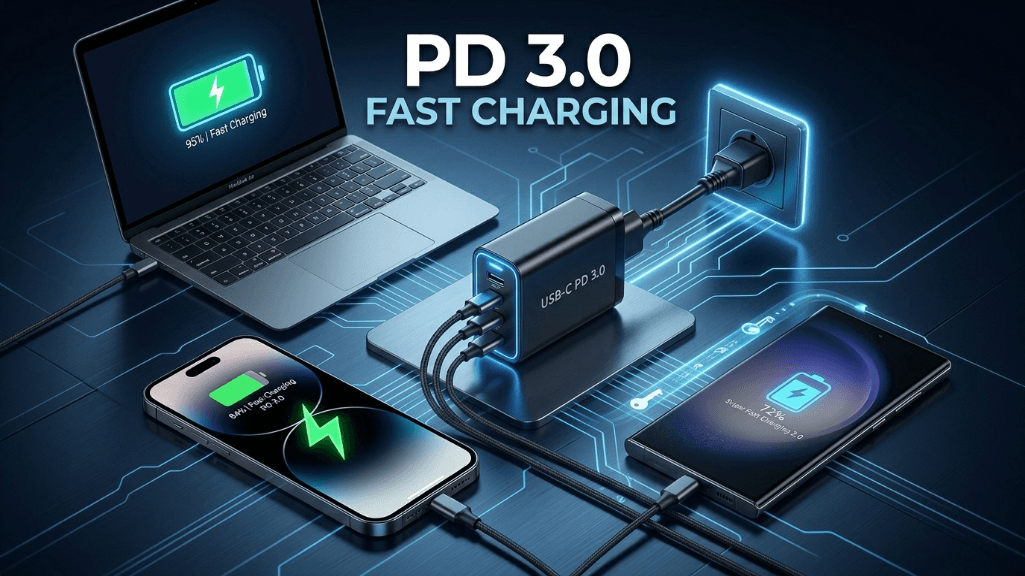
If you are sourcing fast chargers for your own brand or distribution channels, here is a conclusion you need to know upfront: GaN chargers supporting the USB PD 3.0 PPS protocol are currently the most cost-effective choice in the sub-65W category, with wholesale prices ranging from approximately $4.5–$9 per piece (FOB Shenzhen, minimum 1,000 pieces). At the same time, they can cover the three major device ecosystems: iPhone, Samsung, and MacBook Air—one SKU serving multiple markets.
However, this conclusion has one premise: your supplier must provide USB-IF certification documents. Otherwise, in the EU and US markets, the risk is not "slow charging" but customs detention and platform delisting.
What Is USB PD 3.0: From Protocol Mechanism
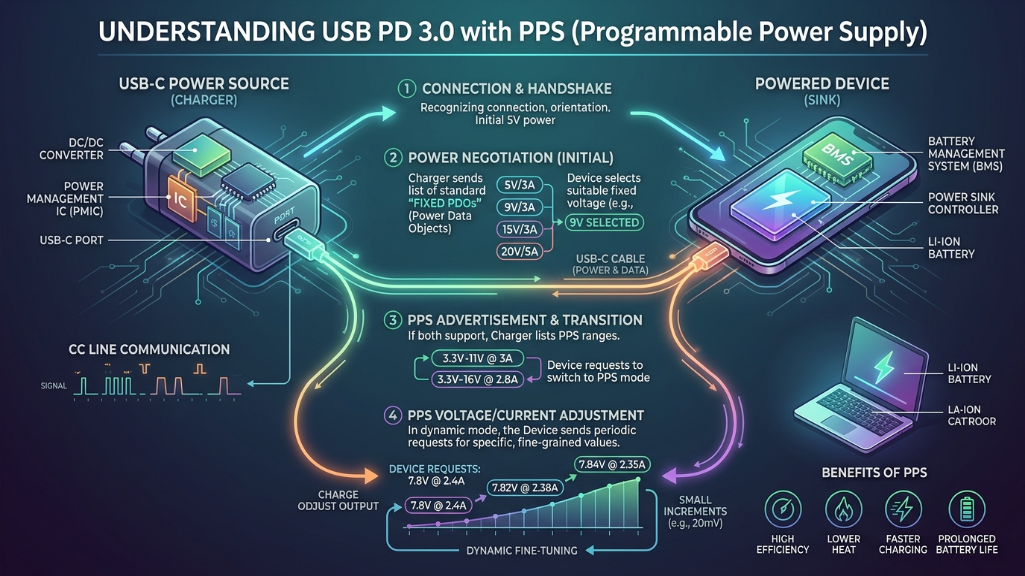
USB Power Delivery, abbreviated as USB PD, is an open charging standard established by the USB Implementers Forum (USB-IF). Its core logic is not "the charger decides how many watts to output," but that the device and charger negotiate real-time power via the CC pin (Channel Configuration Pin) of the USB-C interface—industry term: "Power Contract."
This handshake occurs within milliseconds after the device is plugged in. The charger sends a list of available PDOs (Power Data Objects), from which the device selects the voltage/current combination closest to its needs. Only after both sides confirm does the charger begin delivering power. This means that a 100W PD 3.0 charger connected to a phone that only requires 20W will not "force 100W in"; it precisely outputs the power needed by the device.
PD 3.0 was officially released in November 2015, and in 2017 the most critical sub-protocol was added: PPS (Programmable Power Supply). PPS increases voltage adjustment precision to 20mV steps—one-tenth of QC 3.0’s 200mV steps. Because of this, Samsung Galaxy S series’ "Super Fast Charging" is based on the PD 3.0 PPS protocol—a branded name on the same underlying standard.
PD 2.0 / PD 3.0 / PD 3.1 / QC 3.0: Version Comparison Before Procurement
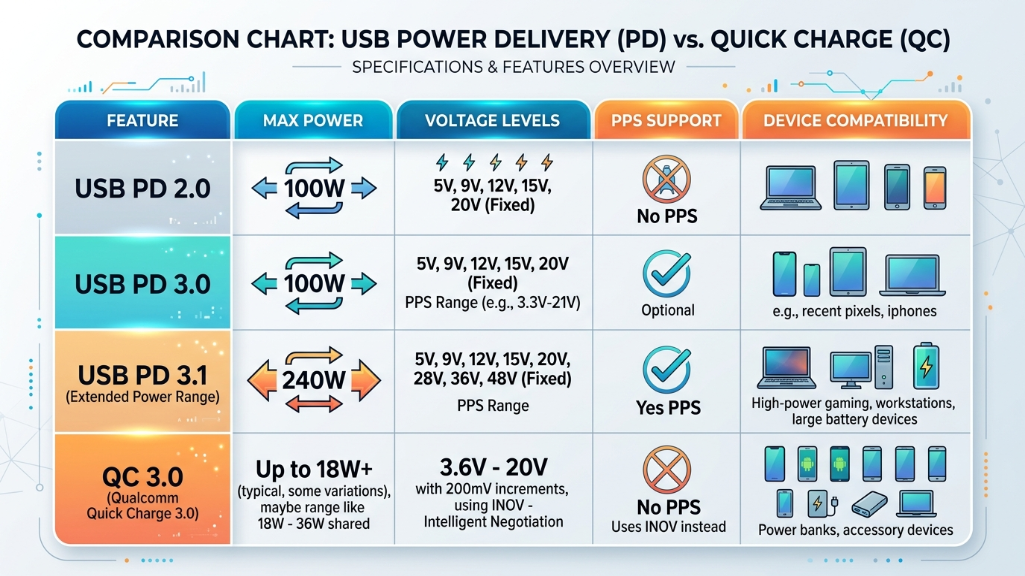
Many buyers ask, "I need a PD fast charger," which for suppliers is equivalent to saying nothing. The protocol version directly affects product compatibility, certification path, and pricing power in target markets.
Table 1: Core Parameters Comparison of USB PD Versions
| Protocol Version | Release Year | Max Power | Voltage Levels | PPS Support | Applicable Mainstream Devices |
|---|---|---|---|---|---|
| USB PD 2.0 | 2014 | 100W | 5V / 9V / 12V / 15V / 20V (fixed) | ❌ | Early USB-C laptops |
| USB PD 3.0 | 2015 / 2017 | 100W | 5V–20V + PPS dynamic (3.3V–21V) | ✅ | iPhone / Samsung / MacBook / Switch |
| USB PD 3.1 | 2021 | 240W | Adds 28V / 36V / 48V (EPR extended range) | ✅ | Gaming laptops / Professional monitors |
| Qualcomm QC 3.0 | 2016 | ~18W | 3.6V–20V (INOV algorithm) | ❌ | Snapdragon Android phones |
Two key takeaways for B2B buyers:
- QC 3.0 is a Qualcomm proprietary protocol; integrating it requires licensing fees. PD 3.0 is an open USB-IF standard, freely implementable by any manufacturer.
- PD 3.1 is not a replacement for PD 3.0 but adds EPR (Extended Power Range). The sub-100W SPR (Standard Power Range) specification is identical to PD 3.0—meaning PD 3.0 products purchased today won’t become "obsolete" for years.
Table 2: Recommended PD 3.0 Power Configurations by Sales Channel
| Sales Channel | Recommended Power Range | Core Devices | Suggested Protocol Combination |
|---|---|---|---|
| Amazon / AliExpress Mobile Accessories | 20W–30W | iPhone 15 series / Samsung A series | PD 3.0 + PPS |
| EU/US 3C Distribution | 45W–65W | iPad Pro / MacBook Air / Surface | PD 3.0 + PPS + QC 3.0 compatible |
| Corporate / Office | 65W–100W | Ultrabooks + multi-port charging | PD 3.0 PPS + GaN |
| Gaming / Creator Channels | 100W–240W | Gaming laptops / professional monitors | PD 3.1 EPR |
How PPS Works: Why It Makes Batteries Last Longer
Traditional fixed-level charging (e.g., PD 2.0’s 9V/2A = 18W) has a fundamental heat loss issue: the device’s internal buck-boost converter must convert the high fixed voltage into the battery’s required lower voltage, wasting 10–15% of energy as heat inside the phone.
PPS solves this at the source. The charger adjusts output voltage in real-time using APDO (Adjustable Power Data Object) in 20mV steps, always close to the battery’s current voltage. The phone’s Charge Pump receives the power directly, bypassing most conversion. According to EDN technical papers citing Infineon data, PD 3.0 PPS reduces full charge time from 80–90 minutes (PD 2.0) to 60 minutes, while significantly lowering device temperature.
Lower heat means what for B2B buyers?
Return rates. Battery health complaints. Negative reviews on Amazon listings. These are the variables that truly matter for procurement cost calculation, not just unit price. Providing you with 2026 US OEM and ODM power bank services: low MOQ, high ROl.
PD 3.0 Compliance Certification: A Threshold Every Importer Must Cross
After covering technical parameters, let's discuss money.
Many buyers overlook a hidden cost on first orders: market access failure due to missing certifications. A batch of 65W GaN chargers without mandatory market certifications could face customs retesting ($3,000–$8,000, 4–8 weeks) or complete destruction. This loss far exceeds any $0.5/unit saved by negotiating lower prices.
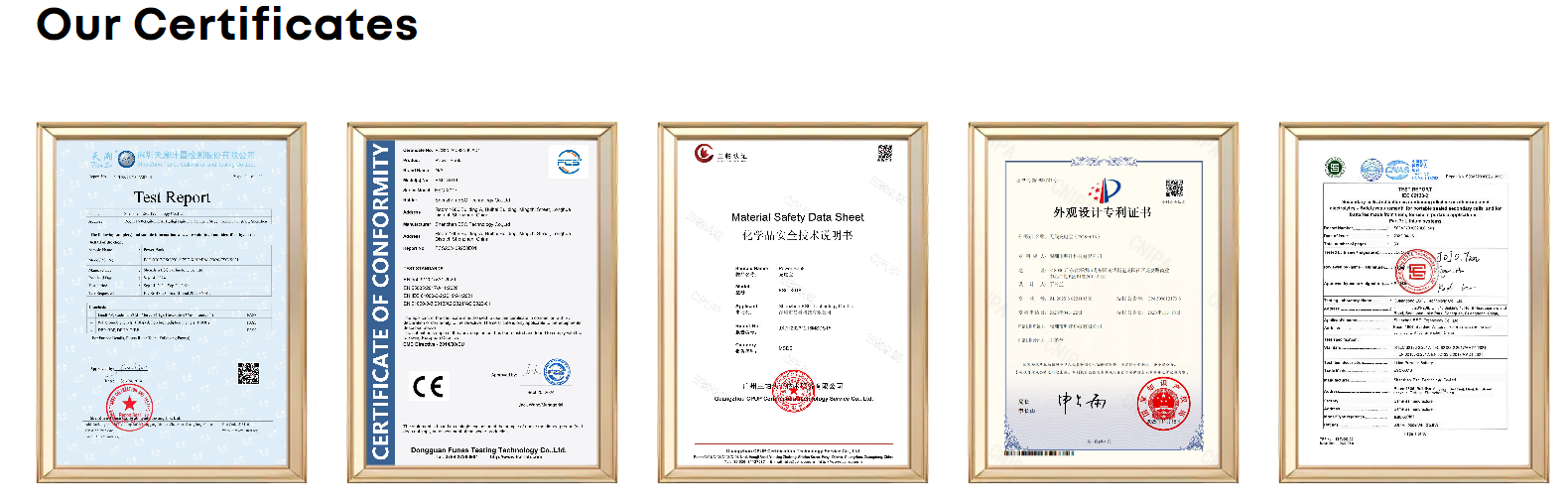
Certification requirements differ by market, but one baseline is globally recognized: USB-IF certification. Products using the USB PD logo must pass USB-IF’s three-level compliance testing (Level 1 Design Verification / Level 2 Production Consistency / Level 3 Market Compliance). This is not a suggestion; it is a USB-IF authorized usage term.
Table 3: Mandatory Certifications for PD 3.0 Export Markets
| Target Market | Mandatory Certification | Regulatory Agency | Consequence of Non-compliance |
|---|---|---|---|
| USA | FCC + UL/ETL | FCC / OSHA | Platform delisting + recall order |
| EU | CE + RoHS + ErP | Member State Market Authorities | Customs detention + fines |
| Japan | PSE (Diamond) | METI | Sales prohibited |
| South Korea | KC Certification | National Institute of Technology | Import prohibited |
| UK (Post-Brexit) | UKCA | OPSS | Independent of CE, cannot be mutually recognized |
| China Mainland | CCC | CNCA | Cannot circulate domestically |
During factory audits, three supplier documentation issues deserve caution:
- Only providing "test reports" instead of original "certificates."
- Certificate model does not match quoted product.
- No per-batch aging test records (Aging Test Report).
These usually indicate "borrowed" or one-time testing certifications, with no guarantee of production consistency.
Identifying PD 3.0 Suppliers With Real Technical Barriers
Hundreds of factories claim "full protocol compatibility," but few can simultaneously run PD 3.0, PPS, QC 3.0, Huawei FCP/SCP, Apple AFC, and BC 1.2 on a single chip solution.
Technical difficulty: different protocol handshakes, voltage ranges, and communication timing conflicts require precise firmware-level arbitration. Poor implementation may trigger wrong protocols, dropping actual charging power to 5W, resulting in "slow charging" complaints.
AOVOLT is a notable case. Based in Dongguan, China, this B2B factory has 15 years in consumer electronics manufacturing, with core products covering fast chargers, power banks, and magnetic power banks. Maximum output 140W. Supported protocols: PD 3.0, PPS, QC 3.0, FCP, SCP, AFC, Apple 2.4A, BC 1.2—allowing one SKU to serve iPhone, Samsung, and Huawei users without separate firmware for each market.
The real difference from trading-type factories is AOVOLT’s vertical supply chain integration: design, R&D, mold opening, injection molding, and hardware integration all completed in-house. This means when you need to adjust casing material, change logo placement, or customize colors, mold modification and sample delivery take less than half the industry average. For Amazon sellers or brands quickly testing new SKUs, this value often outweighs unit price.
FAQ: Five Most Common Questions From B2B Buyers
Q1: Can PD 3.0 chargers be used with older devices that don’t support PD?
Yes. PD 3.0 is fully backward-compatible. When connected to non-PD devices, the charger automatically defaults to 5V standard output (max 15W), without triggering high-voltage levels or damaging the device.
Q2: For bulk PD 3.0 purchases, what is the MOQ and sample cycle?
Mainstream factories’ sample MOQ is 200–500 pcs, sample cycle 7–15 working days. Mass production MOQ is typically 1,000 pcs, lead time 15–25 working days (GaN solutions require 4–6 weeks advance order due to chip lead times).
Q3: Can the same PD 3.0 charger be sold in the US and EU simultaneously?
Technically yes, but FCC (US) and CE (EU) certification is required, and plug types must be physically differentiated (US flat vs EU round pins). Some factories provide foldable plug solutions compatible with multiple countries, but compliance must be confirmed in the target market.
Q4: How much price difference is there between GaN and traditional silicon-based PD 3.0 chargers?
For the same power rating, GaN FOB wholesale prices are typically 15%–30% higher. However, GaN chargers are smaller, have lower return rates, and average selling price premium on platforms like Amazon can reach 40%–60%, resulting in higher overall gross margin.
Q5: How to confirm in the specification that a charger truly supports PD 3.0 PPS and not just PD 3.0?
Check whether the spec explicitly mentions "APDO" (Adjustable Power Data Object) and dynamic voltage range (usually 3.3V–11V or 3.3V–21V in 20mV steps). If only "supports PD 3.0" is listed without APDO, it likely only supports fixed PDO output and lacks PPS. You can request protocol analyzer packet capture screenshots from the supplier as verification.
Conclusion
PD 3.0 is not a technology you must fully understand the USB-IF specification to use, but it is a protocol whose details you must know for safe procurement. From protocol version selection, certification document verification, to evaluating supplier vertical integration, every decision affects return rates, market entry speed, and brand repurchase rates.
If your next product line requires a charger that can fast-charge iPhone, Samsung, and Huawei devices, or you are sourcing private-label products for the EU/US market and need a partner who can deliver CE/FCC/RoHS certification documents and full test reports, a Dongguan-based factory with in-house mold capability, full protocol firmware support, and 15 years of export experience is worth engaging ahead of time.
References: