
In consumer repair, a battery that only powers on the phone may look acceptable at first. But in professional repair shops, refurbishment lines and wholesale supply chains, small battery issues can quickly become real business problems. If a replacement battery triggers warning messages, shows unclear Battery Health information, creates an unknown part concern or fits poorly inside the phone, the repair may turn into a callback, return or customer dispute.
That is why buyers are no longer looking only for a low-cost iPhone replacement battery. They are looking for an iPhone battery without pop up solution — a replacement battery program designed to support cleaner repair handover, better customer confidence and more predictable B2B service results.
Why Standard iPhone Batteries Create Commercial Repair Risk
Many repair shops initially buy standard aftermarket batteries because the unit price is attractive.
But after installation, problems may appear in real service conditions.
Customer-Facing Warning Messages
If the phone shows an unverified battery message or unclear service-history status, customers may think the repair was poor even if the battery works.
This creates:
Customer doubt
Longer explanation time
Higher return risk
Lower repair-shop trust
Inconsistent Battery Health Display
Battery Health has become part of the repair experience.
When customers see missing, unclear or unexpected battery information after replacement, the technician may need to explain technical details that most customers do not understand.
For a busy repair counter, this wastes time.
For refurbishers, it may affect device grading and resale price.
Poor Fit and Installation Friction
A battery may be labeled for an iPhone model but still cause problems if the pack geometry, connector position, flex routing or adhesive layout is not accurate.
Common issues include:
Slow installation
Connector stress
Poor seating
Higher technician error
Potential damage during assembly
Weak Batch Consistency
A sample order may perform well, but later batches may show different labels, different fit or different post-install behavior.
For wholesalers and repair chains, this creates serious scaling risk.
These limitations show one clear point:
A standard replacement battery is not always enough for commercial repair and refurbishment use.
Core Architecture of an iPhone Battery Without Pop Up Solution
A real iPhone battery without pop up solution is not only a battery pack. It is a repair-oriented system combining hardware quality, model matching, diagnostic behavior, packaging, documentation and supply consistency.
1. Model-Specific Battery Design
iPhone batteries are not generic rectangles.
Different models may require different shapes, connector positions and flex cable routes.
Professional buyers should confirm:
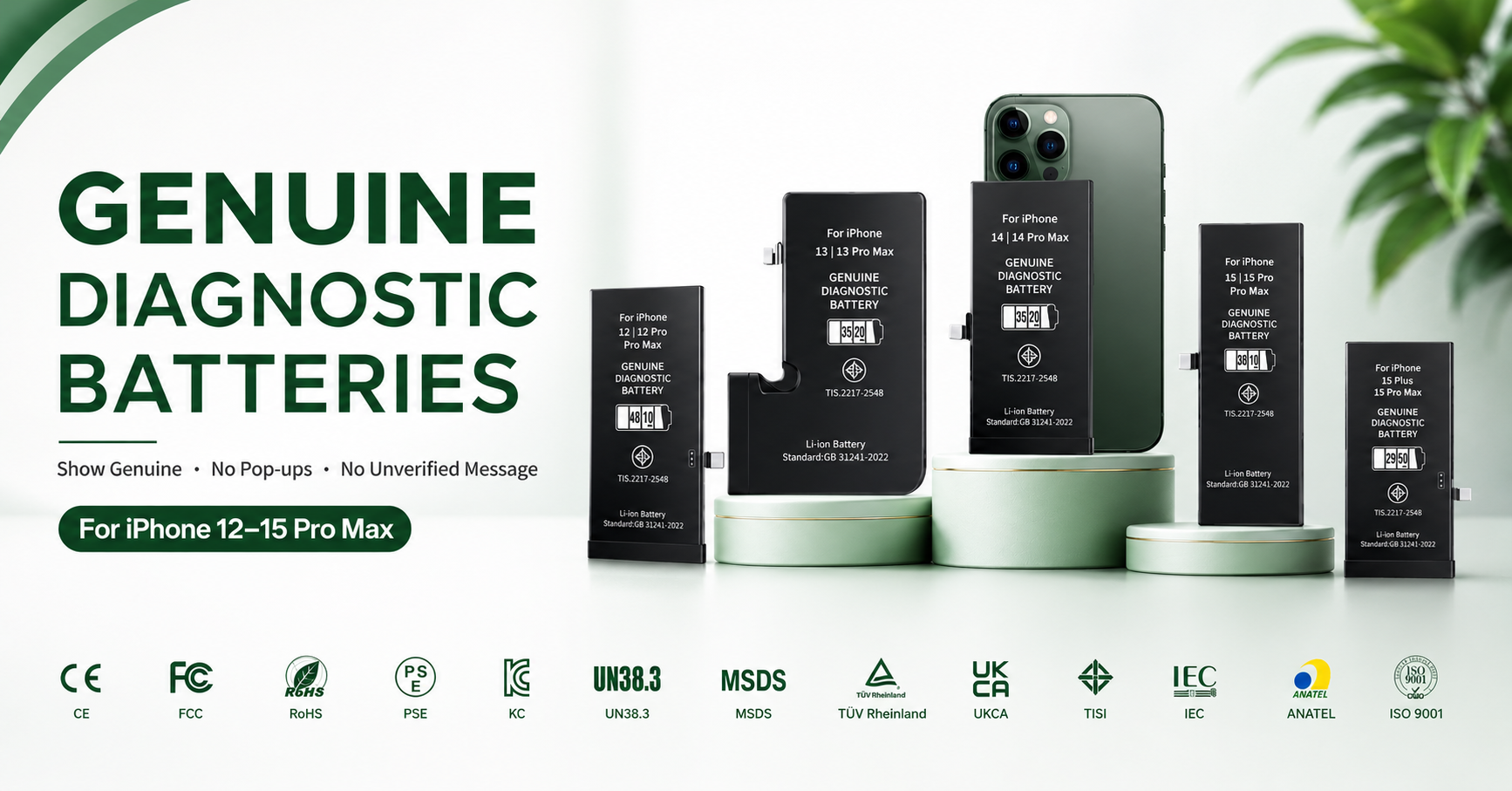
iPhone 12 series compatibility
iPhone 13 series compatibility
iPhone 13 mini compatibility
iPhone 13 Pro / Pro Max compatibility
iPhone 14 Plus compatibility
iPhone 14 Pro Max compatibility
iPhone 15 / 15 Pro / 15 Pro Max compatibility
For repair shops, model-specific fit reduces installation risk.
For wholesalers, clear model separation reduces downstream complaints.
2. Diagnostic and Display Behavior
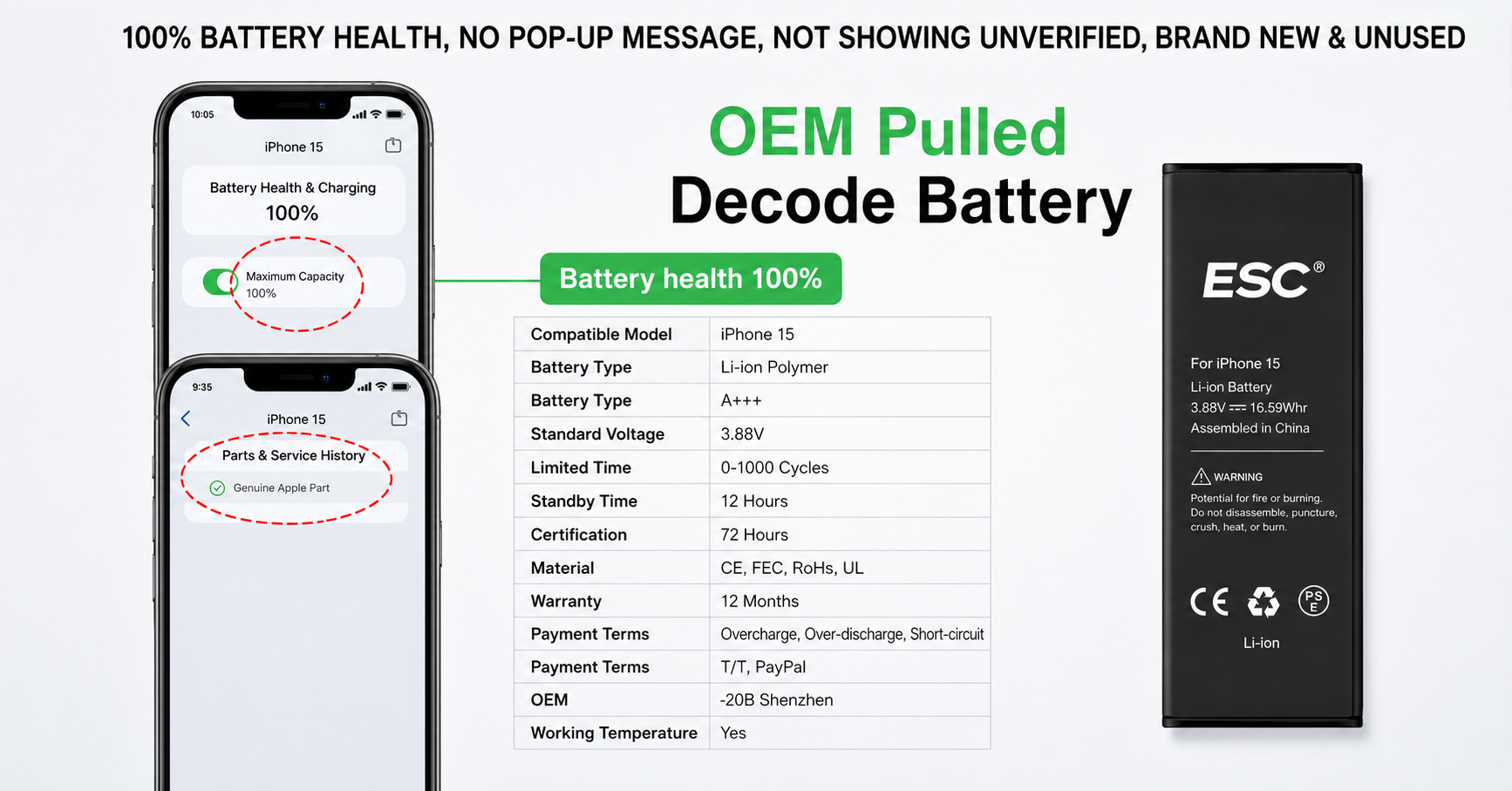
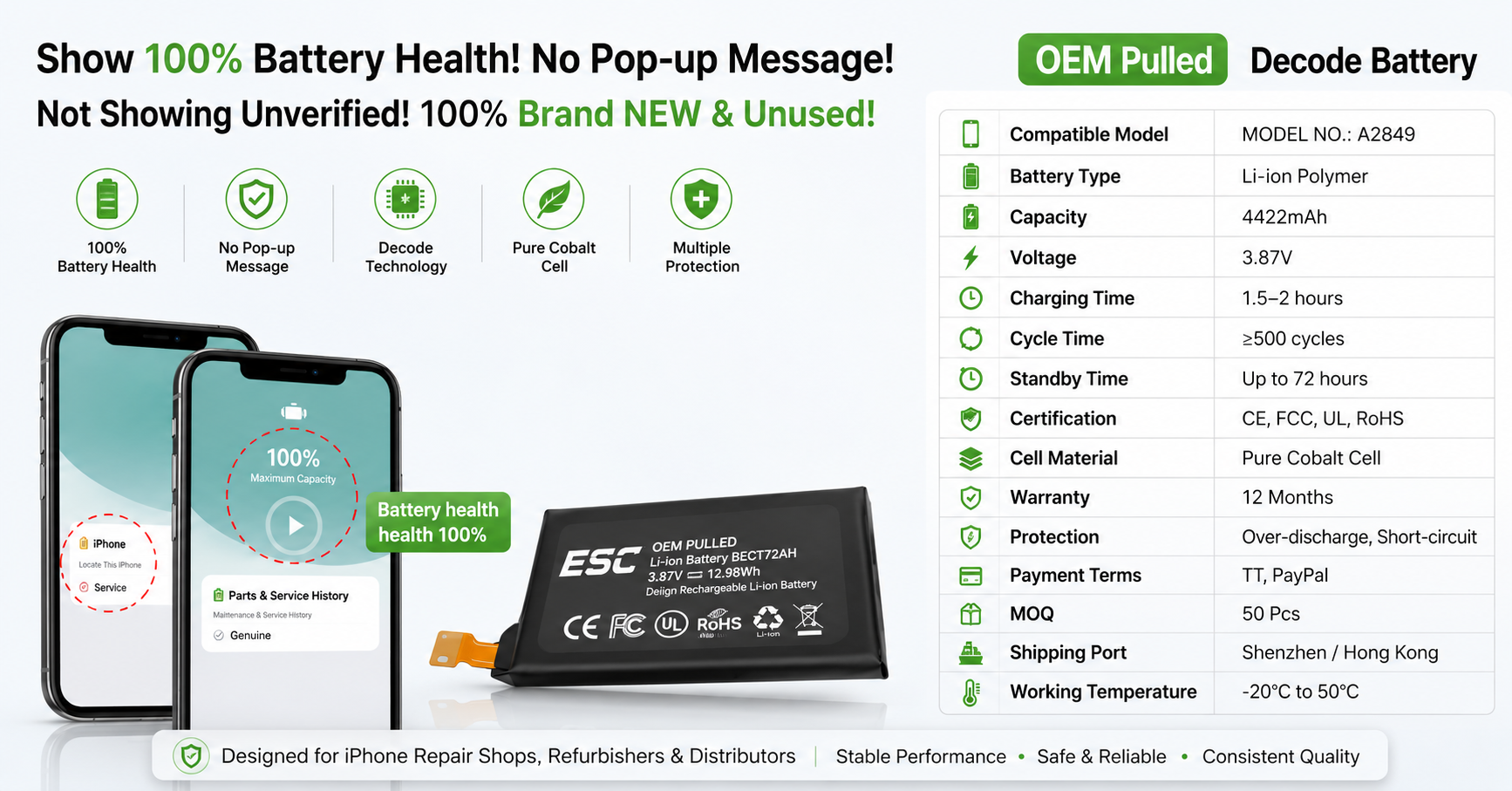
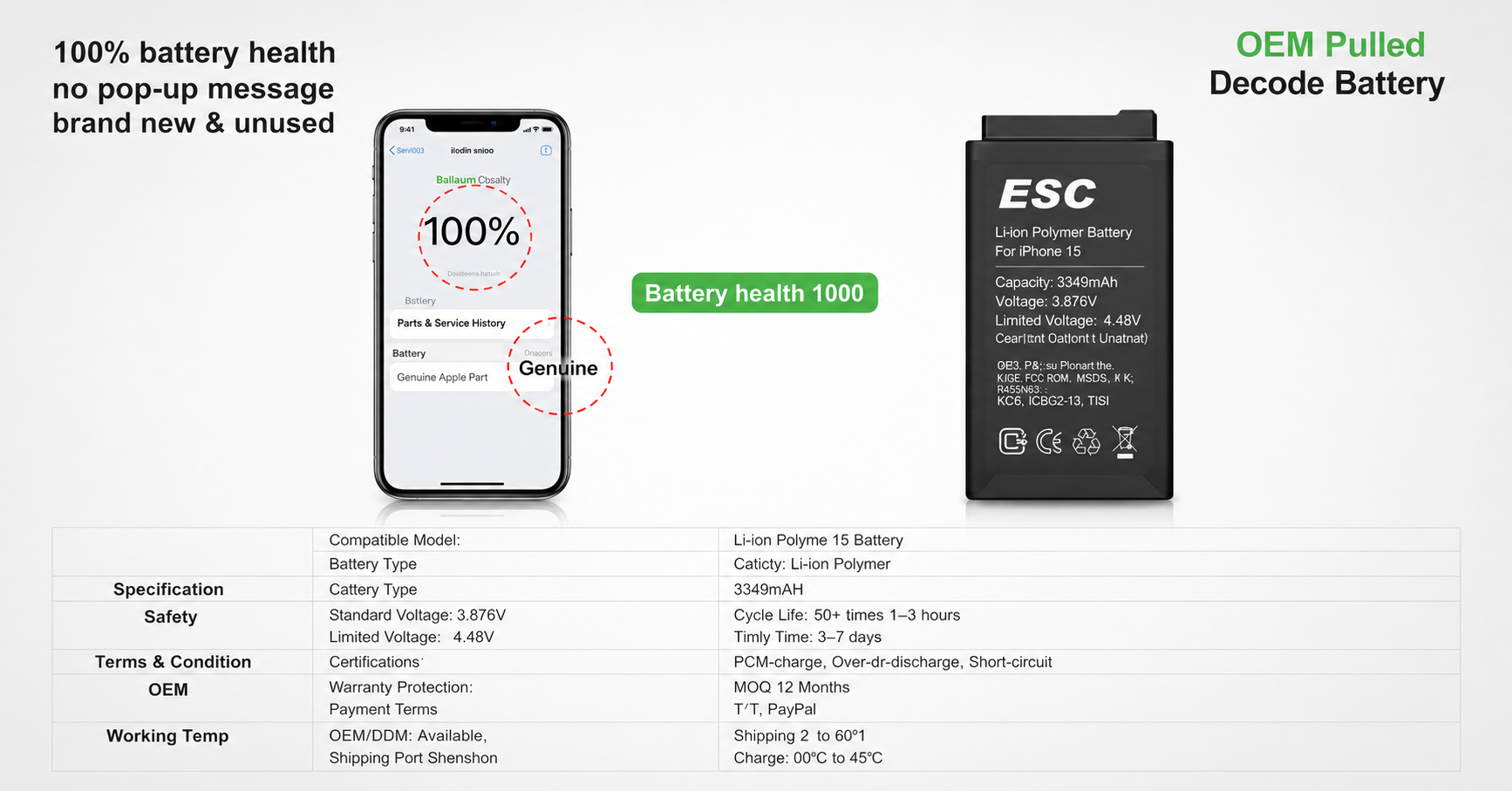
The main value of an iPhone no pop-up battery is not only electrical output.
It is how the phone behaves after installation.
Buyers should check whether the battery is designed to reduce:
Battery warning prompts
Unverified battery messages
Unknown part concerns
Battery Health display issues
Service-history confusion
This does not mean every phone will behave identically.
Final results may depend on iPhone model, iOS version, repair method, device condition and installation quality.
A professional supplier should explain these limits clearly instead of promising a universal result.
3. Stable Battery Performance
A replacement battery must still pass basic electrical expectations.
Buyers should check:
Capacity consistency
Internal resistance
Voltage stability
Charging behavior
Discharge performance
Standby drain
Heat behavior
Percentage stability
A battery with clean display behavior but poor electrical performance is not a reliable repair product.
4. Protection and Safety Design
For commercial repair supply, battery safety is basic infrastructure.
The battery should include proper protection against:
Over-charge
Over-discharge
Short circuit
Excessive current
Abnormal heat
Connector damage
Protection design directly affects after-sales risk, storage safety and shipment reliability.
5. Packaging and Traceability
Commercial buyers need more than loose battery packs.
They need battery products that can be stored, picked, shipped and traced correctly.
Good packaging should include:
Clear model label
Capacity and voltage marking
Batch number
QR code or barcode
Carton mark
Connector protection
Anti-pressure packaging
Mixed-model packing control
Traceability helps buyers quickly identify batch issues when complaints happen.
Real Commercial Application Scenarios
Repair Shops
Repair shops need batteries that install cleanly and reduce customer-facing problems after replacement.
Key requirements:
Accurate fit
Stable charging
Battery Health display where supported
Lower warning-message pressure
Easy customer handover
An iPhone battery without pop up solution helps repair shops reduce callbacks and technician explanation time.
Refurbished Phone Factories
Refurbishers need batch consistency.
A single unstable battery batch can affect hundreds of finished devices.
Key requirements:
Stable model matching
Repeatable installation
Service-screen behavior
Standby drain control
Battery Health check before resale
For refurbished iPhones, battery presentation affects grading, resale confidence and return rate.
Parts Distributors
Distributors need broad model coverage and repeat supply.
Key requirements:
Clear SKU mapping
Stable stock
Model labels
Export documents
After-sales support
A battery line that works well only once is not enough. Distributors need predictable reordering.
E-Commerce Sellers
E-commerce sellers need accurate product descriptions and low return risk.
Key requirements:
Clear compatibility
Realistic claims
Safe packaging
Warning-message explanation
Responsive warranty handling
If product claims are too aggressive, returns and negative reviews increase.
Private Label Buyers
Private label buyers need battery quality plus brand presentation.
Key requirements:
Custom labels
Retail boxes
Barcodes
Warranty cards
Instruction sheets
Carton marks
Product series planning
For private label buyers, one unstable battery line can damage the whole brand.
Cost and ROI: Why Better Batteries Reduce Total Business Cost
At first glance, a standard battery may look cheaper.
But repair businesses should evaluate total cost, not only unit price.
| Factor | Low-Cost Standard Battery | No-Pop-Up Diagnostic Battery Solution |
|---|---|---|
| Initial unit cost | Lower | Higher |
| Customer explanation pressure | Higher | Lower |
| Return risk | Higher | Lower if tested correctly |
| Repair-shop trust | Less predictable | Better customer-facing result |
| Refurbishment resale confidence | More variable | Stronger if display behavior is stable |
| Batch management | Often weaker | Requires stronger supplier control |
| Long-term business cost | Can be higher | Often more controllable |
The commercial logic is simple.
A battery that saves a small amount at purchase may cost more if it creates returns, rework, warranty claims or customer distrust.
OEM and Wholesale Deployment: From Battery Pack to Repair System
Business customers do not only need batteries.
They need repeatable deployment.
Key OEM and Wholesale Capabilities
A professional supplier should support:
Model-specific battery supply
Standard and diagnostic battery options
Battery Health display solutions where supported
No-pop-up battery options
Custom labels
Retail packaging
Barcodes
Warranty cards
Instruction sheets
Carton marks
Mixed-model shipments
Scalability Requirements
For repair chains, wholesalers and refurbishers, scalability matters.
Buyers should confirm:
Can the supplier maintain stock for fast-moving models?
Can the supplier keep labels consistent?
Can the supplier separate standard and diagnostic series clearly?
Can the supplier provide documents for export?
Can the supplier handle repeat orders without changing the part silently?
Can the supplier help analyze after-sales issues?
A battery program becomes valuable only when it can be repeated.
How to Choose the Right iPhone Battery Supplier
1. Confirm Model Coverage
Buyers should not order by family name only.
“iPhone 13 battery” is not enough.
A serious order should confirm:
Exact model
Battery shape
Connector location
Flex cable route
Capacity label
SKU code
Compatible iOS behavior where relevant
2. Test Real Devices Before Bulk Orders
Product images are useful, but real-device testing is stronger.
Buyers should test:
Physical fit
Power-on behavior
Charging behavior
Battery Health display
Warning-message behavior
Restart behavior
Standby drain
Heat behavior
3. Review Documentation
If the product image shows compliance marks, buyers should still request real documents.
Common documents may include:
MSDS
UN38.3
CE
RoHS
PSE
KC
IEC62133
TISI
Market-specific files
Logos on an image are not a substitute for actual documents.
4. Check Packaging and Batch Control
Good suppliers control both product and logistics.
Buyers should check:
Inner protection
Connector protection
Carton strength
Model label
Batch label
Mixed-model packing accuracy
Barcode or QR code
Packing consistency directly affects warehouse efficiency and warranty handling.
5. Evaluate Supplier Communication
A capable supplier should be able to explain:
What “no pop up” means
Which models are supported
What conditions may affect results
How to test samples
How warranty claims are handled
How replacement stock is managed
If a supplier only talks about capacity and price, it may not be suitable for professional repair-channel buyers.
Industry Trends for iPhone Battery Replacement in 2026
The iPhone repair battery market is moving in a clear direction.
From Basic Replacement to Repair Experience
Buyers now care about what the phone shows after installation, not only whether it turns on.
From Single Model Supply to Full Series Coverage
Repair shops and distributors need iPhone 12 to iPhone 15 family coverage, including mini, Plus, Pro and Pro Max variants.
From Price Competition to Risk Control
The lowest unit price is less attractive if it creates callbacks, returns and warranty disputes.
From Loose Parts to Packaged Battery Programs
Wholesalers and private label buyers need labeling, packaging, documents and product series planning.
From Product Claims to Verified Workflow
Sample testing, batch inspection and real-device verification are becoming standard procurement steps.
Common Buyer Mistakes
Mistake 1: Buying Only on Price
Low price does not matter if the battery creates returns.
Mistake 2: Trusting the Headline “No Pop Up” Without Testing
No-pop-up behavior should be verified by model and iOS version.
Mistake 3: Ignoring Physical Fit
Wrong shape or connector position can slow repair and damage the phone.
Mistake 4: Treating Capacity as the Only Quality Metric
Capacity matters, but internal resistance, charging behavior and display behavior also matter.
Mistake 5: Not Asking for Documents
Battery shipping and resale require paperwork in many markets.
Mistake 6: Mixing SKUs Without Clear Labels
Poor labeling causes picking errors and downstream complaints.
FAQ
What is an iPhone battery without pop up?
An iPhone battery without pop up is a replacement battery solution designed to reduce visible battery-related warning messages after installation on supported iPhone models.
Is an iPhone no pop-up battery the same as an original Apple battery?
No. It should not be described as an original Apple battery unless there is verified proof. It is usually an aftermarket or service-oriented replacement battery solution.
Can no-pop-up batteries work on every iPhone model?
No. Behavior can vary by model, iOS version, battery design, repair method and device condition.
Who should buy iPhone diagnostic batteries?
Repair shops, refurbishers, parts distributors, e-commerce sellers and private label buyers are the main users.
What should buyers test before ordering in bulk?
Buyers should test fit, Battery Health display, warning-message behavior, charging, discharge, internal resistance, standby drain and packaging.
Do certification logos prove compliance?
No. Logos are useful signals, but buyers should request actual documents for the exact battery model and destination market.
Why is packaging important for iPhone batteries?
Packaging protects the pouch cell, connector and flex cable during shipping. Poor packaging can create damage before installation.
How should wholesalers build a battery catalog?
Wholesalers should separate standard batteries, high-capacity batteries, diagnostic/no-pop-up batteries and private label series to serve different repair customers.
Final Thoughts: From Replacement Part to Repair Infrastructure
In 2026, iPhone battery sourcing is no longer only about buying a small replacement part.
For repair shops, refurbishers and distributors, the battery is part of the repair infrastructure.
It affects installation speed, customer confidence, resale value, return rate and repeat orders.
A reliable iPhone battery without pop up solution should help buyers control three things:
Physical fit
Battery performance
Customer-facing repair experience
The right supplier is not simply the cheapest one.
It is the supplier that can support model coverage, stable stock, clear labeling, documents, sample testing and consistent post-install behavior.
If you are planning an iPhone replacement battery program for repair, refurbishment or wholesale distribution, start with samples, test the models you actually service, check Battery Health and warning-message behavior, then scale only after the results are repeatable.