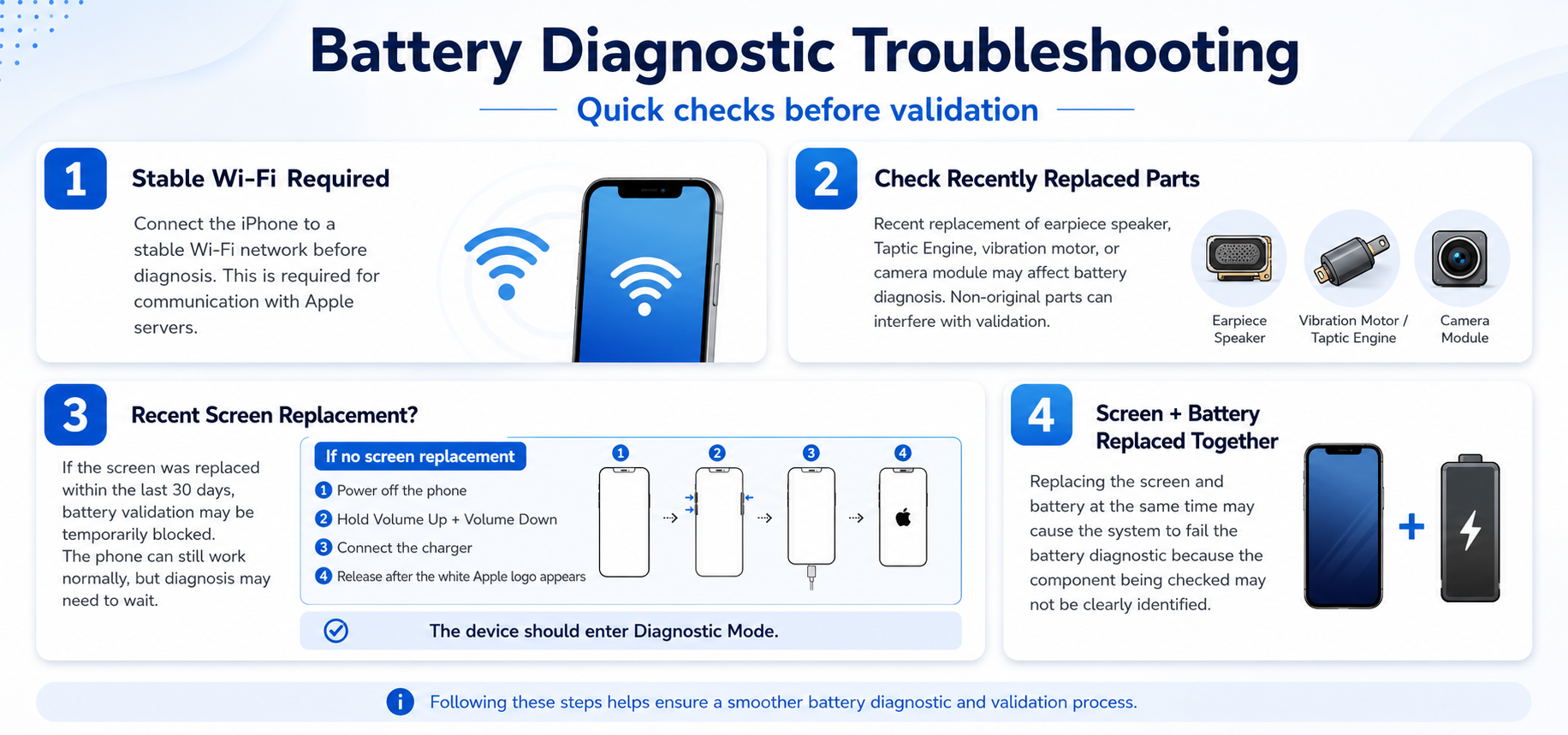

When repair shops, refurbishers and spare-parts buyers search for an iPhone no pop up battery supplier, they are usually trying to solve a practical repair problem. A replacement battery may fit the phone and power it on, but if the device shows an unverified parts message, unclear Battery Health information or a confusing service-history status, the repair becomes harder to explain, harder to resell and harder to support after the sale.
What Is an iPhone No Pop Up Battery?
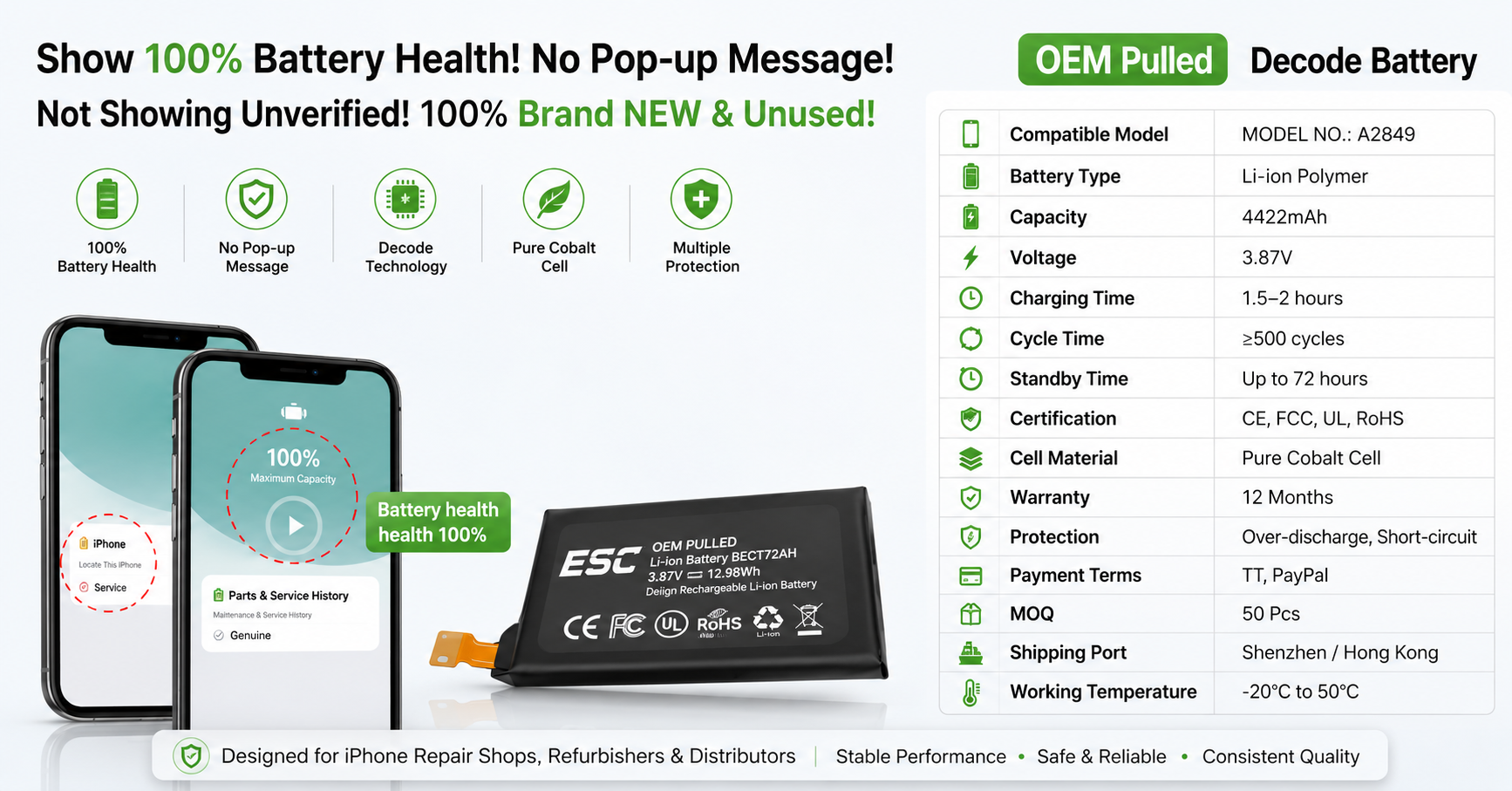
An iPhone no pop up battery is a replacement battery solution designed to reduce visible battery-related warning messages after installation.
In the repair market, “no pop-up” usually means the battery is expected to help the phone present a cleaner customer-facing result after replacement.
It may refer to:
🔋 Battery Health display support
⚠️ Reduced warning-message risk
📱 Cleaner Parts & Service screen behavior
🛠️ Better repair handover experience
📦 Better suitability for refurbishing and resale
However, buyers should understand one important point:
A no-pop-up battery is not automatically the same as an original Apple battery.
The final result can depend on the iPhone model, iOS version, battery structure, installation method, battery board design, device condition and repair history.
For professional buyers, the correct question is not only:
“Does this battery fit?”
The better question is:
“Will this battery help the phone behave cleanly after service?”
Why Does the No Pop-Up Issue Matter in Real Repair Work?
Battery replacement is no longer judged only by whether the phone turns on.
Customers now check the phone after repair.
They may open Battery Health.
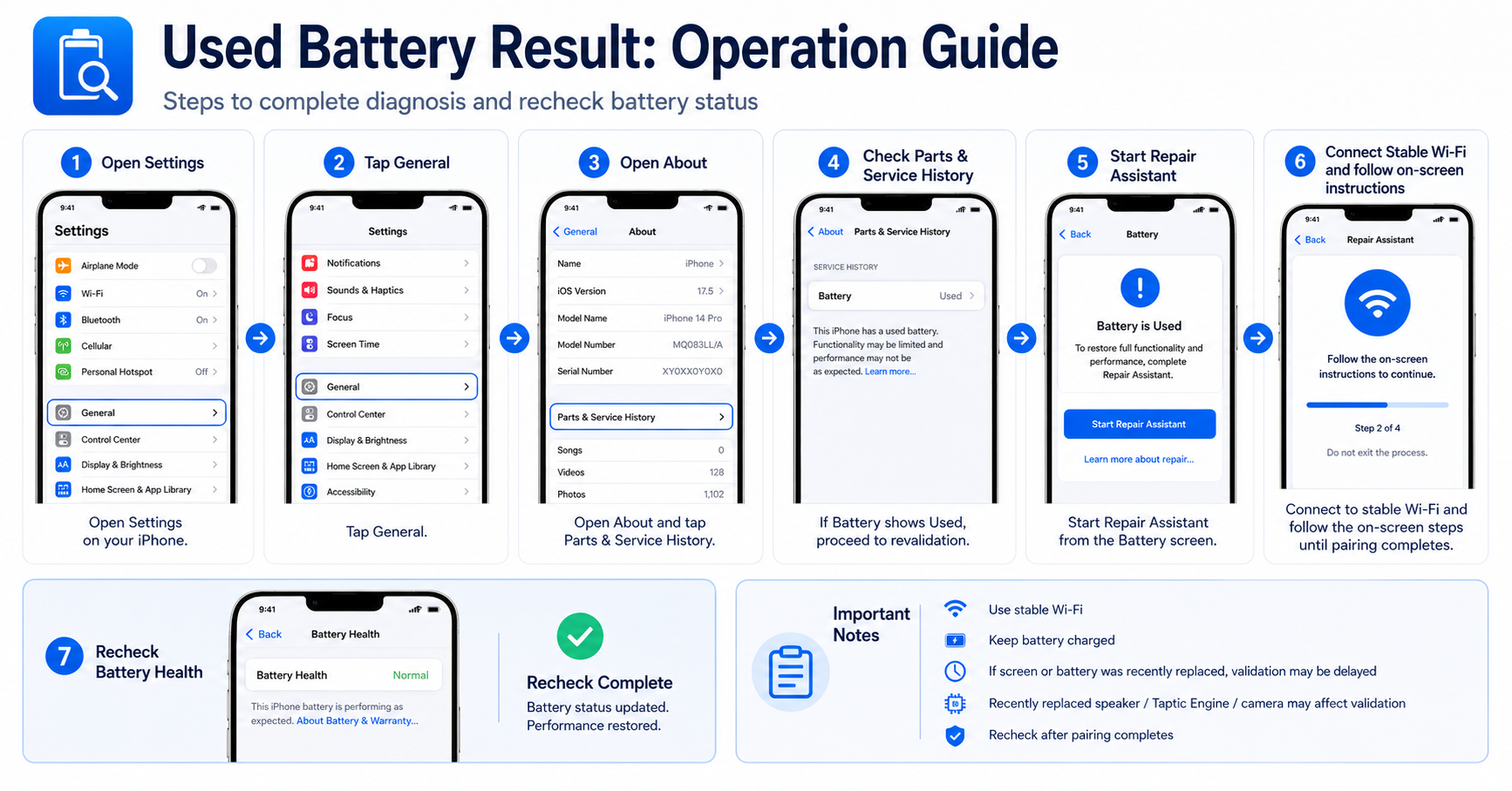
They may check Parts & Service History.
They may ask why a warning appears.
They may question whether the battery is original, safe, new or properly installed.
For repair shops, this creates explanation pressure.
For refurbishers, it creates grading and resale risk.
For wholesalers, it creates downstream complaints.
For e-commerce sellers, it creates return pressure.
For private label buyers, it can damage brand trust.
That is why this category matters.
A good iPhone no pop up battery supplier helps buyers reduce service friction, not only restore battery capacity.
How Can a No-Pop-Up Battery Help Repair Shops?
A no-pop-up battery can support repair businesses in three practical ways.
1. Cleaner Customer Handover
If the phone shows battery information more clearly after installation, the technician has less explaining to do.
This makes the repair feel more complete and professional.
2. Lower Return and Complaint Risk
Many customer complaints start from what the phone displays after repair.
A cleaner interface result can reduce unnecessary doubts, callback visits and warranty disputes.
3. Better Refurbishment and Resale Value
Refurbished iPhones are often checked by buyers before resale.
Battery Health, service messages and visible warnings can affect buyer confidence.
A battery that supports a cleaner post-install result is more useful for refurbishment operations.
Product Data Buyers Should Review
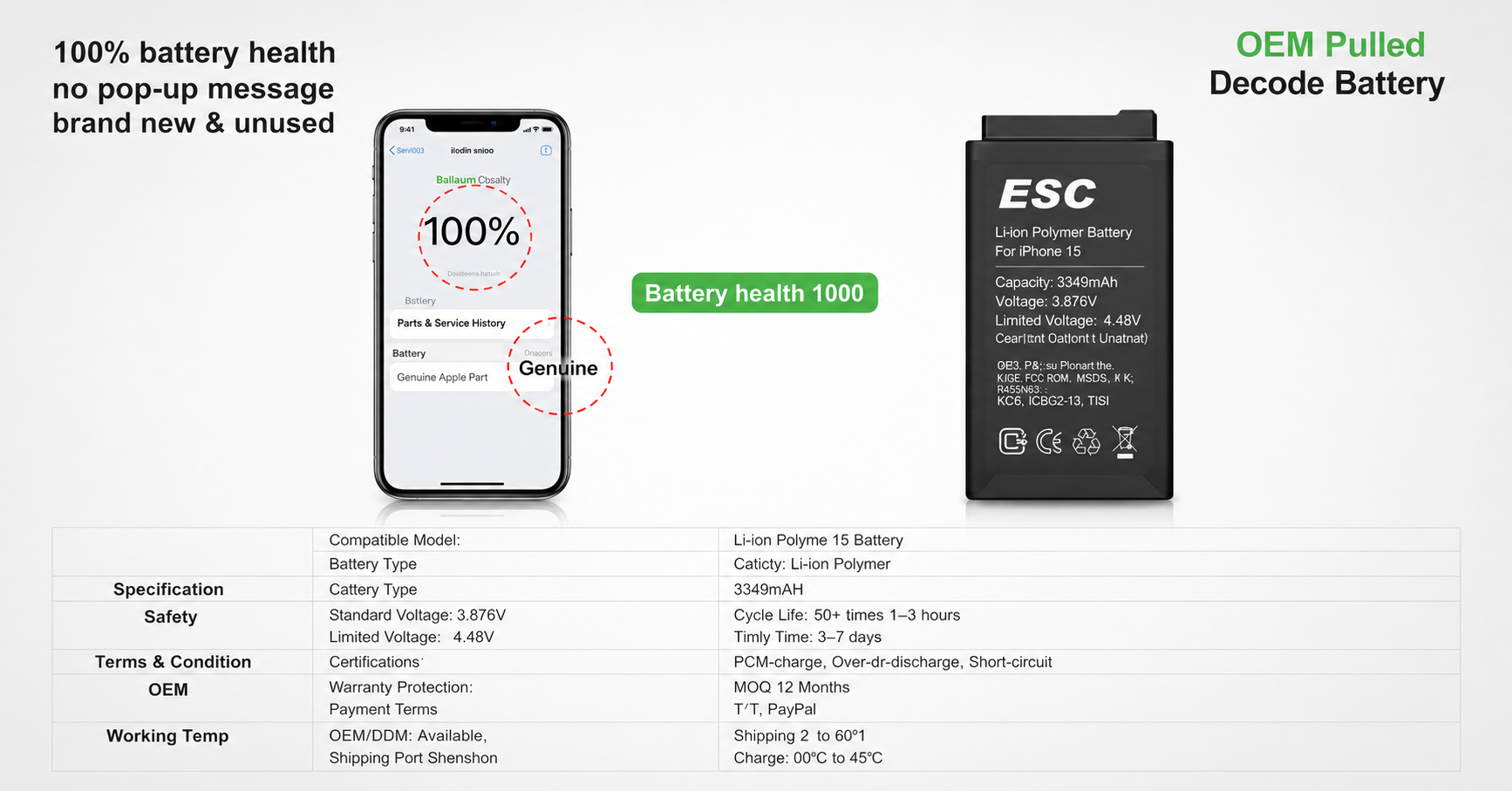
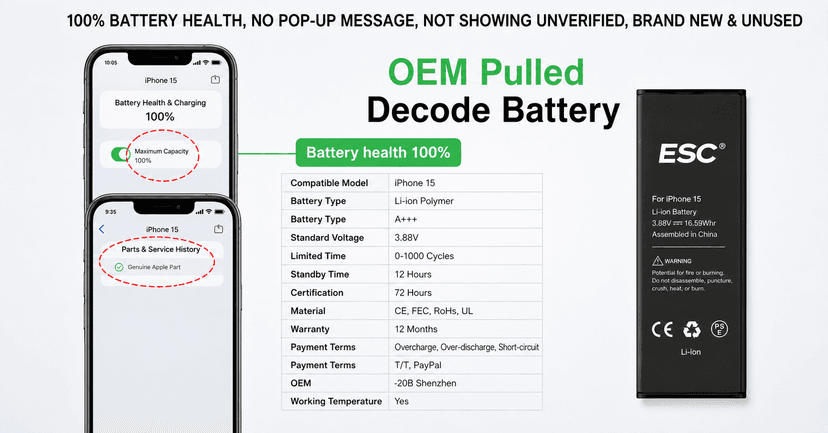
The supplied product data describes an iPhone 15 replacement lithium-ion battery with visible specification points.
These details help buyers compare the product, but they should still be verified through sample testing.
| Buyer Checkpoint | Visible Product Information | Why It Matters |
|---|---|---|
| Battery type | Li-ion / Li-ion polymer | Standard chemistry category for smartphone replacement batteries |
| Target model | iPhone 15 replacement battery | Helps define compatibility and stocking purpose |
| Capacity | 3349mAh | Gives a baseline for runtime comparison |
| Energy | 12.98Wh | Useful for battery specification and transport reference |
| Standard voltage | 3.876V | Helps confirm electrical design range |
| Charge limit voltage | 4.48V | Important for charging behavior and protection design |
| Protection | PCM board mentioned | Helps control over-charge, over-discharge and short-circuit risk |
| MOQ | 20 pcs / small wholesale quantity | Suitable for sample testing and repair-shop stocking |
| Warranty | 12 months claimed | Useful only if the supplier has a clear claim process |
| Working temperature | -10°C to 50°C claimed | Useful for storage and service handling reference |
Printed data is important, but it does not prove batch stability by itself.
A serious buyer should test real samples before placing larger orders.
How Can Buyers Evaluate an iPhone No Pop Up Battery Supplier?
Buyers should evaluate the supplier from the repair workflow, not only from the product photo.
1. Check Exact Model Compatibility
Do not assume one iPhone 15 battery fits all iPhone 15-series models.
Buyers should confirm:
iPhone 15
iPhone 15 Plus
iPhone 15 Pro
iPhone 15 Pro Max
Battery model code
Connector position
Flex cable design
iOS compatibility behavior
Wrong model matching can cause fit problems, display problems or after-sales complaints.
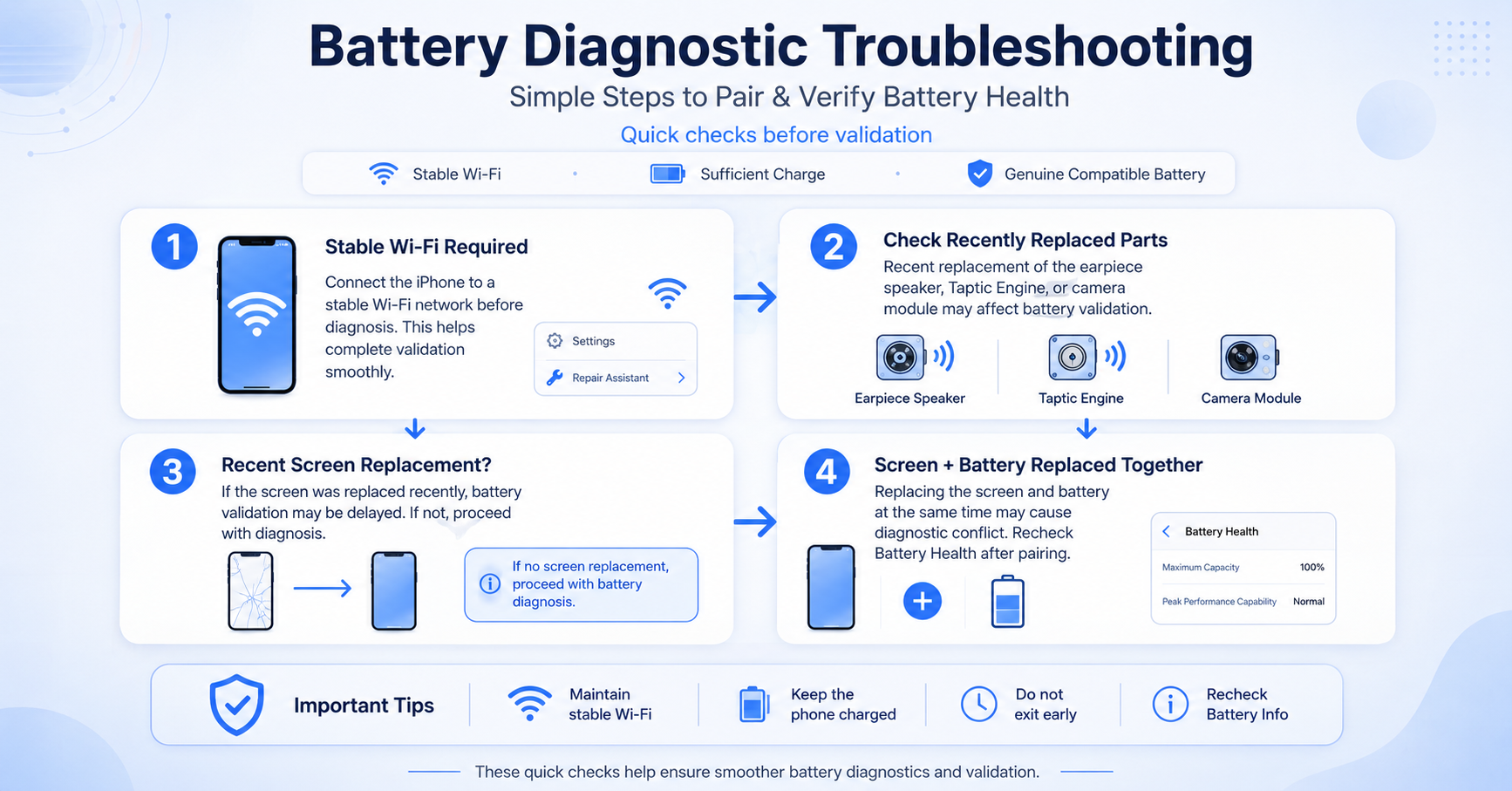
2. Check Battery Health and Service-Screen Behavior
For this category, the phone’s display result matters.
Buyers should test:
Does Battery Health display normally?
Does the phone show warning messages?
Does the battery percentage remain stable?
Does the phone show unverified or unknown part status?
Does the result remain stable after restart?
Does the behavior remain consistent after charging and discharging?
A supplier screenshot is not enough.
Real-device testing is necessary.
3. Check Protection Board and Safety Design
A replacement iPhone battery should not be evaluated only by capacity.
Buyers should check whether the battery includes basic safety protection, such as:
Over-charge protection
Over-discharge protection
Short-circuit protection
Stable PCM board
Good connector quality
Reliable flex cable structure
For service inventory, safety design is a basic requirement, not a premium feature.
4. Check Packaging and Traceability
Repair shops and wholesalers need batteries that are easy to identify and manage.
Good packaging should include:
Model label
Capacity label
Batch number
QR code or barcode
Clear carton mark
Retail packaging option
Protection against pressure and flex cable damage
Traceability becomes important when one batch causes complaints.
5. Check Documents Before Export or Distribution
If the supplier claims CE, FCC, RoHS, MSDS, UN38.3, PSE, KC, IEC62133 or TISI, buyers should request actual supporting files.
Certification logos on a product image are not the same as verified documents.
For cross-border battery shipping, UN38.3 and MSDS are especially important.
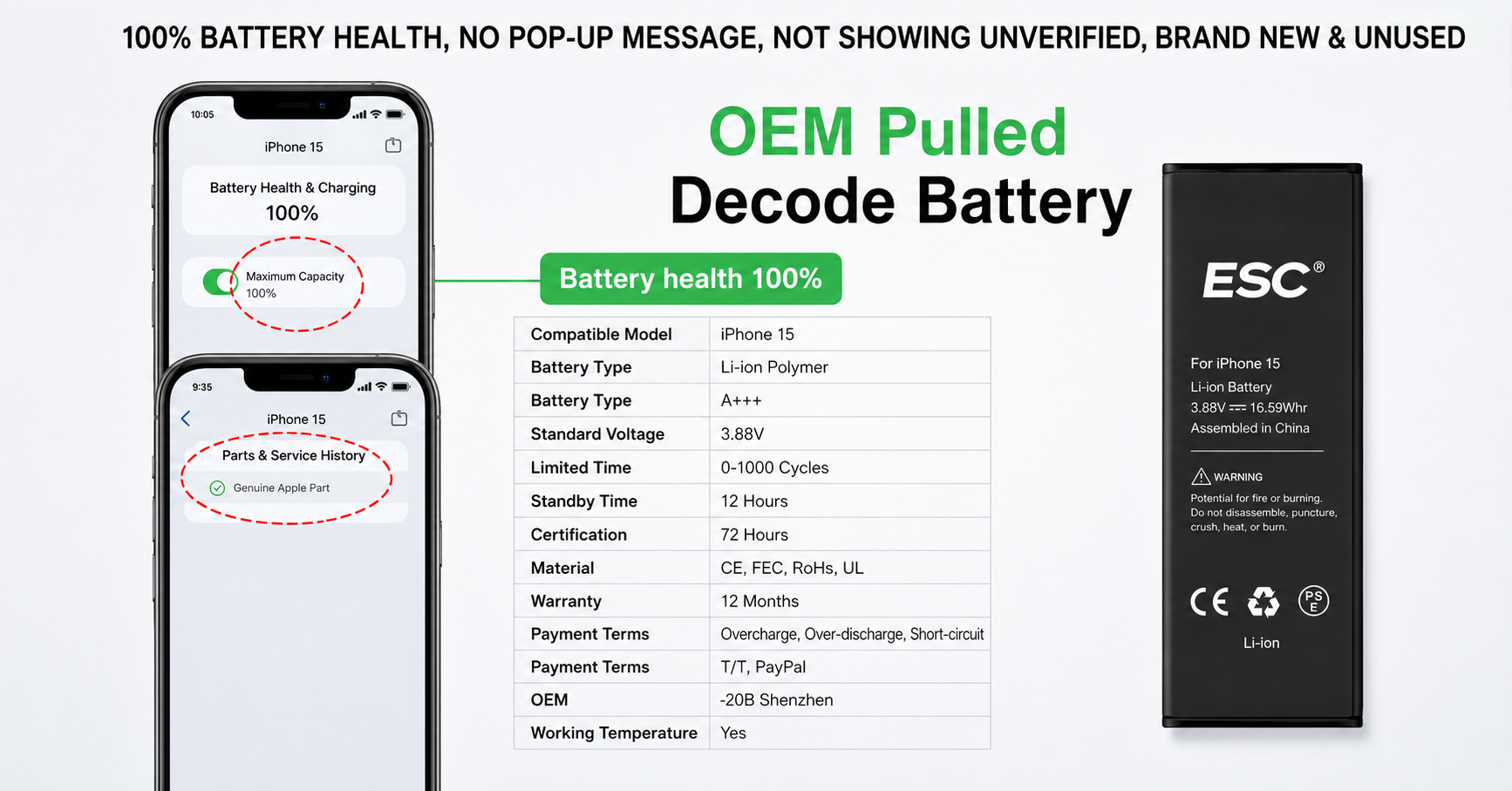
Chart: What Different Buyers Care About
| Buyer Type | Main Concern | What to Check |
| Repair Shop | Customer handover and fewer complaints | No pop-up behavior, Battery Health display, fit, charging stability |
| Refurbisher | Device grading and resale confidence | Batch consistency, service-screen behavior, standby drain |
| Wholesaler | Repeat supply and downstream satisfaction | Packaging, model labels, MOQ, warranty handling |
| E-commerce Seller | Return rate and product reviews | Clear claims, compatibility, real customer experience |
| Private Label Buyer | Brand trust and product positioning | OEM packaging, labels, barcode, warranty card, QC records |
| Export Distributor | Compliance and logistics | MSDS, UN38.3, carton marks, transport documents |
How Can Buyers Avoid Overpromising?
No-pop-up battery claims should be handled carefully.
Do not promise that every phone will behave exactly the same.
Do not describe an aftermarket battery as an original Apple battery unless there is verified proof.
Do not treat one screenshot as batch-level evidence.
Do not rely only on printed capacity.
Do not ignore iOS version, repair method and device condition.
A professional product page should explain the battery’s intended use clearly:
Suitable for iPhone repair shops.
Suitable for refurbishment projects.
Designed to reduce visible battery warning issues where supported.
Actual display behavior may depend on model, software and installation conditions.
This kind of wording is safer, more professional and more credible for B2B buyers.
Common Mistakes Buyers Make
❌ Mistake 1: Assuming all replacement batteries are the same
Two batteries with the same capacity can behave very differently after installation.
❌ Mistake 2: Buying only because of “100% Battery Health” screenshots
A clean screenshot is useful, but it does not prove batch consistency.
❌ Mistake 3: Ignoring physical fit
Connector alignment, flex cable quality and adhesive layout can affect installation quality.
❌ Mistake 4: Not defining “no pop-up” clearly
Buyers should define whether they mean no warning prompt, Battery Health display, service-history status or all of these.
❌ Mistake 5: Skipping sample testing
A small sample order is cheaper than fixing a failed bulk order.
❌ Mistake 6: Ignoring shipping documents
Lithium batteries need proper documents for safe and legal transport.
Practical Buyer Checklist
✅ Confirm exact iPhone model compatibility
✅ Check capacity, voltage and charge limit voltage
✅ Test Battery Health display after installation
✅ Check whether warning messages appear
✅ Test several samples from the same batch
✅ Check connector, flex cable and adhesive fit
✅ Review PCM protection design
✅ Confirm packaging and carton labels
✅ Request MSDS and UN38.3 if shipping internationally
✅ Confirm MOQ, lead time and warranty handling
✅ Avoid relying only on supplier screenshots
✅ Record test results by model and iOS version
FAQ
What is an iPhone no pop up battery supplier?
An iPhone no pop up battery supplier provides replacement batteries designed to reduce visible battery-related warning messages after installation, depending on the phone model, iOS version, battery design and repair method.
Is a no-pop-up battery the same as an original Apple battery?
No. A no-pop-up battery should not automatically be described as an original Apple battery. It is usually an aftermarket or service-oriented replacement battery solution.
Will a no-pop-up battery always show 100% Battery Health?
Not always. Battery Health display can depend on battery design, installation method, device condition, iOS version and supplier process. Buyers should test samples before bulk ordering.
What does “OEM pulled” mean?
In the market, “OEM pulled” can have different meanings. Buyers should ask whether the battery is a pulled original part, a reworked battery, an aftermarket replacement or a newly manufactured equivalent.
Is 3349mAh suitable for iPhone 15 replacement?
3349mAh is the supplied printed capacity. Buyers should verify actual capacity, runtime and batch consistency through testing.
What is the biggest risk when buying no-pop-up batteries?
The biggest risk is assuming the display result is guaranteed across all devices. Real results can vary by device, system version and repair process.
What documents should buyers request for battery shipping?
For lithium battery shipping, buyers commonly request MSDS, UN38.3 and relevant transport documentation. Market-specific documents such as CE, RoHS, PSE, KC, IEC62133 or TISI may also be needed depending on destination.
Who should buy this type of battery?
This type of battery is mainly suitable for repair shops, refurbishers, parts wholesalers, e-commerce repair-kit sellers and private label battery buyers.
Summary
An iPhone no pop up battery supplier helps repair shops and refurbishers solve a real business problem: reducing visible battery-warning friction after replacement.
The value of this battery category is not only the printed capacity.
It includes model compatibility, Battery Health behavior, service-screen result, physical fit, protection board quality, packaging, documents and supplier support.
For buyers, the safest sourcing method is practical:
Start with a sample order.
Test on real iPhones.
Check Battery Health.
Watch for warning messages.
Review labels and documents.
Confirm after-sales handling.
Then decide whether the product is suitable for daily repair, refurbishment, wholesale distribution or private label supply.
A good no-pop-up battery program should help repair shops move faster, reduce customer doubts and support more reliable resale and repair operations.