
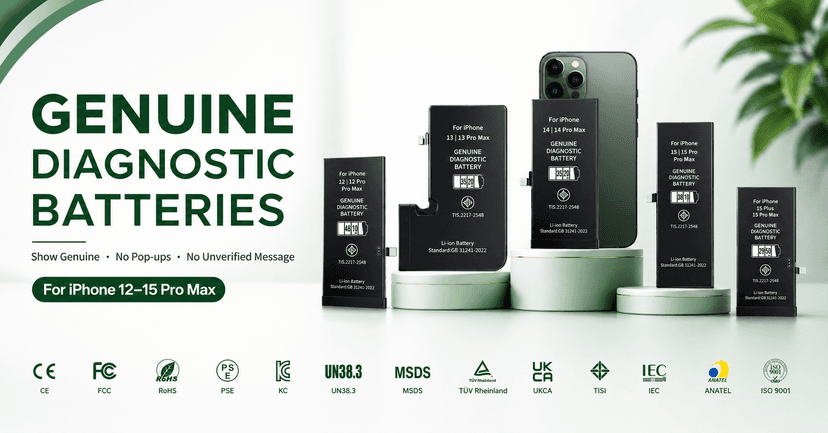
For repair shops and refurbishers, choosing an iPhone battery supplier is no longer a simple parts-buying job. A replacement battery may power on the phone, but if the device shows an unverified battery message, unclear Battery Health information or an unexpected service-history status, the repair can still become a customer complaint. This is why many professional buyers now search for an iPhone no pop-up battery supplier instead of only searching for a normal iPhone battery wholesaler.
What Is an iPhone No-Pop-Up Battery?
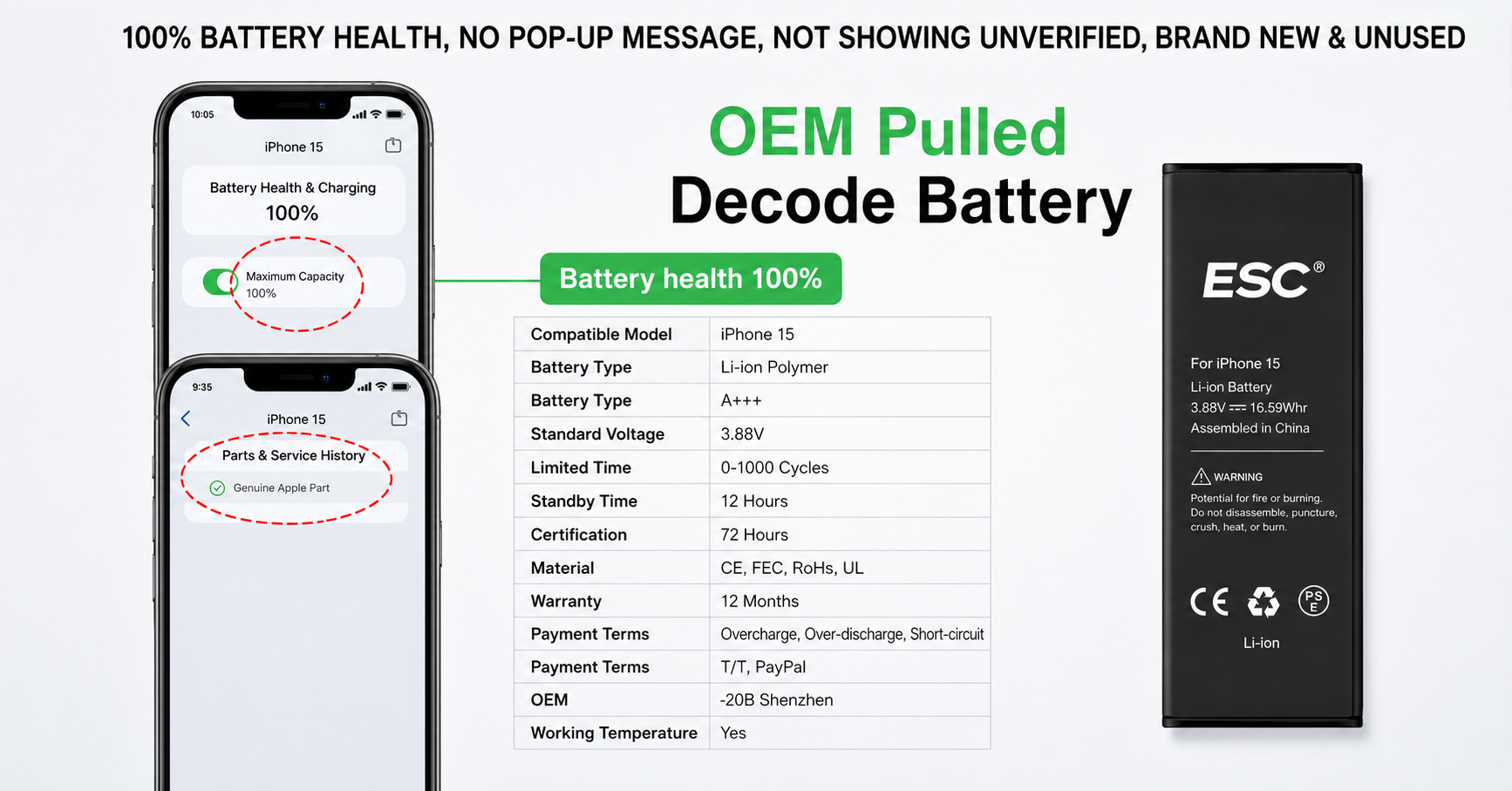
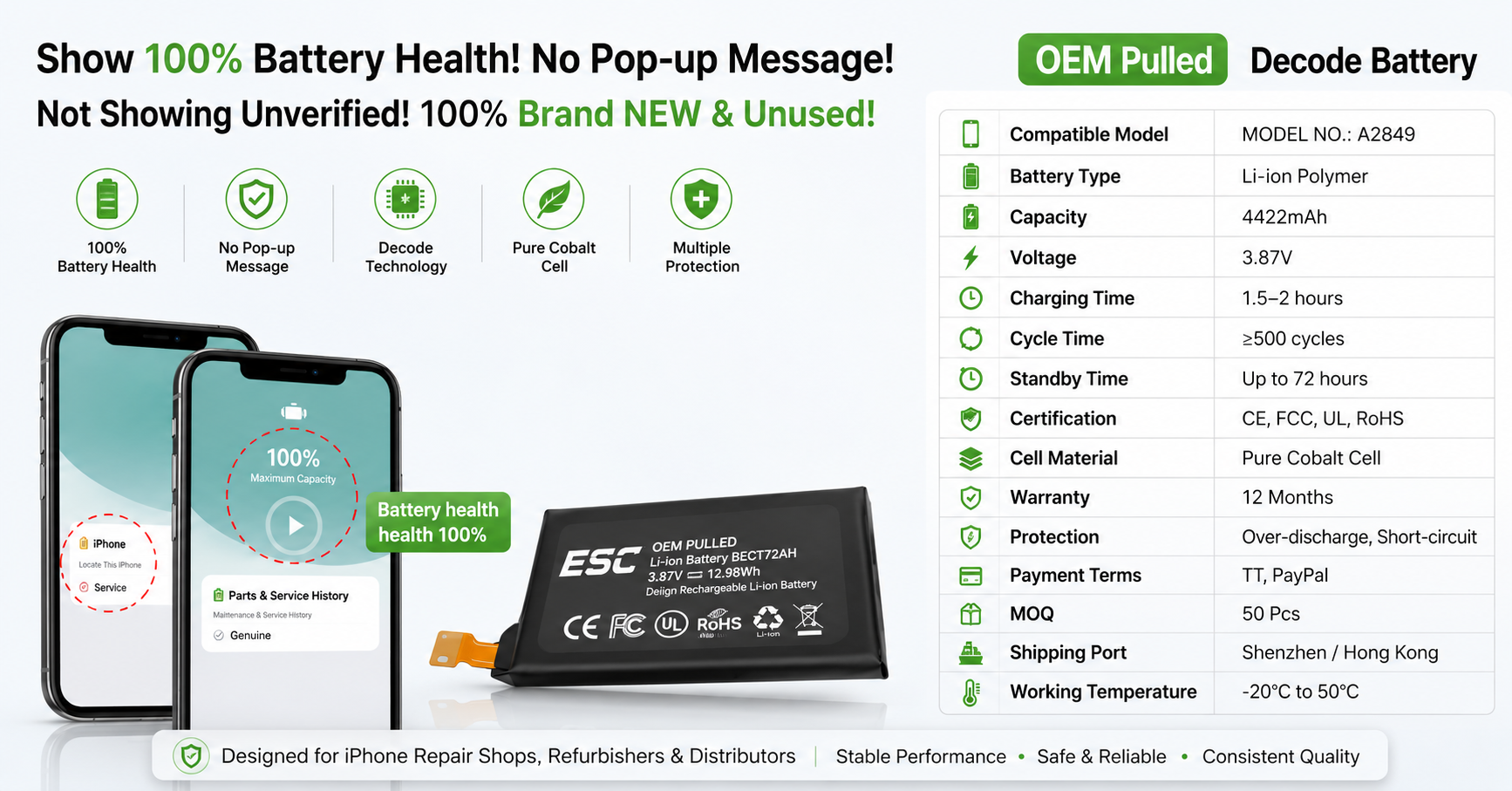
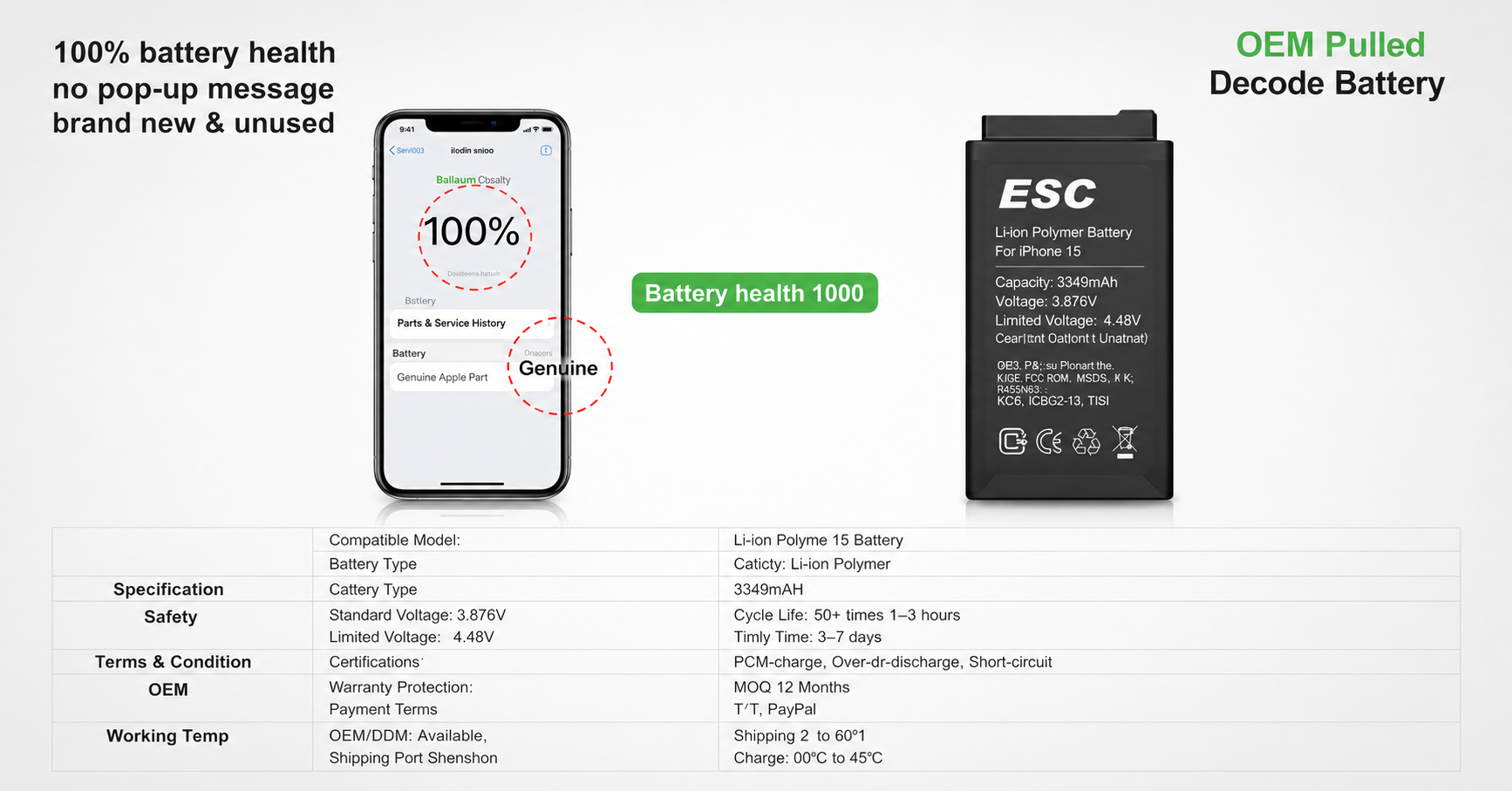
An iPhone no-pop-up battery is a replacement battery solution designed to reduce visible battery-related warning messages after installation.
In repair-market language, “no pop-up” usually means the battery is intended to help the phone show a cleaner customer-facing result after replacement.
It may refer to:
Battery Health display support
Reduced unverified battery message risk
Cleaner Parts & Service screen behavior
Better customer handover after repair
Better suitability for refurbished phone resale
However, buyers should be careful.
A no-pop-up battery should not automatically be described as an original Apple battery.
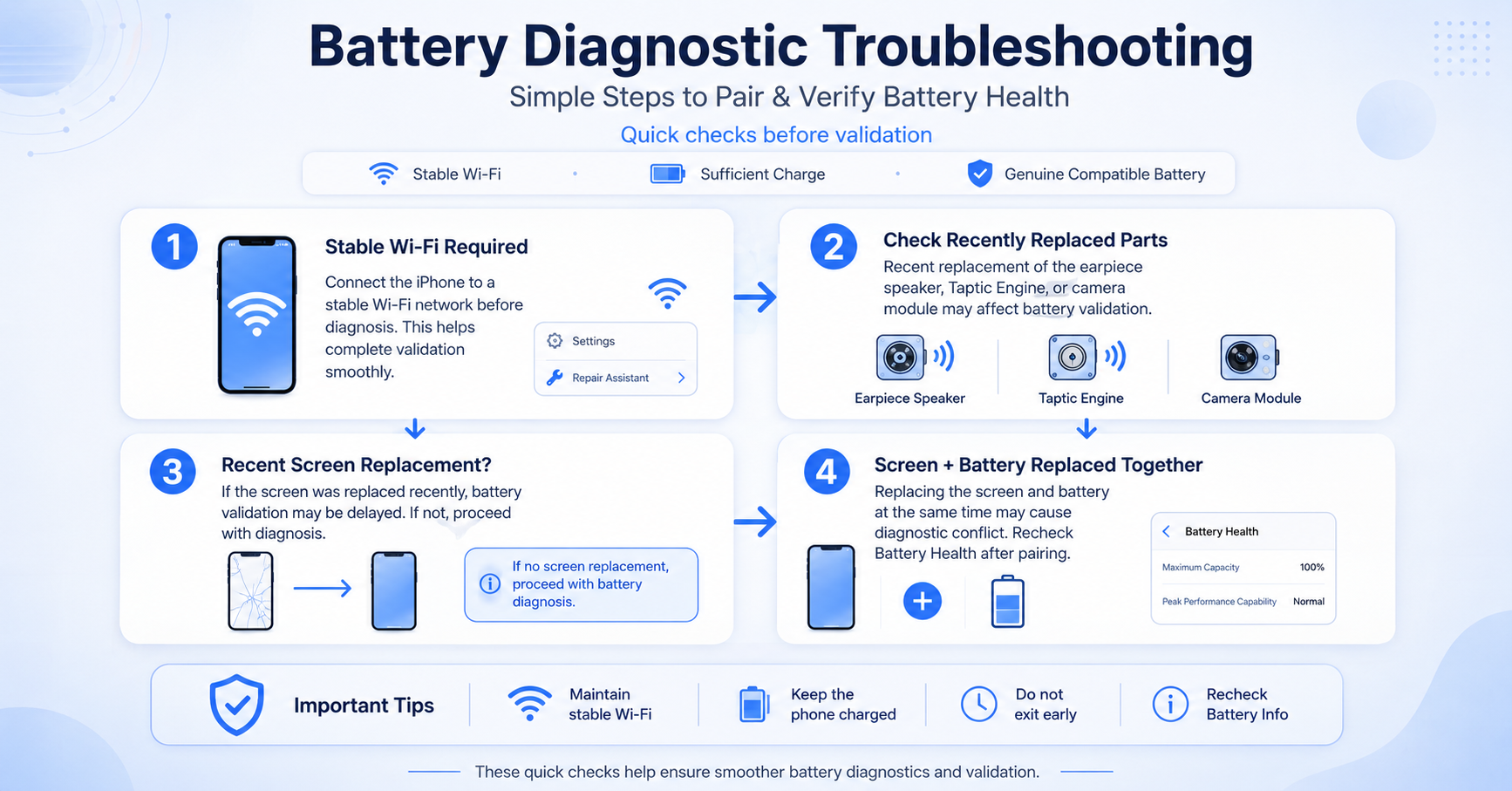
The final result can depend on the iPhone model, iOS version, repair method, battery board design, device condition and installation quality.
For professional buyers, the correct question is not only:
“Does this battery fit the phone?”
The better question is:
“Will this battery help the phone behave properly after service?”
Why iPhone Battery Sourcing Is No Longer Only About Capacity
Years ago, most buyers mainly compared iPhone replacement batteries by model, price and capacity.
That is no longer enough.
Today’s repair shops also care about what the customer sees after installation.
Customers may check Battery Health.
They may check Parts & Service History.
They may ask why a warning message appears.
They may question whether the battery is new, safe or properly installed.
For repair shops, this creates explanation pressure.
For refurbishers, it affects device grading and resale value.
For wholesalers, it creates downstream complaints.
For e-commerce sellers, it can become return requests and negative reviews.
For private label buyers, unstable battery behavior can damage brand trust.
This is why no-pop-up battery solutions have become more important in the iPhone repair supply chain.
How Can an iPhone No-Pop-Up Battery Help Repair Businesses?
An iPhone no-pop-up battery can help repair businesses in three practical ways.
1. It Reduces Customer Doubt
When the phone shows cleaner battery information after replacement, the customer is less likely to question the repair result.
This helps repair shops complete handover faster and with fewer explanations.
2. It Supports Better Refurbished Phone Resale
Refurbished phone buyers often check Battery Health and visible service information before purchase.
A phone with a warning message may still work, but it may be harder to sell at a good price.
3. It Helps Wholesalers Build a Higher-Value Battery Line
Wholesalers can separate basic replacement batteries from diagnostic or no-pop-up battery options.
This creates a more professional product structure instead of competing only on low price.
What This Battery Category Is Trying to Solve
In practical repair work, iPhone battery buyers usually want to solve four problems.
Restore usable runtime after the original battery has degraded.
Reduce visible warning messages after replacement.
Improve Battery Health and service-screen presentation.
Reduce return pressure from repair shops, refurbishers and downstream buyers.
That means this product category sits between battery hardware and repair workflow.
The battery must fit.
The battery must perform.
The battery must also support a cleaner customer-facing repair experience.
Key Specifications Buyers Should Check
A serious iPhone battery supplier should provide clear and stable battery data.
For an iPhone replacement battery, buyers should review the following points:
| Checkpoint | What to Check | Why It Matters |
|---|---|---|
| Compatible model | Exact iPhone model and generation | Avoids wrong fit and return claims |
| Battery type | Li-ion / Li-ion polymer | Defines the battery chemistry category |
| Capacity | mAh rating by model | Helps compare runtime expectation |
| Energy | Wh value where available | Useful for transport and documentation |
| Standard voltage | Nominal voltage | Helps confirm electrical design |
| Charge limit voltage | Maximum charge voltage | Relevant to charging behavior |
| Battery shape | Flat, L-shaped or stepped design | Affects installation fit |
| Connector and flex | Position and cable quality | Affects physical connection |
| PCM protection | Over-charge, over-discharge, short-circuit protection | Basic safety requirement |
| Label clarity | Model, capacity, voltage, batch info | Reduces picking mistakes |
| Packaging | Inner protection and carton labels | Reduces shipping damage |
| Documents | MSDS, UN38.3 and relevant certificates | Supports legal battery shipping |
Printed specifications are useful, but they do not prove batch stability by themselves.
Buyers should still test real samples before placing larger orders.
Why “No Pop-Up” Cannot Be Treated as a Universal Guarantee
The phrase “no pop-up” is useful, but it should be used carefully.
It is not a formal universal standard.
Different suppliers may use different battery board designs, repair methods or programming approaches.
Final results may vary depending on:
iPhone model
iOS version
Battery board design
Repair method
Installation quality
Device service history
Battery connector condition
Prior component replacement
That is why professional buyers should avoid absolute claims such as:
Works on every iPhone
Always shows 100% Battery Health
Always no warning
Same as original Apple battery
A safer and more professional B2B description is:
Designed to reduce visible battery warning messages on supported iPhone models when installed correctly.
This wording is more credible and more suitable for long-term business.
No-Pop-Up Battery vs Standard iPhone Replacement Battery
| Item | Standard iPhone Battery | No-Pop-Up / Diagnostic Battery |
| Main purpose | Restore power | Restore power and reduce warning friction |
| Buyer focus | Price, capacity, fit | Fit, display behavior, Battery Health, service screen |
| Best use case | Cost-sensitive repair | Professional repair, refurbishment, resale |
| Customer questions | May be higher | Usually easier to explain if result is clean |
| Supplier requirement | Basic model coverage | Stronger technical and workflow support |
| Risk if unstable | Fast drain or no charging | Warning messages, customer doubt, resale issue |
The point is not that standard batteries are useless.
Standard batteries are still suitable for many price-sensitive repairs.
But for repair shops and refurbishers that need better customer-facing results, a no-pop-up battery can offer stronger business value.
Where These Batteries Fit in the Supply Chain
iPhone no-pop-up batteries are mainly suitable for B2B service channels.
Repair Shops
Repair shops need batteries that install cleanly, charge normally and reduce customer questions after repair.
Their biggest concern is callback risk.
Refurbishers
Refurbishers need batteries that help phones pass resale inspection.
Their biggest concern is device grading and return rate.
Parts Distributors
Distributors need model coverage, clear labeling and stable batch supply.
Their biggest concern is downstream buyer satisfaction.
E-Commerce Sellers
E-commerce sellers need product descriptions that are accurate and not overpromised.
Their biggest concern is return rate and reviews.
Private Label Buyers
Private label buyers need battery labels, retail boxes, warranty cards, barcodes and product series planning.
Their biggest concern is brand trust.
How Can Buyers Evaluate an iPhone No-Pop-Up Battery Supplier?
A good supplier should be evaluated by repair outcome, not only by product images.
1. Confirm Exact Model Coverage
Buyers should confirm the exact compatible models.
For example, iPhone 12, 12 Pro, 12 Pro Max, 13 mini, 13, 13 Pro, 13 Pro Max, 14 Plus, 14 Pro Max, 15 and 15 Pro may all require different battery shapes, connectors and specifications.
Do not order only by family name.
Always confirm exact SKU and model match.
2. Test Battery Health Behavior
Buyers should install samples into real phones and check:
Battery Health display
Maximum capacity display
Warning-message behavior
Parts & Service screen behavior
Battery percentage stability
Charging behavior
Restart behavior
The phone-screen result matters because customers will see it.
3. Check Physical Fit
Physical fit is often underestimated.
Buyers should check:
Battery thickness
Shape accuracy
Adhesive position
Connector alignment
Flex cable strength
Installation pressure
Compatibility with the phone’s internal structure
A battery that is hard to seat can slow down the repair bench and increase damage risk.
4. Review Labeling and Packaging
Busy repair shops need easy identification.
Good packaging should include:
Clear model label
Capacity and voltage
Batch number
QR code or barcode
Carton marks
Connector protection
Anti-pressure packing
If labels change between batches, picking mistakes and warranty disputes become more likely.
5. Request Documents for Shipping and Compliance
Lithium batteries require proper transport documentation.
Depending on the market and shipping method, buyers may need:
MSDS
UN38.3
Battery transport documents
CE
RoHS
PSE
KC
IEC62133
TISI
Relevant local compliance files
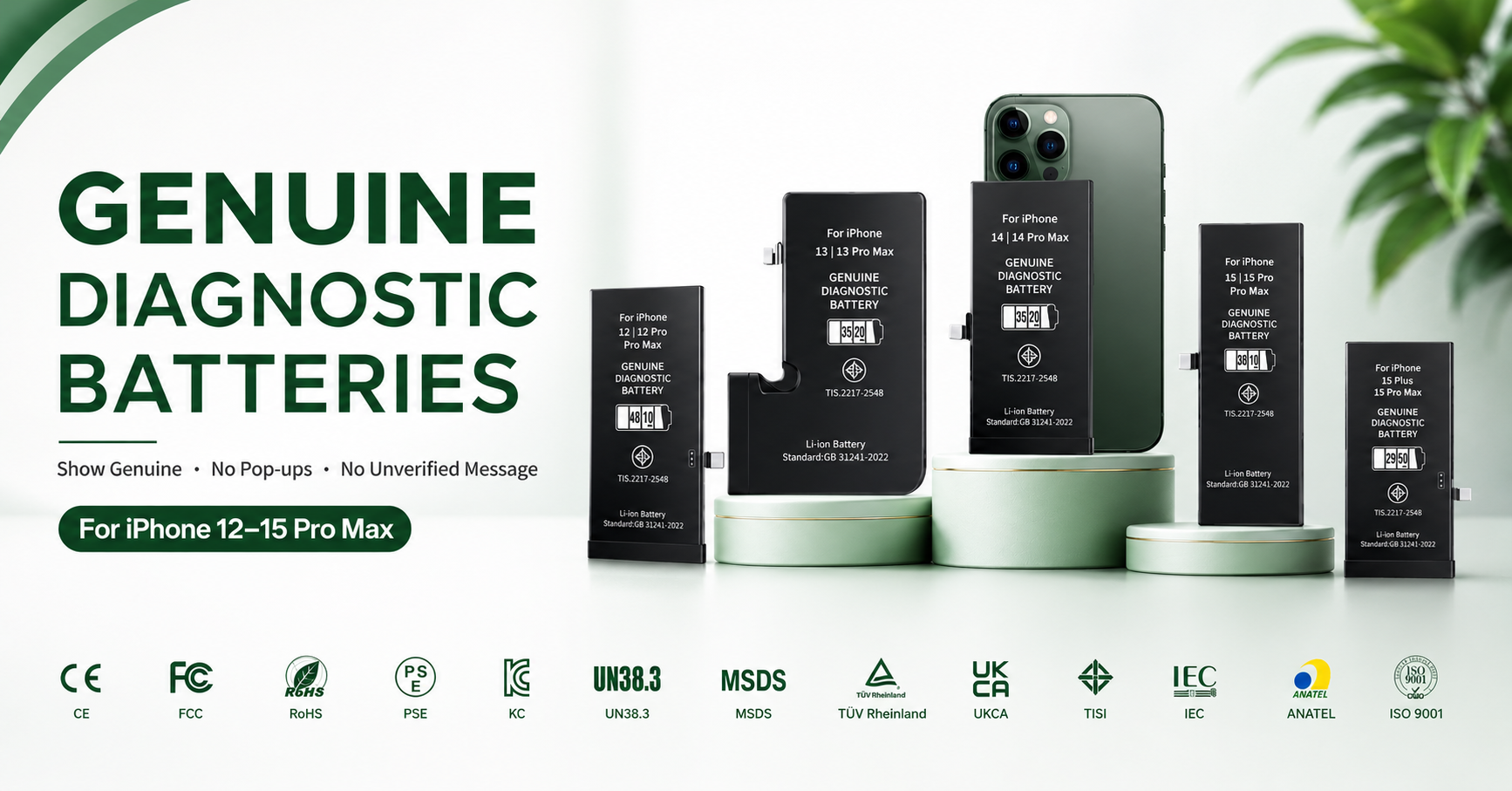
Certification logos in a product image are only signals.
Buyers should request the actual files if they are importing, distributing or selling into regulated markets.
Common Mistakes When Buying iPhone Replacement Batteries
Mistake 1: Ordering by Model Family Only
“iPhone 13 battery” is not specific enough.
Buyers must distinguish between iPhone 13, 13 mini, 13 Pro and 13 Pro Max.
Mistake 2: Focusing Only on Capacity
A higher printed capacity is not useful if the battery is difficult to install or creates warning-message complaints.
Mistake 3: Trusting One Product Image
A screenshot showing Battery Health or clean service status is useful, but it does not prove batch consistency.
Mistake 4: Ignoring Installation Quality
Even a good battery can fail if the flex cable is damaged, adhesive is placed poorly or the device is sealed too quickly.
Mistake 5: Not Defining “No Pop-Up” Internally
Buyers should define exactly what they expect.
Does it mean no warning prompt?
Does it mean Battery Health display?
Does it mean cleaner Parts & Service screen behavior?
Does it require a specific repair workflow?
Clear definitions prevent supplier disputes later.
B2B Procurement Checklist
| Before Ordering | What Buyers Should Do |
| Model confirmation | Request exact SKU list by iPhone model |
| Sample testing | Test real phones before bulk purchase |
| Battery Health check | Verify display behavior after installation |
| Warning-message check | Confirm whether pop-up messages appear |
| Physical fit check | Inspect battery shape, connector and adhesive |
| Packaging review | Check retail pack, inner protection and carton marks |
| Document review | Request MSDS, UN38.3 and market documents |
| Batch consistency | Compare several samples from the same lot |
| Warranty terms | Confirm claim process, not only warranty length |
| Supplier communication | Check whether the supplier can explain technical issues |
This checklist helps buyers avoid the most common sourcing mistakes.
How Can Repair Shops Use These Batteries Better?
Repair shops should not treat every customer the same.
Some customers only want a low-cost replacement.
Some customers care about Battery Health display and warning messages.
A smart repair shop can offer two service levels:
Standard battery replacement for price-sensitive customers.
No-pop-up battery replacement for customers who want a cleaner post-repair result.
This allows the shop to improve service positioning and increase average order value.
How Can Refurbishers Use These Batteries Better?
Refurbishers should test batteries under real resale conditions.
They should check:
Battery Health display
Standby drain
Charging stability
Warning messages
Restart behavior
Screen closing fit
Batch consistency
Packaging traceability
For refurbishment, one unstable batch can affect many finished phones.
That is why consistency matters more than one perfect sample.
FAQ
What is an iPhone no-pop-up battery?
An iPhone no-pop-up battery is a replacement battery solution designed to reduce visible battery-related warning messages after installation on supported iPhone models.
Is a no-pop-up battery the same as an original Apple battery?
No. A no-pop-up battery should not be described as an original Apple battery unless there is verified proof. It is usually an aftermarket or service-oriented replacement solution.
Do all no-pop-up batteries work the same way?
No. Behavior can vary by iPhone model, iOS version, battery board design, repair method and installation quality.
Are capacity numbers enough to judge quality?
No. Capacity is only one factor. Buyers should also check physical fit, safety protection, Battery Health behavior, packaging and batch consistency.
Can certification logos in product images be trusted?
They are useful signals, but buyers should request actual documents for the exact SKU and destination market.
Who should buy no-pop-up iPhone batteries?
Repair shops, refurbishers, parts distributors, e-commerce sellers and private label buyers are the main users.
What should buyers test before bulk orders?
Buyers should test model fit, Battery Health display, warning-message behavior, charging, discharge, internal resistance, packaging and service-screen behavior.
Can no-pop-up batteries remove all customer complaints?
No. They can reduce certain warning-message problems, but repair quality, device condition and installation process still matter.
Conclusion
Sourcing an iPhone battery is no longer only about price, capacity and basic fit.
For professional buyers, the real question is whether the battery can support a clean repair workflow, reduce customer-facing warning messages and perform consistently across real devices.
An iPhone no-pop-up battery supplier should help buyers control three things:
Product fit
Battery performance
Post-repair customer experience
For repair shops, this means fewer callbacks.
For refurbishers, it means better resale confidence.
For wholesalers, it means more stable repeat orders.
For private label buyers, it means stronger brand trust.
Before placing a bulk order, buyers should request exact SKU lists, test samples on real phones, verify Battery Health behavior, check packaging and confirm compliance documents.
A useful iPhone battery program is not the one with the loudest claim.
It is the one that performs consistently in the repair workflow where the buyer actually uses it.