
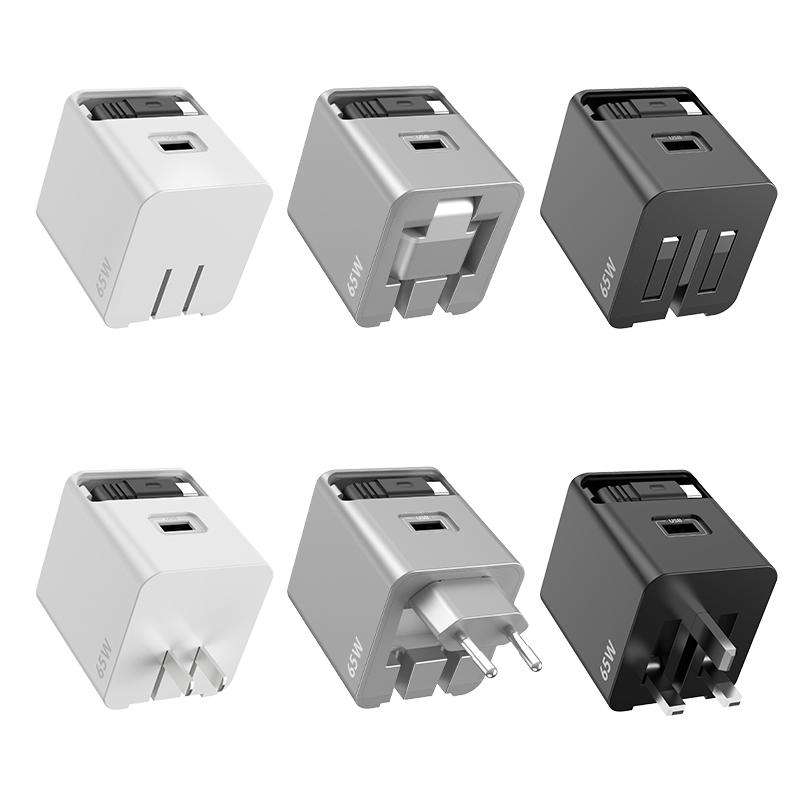
The mold development cycle for fast-charging products typically ranges from 28 to 45 working days. Core costs are primarily driven by mold steel selection, cavity configuration, and structural complexity.
In the fast-charging industry, molds are no longer just tools for plastic injection. They are precision carriers that must support core PCB heat dissipation, comply with global electrical safety creepage distance requirements, and enable clear brand differentiation.
As a B2B buyer or brand owner, you may be facing challenges such as:
-
New product launch speed failing to keep up with market iterations
-
Repeated safety certification failures caused by improper mold structure
-
Severe product homogenization from shared public molds, leading to price wars
AOVOLT’s core R&D team comes from leading smartphone manufacturers such as Xiaomi and OPPO. Through vertically integrated in-house fast-charging ICs and PCBA solutions, we design molds and circuit layouts in parallel, ensuring original-manufacturer-level charging speed, excellent thermal performance, and full patent compliance.
The Complete Lifecycle of Fast-Charging Mold Development
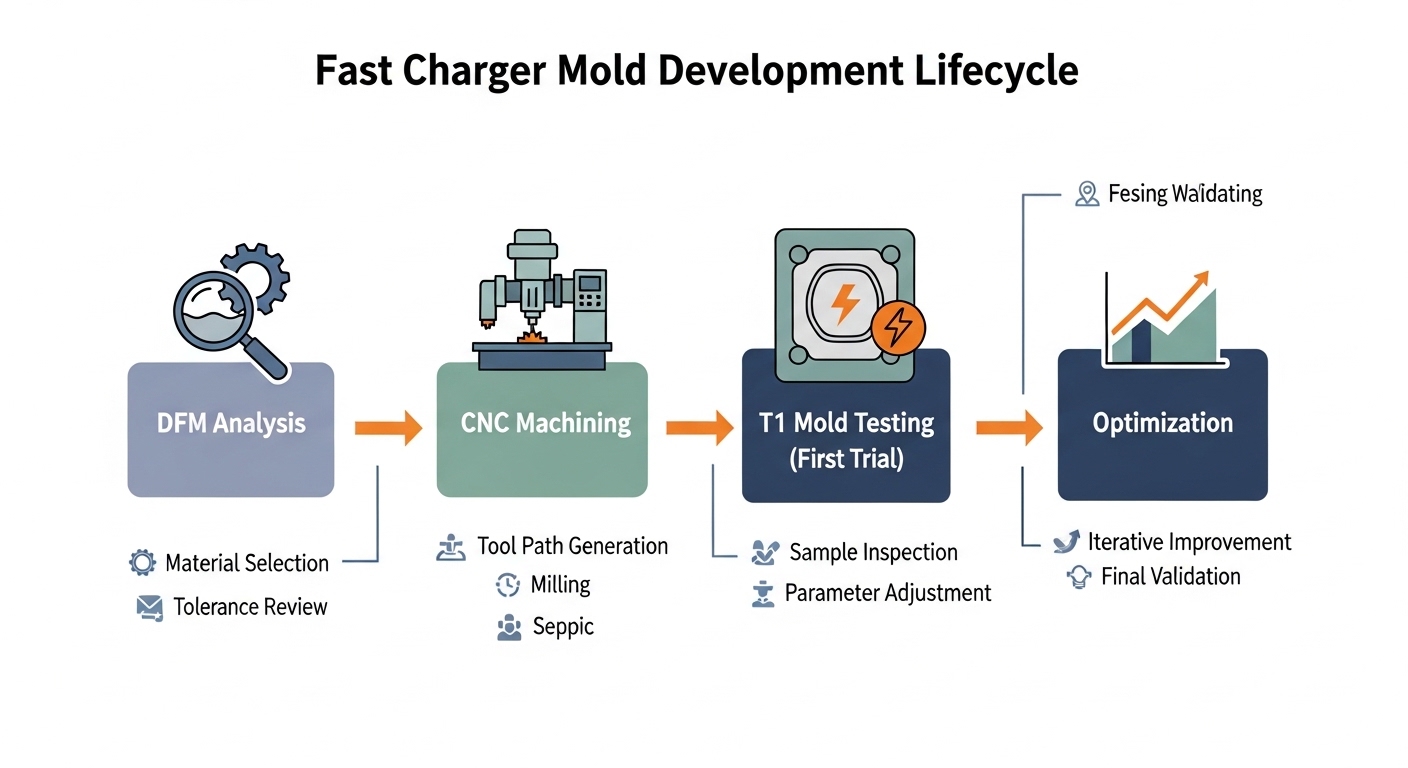
In the 2026 fast-charging market, the widespread adoption of GaN (Gallium Nitride) technology places significantly higher demands on mold design. A standard AOVOLT-level mold development process consists of four critical stages.
DFM (Design for Manufacturing) & Technical Evaluation
Timeframe: 3–5 Days
This is the most critical phase for risk prevention. Our engineers evaluate fast chargers rated at 65W, 100W, or higher, focusing on:
Wall Thickness Analysis
Ensures smooth flow of UL94-V0 flame-retardant PC material, prevents sink marks, and maintains thermal efficiency under high-power operation.
Safety Clearance Planning
Physical isolation distances between high- and low-voltage components are locked in during the mold design stage, ensuring a 100% pass rate for CE and UL certifications.
Precision Machining & CNC Processing
Timeframe: 15–25 Days
Mold durability is determined by steel quality. AOVOLT uses 718H or NAK80 hardened steel, which outperforms standard P20 steel by withstanding higher injection pressures.
-
Injection lifespan: 300,000+ cycles
-
Surface quality: No scratches or deformation
CNC Machining
Ensures seamless enclosure joints and tight tolerances.
EDM (Electrical Discharge Machining)
Micron-level precision for snap-fits and ultrasonic welding zones.
T1 Sampling, Testing & Refinement
Timeframe: 7–10 Days
T1 (first trial mold) samples are sent to certified laboratories for:
-
Drop Testing: Verifies internal reinforcement ribs can withstand a 1.2-meter drop impact
-
Ultrasonic Welding Consistency: Ensures no enclosure cracking under long-term internal pressure
Four Core Cost Drivers in Fast-Charging Mold Development
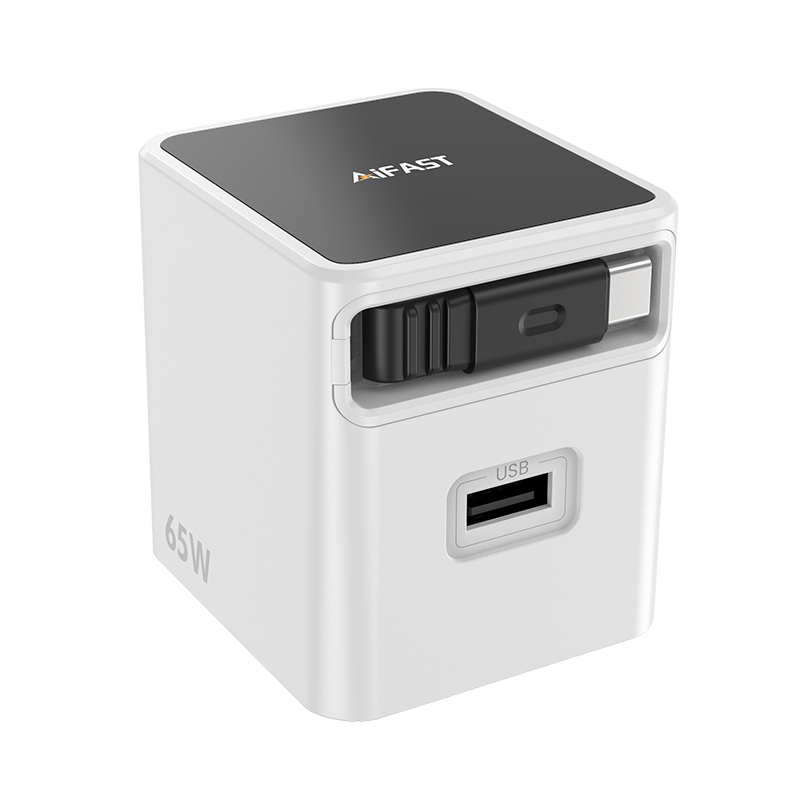
For B2B procurement, focusing solely on the initial mold fee (NRE) is a mistake. Long-term amortized cost and opportunity cost matter more.
Mold Cavity Configuration
The number of cavities directly affects unit injection cost and production capacity.
| Solution Type | Cavity Configuration | Initial NRE Cost | Unit Injection Cost | Typical Use Case |
|---|---|---|---|---|
| Prototyping / Niche Custom | 1×1 (Single) | Low | High | Premium limited editions |
| Standard Economic | 1×2 (Two-Cavity) | Medium | Medium | Startup OEM orders |
| High-Volume Production | 1×4 (Four-Cavity) | High | Lowest | Cross-border bestsellers, global distribution |
Surface Finish Selection
By 2026, market aesthetics favor fine matte textures and Kevlar-style patterns.
-
EDM / Textured Finish: Improved abrasion resistance and fingerprint resistance
-
High-Gloss Finish: Premium appearance but extremely demanding on mold precision—any defect is magnified
Material Compatibility: PC vs. ABS+PC
Fast chargers must use UL94-V0 flame-retardant PC. This material has a higher shrinkage rate. Provide you with a high-performance fast charging PCBA selection guide.
If the mold is designed using standard plastic assumptions, dimensional deviations will occur, directly impacting:
-
PCBA assembly stability
-
Port alignment accuracy
Patented Industrial Design
AOVOLT’s private mold solutions include intellectual property premiums.
Compared with widely available public molds—often flagged or delisted on Amazon—custom molds require 20–30% higher upfront investment, but they:
-
Avoid legal and platform risks
-
Protect distributor market exclusivity
Industry Pitfalls: Why Cheap Molds Usually Cost More
In B2B sourcing, a low initial quote often signals future cost overruns. Based on 15 years in power electronics, we consistently observe three fatal flaws in low-cost molds.
Missing Thermal Path Design
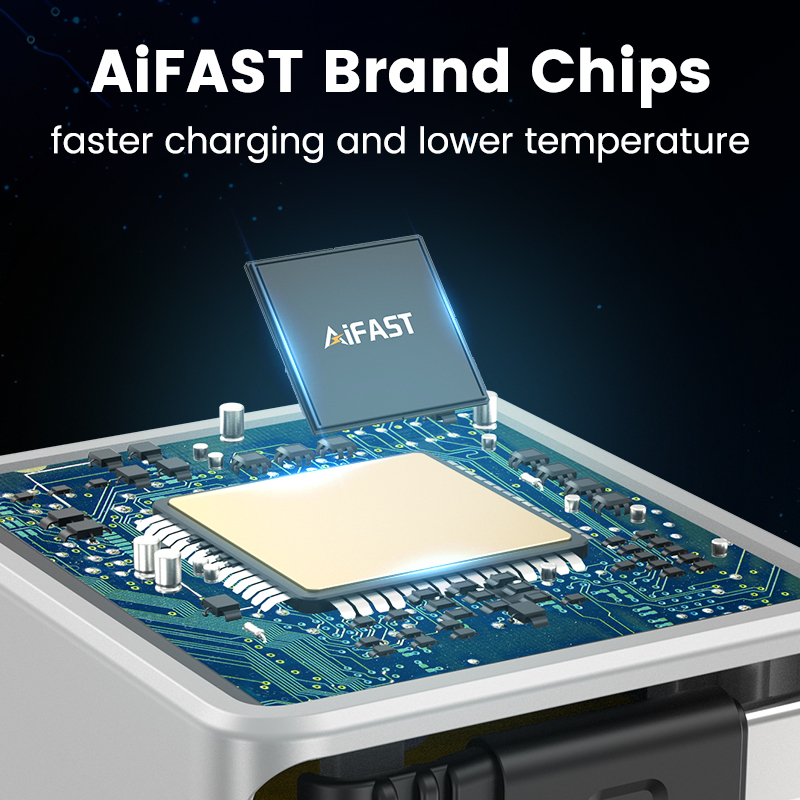
High-power fast chargers—especially 65W+ GaN models—generate extreme internal heat at full load.
-
Low-end designs: Focus only on outer shape, ignoring internal heat conduction
-
AOVOLT solution: Mold engineers design internal ribs and thermal interfaces based on PCBA heat-source distribution, validated by simulation
Result: Enclosure surface temperature fully complies with IEC 62368-1, achieving true low-temperature operation.
“Fake Flame-Retardant” Materials & Mold Degradation
Some factories cut costs by using non-flame-retardant or recycled PC.
Consequences:
-
Accelerated mold corrosion
-
Enclosures deform under heat
-
Failure to pass UL94-V0 testing
If a fire incident occurs at the end-user level, brand owners face massive liability exposure.
Dimensional Accuracy & Port Alignment
A 0.1 mm misalignment of a USB-C port can cause insertion resistance or unstable charging.
-
Low-cost molds shift after repeated cycles
-
AOVOLT uses precision guide pins and sliding block structures
Result: Consistent port alignment across every batch, delivering OEM-grade insertion feel.
How to Optimize Time-to-Market in 2026
The 2026 market does not tolerate long lead times. To help B2B clients enter faster, AOVOLT offers two efficient pathways.
Semi-Customization via Certified Private Molds
If shipment is required within one month, we offer multiple private molds already certified for CE, FCC, RoHS, and UKCA.
-
Customization: Replace laser-etched logo inserts only
-
Lead time: 7–10 days
Advantages:
-
Zero mold investment risk
-
100% compliance certainty
Vertically Integrated Concurrent Development
Traditional OEM workflows build the enclosure first and “fit the electronics later,” leading to wasted space and uneven heat dissipation.
AOVOLT applies Concurrent Engineering:
-
Circuit & Structure in Sync: PCBA chip selection and routing proceed while mold steel is being machined
-
Virtual Assembly: 3D simulations resolve 99% of assembly conflicts before tooling
B2B Decision Checklist & Certification Matrix
Before signing a mold contract, ensure your supplier meets all criteria below:
| Evaluation Item | AOVOLT Standard | Typical OEM Factory | Risk |
|---|---|---|---|
| Mold Steel | 718H / NAK80 (Hardened) | P20 / Carbon Steel | Short lifespan, flash & burrs |
| Certification Support | IEC 62133 / MSDS / UN38.3 | Enclosure samples only | Customs or platform rejection |
| Fast-Charge Protocols | PD 3.1, QC 5.0, PPS | Basic PD 2.0 | Slow charging, poor compatibility |
| IP Protection | Exclusive design patent licensing | Shared public molds | Amazon complaints & account suspension |
Conclusion: Choose a Technology Partner, Not Just a Manufacturer
In the 2026 smart fast-charging market, mold development is no longer a one-time expense—it is the foundation of your competitive moat.
Choosing AOVOLT means working with a technical and commercial team rooted in tier-one smartphone manufacturing, capable of sealing OEM-level speed and extreme safety into a compact enclosure.
Are you planning your next GaN fast charger or high-power power bank?
We can provide a detailed
“2026 Fast-Charging Product DFM Feasibility Analysis Report”
to help you lock in all potential risks before investing in tooling.
Want the latest mold quotations or access to our private mold library?
Contact our expert team today.
References: