
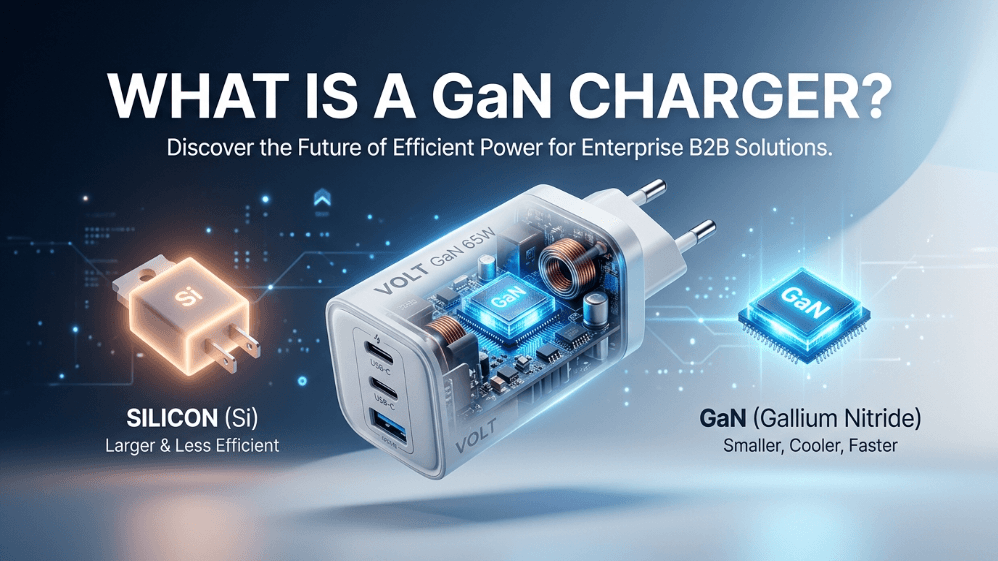
What Exactly Is a GaN Charger?
A GaN charger is a charging adapter that uses Gallium Nitride (GaN) semiconductor material instead of traditional silicon (Silicon) as the core switching device. In essence, it is a power converter that transforms alternating current (AC) into direct current (DC) usable by devices. The introduction of GaN has rewritten the efficiency ceiling of this conversion process at the material physics level.
To understand this difference, we must start with a basic concept in materials science: Band Gap.
Silicon has a band gap of 1.1 eV, while GaN has a band gap of 3.4 eV. A wider band gap means the material can withstand a higher electric field before breakdown. In engineering terms, this means GaN transistors can operate at higher voltages and switch at MHz-level frequencies, while silicon-based transistors typically operate only at hundreds of kHz. Higher switching frequency allows inductors and transformers (passive components) to be much smaller. This is the fundamental reason GaN chargers can reduce size by 50%, not “smarter design.”
In terms of power conversion efficiency, silicon chargers typically operate at 85%–90%, with 10%–15% of energy dissipated as heat. GaN chargers generally exceed 95% efficiency, and high-end PCBA solutions can reach 97% stably. Reduced thermal loss directly eliminates the need for large heat dissipation structures, which is the second driver of size reduction.
Simple conclusion: GaN chargers are smaller, faster, and cooler—not because of better industrial design, but because the material physics itself is superior.
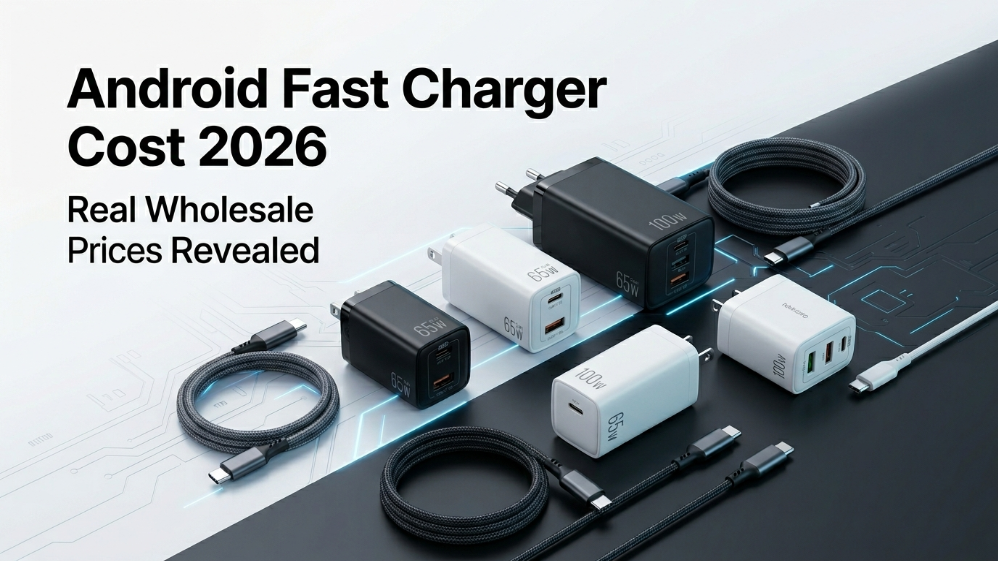
In 2026, a 65W GaN charger has dropped to a wholesale price of $6–9 per unit, is 50% smaller than silicon equivalents, and exceeds 95% efficiency. These three figures alone are enough for any brand still buying silicon chargers in bulk to reconsider their pricing strategy. GaN is no longer a trend—it is the industry baseline.
After the EU Directive 2022/2380 mandated USB-C universal charging ports, the global OEM supply chain is undergoing a forced technological transition. Choosing the wrong charging technology path means your SKU may fail before entering the European market.
Core Technical Comparison: GaN vs Silicon Chargers
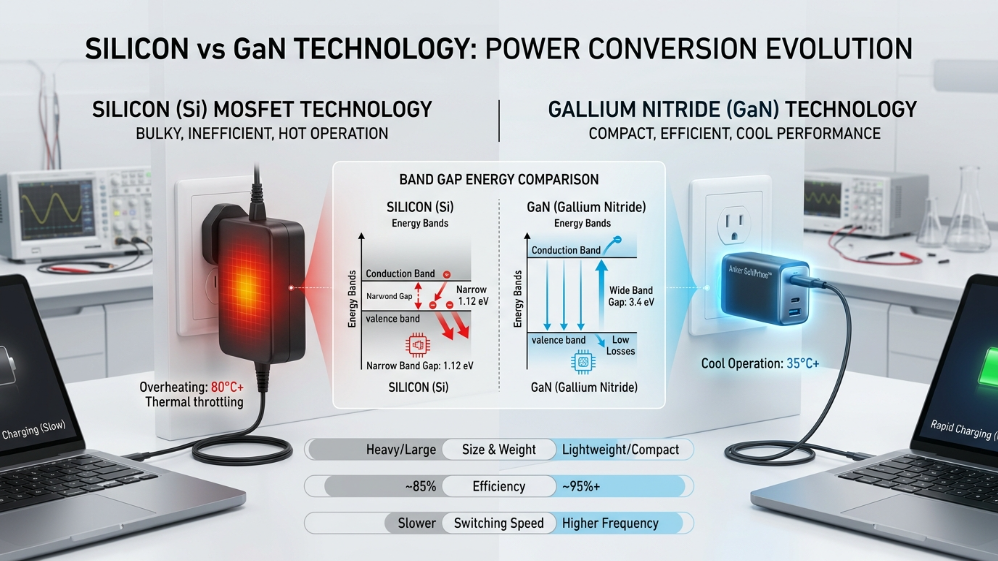
The table below quantifies the most important dimensions for B2B procurement:
| Comparison Dimension | Silicon Charger | GaN Charger (Gen5, 2026) | B2B Procurement Impact |
|---|---|---|---|
| Band Gap | 1.1 eV | 3.4 eV | Higher voltage tolerance, larger safety margin |
| Switching Frequency | Hundreds of kHz | MHz level | Smaller passive components, reduced size |
| Power Conversion Efficiency | 85%–90% | 95%–97% | Easier compliance (ErP Level VI) |
| Size (same power) | Baseline | 30%–50% smaller | Higher carton loading, lower shipping cost per unit |
| Ripple Voltage | Usually >100 mV | High-end <30 mV | Longer device battery life, lower RMA rate |
| Operating Temperature | Higher, requires heat sink | 8–12°C lower under full load (4h) | Lower return rate, >5-year product lifespan |
| Wholesale Price (65W reference) | $3–6 | $6–10 | ~40% premium, offset by SKU consolidation |
This table highlights a commonly ignored factor: ripple voltage.
Low-end GaN solutions (often using generic ICs instead of in-house PCBA design) may exceed 100mV ripple voltage, which can damage device batteries over time through electrical noise. This is not theoretical—it directly affects customer complaints and platform return rates.
In 2026, two 65W GaN chargers with identical labeling can differ in wholesale price by $5–8. The key difference often lies here.
GaN Technology Generations: Differences Every B2B Buyer Must Know
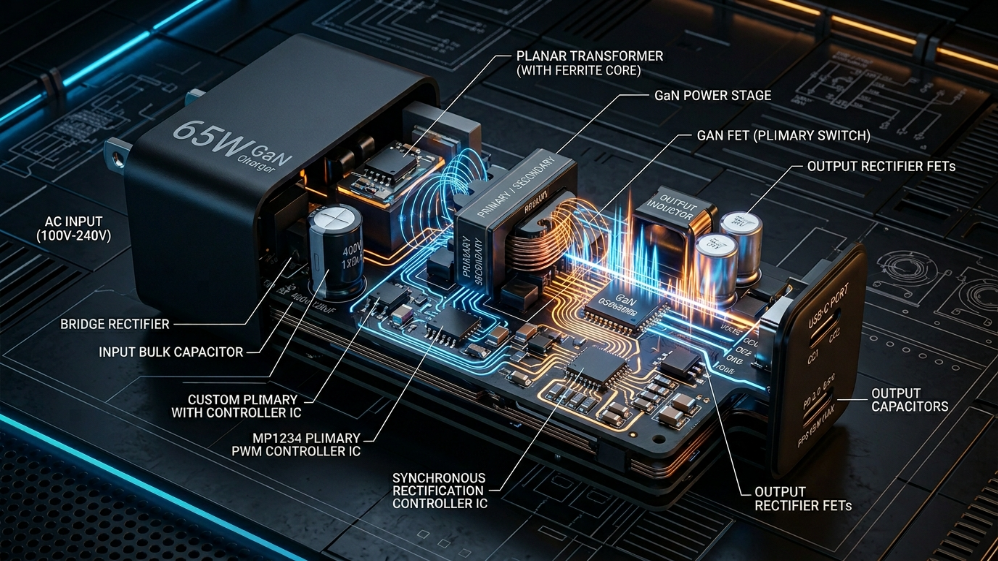
GaN is not a static technology label. Since its commercial introduction in 2018, GaN power devices have evolved through five generations. These differences have a direct impact on procurement decisions.
| Technology Generation | Integration Level | Typical Power Range | Core Features | B2B Application |
|---|---|---|---|---|
| Gen3 (2020–2021) | Discrete solution | 30W–65W | Basic GaN switches, complex external circuits | Phasing out |
| Gen4 (2022–2023) | Semi-integrated | 65W–140W | Integrated driver, improved EMI performance | Mid-range OEM usage |
| Gen5 (2024–2026) | Highly integrated | 20W–240W | Single-chip control + driver + protection, ripple <30mV | Recommended standard for 2026 |
Gen5 solutions not only reduce PCB area, but also reduce solder joints and component count—solder joints are one of the most common failure points in chargers.
According to data from major GaN IC suppliers such as Navitas and Innoscience, Gen5 chips reduce peripheral components by approximately 40%, significantly improving production yield and long-term reliability.
In January 2026, USB-IF officially released full compliance testing specifications for USB PD 3.1 (up to 48V/240W). This means Gen5 GaN chargers supporting USB PD 3.1 now have a standardized certification pathway.
For B2B buyers developing high-power mobile workstation charging solutions, this is a clear product roadmap signal. Bringing you a custom GaN charger mold factory: Precision tools for power in 2026.
Global Certification System for GaN Chargers: Compliance Baseline for B2B Procurement
After technical selection, certification compliance is the final gate before market entry—and the most common failure point in first-time bulk procurement.
Certification is not a label; it is market access authorization.
Major Market Requirements (2026)
| Market | Mandatory Certifications | Energy/Environmental Requirements | High-Value Optional Certifications | Common Pitfalls |
|---|---|---|---|---|
| United States | FCC Part 15, UL 62368-1 | DoE Level VI / CEC | ETL, MFi | Expired UL certificates |
| European Union | CE (LVD + EMC + RE), RoHS 2 | ErP Lot 7 Level VI | UKCA | Self-declared CE without test reports |
| United Kingdom | UKCA | CE self-declaration insufficient | — | No supporting test data |
| Japan | PSE (Diamond mark) | No mandatory efficiency | — | Incorrect model-specific application |
| South Korea | KC | No mandatory efficiency | — | Incorrect Korean labeling |
| Australia | RCM | MEPS efficiency | — | Non-local plug standards |
| Mainland China | CCC | — | — | Missing re-application for export-to-domestic sales |
A critical point: CE is not a single certificate—it is a declaration system.
Low-cost suppliers often provide a simple DoC (Declaration of Conformity) without full technical documentation or third-party test reports. Such certificates are effectively invalid under TÜV, SGS audits, and EU customs inspections, whose scrutiny has significantly increased after 2025.
B2B contracts must explicitly require full lab test reports from accredited laboratories—not just certificate scans.
A compliant GaN charger must include multi-layer protection systems: OVP (Over Voltage Protection), OCP (Over Current Protection), OTP (Over Temperature Protection), SCP (Short Circuit Protection), and surge protection on input.
The casing must meet UL 94V-0 flame retardancy standards—non-negotiable for aviation transport and hotel charging environments.
Why Choose AOVOLT as Your GaN Charger B2B Partner
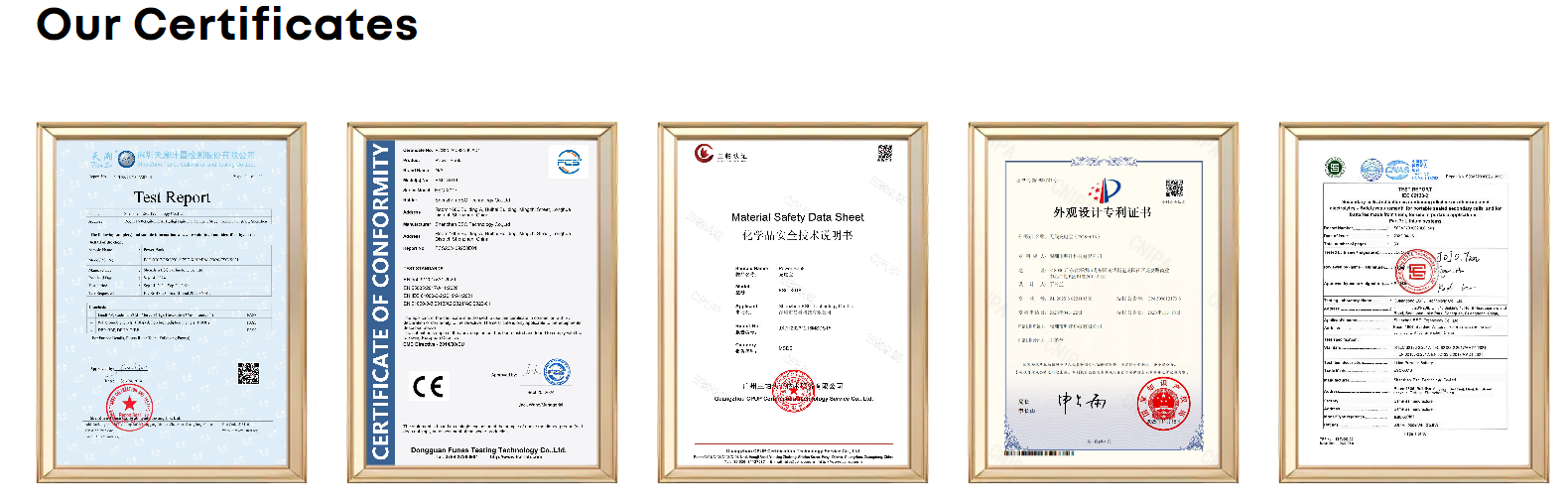
Once technical and compliance requirements are clarified, the real deciding factor is whether a supplier can consistently deliver them across every production batch.
AOVOLT is a B2B source factory based in Dongguan, China, with over 15 years of experience in consumer electronics manufacturing. Its product line covers fast chargers, power banks, and magnetic power banks.
Unlike assembly-based factories, AOVOLT operates a fully vertically integrated production system covering industrial design, R&D, mold development, injection molding, and hardware integration. This means PCBA and casing production are completed under one controlled system rather than outsourced across multiple subcontractors.
Key B2B Advantages:
Consistent Quality
In-house control of molds and PCBA processes ensures tighter tolerance windows. For private-label brands selling on Amazon or European retail channels, batch-to-batch consistency is critical.
Full Fast-Charging Protocol Coverage
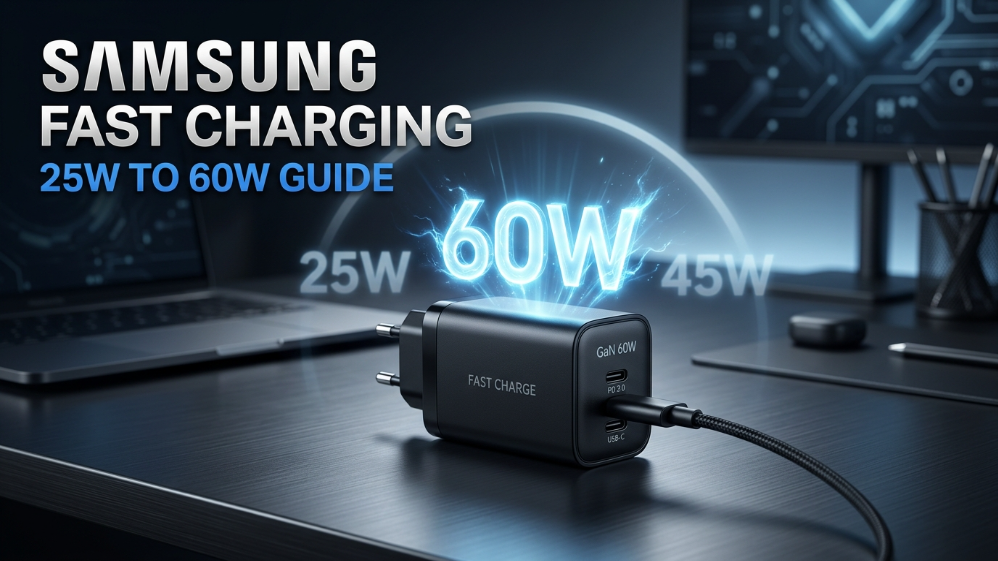
Supports up to 140W output with PD 3.0, PPS, QC 3.0, FCP, SCP, AFC, Apple 2.4A, and BC 1.2 compatibility.
This allows universal fast charging across iPhone, Huawei, Samsung, Lenovo, and more without “connected but slow charging” complaints.
Industrial Design Differentiation
GaN chargers are highly commoditized visually. AOVOLT’s in-house design team supports customized structural development from early mold stages, enabling differentiation for gift, retail, and branded markets.
B2B FAQ (Frequently Asked Questions)
Q1: Can GaN chargers fully replace silicon chargers in my current lineup?
In 2026, GaN chargers in the 20W–140W range are fully production-ready with comparable yield and supply stability. For procurement volumes above 500 units per SKU, there is no reason to continue using silicon solutions.
Q2: What is the MOQ and lead time for OEM customization?
Standard OEM (logo + color) starts from 500 units. Full ODM mold development is recommended from 1,000 units to amortize tooling costs. Lead time is typically 15–30 working days.
Q3: How can I verify certification authenticity?
Request online verification links or certificate numbers and cross-check via TÜV Rheinland, SGS, or Intertek databases. Ensure model numbers match exactly between certificate and specification sheet.
Q4: Are GaN chargers the same as PD chargers?
No. GaN refers to the internal semiconductor material, while USB Power Delivery (PD) is a charging protocol. A high-quality GaN charger typically supports PD 3.0/3.1, but PD support does not guarantee GaN usage.
Q5: Are high-power GaN chargers (100W+) suitable for corporate gifts or retail?
Yes. They provide strong perceived technological value and support multi-device fast charging. However, visual consistency and packaging precision are critical—best handled by manufacturers with in-house tooling capabilities.
Conclusion
GaN charger procurement is fundamentally a technical filtering process: material generation, PCBA architecture, protocol coverage, and certification compliance all contribute to quality differences that only appear in return rates and customer complaints.
Price is an outcome, not a starting point. Without a locked specification, the lowest quote often carries the highest hidden cost.
If you are evaluating GaN charger suppliers for 2026 or planning to build a private-label charging product line from scratch, AOVOLT’s technical and commercial teams can support everything from specification definition to sample development.
Fifteen years of manufacturing experience is not a story—it is a guarantee that every shipment reaches your warehouse on time and to specification.