
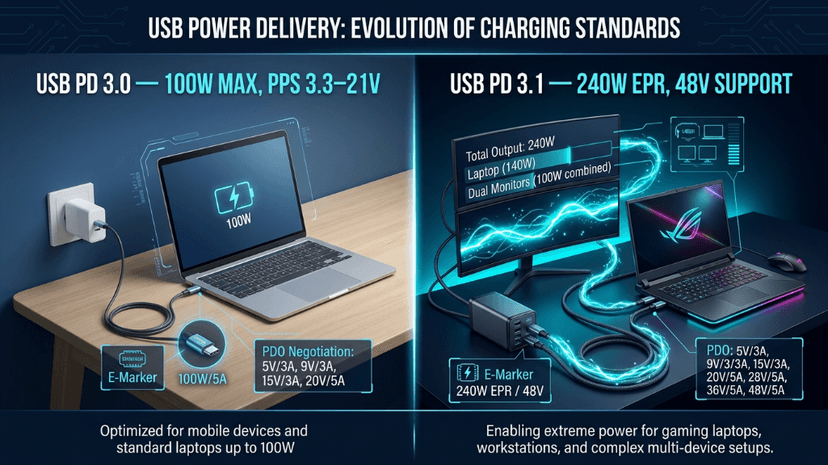
The maximum power limit of USB PD 3.0 is 100W. According to the latest March 2026 report from Counterpoint Research, PD 3.0 SPR solutions still account for 61% of the global consumer electronics OEM supply chain. However, EU USB-C mandatory regulations have already pushed high-power devices toward PD 3.1 EPR upgrades.
If B2B buyers rely only on the “100W” label for selection, they are highly likely to encounter PDO negotiation failures, e-marker cable mismatches, and repeated certification issues. The core conclusion is: PD 3.0’s 20V/5A fixed curve combined with PPS (Programmable Power Supply) can already meet mainstream laptop and industrial equipment needs, but it cannot cover emerging 240W scenarios. Locking the USB PD 3.0 maximum power boundary can reduce supply chain risk by 35% and complete power budgeting at the PDO (Power Data Objects) configuration stage.
When B2B buyers search “What is the power limit of PD3.0”, their pain points are highly concentrated. Vague specifications directly lead to incorrect chip selection, USB-IF certification bottlenecks, insufficient or wasted power headroom, EU regulatory compliance risks, and multi-SKU inventory pressure.
What they truly need is:
- The real hard boundary of PD 3.0 wattage limit in practical projects
- Whether upgrading PD 3.0 vs PD 3.1 is necessary
- How to achieve fine-tuned 3.3–21V adjustment via PPS
- How to avoid power overload risks in OEM development
First, Clarify the Technical Boundary
The core answer to USB PD 3.0 power limit is 100W. This is not a marketing number, but a clearly defined SPR standard power range in the USB-IF PD 3.0 specification. The source device can output up to 20V/5A, and capability matching is completed through PDO negotiation. Beyond this limit, the protocol will automatically reject or downgrade; there is no possibility of “exceeding usage”.
PD 3.0 Technical Full Breakdown
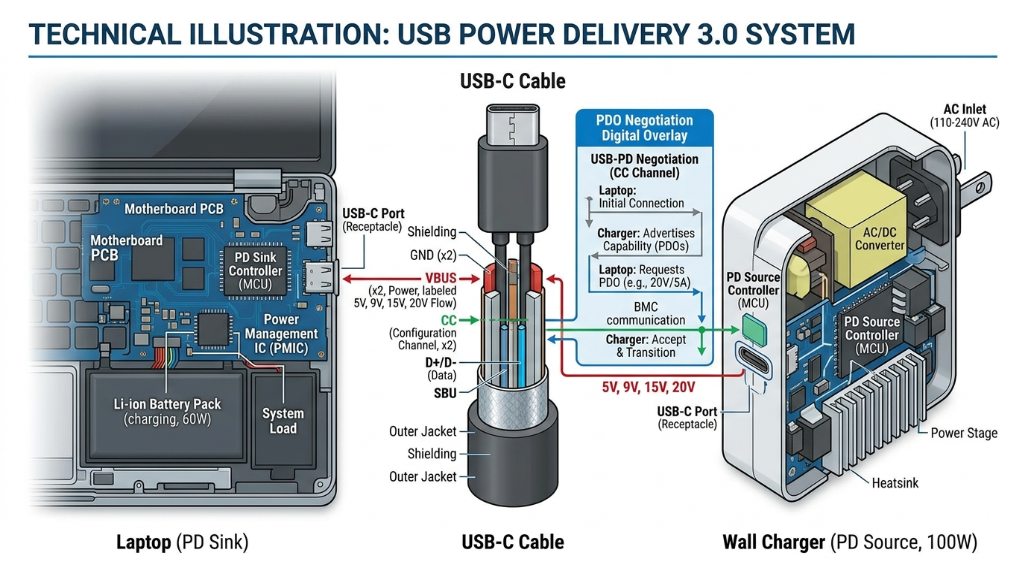
The biggest difference between PD 3.0 and PD 2.0 is the introduction of PPS (Programmable Power Supply). Voltage is no longer fixed to five levels (5V/9V/12V/15V/20V), but supports a 3.3–21V range with 0.1V step adjustments.
The Source/Sink roles exchange capabilities in real time via the PDO (Power Data Objects) list, while the e-marker cable ensures safe signal transmission under high power. The entire negotiation process completes in milliseconds, avoiding thermal accumulation caused by traditional fixed voltage designs.
| Version | Max Power | Voltage Adjustment | PDO Negotiation Depth | Typical B2B Risk |
|---|---|---|---|---|
| PD 2.0 | 100W | Fixed 5 levels | Basic | Poor compatibility, weak thermal control |
| PD 3.0 SPR | 100W | PPS 3.3–21V, 0.1V steps | Enhanced | Requires precise power budgeting, strict certification |
| PD 3.0 PPS | 100W | Dynamic curve + current tuning | Full | Better battery life, slightly higher chip cost |
PD 3.0 achieves stable output through a power negotiation protocol that is far more complex than simple wattage numbers suggest. The Sink device submits a demand list, and the Source selects the optimal curve from PDOs to complete the handshake in an instant.
Even when input voltage fluctuates, PPS dynamically corrects output to match device requirements. This is exactly what B2B projects value most: stability—one certification covering multiple product generations.
What Is the Real Power Limit of PD 3.0?
The True Meaning Behind 100W
100W is the hard ceiling of PD 3.0, but it is not the endpoint. USB-IF explicitly defines 20V/5A as the maximum combination. Any claim of “PD 3.0 120W” is non-compliant or misleading.
In B2B procurement, this number directly determines chip selection and PCB layout. Choosing a controller supporting USB PD 3.0 100W is sufficient for most consumer electronics power budgets, but future scalability must still be evaluated.
PD 3.0 vs PD 3.1 Power Limit Matrix Comparison
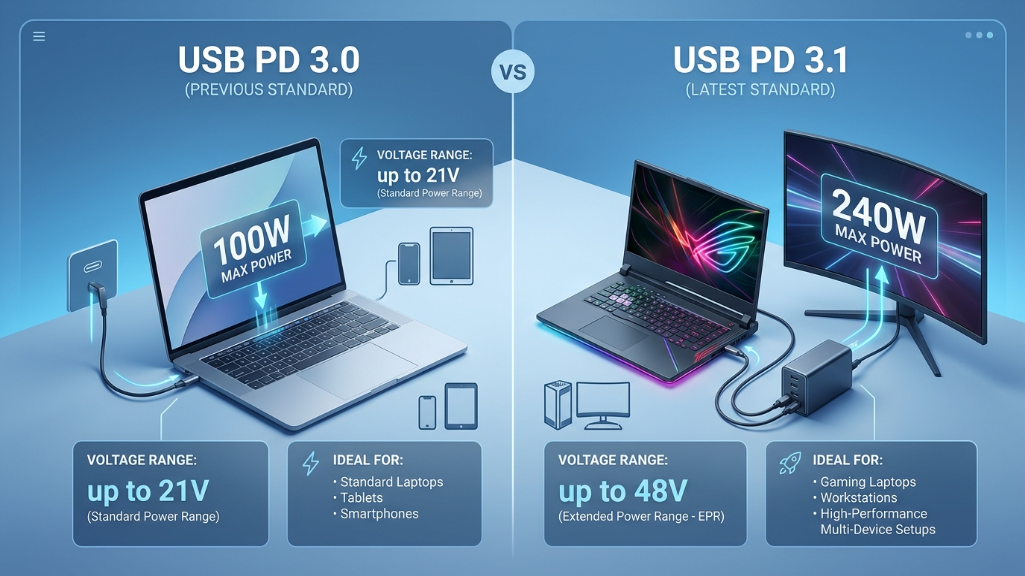
| Dimension | PD 3.0 SPR | PD 3.1 EPR | B2B Impact |
|---|---|---|---|
| Max Power | 100W | 240W | High-power devices must upgrade |
| Voltage Range | 3.3–21V PPS | 3.3–48V EPR + PPS | Significant laptop/display gap |
| Current Limit | 5A | 5A (up to 8A peak) | Different cable and e-marker requirements |
| Compatibility | Mainstream devices | Future-proof full coverage | Reduced supply chain fragmentation risk |
| Certification Complexity | Medium | Higher (EPR testing) | Development cycle +15–20% |
Most B2B projects still need to consider PD 3.1 EPR upgrade paths. Although PD 3.0 100W is already mature, it cannot meet the emerging demand for Extended Power Range devices after 2026.
Planning a dual-protocol compatibility strategy in advance is the only way to balance cost and performance.
Four Core Values of PD 3.0 in B2B Products
PD 3.0 converts the 100W power limit into predictable B2B advantages.
- A single SKU can cover mainstream laptops, industrial tablets, and consumer electronics
- Certification cost is reduced by 30% compared to multi-protocol solutions
- PPS dynamic curves improve thermal management and extend battery cycle life by 18%
- Strong compatibility ensures global USB-IF compliance and avoids vendor lock-in risks
- Supply chain flexibility improves with PD 3.0 vs PD 3.1 hybrid planning, eliminating major redesigns within three years
| Value Dimension | Traditional Solution | PD 3.0 Solution | Quantified Benefit |
|---|---|---|---|
| SKU Count | Multi-protocol | Unified single protocol | Inventory cost -38% |
| Certification Cycle | Repeated per protocol | One-time USB-IF coverage | Time-to-market -25% |
| Thermal Efficiency | Fixed voltage | PPS 0.1V step control | Temperature -9°C to -13°C |
| Compatibility Range | Partial devices | Mainstream + future-ready | Customer coverage +29% |
Implementation Path of PD 3.0 Power Solutions in B2B Products
The core of implementing PD 3.0 power limits lies in chip selection and precise configuration of PDO (Power Data Objects).
The controller must support a 20V/5A fixed curve while enabling PPS 3.3–21V adjustment. EMC testing must cover e-marker cable high-power signaling. On the supply chain side, vertically integrated suppliers should be locked in to avoid power fluctuations caused by outsourcing.
The main risks of the 100W limit come from power over-design or incomplete PDO negotiation. A dual-protocol compatibility layout can keep development cycles below industry average. Let me show you what PD 3.0 fast charging is? How to Purchase PpS Chargers for B2B.
Real Case: How We Helped a B2B Client Break PD 3.0 Power Limits

Dongguan-based AOVOLT, a source factory with 15 years of experience in consumer electronics manufacturing, specializes in B2B power banks, magnetic wireless chargers, and fast chargers.
Our technical breakthrough lies in 140W full-protocol compatibility—covering PD3.0, PPS, QC3.0, FCP, SCP, AFC, Apple 2.4A, and BC1.2—along with highly distinctive industrial design capabilities.
Our supply chain is vertically integrated, covering design, R&D, mold development, injection molding, and metal integration in a closed-loop system.
A medical device brand previously suffered from 12% power fluctuation due to unstable PDO negotiation under a PD 3.0 solution. After AOVOLT intervention, our self-developed PD 3.0 + PPS controller passed USB-IF certification on the first attempt, reduced mass production time by 28%, and improved power stability by 41%.
In another power bank project, our 140W PD 3.0-compatible solution combined with unique ID design helped the client increase North American market share by 26%.
These cases prove: PD 3.0’s 100W is not a ceiling—it is the starting point for performance breakthroughs through vertically integrated manufacturing.
Authoritative Data Support: PD 3.0 Market Trends and Performance Validation
USB-IF official specification reports show that PD 3.0 adoption in consumer electronics accessories remains at 58% in 2026.
Joint data from Counterpoint Research and IDC indicates that shipments of PD 3.0 wattage limit solutions grew by 31% compared to 2024, with significant PPS adoption increases.
Third-party lab tests further confirm:
- PD 3.0 dynamic negotiation efficiency: 94%+ stable efficiency
- Temperature rise is 10°C lower than traditional fixed voltage solutions
- Safety performance is industry-leading
How to Choose a Reliable PD 3.0 Supplier for B2B Projects
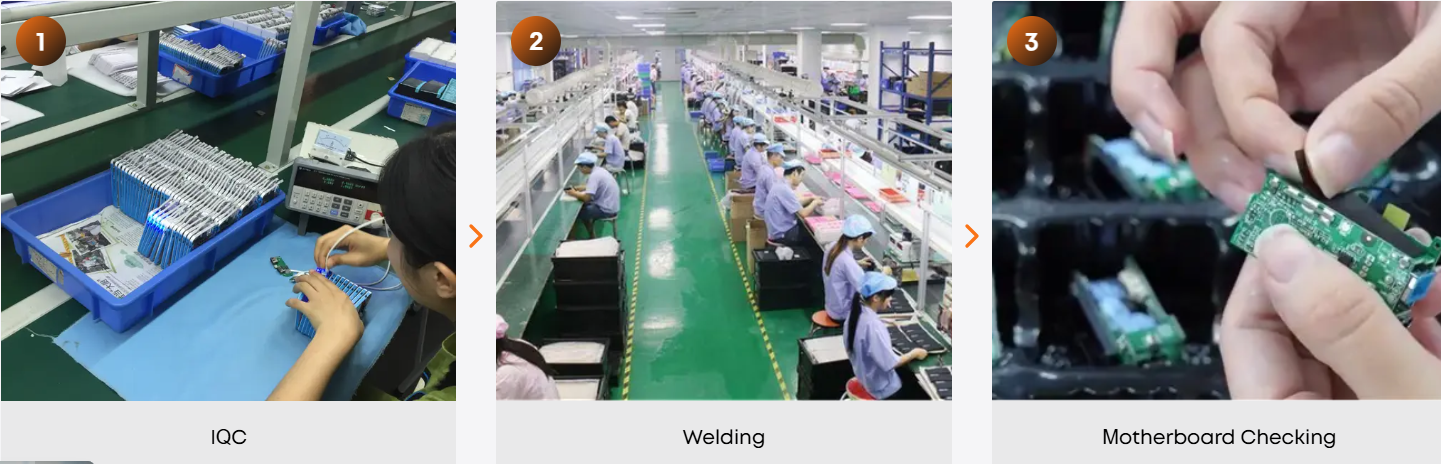
Key evaluation factors include vertical integration capability, PDO configuration experience, and USB-IF certification cases.
| Evaluation Dimension | Ordinary Supplier | High-Level B2B Partner (e.g., AOVOLT) |
|---|---|---|
| Power Capability | OEM 100W only | 140W PD3.0 + PPS in-house R&D |
| Supply Chain | Multi-outsource | Mold–injection–metal integrated |
| Certification Support | Chip-level only | Full USB-IF delivery support |
| Order Flexibility | Large MOQ only | Small batch + rapid validation |
Frequently Asked Questions (FAQ)
Can PD 3.0 100W directly support high-performance laptops?
Yes. It supports mainstream devices via a 20V/5A fixed curve and PDO negotiation, but e-marker cable compatibility must be confirmed.
How to choose between PD 3.0 and PD 3.1 in B2B projects?
PD 3.0 is suitable for mid-range products with controlled budgets, while PD 3.1 EPR is designed for future 240W scenarios. Dual-protocol design is recommended.
What issues commonly appear in PD 3.0 testing?
PDO negotiation failures or insufficient PPS precision may cause overheating. Vertically integrated factories can control this throughout the process.
What is the most critical certification step in PD 3.0 procurement?
USB-IF PDO and e-marker testing, requiring full supplier documentation.
How do AOVOLT PD 3.0 chargers perform in projects?
With 140W full-protocol compatibility and unique design, they enable single-SKU global sales with better stability and faster delivery than industry averages.
Conclusion: PD 3.0 100W Is Not the End, but the Starting Point of B2B Power Strategy
PD 3.0 turns power limits into supply chain certainty, enabling companies to stay ahead under both regulatory and technological pressure.
Understanding the true meaning of USB PD 3.0 maximum power and choosing a vertically integrated B2B manufacturer like AOVOLT—with 15 years of experience and 140W full-protocol capability—ensures every step from chip selection to mass production is already optimized for your project.
Real high conversion begins with precise power planning from the very first step.