
As a fast charger OEM supplier that has served more than 200 global B2B clients, we can tell you directly: the cost of choosing the wrong supplier is far higher than you imagine. A batch of 20,000 units of 65W GaN chargers, if the CE certificates are fake, customs detention and destruction costs in the EU alone can wipe out your entire annual profit. In contrast, choosing the right factory—MOQ as low as 200 units, sample-to-delivery completed within 45 days, and RMA rate controlled below 0.5%—is what a truly scalable and repeatable profit model looks like. This article contains no fluff, only a practical procurement decision framework.
Why the Fast-Charging OEM Market in 2026 Is More Worth Entering Than Ever Before
Numbers speak.
According to the latest report from Grand View Research, the global DC fast charging market size was valued at USD 9.67 billion in 2025 and is expected to grow to USD 51.67 billion by 2033, with a CAGR as high as 23.7%.
On the consumer electronics side, it is equally strong: the global phone charger market will reach USD 7.23 billion in 2026, GaN charger adoption is up 41% year-on-year, and demand for compact fast charging products has increased by 35%.
What is even more important is the structural opportunity on the supply side. In early 2026, the EU USB-C mandatory unified interface regulation is fully implemented, forcing a large number of brands that previously used proprietary charging heads to switch suppliers and re-open molds. At the same time, infrastructure investment driven by the U.S. Infrastructure Investment and Jobs Act is accelerating the deployment of public charging networks, leading to a concentrated surge in OEM demand for commercial fast charging. In Q2 2025 alone, more than 4,200 new DC fast charging ports were added in the United States, setting a new quarterly record.
This is not a trend. This is a market already running—the only question is which factory you use to capture orders.
OEM vs ODM: Differences in Business Logic
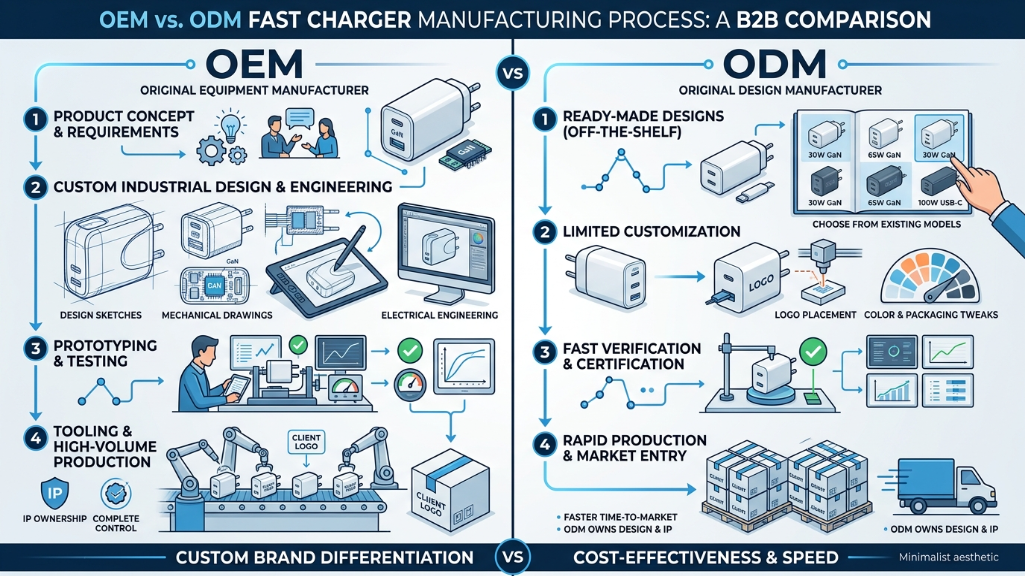
Many buyers waste a lot of time on this issue. Let’s make it simple:
OEM (Original Equipment Manufacturing) means you own the product design, and the factory manufactures according to your specifications. IP belongs to you, mold costs are borne by you, and brand premium space is maximized. It is suitable for brands with R&D capability or those aiming to build a patent moat.
ODM (Original Design Manufacturing) means the factory provides ready-made designs; you choose specifications, apply logos, and customize packaging. Development cycles are shortened by more than 50%, no mold investment is required, and it is suitable for distributors and emerging brands entering the market quickly.
Hybrid model is the mainstream B2B cooperation structure in 2026: ODM base design + OEM customization of housing/packaging. A U.S. tech accessories brand used this model to launch 3 SKUs from zero to market within 90 days. After a 500-unit trial order, it directly scaled up to 8,000 units for mass production. Take you to know the top 10 mobile power manufacturers in China.
Which model you choose depends on your product strategy—not the factory’s recommendation.
Core Technical Specifications: Hard Parameters You Must Understand Before Purchasing
This is the part most competitors’ articles fail to include—they either say “supports multiple protocols” or overwhelm buyers with too many parameters.
We directly provide a comparison table:
Mainstream Fast Charging Protocol Comparison
| Charging Protocol | Max Power | Main Compatible Devices | 2026 Market Position |
|---|---|---|---|
| QC 3.0 / 4.0 | 18W / 27W | Mainstream Android models | Gradually replaced by PPS, still large legacy market |
| USB PD 3.1 | Up to 240W (EPR) | Laptops, phones, tablets | Current preferred B2B procurement protocol |
| PPS (Programmable Power Supply) | 45W+ | Samsung, Xiaomi, OPPO flagship series | Fast charging standard; non-support = outdated |
| UFCS (Universal Fast Charging Standard) | 100W+ | Huawei, Honor, Vivo ecosystem | Essential for China and Southeast Asia exports |
| Apple MagSafe / Qi2 | 15W (wireless) | iPhone 12+ and Qi2 devices | Core driver of wireless charging growth |
A 65W charger without PPS support is barely eligible for listing in the European market in 2026. This is not technical obsession—it is a market entry threshold.
GaN vs Traditional Silicon Charging IC: What Is Your Supplier Using?
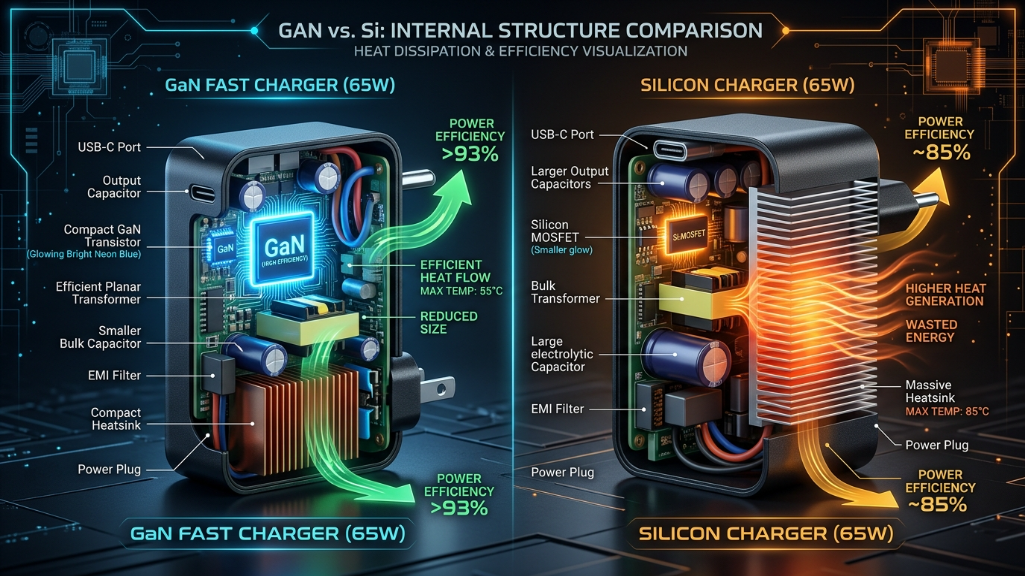
| Comparison Dimension | Traditional Silicon MOSFET | GaN (Gallium Nitride) Solution |
|---|---|---|
| Size | Baseline | ~40% smaller |
| Conversion Efficiency | 85%–89% | 92%–95%+ |
| Operating Temperature | Higher, requires large heat dissipation | 30%–40% lower, suitable for sealed housing |
| Cost | Lower but bulky | Slightly higher but higher premium potential |
| 2026 B2B Trend | Low-end mass products | Mainstream mid-to-high OEM projects |
To verify whether a supplier truly uses GaN instead of false claims, there are three practical methods: request chip procurement invoices or supply chain traceability documents; request real measured efficiency reports (must be ≥92%); and compare actual charger weight—true GaN 65W chargers are usually under 80g, while silicon-based ones are generally over 110g.
Details can be misleading. Data cannot.
Certifications: Protecting Your Customers and Yourself
Market data shows that counterfeit and non-compliant chargers account for nearly 27% of the global market, making them the leading cause of brand delisting on e-commerce platforms and reducing compliant brands’ market penetration by about 19%.
What does this mean? It means nearly 30% of your competitors are taking risks. Once they fail, your compliant products are the direct beneficiaries—provided your certifications are genuine.
Mandatory Certification List by Target Market
| Target Market | Regulations / Certifications | Common Pitfalls |
|---|---|---|
| USA / Canada | UL 62368-1, ETL, FCC ID, DoE Level VI | DoE energy efficiency standards upgraded in 2026; old reports invalid |
| EU | CE (EN 62368-1), RoHS 3, ErP Directive, UKCA | CE self-declaration ≠ real Notified Body certification |
| Japan | PSE (diamond mark, third-party certification) | Circle PSE alone is not sufficient |
| Korea | KC certification | Requires local Korean agent; factory direct filing invalid |
| China | CCC mandatory certification | Export/import conversion requires re-certification |
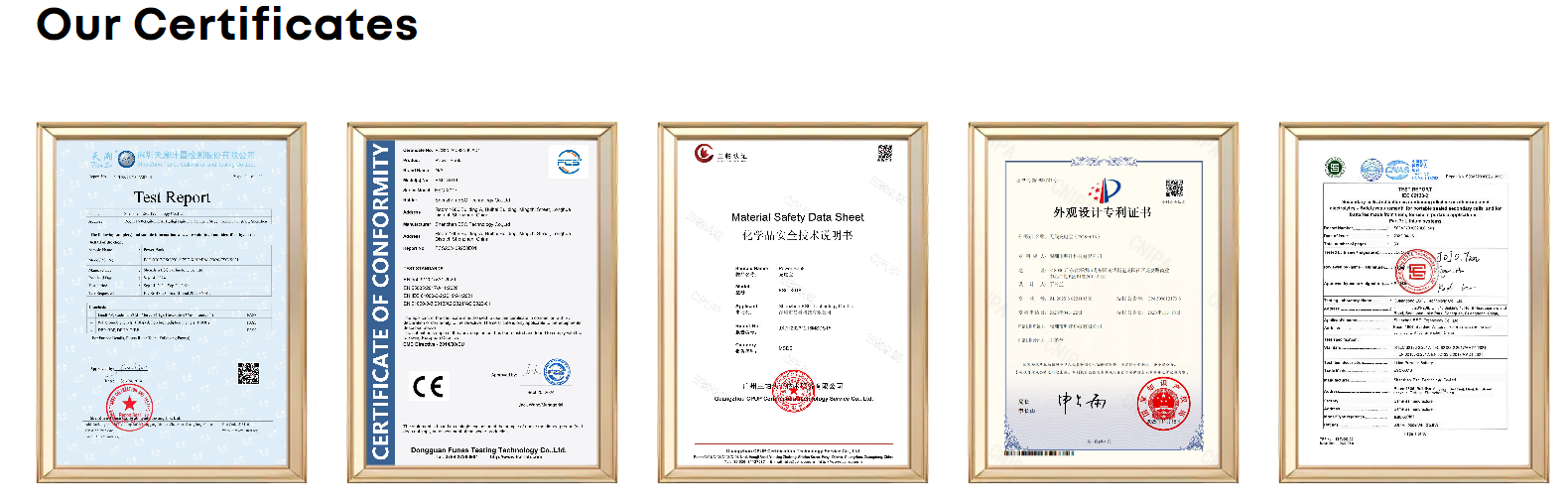
Standard verification step: enter certificate number into official certification databases (e.g., UL Product iQ, EU ICSMS system). Any certificate not found in official databases is considered invalid.
Supplier Evaluation Framework: A 7-Dimension System to Filter 90% of Wrong Choices
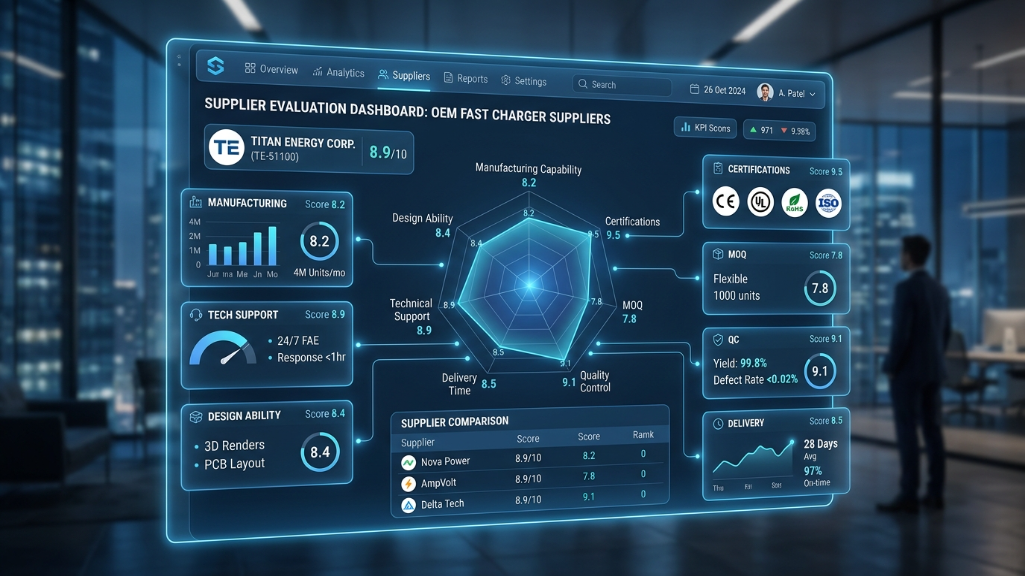
Certification is only the entry ticket. The real determinant of cooperation quality is performance across seven dimensions.
Fast Charger OEM Supplier Evaluation Matrix
| Evaluation Dimension | Minimum Standard | High-Quality Supplier | Risk Signal |
|---|---|---|---|
| Manufacturing Capability | ≥4 SMT lines, ≥500K monthly capacity | In-house mold + injection molding integration | Pure trading company outsourcing production |
| Technical Protocol Coverage | PD3.1 + PPS | Full PD/QC/PPS/UFCS/SCP/FCP/AFC support | Only QC3.0 supported |
| Certification Integrity | Complete for target markets | Real-time verifiable certificates | Fake or untraceable certificates |
| MOQ Flexibility | ≤500 units | 200-unit trial support | ≥5000 units required |
| Delivery Cycle | ≤45 days first batch | 7-day sample, 30-day mass production | No written SLA |
| Quality Control | IQC + IPQC + OQC | Third-party inspection supported | Rejects external inspection |
| Design Capability | Structural modification support | Independent industrial design team | No original design capability |
The core logic: turn supplier evaluation from subjective judgment into a measurable scoring system.
When all seven dimensions are evaluated together, capable factories and marketing-driven intermediaries are immediately separated.
From Inquiry to Delivery: Full OEM Project Timeline
Understanding the process is the foundation of risk control.
Using a standard 65W GaN wall charger OEM project as an example:
Week 1: Submit requirement brief (target market, wattage, protocol, design reference, packaging requirements) → factory provides quotation and specification confirmation
Week 2–3: NDA signed + sample plan confirmed → mold development or existing mold sampling
Week 4: Sample received → internal testing + third-party pre-compliance testing
Week 5–6: Sample confirmed → official PO placed + production schedule agreement signed
Week 7–9: Mass production + IPQC process inspection + optional third-party factory audit
Before Week 10: OQC inspection → shipping → full certification documentation package provided
Total completion within 45 days. This is not average industry performance; it is only achievable by vertically integrated factories.
Why Vertically Integrated Factories Determine Your Profit Ceiling
About 80% of “fast charger OEM suppliers” are actually trading companies: receive order → outsource → markup → deliver.
Each additional layer adds cost and increases risk of information distortion.
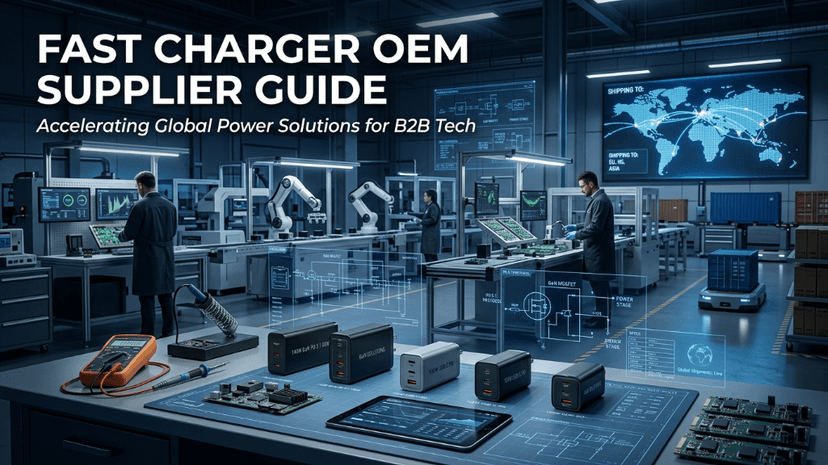
The real competitive advantage lies in factories with full closed-loop vertical integration: industrial design, R&D, mold making, injection molding, and hardware integration.
When a factory fully controls its molds, it means: design modifications can be made directly without external scheduling delays; injection quality is controlled under internal standards rather than external promises; structural innovation can be integrated at the design stage instead of being outsourced after finalization.
This is exactly where AOVOLT stands out from most competitors. With 15 years of experience in consumer electronics manufacturing, its source factory is located in Dongguan, China, and its core product line covers power banks, magnetic power banks, and fast chargers, with full support up to 140W output. Protocol compatibility covers all mainstream standards—PD 3.0, PPS, QC 3.0, FCP, SCP, AFC, Apple 2.4A, BC 1.2—ensuring true plug-and-play compatibility across North America, Europe, and Asia-Pacific markets.
Even harder to replicate is AOVOLT’s industrial design capability. The consumer electronics accessory market is already extremely homogeneous—same plastic shell, different logos, constant price competition on Amazon. AOVOLT’s industrial design team provides differentiated exterior solutions combined with in-house mold development capability, helping B2B clients move from “just another charger” to a “brand-recognizable product.” This is not an add-on—it is the foundation of differentiated pricing.
FAQ: 5 Most Common Questions from B2B Buyers
Q1: What is the MOQ for OEM fast chargers, and what starting quantity is suitable for new brands?
For ODM existing models with private label customization: 200–500 units.
For fully new OEM mold development: recommended 500–1,000 units for initial sampling and market testing.
AOVOLT supports low-MOQ trial orders to help new brands validate the market without inventory pressure.
Q2: How to confirm whether a supplier truly uses GaN technology instead of false claims?
Three actionable verification methods:
- Request GaN chip supplier purchase invoices or BOM list
- Request third-party measured efficiency report (must be ≥92%)
- Check product weight: true 65W GaN chargers are usually 75–85g; silicon-based models are generally over 110g
Q3: For exporting fast chargers to Europe, what level of CE certification is safe?
CE marking itself is based on self-declaration, but after the 2026 EU Product Liability Directive revision, importers bear the burden of proof in case of safety incidents.
It is recommended to choose Notified Body-certified EN 62368-1 testing instead of relying only on self-declaration, and ensure a full Technical Construction File (TCF) is retained for 10 years.
Q4: Do I need separate products for the Chinese market and export markets?
Not necessarily.
UFCS protocol and CCC certification are required for the Chinese domestic market, while export versions for Europe and the U.S. do not require CCC.
With proper hardware planning, a single product platform can support both markets via firmware adjustment, significantly reducing SKU complexity.
Q5: What is the typical mold cost for OEM charger projects, and who owns it?
The mold cost for consumer fast chargers typically ranges from RMB 8,000 to 25,000 depending on structural complexity and steel grade.
The contract must clearly define:
- Mold ownership belongs to the buyer
- Factory only stores and maintains the mold
- Buyer has the right to transfer the mold upon termination
- Mold lifespan is typically 300,000–500,000 injection cycles
Conclusion
Choosing a fast charger OEM supplier is essentially choosing a long-term manufacturing partner.
Wrong choices continuously erode your profit through certification risks, quality instability, and delivery failures.
A qualified partner with vertical integration, strong technical capability, and growth alignment is often the key leverage that helps a brand move from distribution to product ownership.
AOVOLT currently serves B2B clients across Europe, North America, and Southeast Asia.
If you are currently in supplier selection—or questioning certification authenticity, GaN technical depth, or product differentiation with your existing factory—this is the right time for a technical discussion. It does not take long, but it often changes how you define what a “qualified supplier” truly means.
References: