

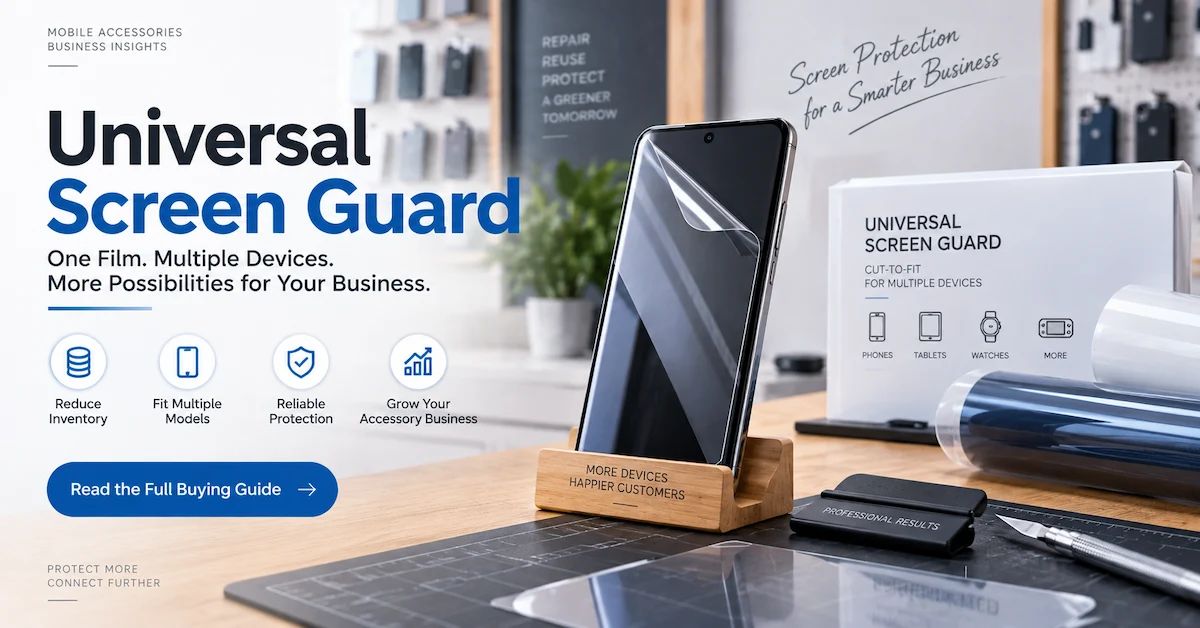
A universal screen guard can help mobile repair businesses provide screen protection for a wider range of smartphones without stocking a separate pre-cut protector for every device. However, the term universal does not mean that one protective sheet automatically fits every screen.
For professional repair chains, phone refurbishers, and mobile accessory wholesalers, the most practical universal screen guard system usually involves a compatible protective film, accurate device-specific cutting patterns, suitable cutting equipment, and a controlled installation process.
The purchasing decision should therefore consider more than film thickness or unit price. Material construction, optical clarity, adhesive behavior, cutting accuracy, touchscreen response, and repeat-order consistency all influence the final service quality.
Quick answer: A universal screen guard is generally a protective film supplied in a standard sheet or blank format that can be trimmed to fit different device models. It is especially useful for multi-brand repair shops and accessory distributors managing fragmented smartphone demand. Its performance depends on the material and the accuracy of the cutting and installation process.
This guide explains how to evaluate universal screen protection systems, select suitable materials, qualify bulk suppliers, manage inventory, and prepare a practical B2B purchasing specification.
1. What Is a Universal Screen Guard?
A universal screen guard is a protective layer designed to cover the display surface of different electronic devices when its size and shape are properly matched.
In the mobile accessories market, the phrase can refer to several products:
-
Universal protective film sheets that can be cut to size.
-
Flexible TPU or other polymer films used with cutting machines.
-
PET films available in standardized dimensions.
-
Large protective sheets that installers manually trim.
-
Pre-cut screen protectors marketed as suitable for multiple devices.
These products are not technically identical.
The most important distinction is between a universal protective material and a universal fit.
A blank film may support hundreds of device patterns through different cuts. However, each completed protector still needs the correct shape, alignment, and clearance for the intended smartphone.
Why Universal Screen Guards Matter to B2B Buyers
Mobile repair businesses frequently encounter different phone brands and generations.
A repair counter may service Samsung, Xiaomi, OPPO, vivo, Google Pixel, Motorola, and other smartphones during the same day.
Maintaining separate inventories of pre-cut protectors for every model can create several problems: excessive SKU counts, obsolete inventory, storage requirements, and unavailable protectors for uncommon devices.
A cut-to-fit film system provides a potential alternative.
Rather than purchasing dozens of low-volume finished protectors, a business can hold suitable blank film stock and prepare protectors when needed.
The commercial value depends on actual demand, cutting-machine costs, installation labor, film waste, and customer acceptance.
2. Universal Screen Guard vs Model-Specific Tempered Glass
Both product categories serve the screen protection market, but they solve different operational problems.
|
Feature |
Universal cut-to-fit film |
Model-specific tempered glass |
|---|---|---|
|
Device coverage |
Multiple models with suitable cutting patterns |
Usually limited to designated models |
|
Material |
Commonly TPU, PET, or multilayer polymer |
Tempered or chemically strengthened glass |
|
Inventory structure |
Blank sheets plus cutting resources |
Separate finished-product SKUs |
|
Installation |
Requires accurate cutting and application |
Uses a pre-cut glass protector |
|
Curved-screen suitability |
Depends on film flexibility and design |
Depends on device-specific glass geometry |
|
Scratch performance |
Material and coating dependent |
Material and surface treatment dependent |
|
Impact performance |
Must be tested; not inherently equivalent to glass |
Must be tested for the actual construction |
|
Business consideration |
Equipment, labor, material cost, waste |
Finished SKU cost, stock availability, returns |
When Universal Film Is the Better Operational Choice
A universal film system may be suitable when a repair shop serves many smartphone models but has limited demand for individual screen protector SKUs.
It can also help refurbishment businesses prepare protective films for mixed-model device inventory.
However, cutting and installation introduce additional process steps that must be controlled.
When Model-Specific Glass May Be Better
Pre-cut tempered glass may be preferable for businesses focused on a smaller number of popular smartphone models or customers seeking the particular feel and surface characteristics of glass.
The key lesson is that neither format is universally superior.
The best option depends on the device, product construction, installation process, and customer expectations.
3. Which Screen Guard Materials Should Wholesale Buyers Compare?
Material selection is one of the most important purchasing decisions.
Different polymers and surface coatings can produce different levels of flexibility, optical performance, scratch resistance, and installation difficulty.
TPU Screen Protection Film
Thermoplastic polyurethane, or TPU, is a flexible polymer used in various protective-film applications.
For smartphones with curved display surfaces, a properly engineered TPU-based film may offer useful conformability.
However, flexibility alone does not guarantee successful edge adhesion or long-term durability.
Buyers should examine coating quality, adhesive behavior, film recovery characteristics, and optical distortion after application.
PET Screen Protection Film
Polyethylene terephthalate, or PET, is another material used in transparent protective films.
PET-based constructions may offer good dimensional stability and optical clarity, depending on film grade, adhesive, and surface treatments.
A PET film should not automatically be described as equivalent to glass in scratch or impact performance.
Multilayer and Coated Films
Some protective films combine a polymer substrate with a hard coating, functional adhesive, release liner, and protective top layer.
Others introduce matte, privacy, or anti-fingerprint surface properties.
These variations can affect the finished protector's appearance and behavior.
|
Material type |
Potential advantage |
Main qualification concern |
|---|---|---|
|
Flexible TPU |
Adaptability to complex surface shapes |
Edge lifting, optical deformation |
|
PET film |
Dimensional consistency and clear presentation |
Conformability and coating durability |
|
Multilayer polymer |
Tunable surface and installation characteristics |
Layer adhesion and manufacturing consistency |
|
Privacy film |
Reduced visibility from certain viewing angles |
Brightness and viewing-angle trade-offs |
|
Matte film |
Reduced apparent reflections in some conditions |
Haze, image sharpness, surface texture |
Procurement recommendation: Request a material construction sheet and sample set rather than selecting products based solely on terms such as premium hydrogel or 9H protection.
The term hydrogel is used broadly in consumer accessory marketing and does not, by itself, identify a single standardized film chemistry.
4. What Does “Universal Compatibility” Really Mean?
Universal compatibility should be treated as a testable operating requirement.
A cutting machine may contain a large device-pattern library, but the library's existence does not prove every pattern is accurate or compatible with every protective material.
For repair businesses, compatibility involves several factors.
Display Dimensions and Border Geometry
The protective film must match the intended coverage area without interfering with the device enclosure.
Screen curvature, rounded corners, and visible bezel geometry affect the cutting pattern.
Front Camera and Sensor Position
Some devices require cutouts or clearances around cameras, speakers, sensors, or other front-facing components.
The correct arrangement depends on the device and selected coverage design.
Case Compatibility
A screen protector that extends too close to the display edge may be displaced by certain phone cases.
A case-friendly pattern should be validated with representative cases rather than advertised as compatible with all cases.
Fingerprint Recognition
Under-display fingerprint sensors can be sensitive to additional protective layers.
Compatibility depends on the sensor technology, film material, adhesive, thickness, and device software.
Installers should test fingerprint enrollment and unlocking on relevant devices.
Touchscreen Response
A protector should not introduce unacceptable interference with touch detection.
Professional testing should include keyboard input, edge gestures, scrolling, and other normal interactions.
For shops already servicing several smartphone brands, screen protection is an adjacent accessory category to the mobile phone replacement battery business, although the two product types require separate purchasing specifications and quality tests.
5. Which Technical Specifications Should a Universal Screen Guard Supplier Provide?
A professional sourcing decision needs measurable specifications rather than unsupported marketing claims.
|
Specification |
What buyers should verify |
|---|---|
|
Material construction |
Substrate, coating, adhesive, and release liner |
|
Total thickness |
Declared thickness and tolerance |
|
Optical transmittance |
Measurement method and results |
|
Haze |
Optical scattering under defined conditions |
|
Surface hardness |
Test method, equipment, and conditions |
|
Adhesive performance |
Initial adhesion, edge retention, removal |
|
Cutting compatibility |
Supported equipment and cutting settings |
|
Touch compatibility |
Installed-device functionality |
|
Surface finish |
Clear, matte, privacy, or other treatment |
|
Packaging |
Batch labels, sheet protection, storage conditions |
Optical Clarity and Haze
A clear screen guard should preserve acceptable display visibility.
Two useful measurements are luminous transmittance and haze. High transparency alone does not guarantee a sharp image if the protective layer introduces excessive light scattering.
ASTM D1003-21, Standard Test Method for Haze and Luminous Transmittance of Transparent Plastics, provides a relevant reference for evaluating suitable transparent plastic films.
Buyers should confirm that the test method applies to the actual material and request results with clearly identified conditions.
Understanding 9H Hardness Claims
Many screen protectors advertise 9H hardness.
This frequently refers to a pencil-hardness designation, not a Mohs mineral-hardness rating.
ISO 15184:2020 describes a pencil test for film coatings, but such measurements should not be interpreted as proof that a protector is impact-proof or scratch-proof under all conditions.
A supplier should identify the actual test method and test specimen before using hardness claims in marketing materials.
Adhesive Performance
Adhesive quality affects installation, edge lifting, removal, and user satisfaction.
Buyers should test adhesion on representative displays and observe behavior after an appropriate evaluation period.
Claims such as bubble-free, residue-free, and self-healing need defined evaluation methods. No protective film should be assumed to perform perfectly under every installation condition.
6. How Should Repair Shops Evaluate Screen Protector Cutting Systems?
A screen protector cutting machine is only one component of the complete protection system.
Buyers should evaluate equipment, software, consumables, and technician workflow together.
Cutting Pattern Accuracy
Request a demonstration using device models commonly serviced by your business.
Inspect camera openings, edge clearance, rounded corners, and overall alignment.
Film and Machine Compatibility
Not every film is suitable for every cutting machine.
The buyer should verify sheet dimensions, blade requirements, cutting pressure, software support, and potential limitations.
Pattern Library Updates
New smartphones may require new cutting files.
Before purchasing equipment, ask how the pattern library is maintained, whether updates require a subscription, and what support is available for uncommon devices.
Operating Costs
Calculate the total cost of the system, including machine investment, film consumption, replacement blades, software fees where applicable, technician labor, and wasted sheets.
An inexpensive film roll does not necessarily create the lowest finished installation cost.
7. How Can Wholesale Buyers Test Universal Screen Guard Quality?
A structured sample qualification program helps distributors distinguish attractive product presentations from dependable commercial performance.
Stage 1: Incoming Material Inspection
Check packaging condition, material identification, sheet dimensions, thickness consistency, visible defects, and batch information.
Record any scratches, contamination, wrinkles, or unexpected surface marks.
Stage 2: Cutting Accuracy
Prepare several patterns representing different smartphone shapes.
Compare completed cuts with the approved design files and record any unacceptable deviations.
Do not rely on one uncomplicated rectangular pattern.
Stage 3: Optical Evaluation
Install samples on representative displays and assess clarity, reflections, haze, and color appearance.
Where quantitative optical claims are supplied, request appropriate supporting measurements.
Stage 4: Touch and Sensor Testing
Evaluate ordinary touch operation, edge gestures, fingerprint recognition where applicable, and relevant sensor functions.
The exact test devices should be recorded.
Stage 5: Adhesion and Environmental Evaluation
Assess edge adhesion and visible lifting under defined storage and usage conditions.
Any accelerated test must have a documented procedure. It should not automatically be presented as proof of a specific product lifespan.
Stage 6: Pilot-Lot Approval
After approving initial samples, repeat the inspection with a representative production lot.
The objective is to identify inconsistencies that may not appear in carefully prepared demonstration samples.
A supplier's strongest evidence is not a claim that every product is perfect, but a repeatable process with documented acceptance criteria.
8. How Can Repair Chains Standardize Screen Guard Installation?
Installation consistency directly affects the quality perceived by customers.
Even a suitable material can produce poor results when technicians use inconsistent preparation and alignment methods.
A practical standard operating procedure should include:
-
Confirm the device model and selected cutting pattern.
-
Inspect the display for pre-existing damage.
-
Prepare a clean installation surface.
-
Inspect the protective film before removing its liner.
-
Align the film using approved reference points.
-
Apply it following the material supplier's instructions.
-
Inspect bubbles, dust, edges, and visible defects.
-
Check touchscreen and relevant sensor performance.
-
Record material batch and installation outcome.
Technicians should not assume that one application method suits every adhesive system.
For retail repair chains, standardized instructions and inspection photographs can reduce disagreements between locations.
9. How Should Distributors Calculate Universal Screen Guard Costs?
The lowest cost per blank sheet does not necessarily produce the lowest cost per successful installation.
A useful calculation is:
Cost per Accepted Installation = (Film + Cutting Consumables + Labor + Allocated Equipment Costs + Waste and Rework) ÷ Accepted Installations
For illustration, suppose a shop processes 100 installations with the following hypothetical expenses:
|
Cost component |
Example cost |
|---|---|
|
Protective film |
$120 |
|
Cutting consumables |
$10 |
|
Installation labor |
$90 |
|
Allocated equipment cost |
$20 |
|
Waste and rework |
$30 |
|
Total |
$270 |
If 95 installations pass the agreed final inspection, the example cost per accepted installation is approximately $2.84.
These numbers illustrate a purchasing calculation only. They are not ESC prices, industry averages, or verified profitability figures.
A distributor should substitute actual quotations, labor rates, machine utilization, and acceptance results.
10. What Should Buyers Ask a Universal Screen Guard Supplier?
A supplier qualification discussion should address both technical performance and commercial reliability.
The buyer should request sample specifications, material construction, available finishes, test methods, packaging options, and cutting-system compatibility.
The supplier should also explain product identification, production-lot traceability, order quantities, shipping protection, and warranty procedures.
For private-label projects, buyers should confirm whether the requested logo, packaging artwork, barcode, instructions, and language requirements are supported.
Universal Screen Guard RFQ Checklist
|
RFQ requirement |
Information to provide |
|---|---|
|
Business type |
Repair chain, distributor, refurbisher, or brand |
|
Target market |
Destination country and sales channel |
|
Screen guard material |
TPU, PET, or specified multilayer film |
|
Product format |
Blank sheet, roll, or pre-cut protector |
|
Devices |
Priority smartphone brands and models |
|
Cutting equipment |
Machine model and software version |
|
Surface finish |
Clear, matte, or privacy |
|
Quality requirements |
Optical, adhesion, fit, and touch tests |
|
Quantity |
Initial order and forecast volume |
|
Customization |
Branding, packaging, and barcodes |
|
Commercial terms |
Samples, MOQ, lead time, warranty |
A complete RFQ can reduce quotation errors and make offers easier to compare.
11. How Does Screen Protection Fit Into a Mobile Repair Parts Business?
Screen protection and internal repair components serve related but different customer requirements.
A repair center may perform battery replacements, display diagnostics, and protective accessory installation within the same customer visit.
However, adding a screen guard does not correct a damaged display panel, defective digitizer, or battery-related problem.
Repair technicians should identify the underlying issue before recommending a service.
For example, ESC's Samsung Note 8 screen problem guide discusses professional display diagnosis and replacement-part evaluation, while its mobile phone battery catalog covers internal replacement batteries.
For businesses purchasing both repair parts and screen accessories, consolidating supplier communication may simplify administration, but each product category still requires separate technical approval.
ESC's public catalog currently confirms replacement battery and charging-product supply rather than a dedicated universal screen guard range.
Businesses interested in combining battery purchasing with screen protection requirements can contact ESC to confirm whether additional accessory sourcing is available. Availability, specifications, and commercial terms must be verified before any order.
12. Frequently Asked Questions About Universal Screen Guards
Is a universal screen guard suitable for every smartphone?
Not automatically. A cut-to-fit film system can cover many devices if accurate patterns, suitable materials, and verified installation methods are available. Each device still requires compatibility checks.
Is universal hydrogel film better than tempered glass?
Neither is universally better. Flexible films may be useful for varied device shapes, while model-specific glass has different surface and handling characteristics. Compare actual product performance and intended use.
Can universal screen guards work with fingerprint sensors?
Some combinations may work, but results depend on the sensor, film, adhesive, thickness, and device. Test the intended configuration before purchasing in volume.
Do 9H screen guards prevent screen breakage?
No universal guarantee can be made from a 9H claim. Pencil-hardness ratings do not establish impact resistance or the likelihood of preventing a display from breaking.
Can universal protective films reduce inventory requirements?
They may reduce the number of pre-cut protector SKUs a repair shop needs. However, the business must still manage film types, cutting patterns, equipment, and consumables.
Should wholesale buyers request samples before placing orders?
Yes. Samples should be evaluated for cutting accuracy, optical clarity, adhesion, touch response, and compatibility with representative devices. Production-lot consistency should also be checked.
Does ESC currently sell universal screen guards?
ESC's publicly verified product catalog primarily covers replacement batteries, power banks, and chargers. A dedicated universal screen guard listing has not been confirmed. Buyers should contact the company directly to establish whether the requested product or a relevant sourcing arrangement is available.
Conclusion
A universal screen guard can be a practical inventory and service solution for multi-brand repair shops, mobile accessory distributors, and refurbishment businesses. Its value comes from a combination of compatible materials, accurate cutting patterns, reliable installation, and controlled quality—not simply from being marketed as universal.
Before buying in bulk, professional buyers should verify material specifications, optical performance, cutting-system compatibility, adhesive behavior, and installed-device functionality. Sample testing, clear RFQ documentation, and repeat-order quality controls can reduce avoidable purchasing risks.
For companies already operating in the mobile repair parts market, screen protection may complement existing repair services and accessory portfolios. ESC provides verified mobile phone replacement battery solutions, and businesses considering broader procurement can discuss their requirements without assuming unlisted products are available.