
How to Match the Right Power Bank Capacity with Your Phone Model —— Power Bank Buying Guide
When choosing a power bank, many users assume “bigger is better.” But overcapacity can lead to wasted energy, higher cost, and unnecessary weight. The goal isn’t to buy the largest unit—it’s to select the optimal power bank capacity that matches your phone’s battery size, usage pattern, and charging habits.
In this guide, we’ll explore how to find the right fit using real examples, technical calculations, and manufacturer insights.
Understanding How Power Bank Capacity Works
Power bank capacity, measured in milliamp-hours (mAh), indicates how much total energy the device can store.
However, conversion losses during voltage regulation mean that not all stored energy reaches your phone.
H3 – Real Efficiency Explained
-
A 10,000mAh power bank typically delivers 6,500–7,000mAh usable energy.
-
Conversion efficiency averages around 70–80% for lithium-ion models.
-
GaN or polymer cell designs push efficiency to 85–90%, reducing heat loss.
So, when matching your phone, always consider effective capacity, not just the printed number.
Matching Power Bank Capacity by Phone Model
Different smartphones have different battery sizes and charging speeds. Below is a reference table to help you identify suitable pairings.
| Phone Model | Battery (mAh) | Recommended Power Bank | Charging Cycles (Approx.) |
|---|---|---|---|
| iPhone 17 / 16 | 3,200–3,500 | 10,000mAh | 2–2.5 times |
| Samsung Galaxy S24 | 4,000–4,200 | 15,000mAh | 2 times |
| Google Pixel 9 | 4,600 | 20,000mAh | 2.5 times |
| Huawei Mate 60 | 5,000 | 20,000mAh | 2–2.5 times |
| Xiaomi 14 Pro | 4,880 | 10,000–15,000mAh | 2 times |
For example, a 10,000mAh portable power bank provides enough power to recharge most flagship phones twice—ideal for daily commuters. Heavy users or travelers, however, should look toward 20,000mAh chargers for multi-day endurance.
Factors Beyond Capacity: Output and Charging Speed
Choosing the right capacity is only half the story. Charging speed—defined by output wattage and protocol—affects real performance.
H3 – Key Parameters to Check
-
Output Wattage:
-
20W for iPhone 17 (PD 3.1 compatible)
-
45W+ for Samsung PPS models
-
-
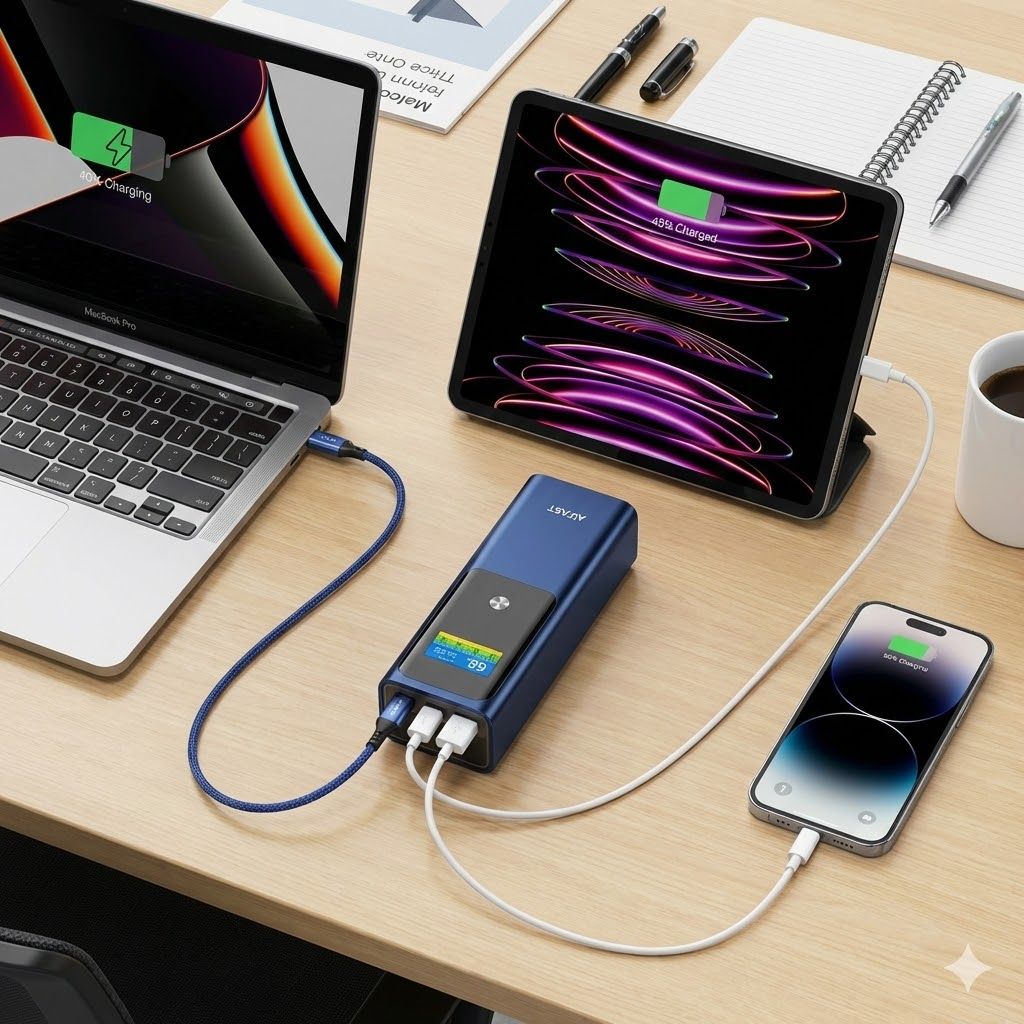
Dual Port Support: Charge two devices without current drop.
-
Smart Power IC: Balances output between wired and wireless ports.
A high-capacity model with poor wattage output can still charge slower than a smaller, more advanced portable power bank.
Calculating Power Bank Needs Based on Usage
To estimate your ideal size, multiply your phone’s battery capacity by how many full charges you need per day:
Example:
iPhone 17 (3,300mAh) × 2.5 = 8,250mAh
Add 20% for conversion loss → 10,000mAh power bank recommended.
For users charging multiple devices (phone + earbuds + smartwatch), consider:
-
10,000mAh → Light use / daily carry
-
15,000mAh → Multi-device / frequent travel
-
20,000–30,000mAh → Outdoor or business trips
Choosing the Right Material and Build Quality
While capacity determines how much you can charge, materials determine how long the power bank lasts.
H3 – What to Look For
-
Battery Type: Li-polymer cells provide higher energy density.
-
Shell Material: Aluminum alloy helps dissipate heat efficiently.
-
Safety Features: Overcharge protection, temperature control, and PD 3.1 support.
Quality power bank manufacturers like ESCCharge use high-density polymer batteries that maintain 90% capacity after 500 cycles, outperforming typical market averages.
Smart Charger Integration: The 2026 Trend
The new generation of smart power banks doesn’t just hold energy—they manage it.
AI-driven chips can detect your phone model and adjust voltage dynamically to extend both device and power bank lifespan.
Example: ESCCharge’s smart charging platform uses dynamic feedback algorithms to prevent overheating and shorten charging time by 15%.
Such innovations make it easier for users to choose higher-efficiency solutions without manually adjusting settings.
Frequently Asked Questions
1. Can a high-capacity power bank damage my phone?
No, as long as it includes smart voltage regulation (PD/PPS). Modern ICs prevent overcurrent or overvoltage.
2. Is a 30,000mAh power bank safe for flights?
Most airlines allow up to 100Wh (~27,000mAh at 3.7V). Always check the printed Wh rating before boarding.
3. Does a larger power bank charge faster?
Not necessarily — output wattage, not capacity, determines charging speed.
4. What’s the most efficient size for daily use?
For most smartphones, 10,000–15,000mAh hits the balance between weight, portability, and capacity.
Final Thoughts: Power Smart, Not Heavy
The right power bank capacity isn’t about numbers—it’s about matching your phone model, habits, and charging environment.
A perfectly sized unit reduces waste, improves safety, and enhances travel comfort.
Whether you’re looking for a compact 10,000mAh daily companion or a 20,000mAh high-capacity power bank for multi-device charging, ESCCharge provides certified, efficient, and customizable solutions for every user.
Explore more at ESCCharge Official Website and discover how smart energy design empowers your devices every day.