
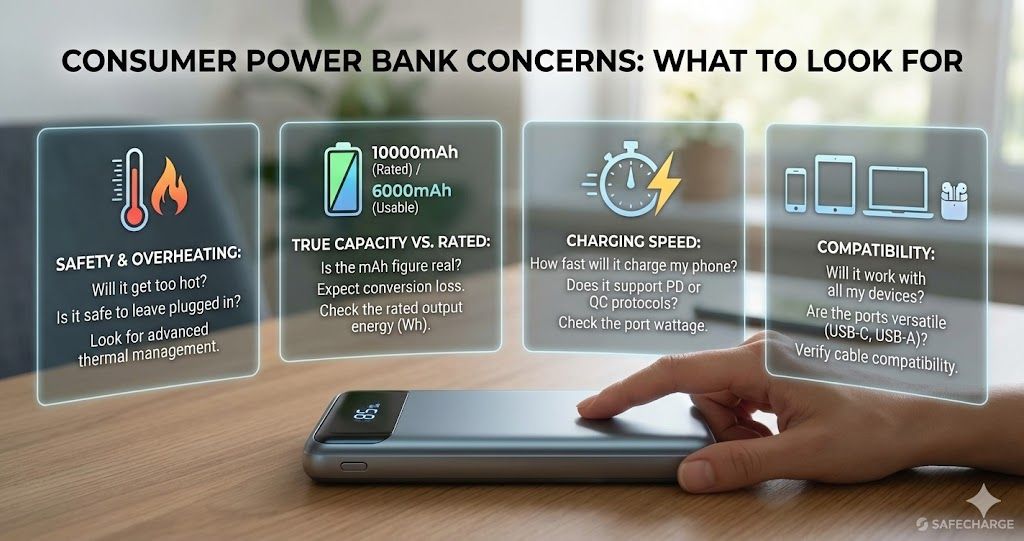
In the consumer electronics industry, the power bank is a deceptive product. It looks like a simple plastic brick, but inside, it is a complex energy system balancing chemistry, physics, and digital protocols.
For brand owners, wholesalers, and Amazon sellers, the difference between a "Best Seller" and a "Product Recall" often lies in understanding user complaints before the product leaves the factory.
Why do power bank complaints matter for your business?
When you ignore market feedback, the consequences are severe:
-
Platform Penalties: Amazon listing suppression due to "Safety Concerns" or "Not as Described."
-
High Return Rates: Erosion of profit margins due to reverse logistics.
-
Brand Damage: One viral video of a melting charger can destroy years of reputation.
-
Customs Seizures: Lack of proper safety documentation (like UN38.3) leads to stuck shipments.
How can FAQ content and technical knowledge reduce pre-sale friction?
By understanding the root causes of these complaints, you can improve your sourcing checklist, update your user manuals, and train your customer support teams.
This guide breaks down the top 5 Power Bank Issues and translates them into actionable verification steps for B2B buyers.
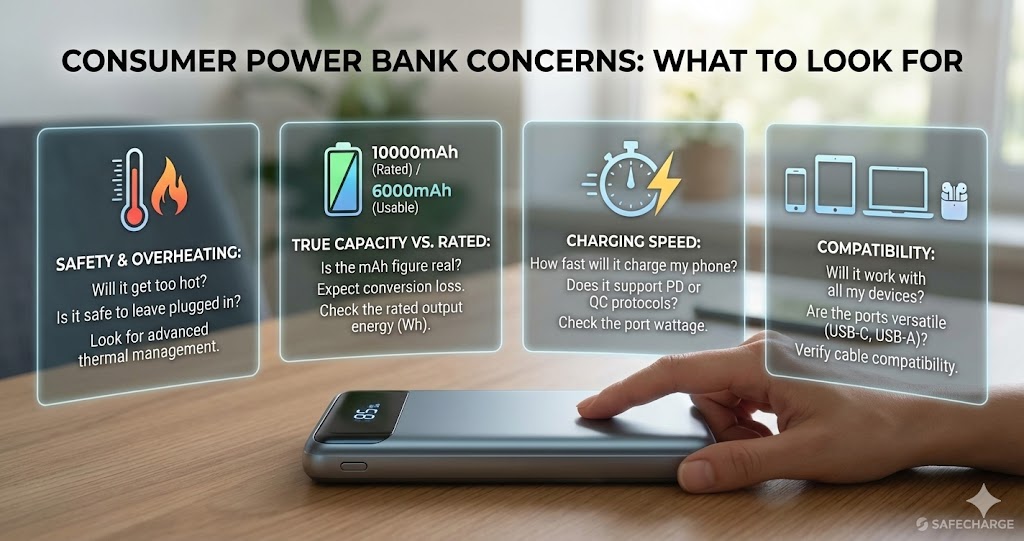
The "Red Flag" Overview: Top 5 Issues at a Glance
Before diving deep, here is a summary of the battlefield. These are the most frequent issues reported by users and the hidden risks for B2B buyers.
| Issue | What Users Feel / Say | Likely Root Cause | What B2B Buyers Should Check | Risk Level |
| 1. Overheating | "It burns my hand!" / "Scary hot." | High internal resistance, poor heat dissipation design, cheap BMS. | Thermal rise curves, NTC sensors, Fire-retardant casing (V0). | High (Safety) |
| 2. Slow Charging | "Takes forever to charge." / "Not Fast Charge." | Protocol mismatch, non-E-marker cables, low input watts. | Input/Output protocol tables, Cable specs, Packaging claims. | Medium (Returns) |
| 3. Won't Charge | "Lights are on, but phone won't charge." | Port handshake failure, Low-current mode missing (for earbuds). | Port reset logic, Trickle charge mode, Compatibility tests. | Medium (Defect) |
| 4. Fake Capacity | "Drains too fast." / "Fake mAh." | Low conversion efficiency, voltage step-up loss, low-grade cells. | Watt-hour (Wh) calculation, Efficiency rates (>85%), Real output test. | High (Trust) |
| 5. Lifespan Issues | "Died after 2 months." / "% jumps to 0." | Cheap recycled cells, poor fuel gauge algorithm. | Cycle life data (500+), Aging tests, Battery internal resistance. | Medium (Long-term) |
Deep Dive: Analyzing the Top 5 Complaints
Let’s dismantle these issues using a Why / What / How framework to bridge the gap between user perception and manufacturing reality.
Issue 1: Hot When Charging (Thermal Issues)
Consumer Questions:
-
Why does my power bank get hot?
-
Is it dangerous if it’s warm?
-
What temperature is considered "normal"?
The Technical Reality: Physics dictates that energy conversion generates heat. Fast charging (e.g., PD 45W or 100W) moves massive amounts of energy quickly. However, there is a difference between "Operating Warmth" (40-50°C) and "Runaway Heat" (>60°C). Cheap power banks often use batteries with high internal resistance or lack proper heat sinks, causing heat to build up inside the casing.
B2B Verification: How can we ensure fast charging ≠ overheating? As a buyer, you must demand proof of Thermal Management.
-
NTC Thermistors: Does the PCBA have NTC sensors glued directly to the battery pack? This cuts off power if temps rise too high.
-
Materials: Is the casing made of UL94 V-0 fire-retardant PC/ABS?
-
Aging Test: Ask for the "Temperature Rise Report" under full load (e.g., charging a laptop at 65W for 1 hour).
Issue 2: Unable to Charge or Slow Charging
Consumer Questions:
-
Why is charging so slow compared to my wall plug?
-
What charger do I need for this power bank?
-
How do I get the advertised fast charge speed?
The Technical Reality: This is usually a "Handshake Failure."
-
Input Limitation: A user tries to charge a 20,000mAh bank with an old 5W iPhone cube. It will take 20 hours.
-
Cable Bottleneck: High power (60W+) requires cables with E-marker chips. Cheap cables throttle speed.
-
Protocol Gap: A Samsung phone needs PPS (Programmable Power Supply). If the power bank only supports standard PD, the phone charges slowly.
B2B Verification: How can we avoid "false fast charge" complaints?
-
Protocol Matrix: Verify that your product supports the specific protocols of your target market (e.g., Samsung PPS, Huawei SCP, Apple PD).
-
In-Box Accessories: Ensure the included cable matches the power bank's max output. Don't ship a 100W bank with a 3A (60W) cable.
-
Manual Clarity: Your user manual must explicitly state: "For fastest recharging, use a wall charger with at least X Watts."
Issue 3: Power % Shows but Won't Charge (The "Ghost" Charge)
Consumer Questions:
-
Why won't it charge my AirPods even though it has 50% power?
-
Is the USB port broken?
-
How to reset a power bank?
The Technical Reality: Most power banks have a "Minimum Load Threshold" (usually 50-80mA). Small devices like wireless earbuds draw very little power. The power bank thinks nothing is connected and goes to sleep to save energy. Additionally, Type-C ports sometimes fail to negotiate who is the "Host" and who is the "Device."
B2B Verification: How can we reduce "Defective on Arrival" claims?
-
Trickle Charge Mode: Does the device have a "Low Current Mode" (activated by double-pressing a button)? This is crucial for wearables.
-
Wake-up Sensitivity: Test the automatic wake-up function with various cables.
-
Port Reset: Does the circuit reset if the user replugs the cable?
Issue 4: Capacity Drains Quickly (The "Fake mAh" Myth)
Consumer Questions:
-
Why does a 20,000mAh power bank capacity only charge my 5,000mAh phone twice? (Should be 4 times!)
-
What is "rated capacity" vs. "cell capacity"?
-
Is this product a scam?
The Technical Reality: This is the #1 misunderstanding in the industry.
-
Cell Capacity: 20,000mAh at 3.7V (Battery Voltage).
-
Output Need: Phones charge at 5V, 9V, or higher.
-
Conversion Loss: Stepping up voltage generates heat and burns energy.
-
The Math: Total Energy (Wh) = 20Ah * 3.7V = 74Wh. If discharging at 5V, effective mAh is roughly 14,800mAh minus 10-15% efficiency loss.
B2B Verification: How can we avoid "fake capacity" accusations?
-
Labeling: Legally, you must print the Rated Capacity (the actual output mAh) on the device, not just the cell capacity.
-
Efficiency Test: Ask the factory for the conversion efficiency rate. Premium manufacturers (like FIXERA) achieve >85-90%. Cheap ones struggle at 70%.
-
Marketing: Create a chart for your listing: "Charges iPhone 15: 3.5 times / Charges Samsung S24: 2.8 times." Manage expectations visually.
Issue 5: Lifespan & Indicator Jumps
Consumer Questions:
-
Why does the battery percentage jump from 30% to 0% instantly?
-
What is the typical lifespan of a power bank?
The Technical Reality: "Percentage Jumping" indicates a Voltage Collapse. This happens when:
-
Low-Grade Cells: The internal resistance increases rapidly after a few months.
-
Cold Weather: Lithium ions move slower in the cold.
-
Poor Algorithm: The Fuel Gauge chip isn't calibrated to the battery curve.
B2B Verification: How can we minimize after-sales returns?
-
Cell Grade: Demand Grade A cells (Ev-grade or top-tier suppliers). Avoid "Recycled" or "B-grade" cells which are common in ultra-low-price offers.
-
Cycle Life: Specify "500 cycles at >80% retention" in your PO (Purchase Order).
-
Aging: Ensure 100% of finished goods undergo aging tests to calibrate the digital display.
The Procurement Checklist: How to Block Risks Early
If you are sourcing from China, use this checklist to filter suppliers. If a supplier hesitates to provide these, walk away.
1. Essential Documentation (Non-Negotiable)
-
[ ] UN38.3 & MSDS: Required for ANY shipping (Air/Sea).
-
[ ] CE / FCC / RoHS: Required for customs clearance in EU/USA.
-
[ ] IEC 62133: Safety standard for the battery cell itself.
2. Performance Verification
-
[ ] Power Output Test: Does the 45W port actually sustain 45W, or does it drop to 20W after 5 minutes?
-
[ ] Capacity Grading: Ask for the OQC (Outgoing Quality Control) report on capacity.
-
[ ] Ripple & Noise Test: Ensures clean power that won't damage the phone screen/touch IC.
3. Physical Inspection
-
[ ] Drop Test: Standard 1.2m drop test on 6 sides.
-
[ ] Port Durability: USB ports should withstand 3000+ plug/unplug cycles.
Educating the End-User: How to Extend Power Bank Life
Add this section to your blog or user manual to add value.
How to charge correctly? Always use the cable provided or a certified brand cable. Cheap cables cause resistance and heat.
How to store long-term? If not using the power bank for months, store it at roughly 50% charge. Storing it at 0% or 100% for long periods degrades the chemistry.
What temperature ranges are safe? Avoid leaving power banks in hot cars in summer. Temperatures above 60°C can trigger safety valves or causing swelling.
FAQ: Common Questions from Buyers
Q: Can I customize the charging protocols for my local market? A: Yes. Professional OEM factories (like FIXERA) can adjust the protocol IC to prioritize Samsung PPS, Apple PD, or other regional standards based on your request.
Q: Why is there a price difference of $5 between two 20,000mAh models? A: The difference is usually inside. One uses Grade A cells and fire-retardant materials with a high-efficiency chip. The cheaper one likely uses recycled cells, a basic casing, and lacks NTC thermal protection. The $5 saving costs you in returns and brand reputation.
Q: How do I test the "Real Capacity" myself? A: You can use a USB Power Meter (tester). Fully discharge the bank, then fully charge it through the meter to see the Input Wh. Then discharge it to a load to see Output Wh. Output Wh / Input Wh = Efficiency.
Conclusion: Quality is Your Best Marketing Strategy
In 2026, the power bank is no longer just a cheap accessory; it is a critical "Energy Product" that users rely on for their daily lives.
For Brand Owners, treating power banks as high-precision devices rather than disposable commodities is the key to building trust. For Power Bank Wholesalers, choosing stable, compliant products ensures sustainable profits without the nightmare of recalls.
Don't let technical ignorance eat your margins. At FIXERA, we specialize in high-performance, private-mold charging solutions that solve these exact pain points. We invite you to test the difference.