
If you are a distributor or brand manager in the consumer electronics space, you have likely asked yourself these frustrating questions:
-
Why do "fast chargers" still overheat in real-world use despite claiming high efficiency?
-
What happens when heat becomes a customer complaint on Amazon or your e-commerce site?
-
How does excessive heat translate directly into returns, 1-star reviews, and warranty claims?
-
Why do many electronic failures appear only after weeks of use, rather than during factory QC?
Heat is the silent killer of electronics profitability. In the race for smaller sizes and higher wattages, many manufacturers sacrifice thermal management for marketing specs. The result? A charger that hits 45W for two minutes, gets dangerously hot, throttles down to 15W, and eventually fails.
For a B2B buyer, this isn't just a technical glitch; it is a financial liability.
The Chain of Consequences: Heat to Returns
Here is how a thermal issue evolves into a business loss:
Heat Accumulation $\rightarrow$ Aggressive Throttling (Slow Charging) $\rightarrow$ User Frustration $\rightarrow$ Negative Review $\rightarrow$ Product Return $\rightarrow$ Dead Inventory
In this article, we will explore what stability actually means, how GaN and AI control solve the overheating crisis, and why the Shenzhen ESC-C020—with its 40x40x30mm form factor—represents the new standard for safe, stable, and cost-effective charging.
What Does "Stability" Mean in Charging (Beyond Peak Wattage)?
Marketing materials often highlight "Peak Power" (e.g., 45W), but professional buyers must ask: What is charging stability?
Stability is not about the highest number on the box. It is about the consistency of the power delivery over time.
1. Sustained vs. Peak Power
What is the difference? Peak power is what a charger can deliver for a short burst (often just minutes). Sustained power is what it can hold for 30 to 60 minutes without overheating. If a "45W charger" drops to 20W after 10 minutes due to heat, it is unstable.
2. Voltage Ripple and Noise
How does this affect the device? Ripple refers to the small fluctuations in voltage output. High ripple causes the phone's internal power management IC (PMIC) to work harder and get hotter. A stable charger delivers "clean" DC power, keeping the phone cool.
3. Soft Throttling vs. Hard Drops
What happens when it gets warm? All chargers manage heat. A poor charger will "panic" and cut power drastically (Hard Drop). A stable charger uses AI to lower power imperceptibly (Soft Throttling), maintaining a good charge speed while protecting the device.
Comparison: Peak Wattage vs. Real-World Stability
| Feature | Generic "High Watt" Charger | Stable AI-Controlled Charger (ESC-C020) |
| Headline Spec | 45W | 45W |
| 30-Min Output | Drops to 15W-20W (due to heat) | Maintains high power (Smart adjustment) |
| Phone Temp | Gets hot (Device throttling) | Remains cool (Clean output) |
| User Experience | "Fast" only at the start | Consistently fast (60% in 30 mins) |
What GaN Changes: Smaller Size, Higher Efficiency, Lower Heat (But Not Magic)
To understand the ESC-C020, we must first answer: What is GaN and how does it reduce heat?
Gallium Nitride (GaN) is a semiconductor material that has replaced silicon in high-end chargers.
-
How does it work? GaN runs at a much higher switching frequency than silicon.
-
Why does this save space? Higher frequency allows for much smaller transformers and capacitors—hence the ultra-compact 40x40x30mm size of the ESC-C020.
-
How does it improve efficiency? It has lower switching losses, meaning less energy is wasted as heat.
However: Why do some ESC-C020 still run hot?
GaN is a material, not a magic wand. If a manufacturer uses GaN but cuts corners on the thermal layout, PCB design, or heat dissipation materials, the charger will still overheat. The chip might be efficient, but if the heat is trapped inside a tiny plastic shell, the product fails.
Comparison: GaN vs. Silicon
| Metric | Traditional Silicon Charger | Modern GaN Charger (ESC-C020) |
| Efficiency | 85% - 88% | 92% - 95% |
| Size (45W) | 60mm x 50mm x 30mm | 40mm x 40mm x 30mm |
| Heat Waste | High | Low |
| Power Density | Low | Ultra-High |
Why AI Control Is the 2026 Differentiator (The "Brain" Behind Safe Fast Charging)
Hardware (GaN) is the body, but AI Control is the brain. This is where the Shenzhen ESC-C020 separates itself from generic competitors.
What does "AI control" mean in a charger?
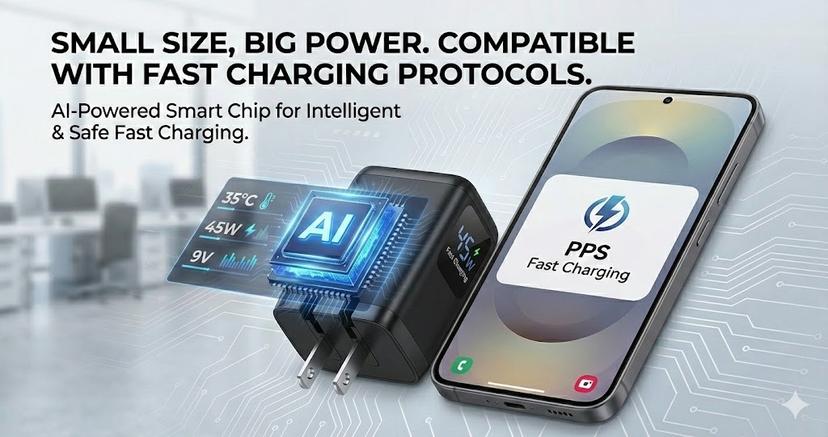
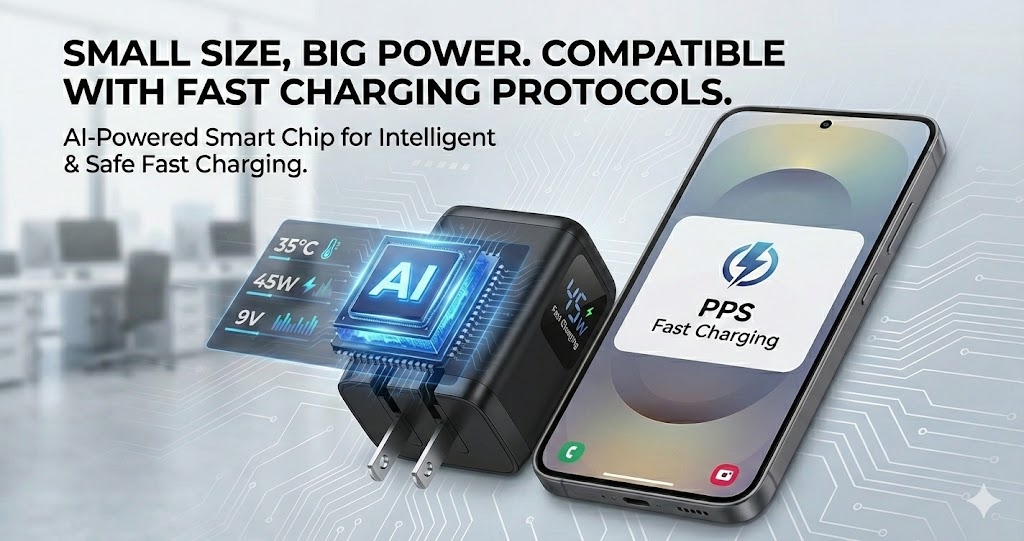
It is not just a buzzword. It refers to a dedicated MCU (Microcontroller Unit) running an algorithm that constantly monitors the charging environment.
-
Dynamic Load Recognition: How does it know what is plugged in? The ESC-C020 detects whether you have connected an iPhone 17 Pro Max, a Samsung Galaxy S25, or a pair of earbuds. It doesn't just "push" power; it negotiates the perfect protocol (PD3.0, PPS, QC3.0, etc.).
-
Thermal Prediction: How can it prevent overheating? Instead of waiting for the charger to get hot and then cutting power, the AI predicts heat accumulation based on the current load and ambient conditions. It micro-adjusts the voltage/amperage curve to prevent the temperature spike before it happens.
-
Protocol Mastery: The ESC-C020 is a "polyglot." It fluently speaks the charging languages of almost every major device:
-
Apple: PD3.0
-
Samsung: AFC / SSCP
-
Huawei/Others: FCP / ChargeTurbo / Super VOOC / Super FlashCharge / QC3.0
-
How does AI control reduce returns?
-
No "Hot to Touch" Complaints: By keeping surface temperatures regulated, users feel safe.
-
No "Why is it slow?" Complaints: By avoiding drastic throttling, the charging speed remains perceived as fast.
-
Protection: It offers OVP (Over Voltage), OCP (Over Current), and SCP (Short Circuit) protection that reacts in microseconds.
The Real ROI: How Lower Heat Cuts Warranty and Return Costs
Let's translate this technology into business terms. Why is paying for quality GaN + AI worth it for a B2B buyer?
How much does a 1% return rate cost a reseller?
When a customer returns a cheap, overheating charger, you lose far more than the cost of the unit.
-
Direct Cost: Refund + Shipping.
-
Platform Penalty: Amazon/eBay algorithm demotion.
-
Brand Damage: One 1-star review on heat ("This thing melted!") can deter hundreds of future customers.
The "Multiplier" of Heat Complaints
Heat issues are unique because they trigger fear. A customer might tolerate a cable that stops working, but a charger that gets too hot is perceived as a fire hazard. This leads to immediate returns and aggressive complaints.
By utilizing the ESC-C020, which combines GaN efficiency with AI temperature supervision, you drastically reduce the failure modes (like capacitor fatigue and solder joint stress) that lead to these returns.
What to Measure: A B2B Verification Checklist (Specs That Predict Low Returns)
If you are sourcing chargers in 2026, do not just look at the price tag. What specific metrics should you demand from your supplier? Use this checklist to verify quality.
1. Thermal Metrics
-
What to ask: "What is the surface temperature after 60 minutes at full 45W load in a 25°C environment?"
-
Target: The ESC-C020 keeps this well within international safety standards (IEC 62368-1).
2. Electrical Stability
-
What to ask: "Can I see the V/I (Voltage/Current) curve for the first 30 minutes?"
-
Target: Look for a smooth line, not a jagged "sawtooth" pattern which indicates unstable throttling.
3. Protocol Compliance
-
What to ask: "Does it support PPS (Programmable Power Supply) for Samsung?"
-
Target: Essential for modern Androids. The ESC-C020 fully supports PPS alongside Super VOOC and ChargeTurbo.
4. Certification & Safety
-
What to ask: CE, FCC, RoHS, and fire-retardant shell material (PC V0).
Common Buyer Questions (FAQ)
Here are the answers to the most frequent questions we receive from global buyers.
Q1: Why does my 45W charger sometimes show only 25W on the screen?
A: This is AI control in action. If your phone battery is already at 80%, or if the phone screen is on and generating heat, the phone requests less power. The ESC-C020 respects this request to protect your battery.
Q2: How can we verify PPS support for Samsung full-speed charging?
A: When you plug in a compatible Samsung device, the ESC-C020’s smart detection (and if equipped with a screen, the display) will confirm "Super Fast Charging." Without PPS, Samsung phones will only charge at slower speeds.
Q3: What temperature is considered "safe" for a compact charger?
A: International standards usually allow up to 77°C (170°F) for plastic surfaces. However, premium AI chargers like the ESC-C020 aim lower to ensure user comfort and component longevity.
Q4: How can a small charger (404030mm) be both powerful and cool?
A: This is the synergy of GaN (less heat generation) + 3D Stacking (efficient space use) + AI Chip (preventing heat buildup). It is density without danger.
Q5: What causes batch inconsistency—and how can suppliers prevent it?
A: Inconsistency comes from poor component tolerance. Shenzhen ESC "deadly focuses on cost" but never on critical components. We optimize supply chain management to ensure every unit in a 10,000-piece order performs identically to the sample.
Conclusion: The New Buying Logic for 2026
The era of buying chargers based solely on "Lowest Price per Watt" is ending. In 2025-2026, buyers are shifting to a new logic: Efficiency (GaN) + Intelligence (AI) + Proven Stability.
The Shenzhen ESC-C020 45W GaN AI Smart Charger perfectly embodies this shift. It combines the hottest market trends—a compact 404030mm aesthetic, full-spectrum protocol compatibility (AFC, FCP, SSCP, Super VOOC, PD3.0), and intelligent safety features—into a package that consumers love and B2B buyers can trust.
It offers the "original charger" speed experience with a better design and a price point that maximizes your margin.
Ready to lower your return rates and upgrade your product line? Contact Shenzhen ESC today for a sample of the ESC-C020 and see the stability difference for yourself.