
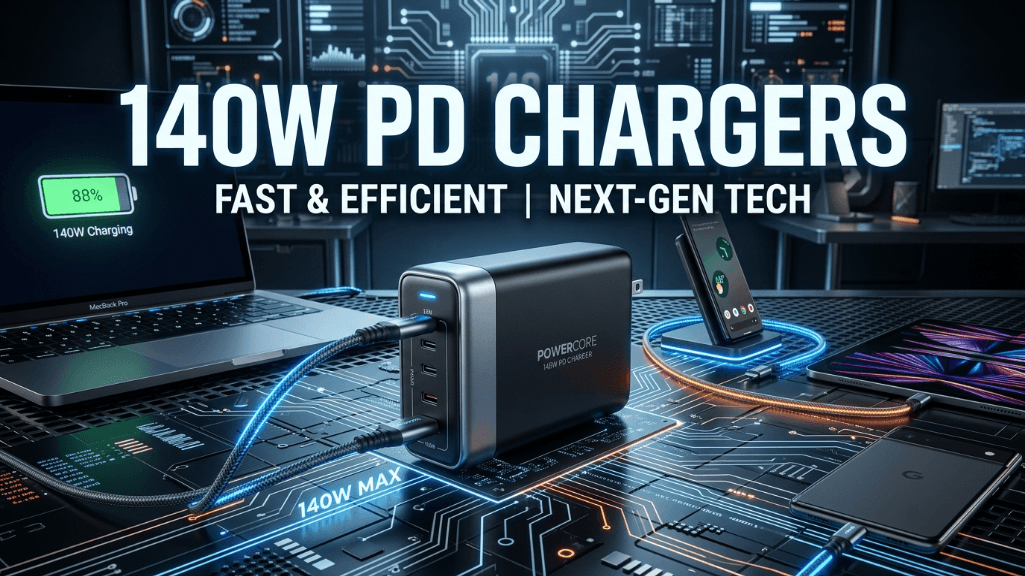
In the 2026 high-power charger B2B market, 140W (PD 3.1) is more than just a number—it represents the current “physical ceiling” of fast-charging technology and marks a watershed for brand premiums. Here is the core conclusion upfront: finding the direct factory price for 140W PD chargers is not about comparing quotes, but auditing the factory’s ripple control and thermal management capabilities under the 28V/5A architecture.
Currently, a 140W charger that complies with international safety standards, uses a mainstream GaN III solution, and supports the full PD 3.1 protocol, has an actual B2B bulk wholesale price at Dongguan source factories of $18–26 per unit (depending on customization level). If your supplier’s quote is far below this range, make sure to check whether the MOSFET specs are reduced or if the PCBA has removed essential EMI filtering components.
Why the “Factory Price” Is Only the Tip of the Iceberg for 140W PD Procurement
In Dongguan, there are over a thousand companies claiming to be Dongguan electronics factory sources. However, when you drill down into the 140W segment, most of these companies are merely assembling off-the-shelf solutions.
Penetrating the Quote: Understanding GaN III Cost Structure
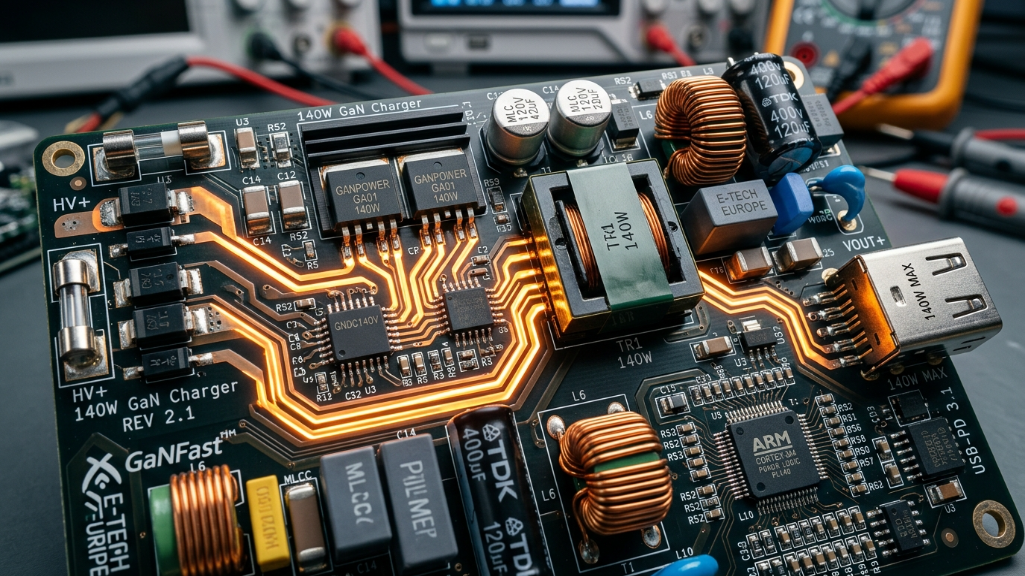
The core cost of a 140W charger lies in the integration level of the GaN chip and the voltage rating of surrounding passive components. The PD 3.1 protocol raises output voltage to 28V, demanding high precision from the MCU’s AVS (Adjustable Voltage Supply) algorithm.
Fluctuations in bulk 140W GaN charger pricing often stem from inductor core material selection. While high-performance amorphous cores cost about 30% more, they significantly reduce high-frequency eddy current losses.
Trader Premium Logic and High-Power Risks
Many traders wear the guise of “source factories.” For entry-level products like 65W, they may lower prices through sheer volume. But in 140W technology-intensive products, without direct control over high-power PCBA design factories, they cannot resolve “current drop” or repeated reconnection issues at high-voltage outputs.
Blindly chasing ultra-low prices in B2B purchases often leads to >5% repair rates and expensive overseas return logistics.
Breaking Technical Barriers: What Makes a 140W Charger Truly Reliable?
Developing 140W chargers is not merely about amplifying power; it’s about restructuring power electronics logic. After 15 years in the industry, I must stress: protocol compatibility is an invisible cost in B2B procurement.
Mastering PD 3.1 and PPS: Ensuring Full Protocol Compatibility
A top PD 3.1 fast charger manufacturer must resolve handshake logic conflicts. During AOVOLT’s development of 140W full-protocol products, we collected extensive real-world data:
When a MacBook Pro 16 triggers 28V output on one port, and a Samsung phone supporting PPS connects to the second port, the PCBA MCU must redistribute power in milliseconds without causing a restart.
Low-cost solutions often trigger protective shutdowns under multi-channel switching. Our solution: an independent high-frequency sampling chip that monitors VBUS voltage in real time. This low-level optimization for full-protocol charging hubs cannot be matched by generic solutions.
Thermal Management: Solving High-Temperature Issues with 15 Years of Manufacturing Experience
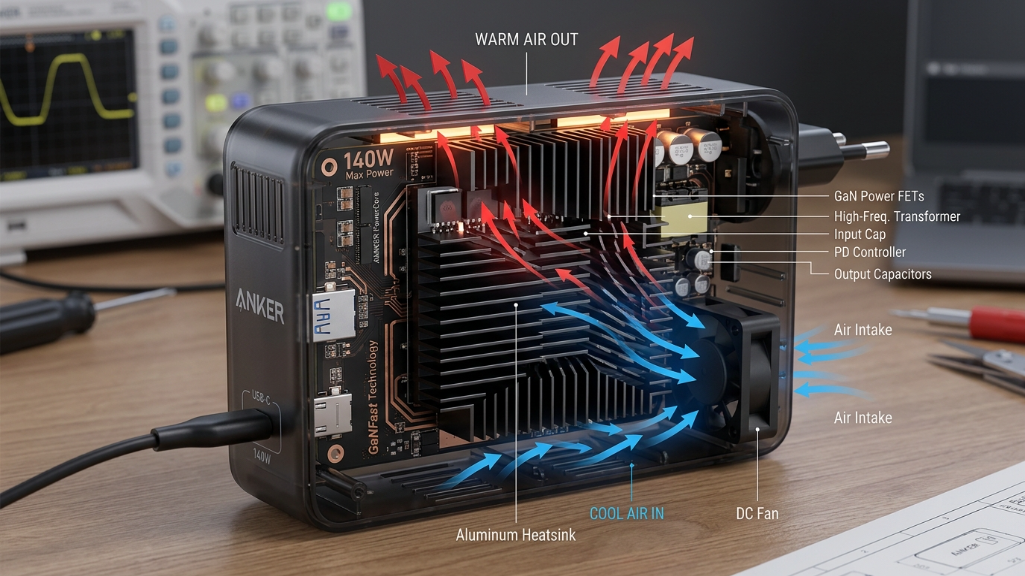
At full load, 140W chargers generate heat rapidly. Traditional potting is effective but adds weight and reduces serviceability.
| Technical Dimension | Industry 140W Standard | AOVOLT 140W Flagship | Procurement Insight |
|---|---|---|---|
| Topology | Flyback | ACF (Active Clamp Flyback) / LLC | Conversion efficiency directly affects temperature rise |
| GaN Version | Gen I / II | GaN III high-integration chip | Volume reduced 30%, heat reduced 20% |
| Ripple Control | 150–200 mV | ≤ 100 mV | Lower ripple reduces computer battery damage |
| Casing Material | Standard PC, flame retardant | High thermal conductivity PC + aluminum frame | Key to long-term thermal performance |
| Protocol Handshake | PD 3.1 | Full protocol (including private protocols) | Determines end-user compatibility complaints |
Vertical Integration Advantage: Why “Asset-Heavy” Factories Are the Ultimate Choice
In today’s transparent supply chain, vertical supply chain manufacturing is the only guarantee for authentic direct factory pricing for 140W PD chargers. Provide you with 140W PD3.0 fast charging PCBA design: solving heating & compatibility.
In-House Mold Opening & Injection: Shortening R&D Delivery Cycles
Most B2B buyers fear “mismatched products” or endless delays when seeking OEM/ODM charging solutions for 140W. Factories without mold workshops face weeks of external coordination for minor modifications, like adding cooling grids or adjusting port positions.
In-house mold opening allows parallel engineering: while circuit engineers optimize PCBA layout, mold designers run 3D simulations. At AOVOLT, mold precision is within 0.02mm, ensuring tight-fitting housings even at scale.
Closed-Loop Production for Consistent Quality in Bulk Orders
A full closed-loop supply chain—from SMT PCBA, precision hardware integration, to final assembly—allows traceable quality. Abnormalities in 100% load aging tests can be traced within 10 minutes, instead of blaming multiple suppliers. This determinism is what B2B clients value as premium assurance.
Unique Aesthetic Customization: Brand Recognition Without Middlemen
In the cross-border market, generic black-and-white cubes fatigue consumers. Direct factory connection enables brands to leverage design resources, such as semi-transparent casings or brushed metal finishes, with customization costs far lower than traditional outsourcing.
Weighing B2B Procurement Modes: White Label vs. Deep OEM/ODM Customization
Procurement decisions involve not just price but brand positioning. Many are tempted by ultra-low white-label prices but ignore market homogenization and price wars.
Leveraging Source Factory Customization for High-End Brand Premium
White-label solutions provide fast turnover. True profit lies in deep customization. Partnering with high-power PCBA design factories, buyers can tweak charging protocols or develop exclusive handshake logic.
| Procurement Strategy | Technical Depth | Market Competitiveness | Supply Chain Barrier | Long-term ROI |
|---|---|---|---|---|
| Standard White Label | Generic PCBA, off-the-shelf casing | Low (easy price war) | None, ready stock | Fast short-term, low long-term premium |
| Basic OEM Customization | Logo replacement, packaging | Medium | 1k–3k MOQ | Brand recognition begins to form |
| Deep ODM Cooperation | Proprietary circuit topology + exclusive mold | Very High | 5k+ MOQ + R&D | Pricing control, strong risk resistance |
Successful brands often choose “small-step fast” customization, using AOVOLT 140W high-efficiency PCBA as the base, with exclusive ID and thermal structure customization via in-house molds. This avoids months of circuit R&D while achieving visual differentiation.
Compliance & Global Access: The “Technical Passport” of 140W Chargers
High-power charger certification is essential. 140W involves high voltage and current, and leakage or fire can lead to catastrophic recalls and lawsuits.
UL, CE, FCC: Engineering Audits for High-Power Devices
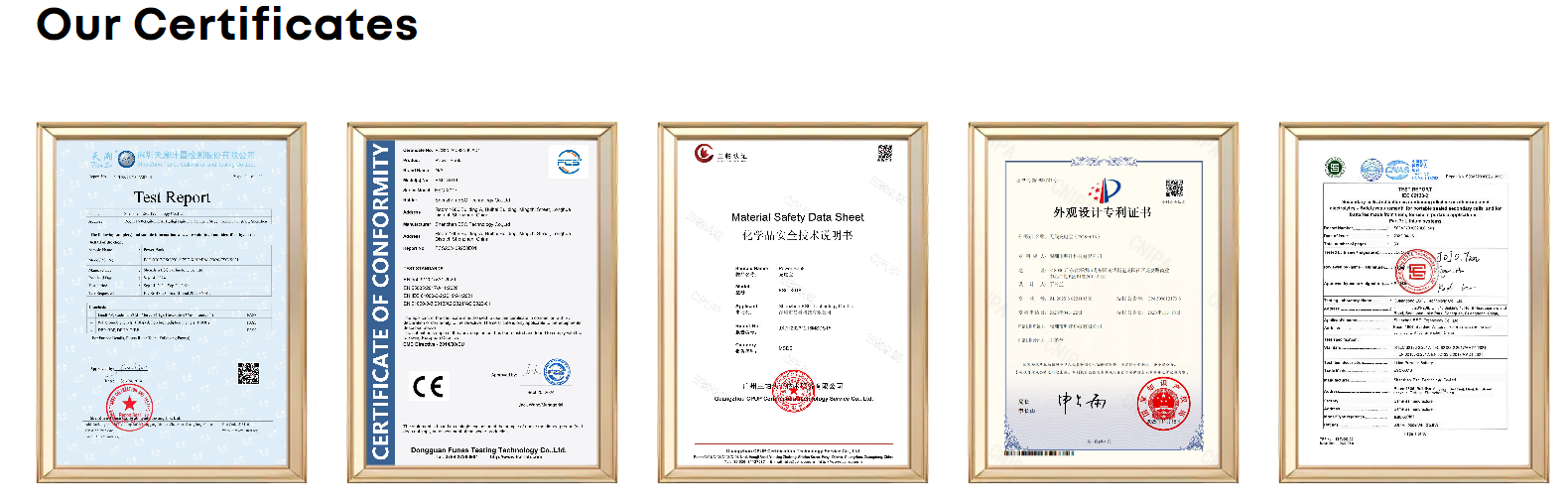
B2B buyers must check the “core component list (CDF)” on certificates. Low-cost factories may swap components between certification samples and bulk production.
At AOVOLT, all UL/CE/RoHS-certified 140W PD components undergo secondary lab inspection. For 28V high-voltage operation, we use high-temp, long-life solid capacitors to avoid systemic risks.
Dongguan Factory Audit Checklist: Identifying Real Manufacturers
Don’t rely on verbal claims. Genuine factories should demonstrate aging tests on demand. At AOVOLT Dongguan, each 140W charger undergoes 4 hours of full-load aging. Factories unable to show real-time power data or with few units on aging racks cannot claim true source factory status.
B2B Procurement FAQ
Q1: Are 140W PD 3.1 chargers safe for older laptops?
Absolutely. PD handshake ensures the charger locks to 20V/3.25A for 65W devices. Multi-level step-down protection prevents overvoltage.
Q2: How to differentiate real source factories from top-tier traders in Dongguan?
Check asset-heavy ratios or visit tooling rooms and injection machines. Traders may rent lines but cannot sustain multi-million vertical supply chain facilities.
Q3: MOQ for custom logos on 140W GaN chargers?
Laser engraving or silk screen: 500–1000 units. Custom casing color: 3000+ units.
Q4: Why is 140W pricier than 100W?
Not just 40W difference—PD 3.1 EPR requires advanced magnetic components and high-voltage semiconductors, causing nonlinear BOM cost growth.
Q5: Do 140W chargers require special cables?
Yes. Standard E-Marker cables max at 100W (20V/5A). Full 140W output requires PD 3.1 28V/5A 240W-rated cables. We recommend complete bundled purchase to avoid user confusion over slow charging.
Conclusion: Supply Chain Depth Determines Brand Height
While price has limits, technical support and supply chain stability are endless. A 15-year-experienced factory offers not a few cents saved per unit, but confidence facing global compliance, protocol compatibility, and tight delivery pressure.
From schematic design, to precise mold fit, to high-power PCBA voltage swings in aging racks, every step reflects respect for manufacturing. When your brand stakes its claim in the 140W high ground, success is determined by the factory’s R&D depth.
This deep collaboration transcends simple buying and selling. If planning next-gen high-power fast chargers, or seeking performance tuning and customization of existing PCBA, engineering communication from the ground up is key. At AOVOLT, we define ourselves as your offshore R&D center, translating 15 years of technical language into the most cost-effective, stable commercial path in the manufacturing city of Dongguan.
References: