
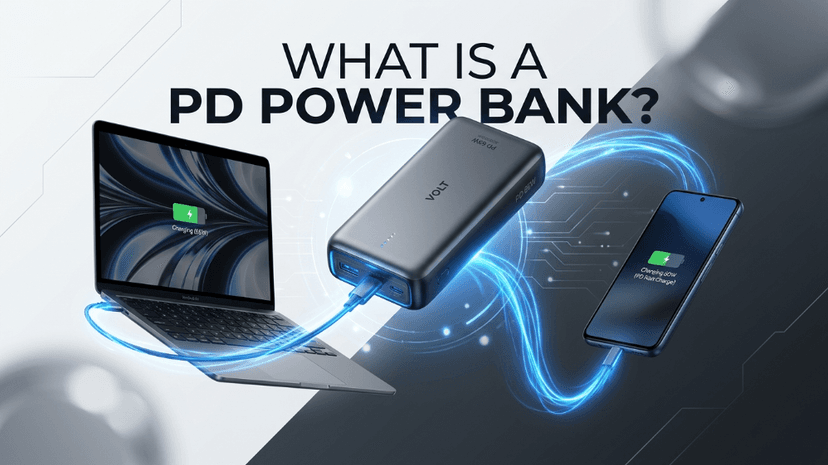
What exactly is a PD mobile power bank?
In simple terms, it is a portable energy storage device based on the USB-C Power Delivery protocol, which provides high-wattage bidirectional fast charging for smartphones and even high-performance laptops through a dynamic voltage negotiation mechanism.
If you are a B2B buyer, here is the direct conclusion: in 2026, with the EU officially mandating USB-C as the unified interface for all newly sold laptops, demand for 65W and above PD fast-charging power banks will experience explosive growth. At present, a 20000mAh 65W laptop-grade PD power bank that passes basic safety certification is generally priced at the factory wholesale level in the range of:
15 to 22 USD
For retailers, this represents a gross profit margin of over 60%. Stop wasting budget on outdated 5V/2A “bricks.” This is a protocol-driven reshuffle of the entire charging industry.
This article will thoroughly break down everything from underlying technology to sourcing high-quality OEM factories, fully revealing its commercial fundamentals.
What Does “PD” Mean in a Power Bank?
The Definition of USB-C Power Delivery
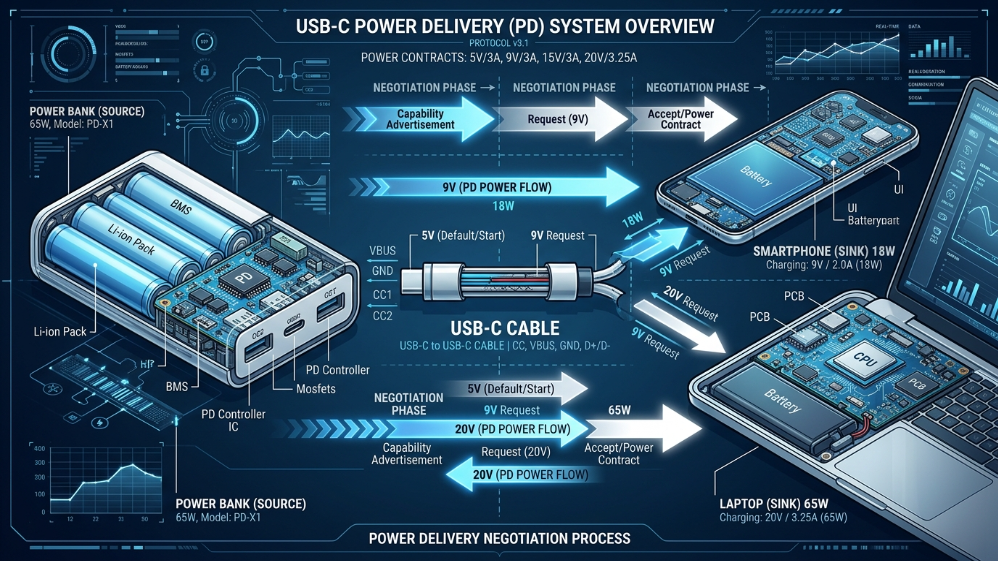
Stripping away marketing language, PD is essentially a hardware and software hybrid specification defined by the USB-IF (USB Implementers Forum). Traditional power banks can only output a fixed 5V voltage passively. However, a PD-enabled PCBA motherboard is completely different—it integrates a dedicated protocol chip.
When a device is connected via a USB-C to USB-C cable, a handshake protocol is instantly established between the power source and the receiving device.
The power management chip actively “asks” the phone or laptop:
“What is the maximum voltage and current you can accept?”
The power bank then dynamically adjusts and outputs 5V, 9V, 15V, or 20V accordingly. This is why the same battery can charge an iPhone at 20W and also fully power a MacBook at 65W.
In addition, the bi-directional charging mechanism allows the same USB-C port to both discharge power and perform ultra-fast high-wattage self-charging.
PD vs QC: Which Fast Charging Protocol is Better?
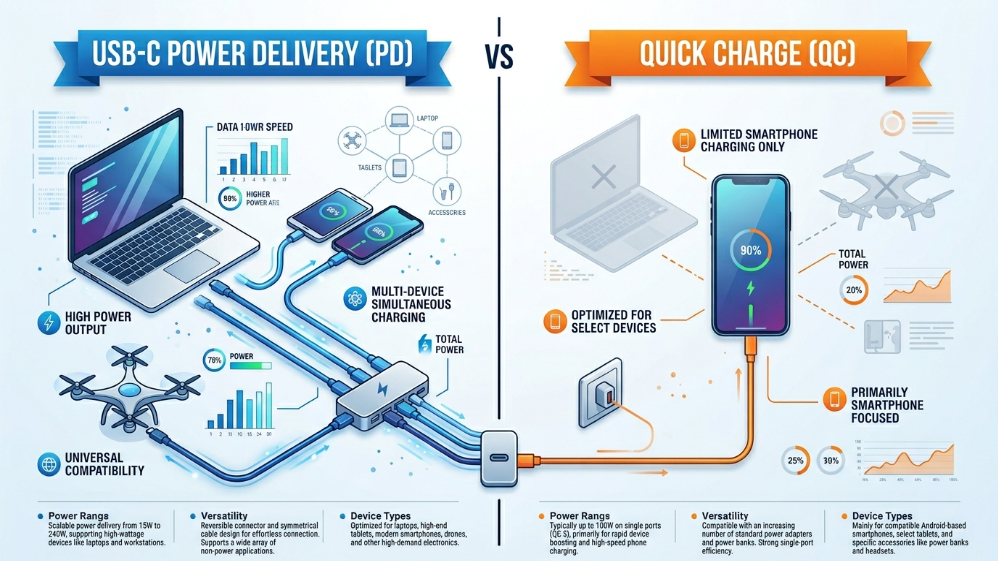
The market once experienced a fragmented era where Qualcomm’s QC (Quick Charge) dominated. However, in today’s fast charging protocol competition, PD has ultimately won.
QC mainly relies on increasing voltage to raise power output, while PD not only increases voltage but also supports high-current transmission (up to 5A). More importantly, PD breaks the chipset ecosystem barrier at the architectural level.
Multi-Dimensional Comparison Table 1: PD vs QC Core Parameters & B2B Impact
| Evaluation Dimension | USB-C Power Delivery (PD) | Qualcomm Quick Charge (QC) | B2B Purchasing Impact Analysis |
|---|---|---|---|
| Maximum Power Output | Up to 240W (PD 3.1) | 100W (QC 5) | PD fully covers high-margin laptop market, increasing average order value |
| Device Compatibility | Apple, Android, PC, drones universally compatible | Highly dependent on Snapdragon ecosystem | PD reduces SKU redundancy and inventory risk across brands |
| Interface Limitation | USB-C only | USB-A / USB-C | EU regulations push global C-port dominance; PD = future asset |
| Handshake Mechanism | Highly precise (mV-level adjustment, e.g. PPS) | Relatively coarse (step voltage switching) | Better thermal control, lower defect return rate |
How Does a PD Power Bank Actually Work?
Understanding Wattage (18W to 240W)
Once the protocol is understood, the biggest concern for B2B buyers is product-line matching. Wattage directly determines the target customer segment.
- 18W–20W: basic smartphones (“starter level”)
- 30W: suitable for most tablets
- 65W / 100W laptop power banks: mainstream for premium business gifting
These high-wattage devices are not simply larger batteries. They typically use a 2-series to 4-series cell architecture, combined with complex buck-boost conversion circuits to achieve high-voltage output. This requires strong PCB layout and thermal design capabilities from the OEM factory.
The Evolution: From PD 2.0 to PD 3.1 & PPS
Do not assume that “PD” alone guarantees performance—the protocol itself evolves rapidly.
Early PD 2.0 only defined fixed voltage levels. The introduction of PD 3.0 vs PD 3.1 / PPS (Programmable Power Supply) represents a real technological leap.
PPS allows voltage to be adjusted in ultra-fine 20mV increments. It transforms charging into a precise balancing system: real-time battery temperature monitoring reduces conversion loss inside the device.
Phones run cooler, and battery lifespan is extended.
PD 3.1 introduces the EPR (Extended Power Range) architecture, pushing voltage up to 48V and total power to 240W, enabling power banks to compete with traditional portable power stations. Here’s PD vs Quick Charge 3.0: Best Quick Charge B2B Buyer’s Guide Report.
Multi-Dimensional Comparison Table 2: PD Version Evolution & Product Strategy
| Version | Core Features | Max Power | Voltage Precision | Best B2B Strategy |
|---|---|---|---|---|
| PD 2.0 | Fixed voltage levels (5/9/15/20V) | 100W | None | Low-end promotional gifts only |
| PD 3.0 (PPS) | Dynamic adjustment, reduced heat | 100W | 20mV step | Mainstream product line; require PPS test reports |
| PD 3.1 (EPR) | 28V / 36V / 48V support | 240W | Ultra-fine control | High-end niche: gaming laptops, drones, photography |
Why B2B Buyers Need to Invest in PD Power Banks
Why is now the critical entry point?
Consumer demand is clear: “one cable, one power bank for everything” is no longer a geek fantasy—it is mainstream necessity.
Traditional wholesale fast charging power banks that still rely on USB-A and do not support PD face a sharp decline in demand.
According to Fortune Business Insights data models, driven by multi-device productivity, the global fast-charging power bank market is expanding irreversibly.
High wattage means high technical barriers—and therefore high profit margins.
A generic 10,000mAh power bank may retail for just over $10. But with a high-quality supply chain, a premium casing, and a 100W dual-direction PD board, retail prices can easily exceed $80.
Profit has always belonged to those closest to the core technology.
The Ultimate B2B Sourcing Checklist for PD Power Banks
Battery Cell Quality: Li-Polymer vs 18650
Battery cells determine product survival.
Low-cost products often use 18650 cylindrical lithium-ion cells. While cheap and mature, they suffer from fixed size limitations, lower energy density, and higher thermal risk in high-power configurations.
For premium PD power banks, Li-Polymer soft-pack cells are the only correct choice. They allow flexible industrial design, stable voltage under high load, and significantly lower swelling risk.
The Importance of a Smart BMS
High power equals high risk.
A high-quality PCBA must be supported by a strong Battery Management System (BMS).
The BMS acts as the brain of the product. It continuously monitors temperature via NTC sensors in milliseconds. If abnormal conditions such as short-circuit, overcurrent, or overheating occur, it immediately cuts off the circuit.
This is why premium products maintain extremely low return rates, while low-end products often face safety incidents.
Mandatory Safety Certifications for Import
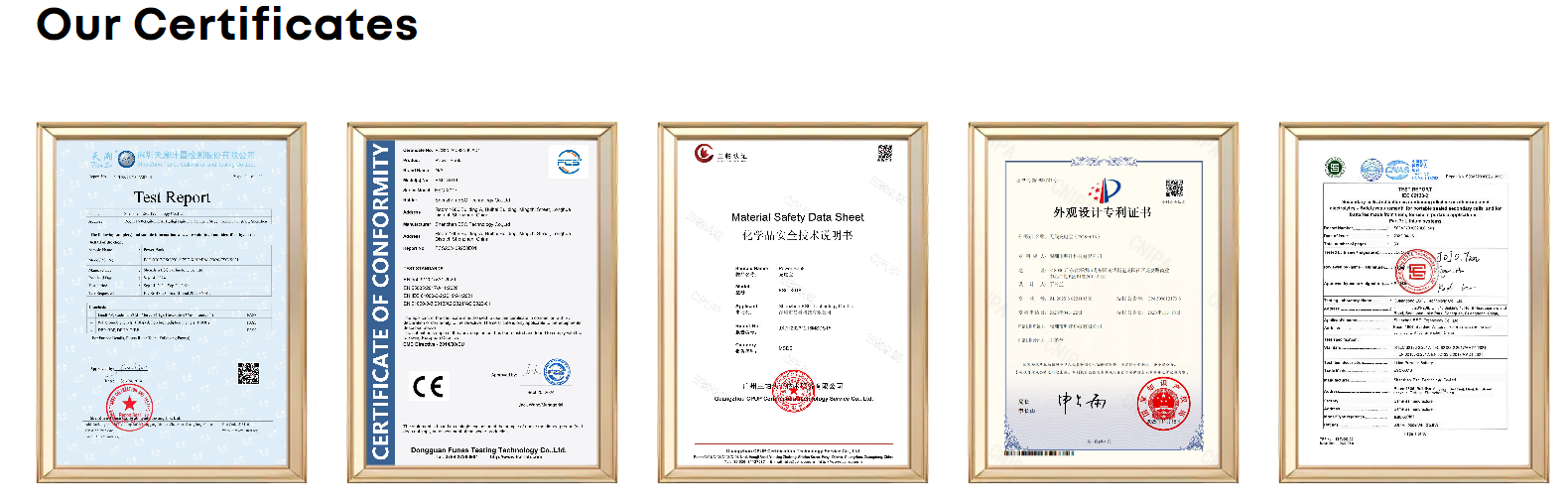
Compliance is the “hard currency” of global trade.
Without power bank safety certifications, shipments risk customs seizure.
- North America: UL, FCC
- Europe: CE, RoHS, REACH
For aviation compliance:
Battery capacity must remain under 100Wh.
Formula:
(mAh ÷ 1000) × 3.7V
Example:
20000mAh ≈ 74Wh → safe for carry-on
30000mAh ≈ 111Wh → restricted
How to Choose a Reliable OEM/ODM PD Power Bank Manufacturer
In the consumer electronics supply chain, true competitive advantage comes from vertically integrated manufacturers.
In Dongguan, China, AOVOLT represents a benchmark-level B2B OEM factory.
With 15 years of manufacturing experience, AOVOLT focuses on high-end fast-charging chargers, power banks, and magnetic wireless charging products.
While many factories struggle with heat management at 65W, AOVOLT has achieved 140W ultra-fast charging with full protocol compatibility:
- PD 3.0 / PD 3.1
- QC 3.0
- FCP / SCP / AFC
- Apple 2.4A / BC1.2
This ensures compatibility across MacBook M-series and legacy Android devices.
More importantly, AOVOLT owns a fully integrated supply chain:
- Industrial design (ID)
- Mold opening
- Injection molding
- Hardware integration
This full-chain control significantly reduces defect rates and improves product consistency.
Multi-Dimensional Comparison Table 3: Supply Chain Risk Assessment
| Supplier Type | R&D Capability | Integration Level | Cost & Customization | Recommendation |
|---|---|---|---|---|
| Trading Company | None | None | High cost, slow customization | Not suitable for long-term branding |
| Assembly Factory | Limited | Partial outsourcing | Unstable quality | High risk of defects |
| Vertically Integrated Factory (e.g. AOVOLT) | Full protocol mastery | Full in-house production | Fast development, lower cost | Strongly recommended |
Frequently Asked Questions (B2B & B2C FAQs)
Q1: Can a PD power bank safely charge older non-PD devices?
Yes. PD is fully backward compatible. It automatically switches to 5V/1A or 5V/2A output when no handshake is detected.
Q2: What is the minimum wattage required for laptops?
- Minimum usable: 30W
- Recommended: 45W
- Standard: 65W
- High performance: 100W+
Q3: How do I calculate airplane compliance?
Use Wh calculation:
(mAh ÷ 1000) × 3.7V < 100Wh
Q4: What is OEM lead time?
- 45–60 days: outsourced tooling
- 25–35 days: integrated factory with in-house mold production
Q5: Why do some power banks restart when charging smartwatches?
Because ultra-low current triggers auto-shutdown. Premium units include “trickle charging mode” to solve this issue.
Conclusion & Strategic Next Steps
From the chaotic 5V era to the unified USB-C PD ecosystem, the charging industry has fundamentally reset its rules.
For B2B buyers, this is both a disruption risk and a profit opportunity.
The future belongs to brands that master high-wattage PD technology, strict battery/BMS control, and strong industrial design capability.
The choice is clear: compete in a saturated price war—or upgrade your supply chain and move into the high-margin fast-charging segment.