
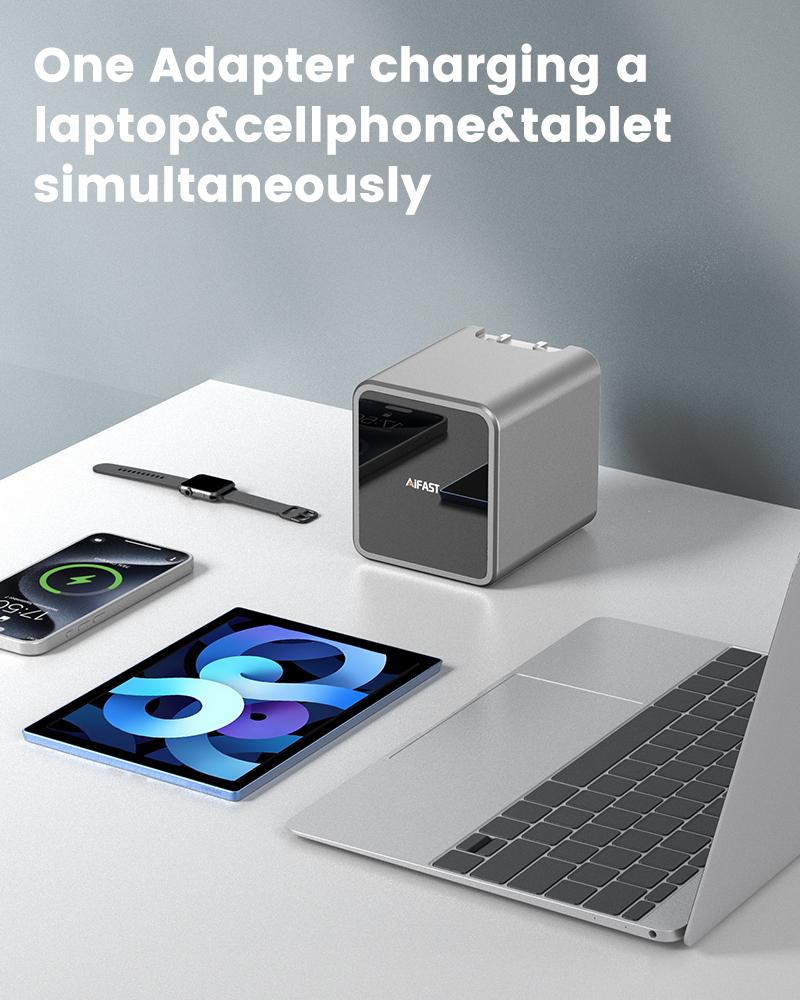

Output Architecture Required for Mixed Device Environments
In shared or mixed device environments, a Type-C charger is expected to serve multiple categories of equipment without configuration changes. Smartphones, tablets, and laptops impose different voltage, current, and negotiation behaviors on the charger, often within the same day and using different cables.
A charger intended for this scenario must support a complete PD output architecture rather than a narrow power window. AOVOLT Type-C chargers are configured to cover standard PD voltage steps including 5V, 9V, 12V, 15V, and 20V, allowing automatic adaptation to common mobile devices and mid-power laptops. PPS support further enables fine-grained voltage control when supported by the device, reducing unnecessary current spikes and thermal stress.
In mixed use, peak wattage is less important than smooth profile transitions. Chargers that repeatedly renegotiate or fall back to lower profiles create inconsistent user experience and accelerate component aging. This is why output architecture design is the foundation of any deployment-ready solution from a type-C charger manufacturer.
Hardware Configuration Built for Continuous Multi-Device Rotation
AOVOLT designs Type-C chargers around continuous usage rather than isolated charging events. In offices, retail counters, logistics hubs, and shared charging stations, chargers remain powered for long periods and serve rotating devices.
Key hardware configuration principles include:
-
Wide-range AC input (100–240V) to support global deployment without electrical modification
-
High-efficiency power conversion stages optimized for mid-load operation, where chargers spend most of their runtime
-
Multiple thermal sensing points placed near switching components to manage heat under repeated device changes
-
Component derating strategy that maintains electrical margin under sustained output rather than short bursts
Once validated, these configurations are locked at the production level. This prevents silent changes in component sourcing or layout that could alter charging behavior across batches. Such discipline distinguishes a consumer accessory from a type-C charger manufacturer program built for scale.
Electrical Performance Metrics Used in Mixed Device Validation
Mixed device environments demand performance evaluation beyond headline specifications. AOVOLT validates chargers under variable load conditions that reflect real deployment patterns.
Key electrical metrics include:
-
Voltage regulation maintained within ±5% during device switching
-
Current stability when transitioning between low-power phones and higher-power tablets or laptops
-
Efficiency at 30–60% rated load, which directly affects long-term heat accumulation
-
Ripple and noise control aligned with PD specification limits to protect sensitive devices
-
Protection response behavior, ensuring that overload or thermal protection activates smoothly rather than abruptly
These parameters define whether chargers remain stable throughout a full day of mixed usage. This validation methodology is essential for any type-C charger manufacturer serving shared infrastructure.
Specification Comparison: Generic Chargers vs Mixed-Environment Configuration
| Specification Area | Generic Type-C Charger | AOVOLT Mixed-Use Configuration |
|---|---|---|
| PD voltage coverage | Partial | Full PD range |
| PPS support | Limited or absent | Enabled and validated |
| Voltage stability | Device-dependent | Controlled across transitions |
| Mid-load efficiency | Not optimized | Tuned for continuous use |
| Thermal rise over 2-hour operation | Rapid increase | Gradual, controlled |
| Output behavior during switching | Renegotiation delays | Smooth profile adaptation |
| Batch electrical consistency | Variable | Fixed configuration |
This comparison illustrates how mixed device performance is achieved through configuration and validation rather than assumed compatibility.
Device Category Coverage and Validation Scope
AOVOLT validates Type-C chargers across three primary device categories to ensure consistent behavior:
-
Smartphones
Frequent connect/disconnect cycles, fast charging negotiation, and cable variability -
Tablets
Longer charging sessions with moderate power demand and sustained output -
Laptops
Higher voltage profiles, stable negotiation requirements, and thermal sensitivity
Validation focuses on maintaining stable output behavior as devices change, without requiring user intervention. This approach ensures chargers supplied by a type-C charger manufacturer remain reliable in environments where device mix cannot be controlled.
Safety Margin, Compliance, and Deployment Readiness
Type-C chargers intended for mixed device environments must meet electrical safety and regulatory requirements such as CE, FCC, and RoHS. Beyond certification, operational safety margins are validated through overload protection, thermal shutdown behavior, and insulation testing.
AOVOLT integrates compliance and deployment considerations early in the project timeline. Labeling, documentation, and packaging specifications are finalized before mass production begins. This alignment ensures chargers can be shipped and deployed without reconfiguration or market-specific modification, reducing operational friction for B2B programs.
OEM Supply Continuity and Long-Term Consistency
AOVOLT supports OEM supply structures where product behavior remains consistent across sampling, pilot runs, and mass production. Electrical parameters, component selection, and test criteria are fixed once approved.
This continuity ensures that chargers delivered in subsequent orders behave identically to those already deployed. For shared infrastructure and long-term programs, this consistency is the defining capability of a type-C charger manufacturer supporting mixed device environments.
For detailed charger specifications and available models:
https://www.esccharge.com/products/
For OEM configuration and deployment planning:
https://www.esccharge.com/solution/customized-solution