
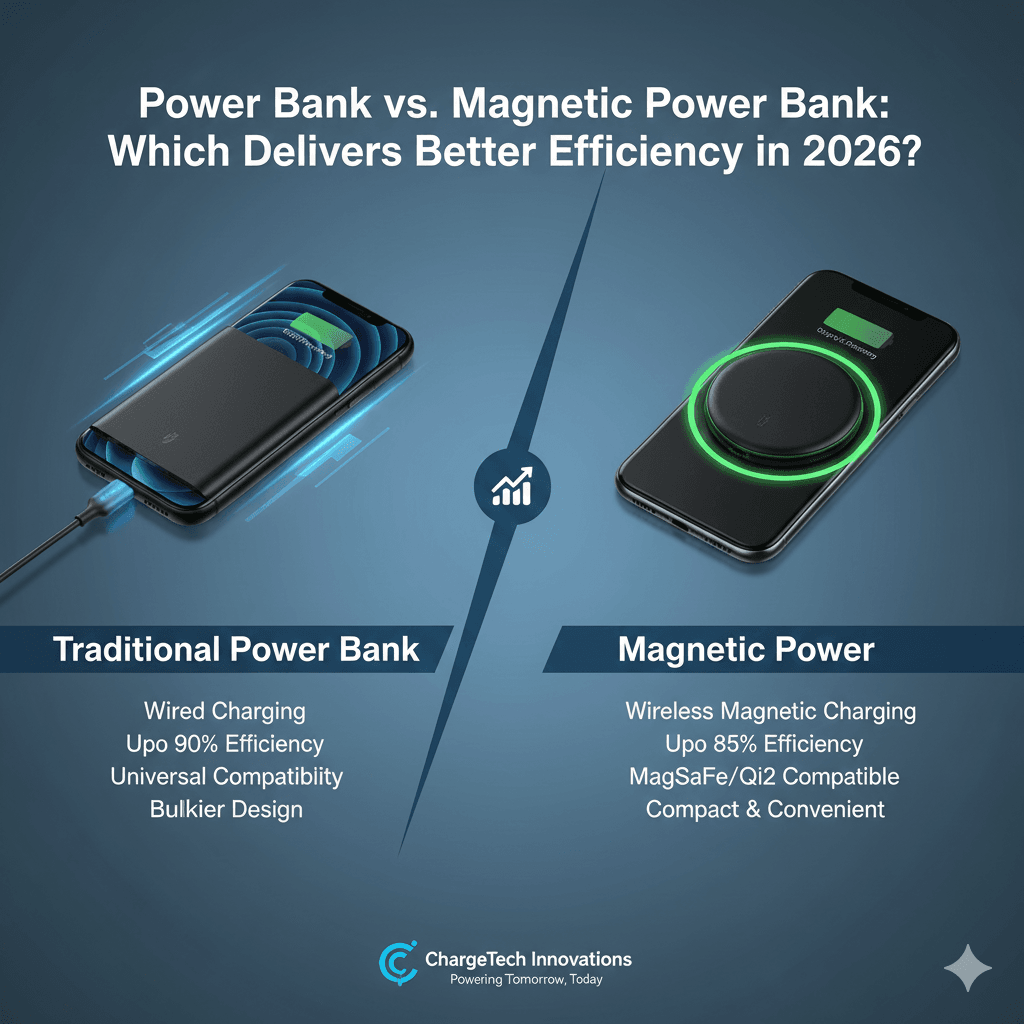
Power Bank vs. Magnetic Power Bank: Which Delivers Better Efficiency in 2026?
A Changing Landscape in Portable Power
By 2026, charging technology has matured from single-port plastic bricks into smart, compact systems that integrate GaN semiconductors, PD 3.1 protocols, and even wireless magnetic modules.
Both traditional wired power banks and magnetic wireless power banks serve mobile users well—but their efficiency, charging speed, and use environments differ dramatically.
Let’s break down their strengths, weaknesses, and practical performance to find which delivers better efficiency in 2026.
1. Charging Efficiency and Speed
Wired Power Banks: Direct, Stable Power Flow
Traditional power banks rely on USB-C or USB-A ports to deliver energy through direct contact.
Their main advantage is minimal energy loss—up to 93–95 % conversion efficiency with modern GaN circuits.
They also maintain steady voltage output for laptops and tablets requiring high wattage (65 W–100 W).
Pros:
-
Faster charging for high-capacity devices.
-
Consistent current and lower heat.
-
Ideal for power-hungry electronics such as MacBooks and drones.
Cons:
-
Requires cables; less convenient for short, quick use.
-
Cable wear and connector fatigue over time.
Magnetic Power Banks: Cable-Free, Yet Power-Capped
Magnetic (MagSafe-style) models deliver energy via Qi 2.0 wireless coils and magnetic alignment.
Their convenience is unmatched—just snap and charge—but wireless transfer introduces more heat and energy loss.
Efficiency typically averages 80–85 %, depending on coil quality and alignment precision.
Pros:
-
Cable-free convenience, perfect for quick boosts.
-
Seamless attachment for iPhone 15–17 series.
-
Dual-function use: power bank + desktop stand.
Cons:
-
Lower efficiency and slower charging for large devices.
-
Limited wattage (usually 15–25 W).
-
Generates more heat under prolonged use.
2. Heat Management and Safety
Thermal Behavior Defines Lifespan
Wired power banks use direct conduction, dissipating heat more effectively through the metal frame.
Magnetic power banks, by contrast, must manage both electromagnetic induction and surface heat.
To maintain safety, advanced models—like those from ESCCharge—include:
-
Graphene cooling layers for rapid heat spread.
-
NTC sensors to control temperature below 45 °C.
-
Auto-cut protection against over-voltage or short-circuit events.
The difference becomes clear: wired charging remains cooler, especially for continuous 65 W output, while wireless designs suit moderate, intermittent use.
3. Battery Type and Capacity Range
| Category | Typical Capacity | Recommended Devices | Recharge Cycles |
|---|---|---|---|
| Wired Power Bank | 10 000 – 30 000 mAh | Phones, tablets, laptops | 500 – 800 |
| Magnetic Power Bank | 5 000 – 10 000 mAh | Smartphones, earbuds | 300 – 500 |
Wired models dominate in energy density, using high-grade lithium-polymer cells rated for higher voltage output.
Magnetic banks prioritize portability and weight reduction, often compromising raw capacity for convenience.
4. Portability and Design
Magnetic Models Win in Everyday Convenience
Wireless magnetic chargers shine for commuters, travelers, and casual users.
They easily attach to a phone while in use, acting as a grip or mini-stand.
ESCCharge’s MagSafe 2.0 series integrates N52 magnets, anti-slip silicone pads, and AI power optimization for better alignment accuracy.
Meanwhile, wired banks with dual PD ports suit professionals who carry laptops and phones, offering universal compatibility across brands and devices.
5. Compatibility and Ecosystem Integration
Magnetic charging remains primarily optimized for Apple’s ecosystem—iPhone, AirPods, and Apple Watch.
Although Qi 2.0 broadens compatibility, Android magnetic support remains limited in 2026.
Wired PD 3.1 ports, on the other hand, support nearly every USB-C device on the market, including notebooks, tablets, cameras, and handheld consoles.
Thus, OEM distributors targeting cross-platform users often prefer dual-port wired models for universal usability.
6. Cost, Durability, and OEM Customization
Wired power banks are easier to manufacture and customize:
-
Broader mold options for branding and color.
-
Easier integration of custom logo engraving and LED displays.
-
Longer lifespan due to fewer moving parts.
Magnetic power banks cost more because of magnet modules, alignment rings, and Qi certification testing.
However, they command higher retail pricing and make ideal corporate gifts or premium accessory lines.
ESCCharge supports both series with:
-
In-house SMT assembly and PCB design.
-
Complete OEM customization (logo, capacity, packaging).
-
Full certification package (UN38.3, CE, FCC, Qi 2.0).
7. Ideal Use Scenarios
| Scenario | Recommended Type | Reason |
|---|---|---|
| Long-distance business travel | Wired PD Power Bank | High-capacity, fast laptop charging |
| Daily commuting / urban use | Magnetic Power Bank | Lightweight, cable-free convenience |
| Outdoor shooting / field work | Wired Dual-Port Power Bank | Rugged housing, sustained power output |
| Promotional or branded gifts | Magnetic Power Bank | Stylish, visible branding surface |
| Multi-device professionals | Dual-Port GaN Power Bank | Simultaneous output with smart control |
Conclusion: Choosing Smart Power for 2026
In 2026, the answer to which delivers better efficiency depends on how you charge.
If speed, reliability, and multi-device power are your priorities, wired GaN power banks remain unbeatable.
If mobility, simplicity, and aesthetic integration matter more, magnetic wireless models provide unmatched user convenience.
Both categories evolve under smarter IC management, safer cell chemistry, and more sustainable design.
At ESCCharge, we merge both innovations—offering dual-mode power banks that support wired PD 3.1 and MagSafe 2.0 wireless charging in one unit.
It’s how efficiency meets design, delivering real freedom to the modern user.
Explore ESCCharge’s 2026 portable energy collection at
ESCCharge Official Website
and find the perfect charging solution for every device and every journey.