
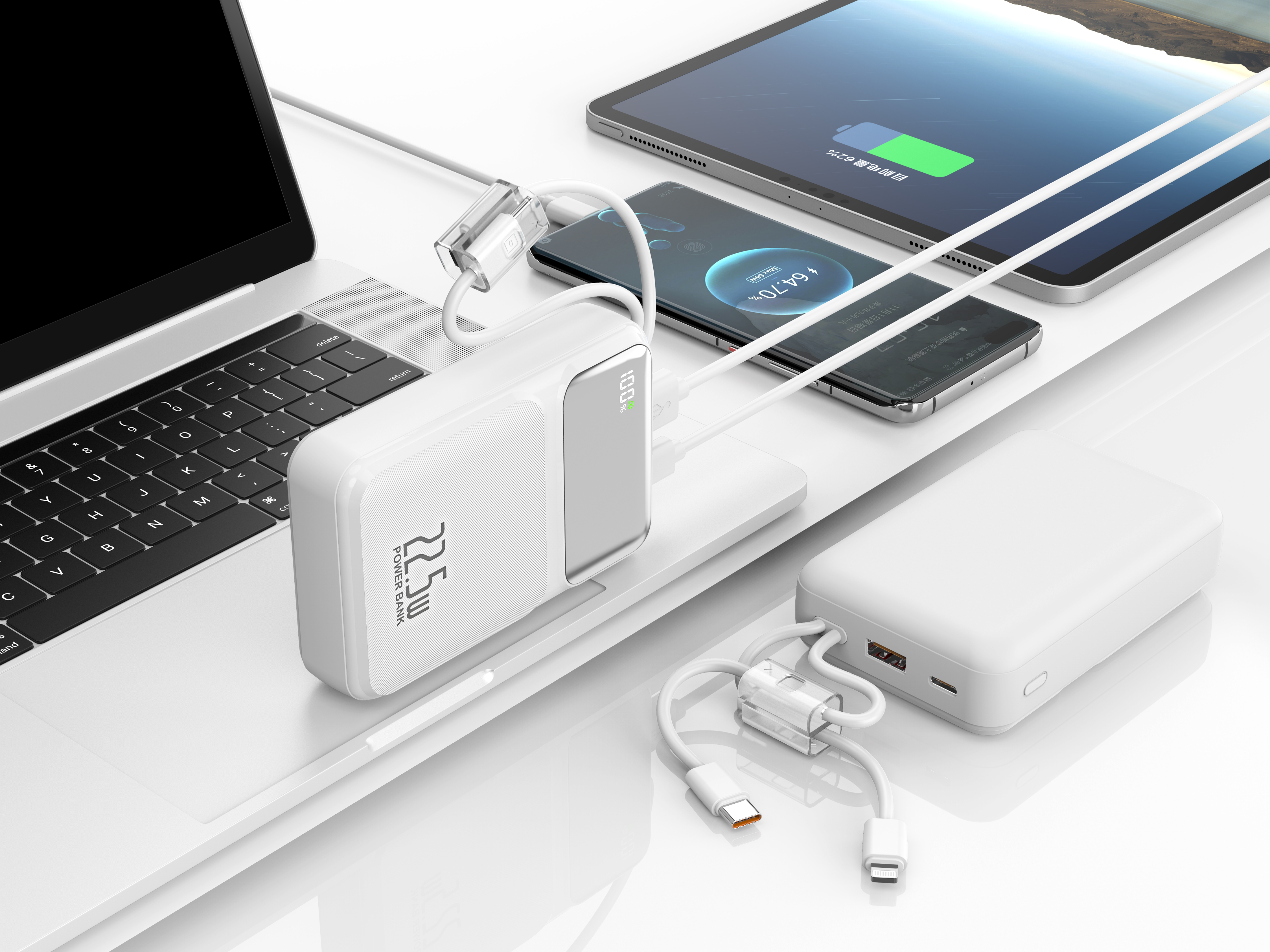
Real-World Multi-Device Charging Is Where Most Designs Break
Multi-port chargers don’t fail in product catalogs. They fail when three devices are plugged in at once — a laptop pulling high voltage, a phone negotiating PPS, and a tablet entering mid-cycle.
At that moment, instability shows up immediately. Voltage drops. Charging speed fluctuates. Devices reconnect. Heat rises faster than expected. In high-usage environments like offices, retail demo zones, or shared charging stations, this instability becomes even more visible within minutes rather than hours. Especially when users frequently plug and unplug devices, the system is forced into constant renegotiation cycles, amplifying even small design weaknesses.
These are not isolated defects. They come from a fundamental issue: most designs are built around single-port performance, not simultaneous load behavior.
This is exactly why buyers today evaluate a multi-port charger factory differently. The question is no longer “how many watts,” but whether power remains stable when devices interact with each other under continuous, mixed-load conditions.
From Single Output Design to Dynamic Power Allocation Systems
At AOVOLT, multi-port chargers are designed starting from load interaction, not from maximum output rating.
Instead of assigning fixed power per port, the system continuously redistributes power based on real-time demand. This allows devices to draw only what they need without forcing the system into unstable switching states. In practice, this means a laptop can maintain stable charging even when additional devices are introduced, without triggering voltage collapse.
The design approach is built on three layers working together:
-
Dynamic allocation control
Power is not locked to ports. A 65W system can shift from single-device full load to multi-device balanced output without instability -
Protocol-coordinated negotiation
PD3.0, PD3.1, and PPS are managed as a shared system rather than isolated signals, preventing handshake conflicts during simultaneous charging -
Thermal-linked power regulation
Output is adjusted based on internal temperature feedback, avoiding late-stage performance drop during extended use
This is not an upgrade — it is a different design logic. And it is what separates a basic supplier from a true multi-port charger factory capable of stable long-cycle performance.
Electrical Stability Depends on Interaction, Not Specification
Once multiple devices are connected, performance is determined by interaction between loads rather than individual port capability.
Three variables become critical:
-
How fast the system responds to new load conditions
-
How stable voltage remains across ports under shared demand
-
How heat accumulates over time during continuous operation
AOVOLT chargers are validated under continuous multi-device conditions:
-
Load redistribution response: <200 ms
-
Voltage fluctuation under shared load: ≤ ±4%
-
Efficiency under real usage load: 92–94%
-
Continuous operation: 2+ hours without output drop or throttling
In extended testing, stability is also measured after repeated plug-in cycles (50–100 connection events), ensuring that performance does not degrade under frequent usage patterns — a common scenario in commercial environments.
These are sustained metrics, not peak values. They reflect real-world behavior, especially in environments where devices are frequently connected and disconnected.
Performance Comparison Under Multi-Device Load Conditions
Test Conditions: 220V / 25°C / Laptop + Phone + Tablet / 120 min continuous load
| Performance Factor | Generic Market Solution | AOVOLT Configuration |
|---|---|---|
| Load redistribution delay | 400–800 ms | <200 ms (-60%) |
| Voltage fluctuation | ±8–12% | ≤ ±4% (-50%) |
| Efficiency (multi-load) | 85–88% | 92–94% (+6–8%) |
| Thermal rise after 1h | +32–38°C | +20–24°C (-35%) |
| Output drop after 2h | 7–10% | <2% (-75%) |
| Device reconnection rate | 5–12% | <1% (-90%) |
These results show that performance gaps widen over time, not at startup. Long-duration stability is where optimized systems clearly outperform generic designs.
A reliable multi-port charger factory must be able to reproduce these results consistently across production batches, not just in engineering samples.
Compatibility Across Apple, Samsung, and Laptop Charging Systems
Multi-port charging becomes more complex when different ecosystems are connected simultaneously, especially when devices request different voltage profiles at the same time.
Each system has different requirements:
-
Apple devices
Require stable PD voltage curves and strict thermal control to maintain peak charging speed without triggering protection -
Samsung devices
Depend on PPS fine-step adjustment (20mV level) for efficient and stable fast charging -
Laptop devices (MacBook / Dell / Lenovo)
Require continuous high-voltage output (20V/5A) without interruption or power throttling
AOVOLT integrates multi-protocol support with coordinated output control, allowing all three device types to operate simultaneously without interference or repeated renegotiation. Even when devices switch charging states (e.g., from fast charge to trickle), output remains stable.
This level of compatibility is essential for any multi-port charger factory targeting global, mixed-device environments.
Certification, Safety, and Long-Duration Stability
When charging multiple devices, safety risks increase — especially under long usage cycles and higher total load conditions.
AOVOLT chargers are designed with compliance integrated into the system:
-
CE / FCC / RoHS certified
-
Full-load thermal testing under multi-port conditions
-
Overcurrent, overvoltage, and short-circuit protection
Testing is performed under continuous multi-device load rather than idle or single-port scenarios, ensuring real-world reliability. Additional stress testing under elevated ambient temperatures further validates long-term stability.
In large-scale B2B deployment, thermal instability and certification gaps are among the leading causes of returns, delays, and compliance issues.
OEM Supply Consistency and Procurement Decision Factors
From a procurement perspective, the biggest risk is not performance — it is inconsistency across batches.
Samples perform well. Bulk production does not. This gap often comes from uncontrolled BOM changes or firmware variation.
AOVOLT controls this through:
-
Locked BOM after validation
-
Stable PCBA layout across production runs
-
Identical firmware behavior in mass production
For buyers evaluating a multi-port charger factory, key decision points should include:
-
Stability under full multi-device load
-
Thermal performance over extended use
-
Consistency between sample and production batches
-
Certification readiness for target markets
These factors directly impact return rates, warranty costs, and brand reputation.
From Stable Design to Scalable Supply
Multi-port charging is no longer about adding ports. It is about managing interaction — electrical, thermal, and protocol-level — across devices.
When these factors are controlled, performance becomes predictable even under complex usage conditions. When they are not, instability appears immediately in real-world scenarios, often leading to user complaints within the first few days of use.
AOVOLT focuses on building systems that remain stable under complexity, ensuring consistent output, controlled heat, and reliable supply.
Explore charger products:
https://www.esccharge.com/products/charger-plug
For OEM solutions and customization:
https://www.esccharge.com/solution/customized-solution