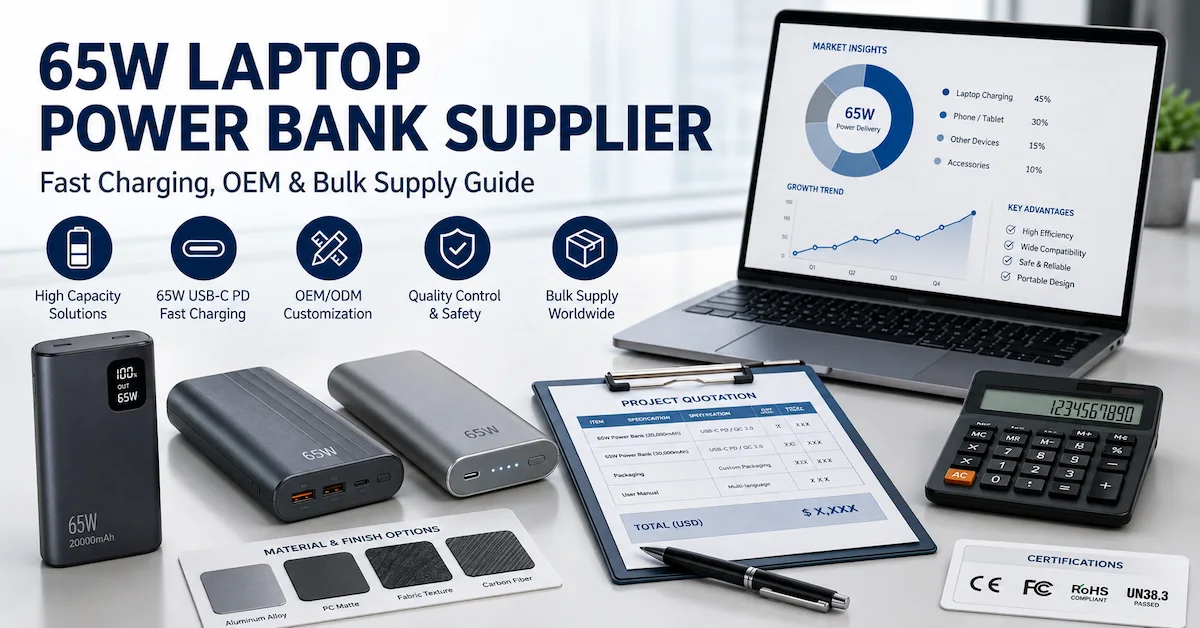

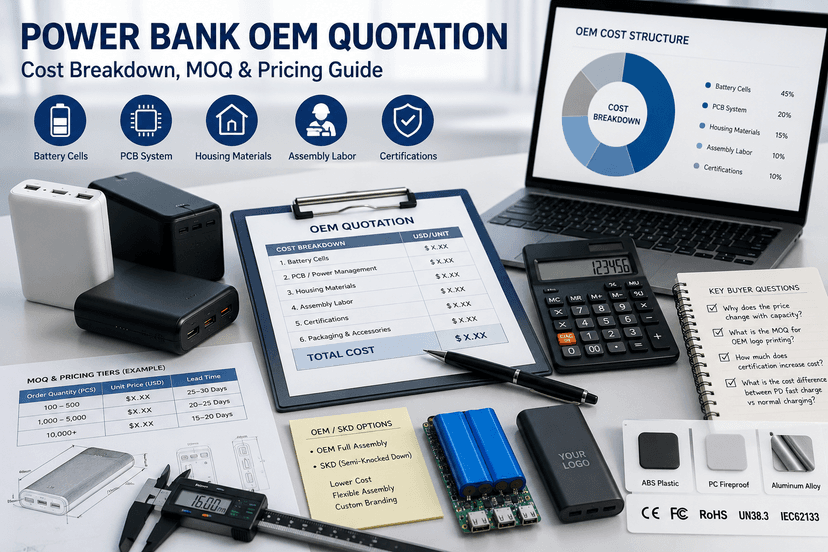
When buyers request a power bank OEM quotation, they often expect a single unit price. However, in real manufacturing systems, pricing is not a fixed number—it is a structured cost model driven by components, certifications, order volume, and customization complexity.
Understanding a power bank OEM quotation is essential for importers and brand owners. By analyzing battery costs, PCB systems, certification, and MOQ, buyers can make informed decisions and optimize sourcing strategy.
A professional OEM quotation reflects the true engineering and supply chain cost, not just a retail estimate. To understand more about our factory and OEM capabilities, visit our About Us page.
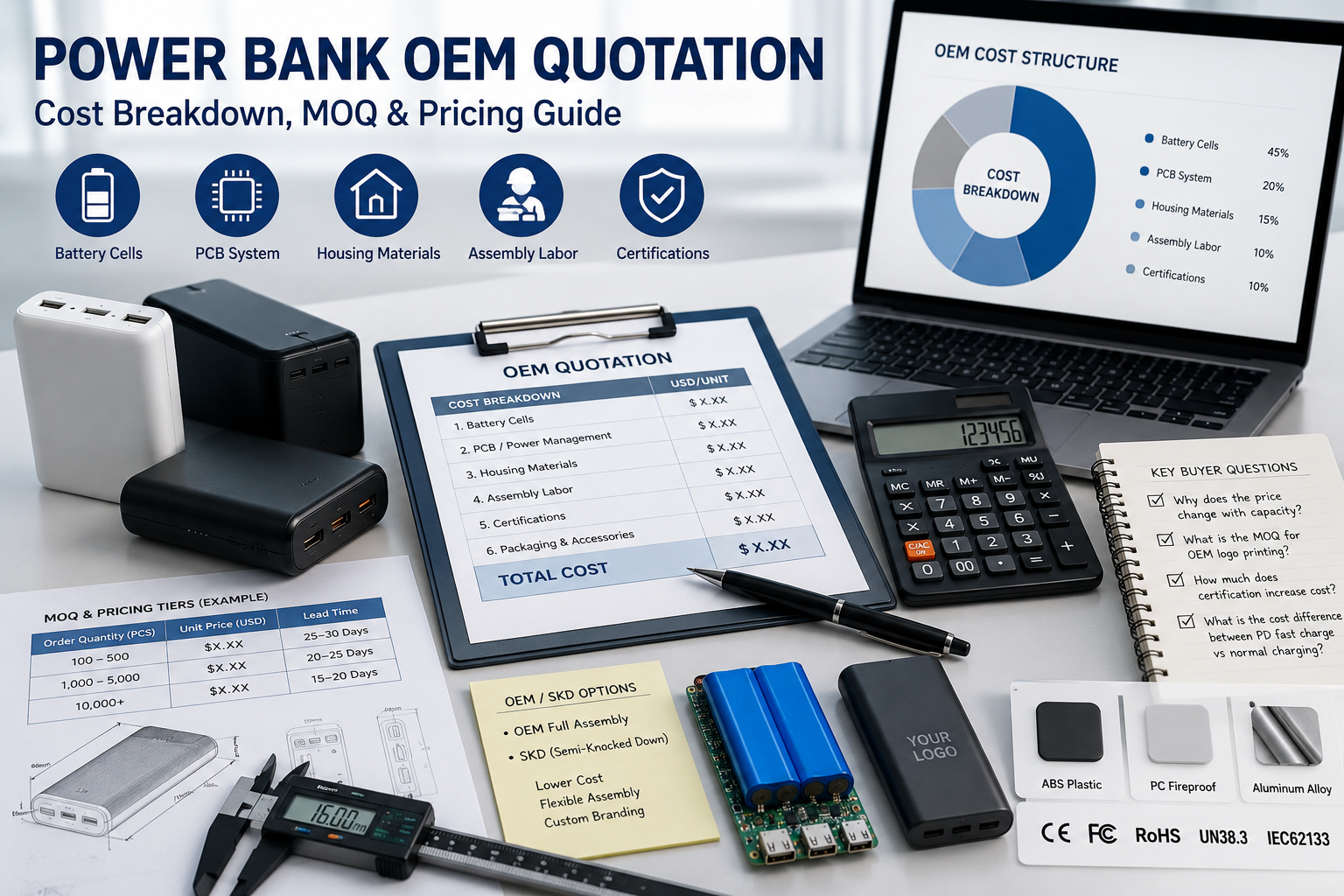
In most cases, power bank pricing is built from five core cost layers: battery system, PCB management board, housing materials, assembly labor, and compliance certifications. You can explore our complete range of power bank products for OEM solutions.
Buyer Types & What They Really Care About
Different buyers interpret OEM quotation differently:
- Brand owners → care about margin + customization
- Amazon sellers → focus on unit cost + certification
- Distributors → care about MOQ + stable pricing
- Corporate buyers → focus on safety + branding
Key buyer questions include:
- Why does the price change with capacity?
- What is the MOQ for OEM logo printing?
- How much does certification increase cost?
- What is the cost difference between PD fast charge vs normal charging?
What Determines Power Bank OEM Price?
1 Battery Cell Cost (Core Cost Driver)
Battery type significantly impacts pricing:
- 18650 cells (lower cost, stable supply)
- Polymer lithium cells (lighter, higher cost)
Capacity directly affects price:
- 5000mAh → lower cost structure
- 20000mAh+ → higher energy density requirement
2 PCB / Power Management System
The PCB controls:
- PD / QC / PPS fast charging
- Voltage stability
- Multi-port output
More protocols = higher cost.
3 Housing & Structural Design
Materials affect OEM quotation:
- ABS plastic (low cost)
- Fireproof PC material (medium cost)
- Aluminum alloy (premium cost)
Custom molds increase initial NRE cost significantly.
4 Certification Requirements
Certifications affect both cost and lead time:
- CE
- FCC
- RoHS
- UN38.3
- IEC62133
For export markets (EU/US), certification cost is unavoidable.
5 OEM Branding & Customization
Customization includes:
- Logo printing (silk screen / laser)
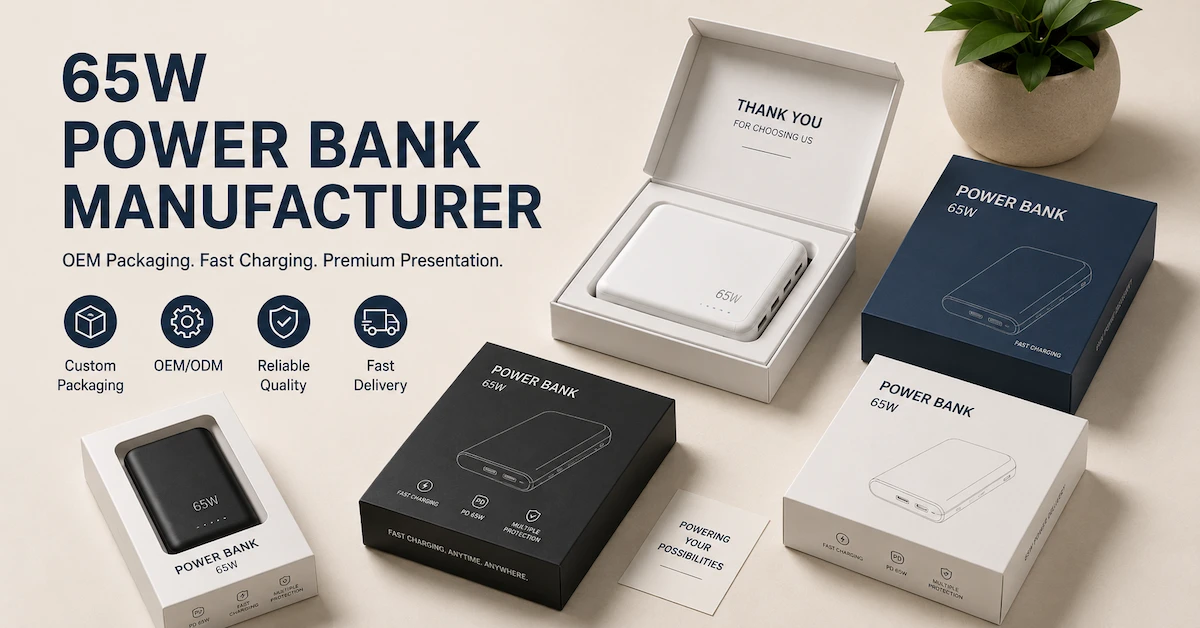
- Packaging design
- Color customization
- Private mold development
Higher customization = higher unit price + tooling cost.
OEM vs SKD Pricing Difference
OEM Full Assembly
- Factory produces complete product
- Higher unit price
- Lower operational complexity for buyer
SKD (Semi-Knocked Down)
- Partial assembly provided
- Buyer completes final assembly or branding
- Lower cost structure
- Better for local assembly or regional compliance
SKD is often used to optimize tariff costs and logistics efficiency.
MOQ and Its Impact on Price
MOQ is one of the most important pricing factors.
Typical structure:
- 100–500 pcs → highest unit cost
- 1000–5000 pcs → optimized pricing
- 10,000+ pcs → factory-level cost advantage
Why?
Because fixed costs (mold, setup, certification allocation) are distributed across volume.
Example OEM Quotation Structure (Reference Model)
| Cost Item | Description | Impact Level |
|---|---|---|
| Battery cells | Energy storage core | High |
| PCB board | Fast charging system | High |
| Housing | Structural design | Medium |
| Assembly | Labor cost | Medium |
| Certification | Export compliance | Medium-High |
| Packaging | Branding & retail | Low-Medium |
Hidden Cost Factors Buyers Often Ignore
Many buyers misjudge OEM pricing because they ignore:
- Shipping battery restrictions (DG cargo)
- Sample development cost
- Mold development fee
- Voltage compatibility testing
- Quality failure rate buffer
These factors directly affect final quotation accuracy.Learn more about our frequently asked questions for guidance on OEM power bank orders.
How to Reduce OEM Cost Without Losing Quality
Professional buyers optimize cost through:
- Standardizing capacity models (10000mAh / 20000mAh)
- Using existing molds
- Reducing unnecessary protocol complexity
- Consolidating packaging design
- Increasing order volume for scale pricing
Cost optimization is not about lowering quality—it is about reducing unnecessary complexity.For more insights on power bank manufacturing and technology, check out our blog.
When Should You Request OEM Quotation?
You should request a formal quotation when:
- Product specification is clear
- Target market is defined
- Branding requirements are confirmed
- Expected MOQ is known
Unclear requirements lead to unstable pricing.
FAQ
Q1: Why does OEM power bank price vary so much?
Because battery, PCB, certification, and customization all affect cost structure.
Q2: What is the minimum MOQ for OEM power bank?
Usually 500–1000 pcs depending on customization level.
Q3: Does certification increase cost?
Yes, especially for UN38.3 and IEC safety standards.
Q4: Can I reduce cost with SKD solution?
Yes, SKD reduces assembly and logistics cost.
Q5: What is included in OEM quotation?
Unit cost, tooling, certification allocation, packaging, and customization fees.
Conclusion
A power bank OEM quotation is not a simple unit price—it is a structured reflection of engineering design, supply chain cost, certification requirements, and production scale.
Understanding how pricing is built allows buyers to:
- Reduce procurement risk
- Optimize product positioning
- Improve profit margin
- Choose the right manufacturing model (OEM vs SKD)
For stable pricing and scalable production, working directly with a qualified manufacturer ensures better control over cost and quality consistency. You can contact our team to request a custom power bank OEM quotation.