
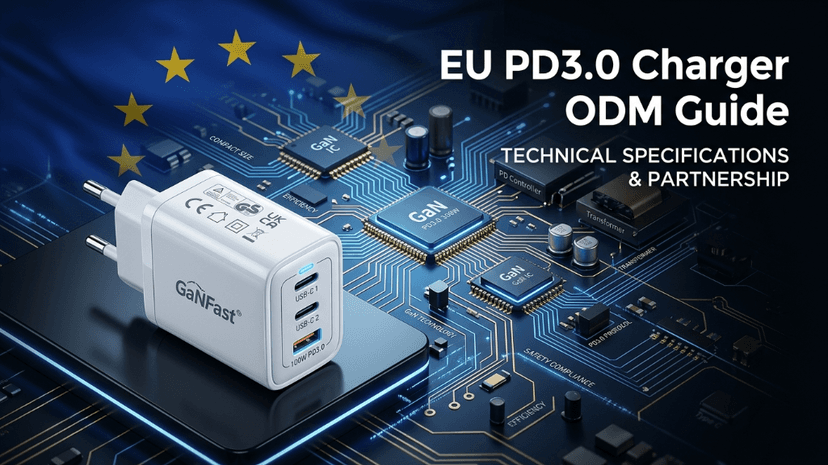
When screening EU standard PD3.0 charger ODM manufacturers, if your purchasing team is still deciding multi-million-euro orders by comparing the numbers at the bottom of generic quotation sheets, it’s only a matter of time before your products get detained at Frankfurt customs or forcibly delisted on Amazon Europe. The market access threshold in Europe has long surpassed the simplicity of buying a CE certificate for a few thousand dollars. The underlying logic has changed. With the full implementation of the USB-C Common Charger Directive, brands now require hardcore manufacturers capable of reconstructing thermal management and safety compliance systems from the ground up, starting from circuit topology.
Direct Conclusion
Currently, on the leading ODM production lines in the Pearl River Delta, a truly EN 62368-1 safety standard-compliant and tested 65W GaN power adapter for the European market, based on a minimum order quantity of 5K, has a unit cost floor for PCBA plus custom housing tightly locked between $8.80 and $11.50. Below this threshold, the contract manufacturer has inevitably performed fatal “optimizations” in hidden areas—either reducing the creepage distance between primary and secondary circuits or cutting corners on the copper turns in the transformer. For European local 3C brands seeking profit growth, ceasing blind competition in the generic model market and turning to ODM factories with fundamental hardware definition and mold-making capabilities is the only way to safeguard brand reputation and maintain over 40% gross margin.
Decoding EU Market Access: Beyond a Simple “CE” Mark
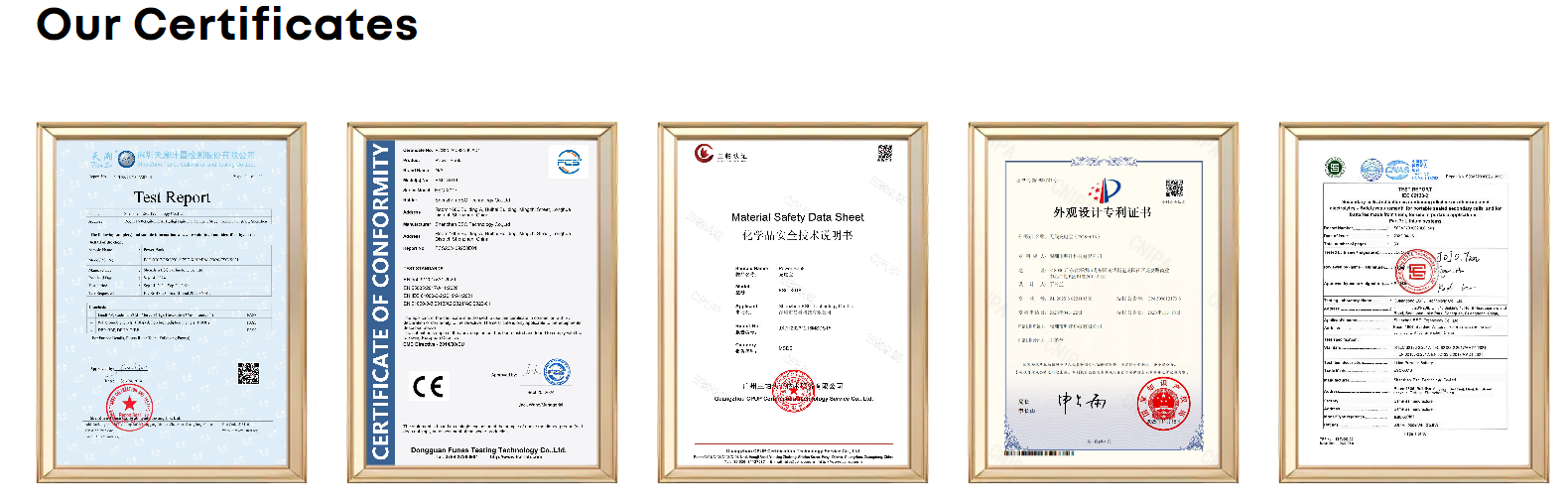
Many B2B buyers have extremely shallow understanding of compliance. They assume that as long as a CE mark is printed on the housing, everything is fine. Absurd. CE is not a mere piece of paper; it is supported by a full set of rigorous test reports as a self-declaration. A reliable ODM manufacturer must deliver complete technical construction files (TCF) that can withstand scrutiny, proving the product is strictly CE-LVD and CE-EMC certified (low voltage and electromagnetic compatibility).
Deep Dive into EN 62368-1 Safety Standard
Inside highly compact GaN fast chargers, the physical distance between high-voltage AC and low-voltage DC is extremely compressed. Inexperienced PCB engineers designing custom PCBA for fast chargers often focus on reducing size while ignoring critical creepage and clearance distances.
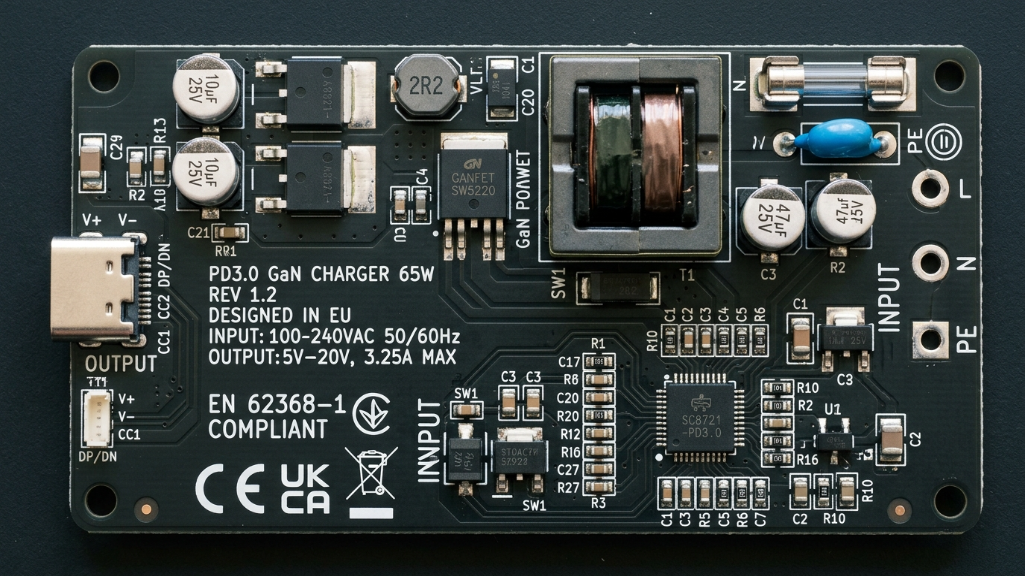
According to the new regulations, the physical creepage distance from primary to secondary circuits must reach at least 6.4mm or more, depending on the pollution degree and the CTI of the insulation material. If the distance is insufficient, a 3000V dielectric withstand voltage (Hi-Pot) test can instantly arc through the isolation layer, destroying the PD protocol chip and potentially directing 220V mains directly to the user’s device. Our engineering red line is clear: never compromise compliance. Layouts must include at least 15% physical distance margin.
Facing ErP Lot 6 – The Overlooked Energy Efficiency Killer
The European market is obsessed with energy efficiency. Many clients’ samples perform well at full load but fail in standby tests. ErP Lot 6 requires devices to consume extremely low power when plugged in without a connected phone.
The strict EU limit is below 0.1W, and some top-tier retailers demand <0.075W. This requires designers to implement active X-capacitor discharge and ultra-low quiescent current PWM controllers on the primary side. Saving $0.10 in BOM by omitting a low-power chip risks the entire shipment being recalled by the EU RAPEX rapid alert system.
Low-Level Adaptation to USB-C Common Charger Directive
By the end of 2024 and beyond, the EU mandates a unified interface for all portable devices. This is far more than replacing USB-A pads with Type-C sockets. Chargers must achieve perfect backward compatibility and dynamic handshaking, involving deep application of the Programmable Power Supply (PPS) protocol. An excellent ODM solution must output stable 20V/3.25A fixed voltages and perform fine voltage adjustments in 20mV steps from 3.3V to 21V, accommodating devices from Apple and Samsung to lesser-known local low-power devices.
Perfect EU-Standard Plug Mechanical Engineering: Blind Spot for B2B Buyers
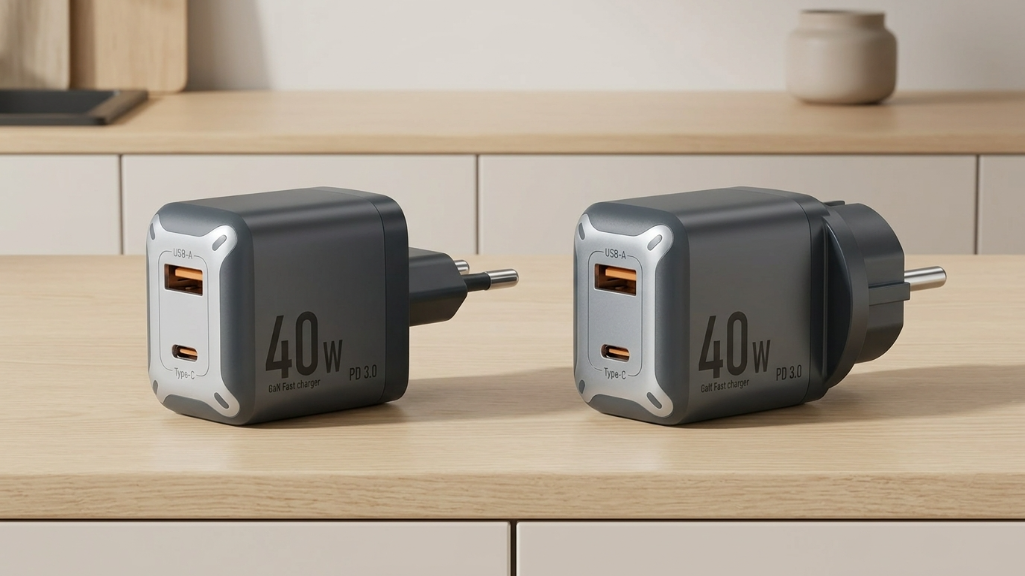
In procurement, buyers often spend 90% of their energy on fast charge protocols and power density while neglecting the metal plug structure—a critical cognitive bias. Mechanical defects in plug pins are the main cause of electrical fires and returns in Europe.
Deadly Confusion: 4.0mm vs. 4.8mm Pin Diameter
European socket systems are extremely complex. In custom designs, failure to distinguish Europlug pin diameters (4.0mm vs. 4.8mm) exposes products to serious complaint risks.
| Plug Specification | Pin Diameter | Max Current | Typical Applications | ODM Engineering Recommendations |
|---|---|---|---|---|
| Europlug (CEE 7/16) | 4.0 mm | 2.5A (~500W) | 20W–65W lightweight portable chargers | Reinforce pin base in mold design |
| Schuko / French (CEE 7/7) | 4.8 mm | 16A (~3500W) | ≥100W desktop chargers or power strips | Ground pin with strong mechanical engagement; overmold for stability |
| Cheap generic “stitched” models | 4.0 mm but overweight | High risk | Misapplied in high-power GaN | Avoid; pins may loosen or spark |
VDE Pin Pull-Out Force and Internal Torque Tests
Pins are not arbitrarily inserted into plastic housings. European VDE standards strictly define pull-out force and torque.
Our team, with over ten years of frontline manufacturing experience, once inherited a “mess” from a German retailer. The previous supplier prematurely ejected plastic molds, leaving residual stress. After three months of thermal cycling, the 4.0mm metal pins detached during user removal, remaining in the 220V socket. This was not just a quality issue but a serious legal risk.
We redesigned mold cores and adopted custom nickel-plated copper pins with cross-lock slots, combined with overmolding, completely eliminating pin freedom in Z-axis and rotation. VDE lab simulations showed zero displacement after 5,000 forced insertions and removals—illustrating the real gap between genuine ODM manufacturing and simple contract assembly.
Extreme Thermal Management and Spatial Magic: Deep ODM Integration of PD 3.0 and GaN
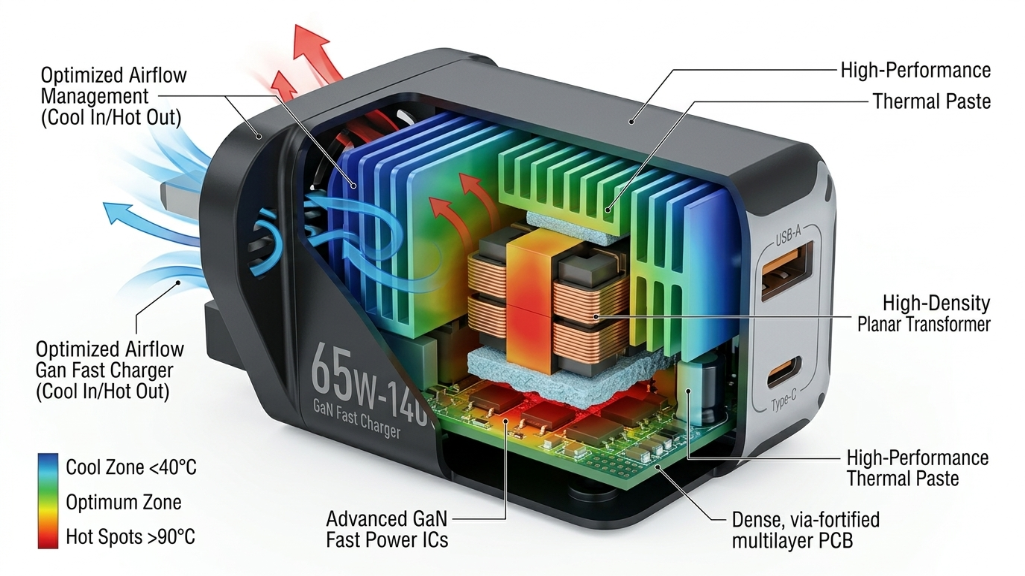
Within the compact housing of EU chargers, 140W high power density challenges thermal management. For a qualified EU standard PD3.0 charger ODM manufacturer, the solution is not “adding materials” but maximizing energy conversion efficiency. Multiport PD Fast Charger Supplier Guide 2026 is provided to you.
Collaboration of Thermal Materials and Planar Transformers
Traditional wound transformers are bulky and unevenly dissipate heat. Our AOVOLT ODM solution uses high-frequency planar transformers, printing windings on PCB to greatly increase heat dissipation area. Coupled with high thermal conductivity potting compounds, heat is quickly conducted through the housing. Even in high Mediterranean summer temperatures, full-load casing temperature remains within EN 62368-1 limits.
Localized Protocol Firmware Adaptation
For Europe, PD 3.0 handshakes involve not only power matching but safety handshake. Our engineering team performs tens of thousands of low-level protocol tests on European mainstream devices (e.g., Fairphone, Nokia, local German/French tablets). Optimizing PPS stepping ensures millivolt voltage changes are precise, minimizing abnormal device heating from protocol incompatibility.
Foundation of True ODM Capability: From Concept Sketch to Million-Unit Delivery
Many so-called contract factories are merely assembly workshops. A real ODM manufacturer must have full industrial design (ID) capabilities and a capital-intensive production chain.
Vertical Integration – The Ultimate Supply Chain Moat
In the consumer electronics market, speed is survival. AOVOLT’s Dongguan base achieves true vertical integration—not only reducing costs but ensuring certainty.
| Manufacturing Step | Traditional Outsourced | AOVOLT Integrated | Value for Customers |
|---|---|---|---|
| Industrial Design & R&D | Buy generic plans; lack differentiation | Deep closed-loop R&D on custom PCBA & ID | Unique recognizable private molds |
| Mold Opening | Wait 45+ days externally | In-house precision molds; 25 days | Fast response to market trends |
| Injection Molding | Difficult to control gate; brittle housing | 100% virgin fire-resistant PC; automated V0 compliant | Reliable safety compliance |
| Hardware Integration & Assembly | Generic pins; inconsistent specs | In-house high-precision nickel pins | No loose connections |
| Quality Control | Spot checks; no full lifecycle trace | 100% full-load aging + automated AOI | 0% early failures; protect brand |
In-Depth FAQ: Core Questions on EU PD 3.0 Charger Customization (PAA)
Q1: Why did my CE certificate fail Amazon Germany review?
Many factories provide “form certificates” based on minimal testing. Amazon DE usually requires complete test reports from CNAS/ILAC accredited labs, including EN 62368-1 latest standards. AOVOLT delivers full TCF documentation for every ODM project.
Q2: Is GaN technology mandatory for Europe?
Not absolutely, but for >30W power, GaN is nearly the only compliant solution. Silicon-based designs are too large and generate too much heat to meet efficiency and temperature tests. GaN adapters reduce size and comply with ErP Lot 6 standby targets.
Q3: Can a 4.8mm Schuko plug be ultra-thin?
Technically challenging. Large plugs include grounding contacts, defining volume. AOVOLT engineers use embedded hardware layout and high-density PCBA to make slimmer designs while maintaining 4.8mm spec.
Q4: How to ensure ripple does not interfere with touchscreens?
This is a CE-EMC issue. We add secondary LC filtering on the output, keeping ripple <50mV, and perform pre-screening of conducted and radiated interference during ODM R&D.
Q5: What does private mold ODM cost include?
Beyond unit price: mold opening and protocol licensing fees. AOVOLT’s vertical integration significantly spreads mold cost; for high-volume clients, we offer mold fee rebates converting upfront investment into long-term market advantage.
Conclusion: Building Technical Barriers in the Deep Waters of Global Compliance
In selecting an EU standard PD3.0 charger ODM manufacturer, low price is only the starting line; “engineering certainty” is the finish. The European market rewards only those rigorously self-disciplined in every capacitor, creepage distance, and gram of flame-retardant plastic.
AOVOLT’s 15 years of deep consumer electronics manufacturing experience is reflected in both our automated Dongguan line and our respect for EU regulations. From full-protocol PCBA development supporting 140W peak power to highly distinctive industrial design, we don’t just manufacture—we build a technical moat protecting your brand.
With USB-C dominating Europe, instead of wasting brand equity on generic models, partner with factories possessing capital-intensive, closed-loop manufacturing. Only ODM solutions integrating safety, efficiency, and differentiated ID from the design stage can both enter and dominate the European 3C ecosystem. Such engineering-deep collaborations are your most stable anchor in the ever-changing global supply chain.
References:
European Commission Guidance on the Common Charger Directive