
Choosing a custom logo phone battery supplier is not only about printing a brand name on a battery label or retail box. For mobile parts distributors, repair chains, e-commerce sellers and private label buyers, a customized phone battery project must solve real business problems: unstable quality, fake capacity claims, wrong model matching, poor packaging, weak batch control, high return rate and low brand trust. A private label battery line only works when the product behind the logo is stable enough to protect the buyer’s market reputation.
Product Pain Points: A Logo Cannot Hide Battery Quality Problems
Many buyers start private label phone battery projects because they want higher margins, better customer loyalty and less direct price comparison.
That logic is correct.
But the risk is also obvious.
If the battery drains fast, swells, fails to charge, does not fit properly or causes repeated warranty claims, the customer will not blame the factory behind the product.
They will blame the logo printed on the package.
For distributors, poor custom batteries create channel complaints from repair shops.
For e-commerce sellers, they create negative reviews and return requests.
For repair chains, they create inconsistent service quality across stores.
For private label brands, they damage the entire brand before the market has time to trust it.
Common problems include exaggerated capacity, unstable internal resistance, poor PCM matching, weak connector fit, unclear model labels, fragile packaging, mixed-model confusion and supplier silence after shipment.
This is why a custom logo phone battery supplier should be evaluated by product control first, branding second.
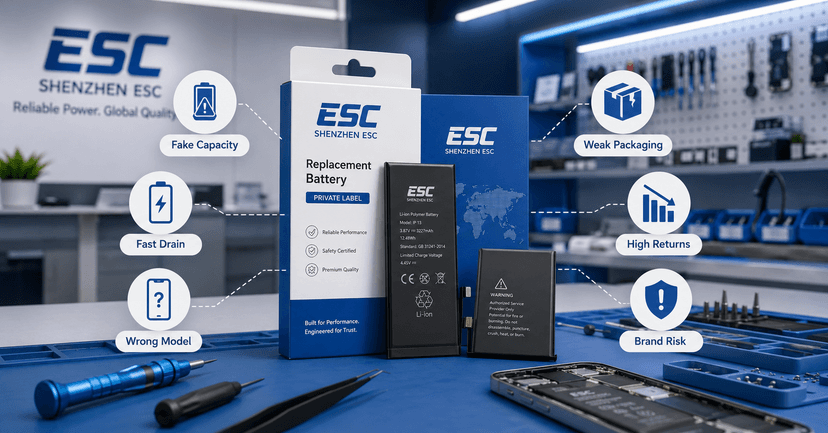
Illustration Suggestion: Product Pain Points
Create a 1200×628px professional B2B infographic showing custom logo phone battery packaging on a repair counter with warning icons around it. Use short labels only: Fake Capacity, Fast Drain, Wrong Model, Weak Packaging, High Returns, Brand Risk. Place Shenzhen ESC private label battery samples and packaging in the center. Use premium blue-white technical style with minimal text.
Battery Principle: What Must Be Controlled Behind the Custom Logo
A replacement phone battery is a compact lithium-ion battery system.
The visible parts are the battery label, logo, box and packaging.
The real quality comes from the internal structure.
A typical replacement phone battery includes lithium-ion polymer cell, PCM protection board, flex cable, connector, insulation layer, pouch film, adhesive structure, product label, barcode label and packaging.
The lithium-ion cell determines actual capacity, runtime and discharge stability.
The PCM protection board helps manage overcharge, over-discharge, over-current and short-circuit protection.
The flex cable and connector affect installation fit and electrical contact.
The insulation layer and pouch film affect safety, sealing and mechanical stability.
The label, barcode and carton packaging affect inventory management, model identification and customer trust.
For private label buyers, the most important technical checks are real capacity, internal resistance, voltage consistency, discharge curve, PCM function, connector accuracy, flex cable direction, installation fit, batch consistency and packaging protection.
A custom logo can make the product look professional.
But only stable battery engineering makes the brand worth buying again.

Supplier Comparison: Logo Printing Vendor vs Professional OEM Battery Supplier
A logo printing vendor focuses on appearance.
They may offer label design, box printing and fast quotation.
This looks convenient, but it is not enough for a serious private label battery project.
A professional OEM phone battery supplier focuses on both product and brand system.
The difference is simple.
A logo printing vendor asks what logo you want.
A professional supplier asks what market you serve, what models sell fastest, what capacity tier you need, what packaging structure fits your channel, what warranty language you use and how the battery will be tested before shipment.
A logo printing vendor may provide one box design.
A professional supplier helps build product series.
A logo printing vendor may sell random batteries under your logo.
A professional supplier helps control model accuracy, battery consistency, barcode labels, carton marks, QC documents and after-sales analysis.
For B2B buyers, private label is not decoration.
It is supply-chain responsibility with your brand name attached.
Solution: How to Build a Custom Logo Phone Battery Project
Define the Target Market Before Designing Packaging
A private label project should start with customer type.
Repair shops need accurate fit, stable runtime and low complaint rate.
Wholesalers need mixed-model stock, barcode labels and stable replenishment.
E-commerce sellers need retail-ready packaging, compatibility clarity and low return risk.
Refurbished phone suppliers need consistent quality for repeated installation.
Regional distributors need a brand system that can support long-term channel sales.
Do not start with color and logo first.
Start with who will buy the battery and why they will buy again.
Plan the Product Series
A strong private label battery line should not be a random SKU list.
It can be organized into clear series.
Standard Capacity Series for daily repair demand.
High Capacity Series for premium runtime demand.
Battery Health Display Series for selected iPhone repair markets.
Decoded Series for professional repair channels.
Repair Kit Series for e-commerce sellers.
Bulk Pack Series for wholesalers and refurbishment buyers.
This structure helps buyers sell different products to different customers instead of competing only by price.
Confirm Model Coverage and Model Accuracy
A custom logo phone battery project usually needs multiple models.
Common categories include iPhone batteries, Samsung batteries, Huawei batteries, Xiaomi batteries, Redmi batteries, OPPO batteries, Vivo batteries, Realme batteries and iPad batteries.
Buyers should confirm battery model code, compatible phone model, capacity, voltage, connector position, flex cable direction, dimensions and packaging label.
Wrong model matching is one of the fastest ways to destroy distributor trust.
Verify Real Capacity and Internal Resistance
Capacity should not be judged only by printed mAh.
Private label buyers should request sample testing and check whether the claimed capacity is realistic for the battery size and cell structure.
Internal resistance also matters.
High internal resistance may cause heat, voltage drop, fast drain or sudden shutdown.
For private label projects, every exaggerated claim becomes a brand risk.
Check PCM Protection and Safety Design
The PCM protection board is a core quality component.
Buyers should confirm basic protection functions such as overcharge protection, over-discharge protection, over-current protection and short-circuit protection.
Poor PCM matching may cause no charging, overheating, shutdown, unstable percentage or higher warranty claims.
A private label product should never depend only on appearance.
Safety and stability must be controlled before the logo is printed.
Build Packaging Around Business Use
Packaging should match the buyer’s sales channel.
For repair shops, packaging should be clear and easy to identify.
For wholesalers, model stickers, barcode labels and carton marks are critical.
For e-commerce, retail box, installation guide, tools and compatibility information matter.
For private label brands, box design, warranty card, user manual and product series identity matter.
Good packaging does three jobs.
It protects the battery.
It reduces model confusion.
It makes the brand look trustworthy.
Test Samples Before Bulk Production
Before mass production, buyers should test several samples from the same batch.
Useful checks include appearance, voltage, internal resistance, capacity, charge-discharge behavior, installation fit, connector alignment, heat observation, packaging strength and label accuracy.
One good sample is not enough.
A private label project needs repeatable quality because the brand will carry the result.
Confirm QC, Warranty and After-Sales Process
A custom logo project should include clear quality and after-sales rules.
Buyers should confirm inspection steps, defect handling, warranty terms, complaint analysis process and replacement policy.
A reliable supplier should help analyze whether a problem comes from battery cell, PCM, phone motherboard, charger, installation, storage condition, shipping damage or end-user behavior.
After-sales support is not a favor.
It is part of the supplier’s real value.
Shenzhen ESC Solution: Custom Logo Phone Battery Supply for B2B Buyers
Shenzhen ESC supports distributors, repair chains, wholesalers, e-commerce sellers, refurbished device suppliers and private label brands with custom logo phone battery solutions.
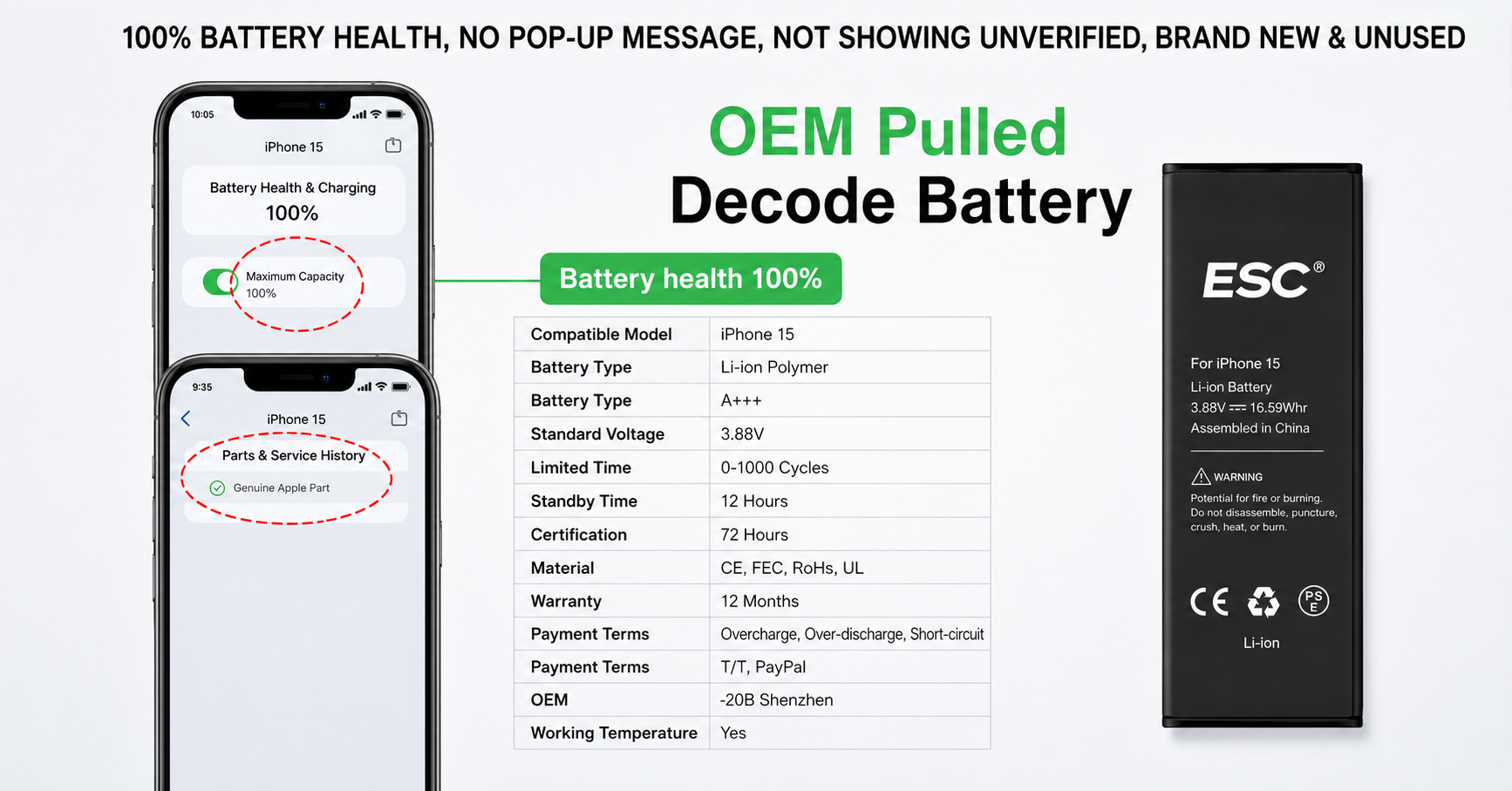
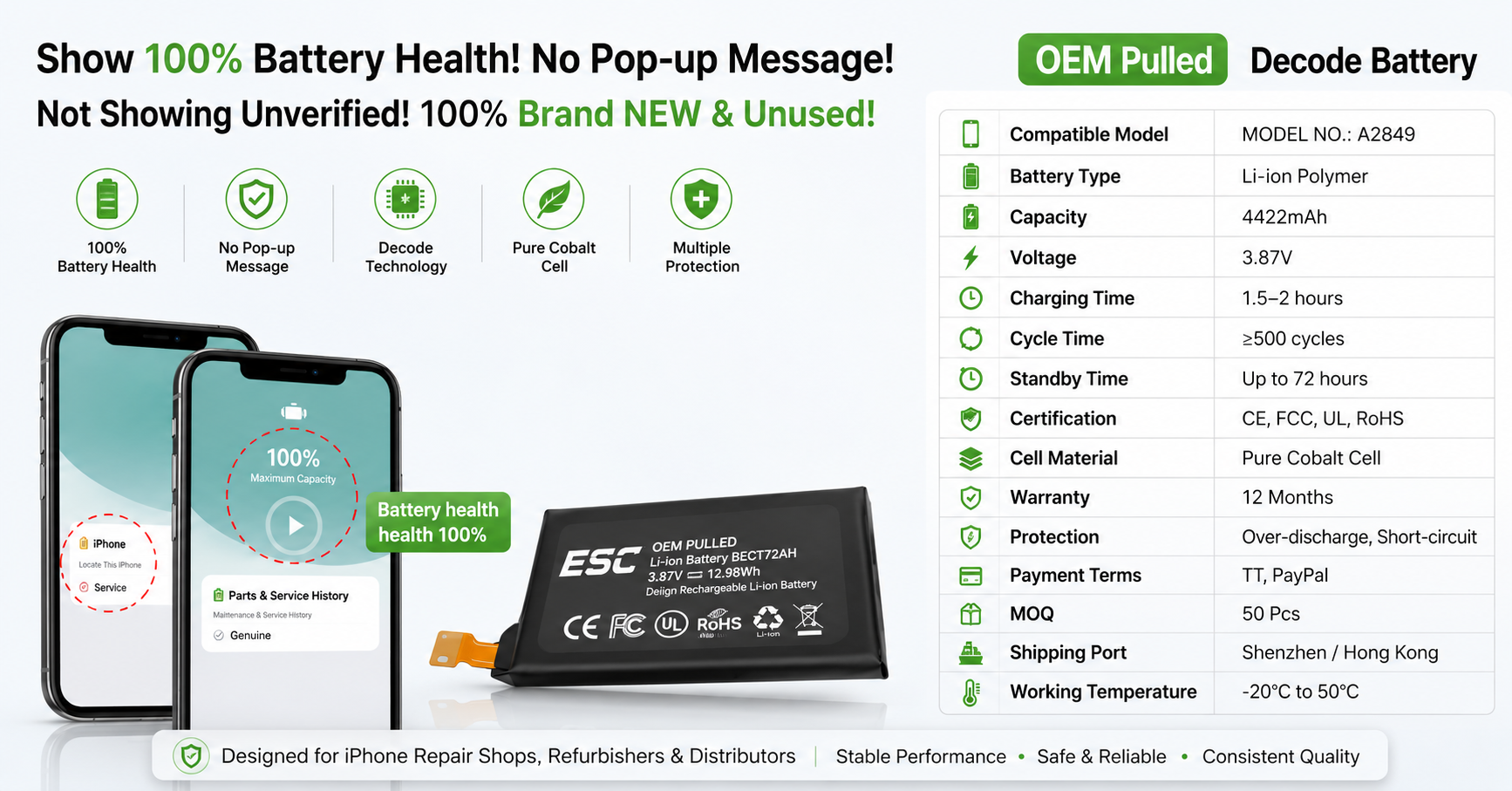
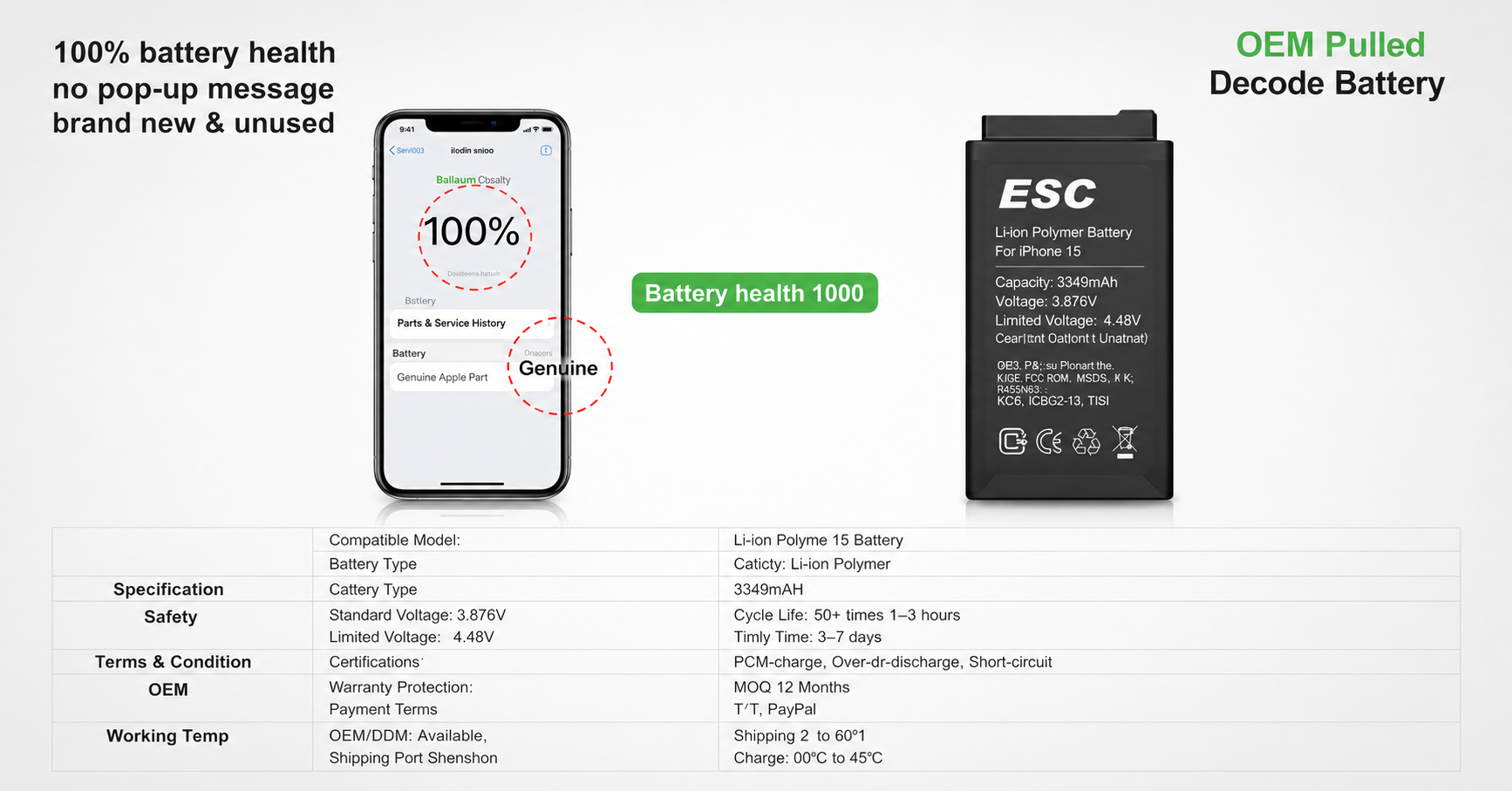
As a custom logo phone battery supplier, Shenzhen ESC can support model selection, sample evaluation, standard capacity batteries, high capacity batteries, Battery Health display options, decoded iPhone battery solutions, battery labels, retail boxes, barcode labels, warranty cards, user manuals, carton marks and bulk packaging.
Shenzhen ESC focuses on practical OEM needs: model accuracy, stable capacity, internal resistance control, PCM protection, installation fit, packaging clarity, batch consistency and after-sales support.
The goal is not to print a logo on random batteries.
The goal is to help buyers build a private label battery product line that can support repair shops, wholesale distribution, e-commerce sales and long-term brand growth.
Core Advantages: Why Custom Logo Batteries Create B2B Value
The first advantage is stronger brand identity.
A customized battery line helps distributors and e-commerce sellers reduce direct price comparison.
The second advantage is higher customer loyalty.
Repair shops and resellers are more likely to repeat orders when they trust a stable branded battery line.
The third advantage is better catalog management.
Model labels, barcode stickers and carton marks help distributors reduce warehouse errors.
The fourth advantage is premium positioning.
Buyers can create different series for standard repair, high-capacity demand, Battery Health display and decoded iPhone repair.
The fifth advantage is long-term channel control.
A private label battery brand allows buyers to build market recognition instead of always selling generic products.
The sixth advantage is better after-sales structure.
When products are organized by series, batch and model, quality feedback becomes easier to trace and improve.
Application Scenarios: Where Custom Logo Phone Batteries Create Value
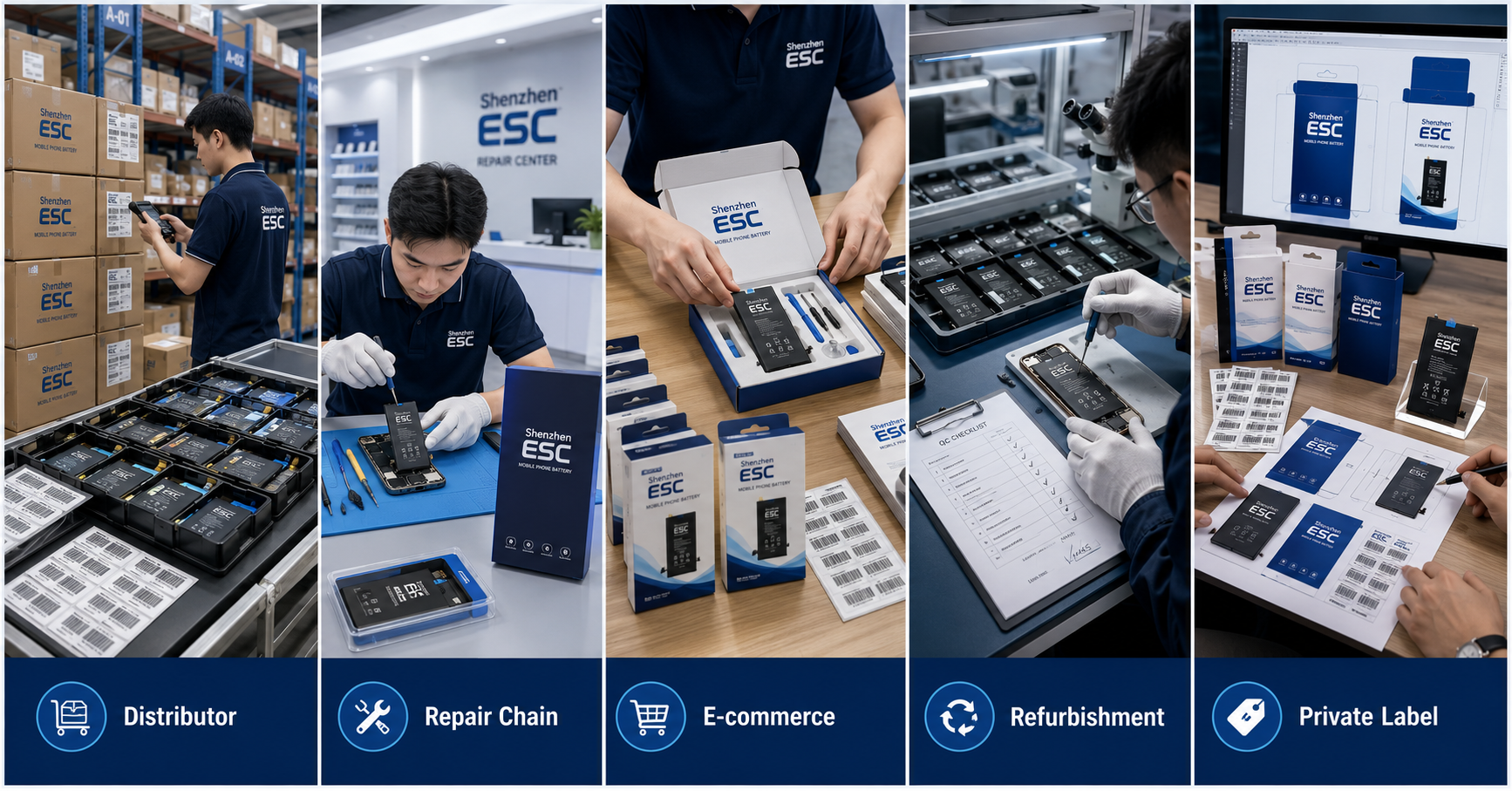
Mobile parts distributors use custom logo phone batteries to build a recognizable battery catalog for local repair shops and dealers.
Repair chains use private label batteries to standardize repair quality across multiple stores.
Wholesalers use custom packaging and barcode labels to improve warehouse control and customer retention.
E-commerce sellers use custom battery kits to improve product presentation and reduce price-only competition.
Refurbished phone suppliers use branded batteries for consistent replacement and stronger resale confidence.
Private label brands use OEM batteries to build local market identity and long-term repeat business.
Selection Advice: How Different Buyers Should Choose
Distributors should choose a supplier that supports broad model coverage, barcode labels, carton marks and stable replenishment.
Repair chains should choose batteries with consistent installation fit, stable quality and clear warranty terms.
E-commerce sellers should focus on retail packaging, compatibility information, accessory kits and realistic product claims.
Refurbished phone suppliers should choose batteries with predictable capacity and batch consistency.
Private label buyers should choose an OEM partner that can help build product series, not only print packaging.
Before bulk ordering, buyers should request samples, test real capacity, check internal resistance, confirm installation fit, review packaging, verify labels and define warranty terms.
FAQ
What is a custom logo phone battery supplier?
A custom logo phone battery supplier provides replacement phone batteries with customized battery labels, retail boxes, barcodes, warranty cards, manuals, carton marks and private label packaging for B2B buyers.
Is custom logo battery supply only about packaging?
No.
Packaging is only one part.
A serious custom logo project also includes model selection, capacity control, PCM protection, sample testing, batch consistency and after-sales support.
Who should buy custom logo phone batteries?
Custom logo phone batteries are suitable for mobile parts distributors, repair chains, wholesalers, e-commerce sellers, refurbished phone suppliers and private label battery brands.
What should I check before ordering custom logo batteries?
Buyers should check model coverage, real capacity, internal resistance, PCM protection, installation fit, packaging design, barcode labels, carton marks, sample testing and warranty terms.
Can Shenzhen ESC support private label packaging?
Yes.
Shenzhen ESC can support battery labels, retail boxes, barcodes, model stickers, warranty cards, user manuals, carton marks and private label packaging.
Can I customize different product series?
Yes.
Buyers can build product series such as standard capacity, high capacity, Battery Health display, decoded iPhone battery and repair kit series.
Why should I avoid choosing only the cheapest OEM supplier?
The cheapest supplier may create higher total cost through returns, warranty claims, negative reviews, wrong models and brand reputation damage.
What is the MOQ for custom logo phone batteries?
MOQ depends on model, packaging type, logo requirements and order structure.
Buyers can discuss sample testing, trial orders and bulk production plans with Shenzhen ESC.
Conclusion
Choosing a custom logo phone battery supplier is a brand-building decision, not only a packaging decision.
Private label buyers need stable capacity, model accuracy, PCM protection, installation fit, clear labels, barcode support, safe packaging, QC process and after-sales analysis.
A strong supplier helps buyers turn replacement phone batteries into a structured product line with stronger trust, better repeat orders and lower channel risk.
Shenzhen ESC supports B2B customers with custom logo phone battery supply, model recommendations, sample testing, OEM packaging, private label design and mixed-model bulk supply.
Contact Shenzhen ESC to request custom logo phone battery samples, packaging options, model lists and wholesale pricing for your private label battery business.