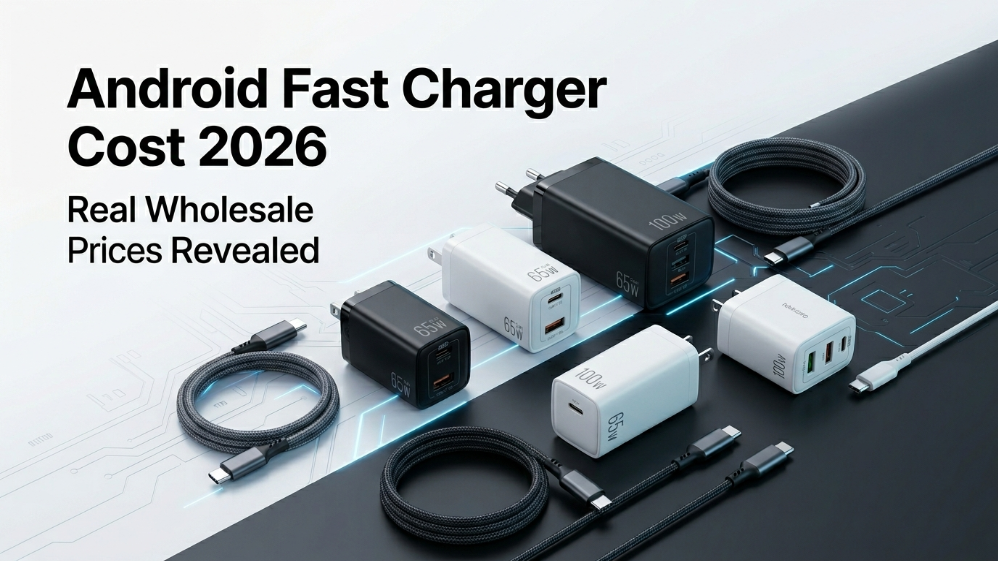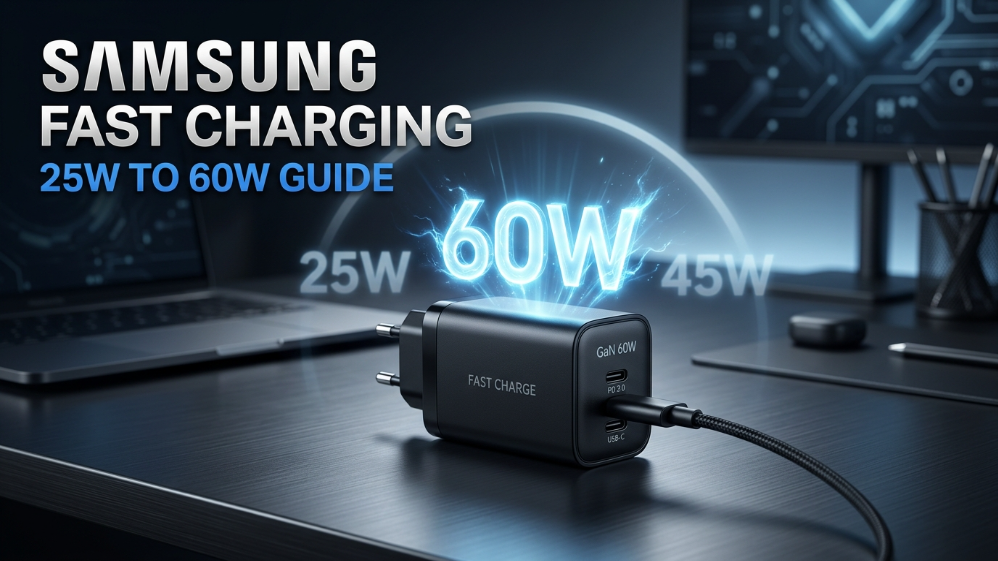

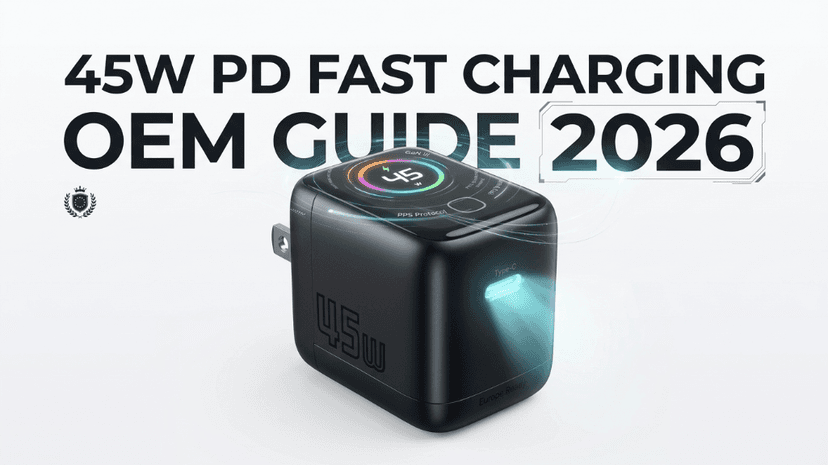
Don’t beat around the bush. If you are looking for a reliable 45W PD fast charging OEM partner, you’re essentially concerned about three things: BOM cost, thermal management, and lead time. As a product manager who has been navigating the power adapter production line for 15 years, I can give you a straight insight: in mature Shenzhen factories, a single-port 45W GaN charger with mainstream safety certifications typically has a bare PCBA cost of $2.20–$2.80. Adding the casing, packaging, and assembly, the wholesale price for a 45W wall charger (based on a 5K MOQ) reasonably falls between $3.50–$4.80. Below this threshold? You’d better open it up to check whether the high-frequency transformer is skimped or whether over-voltage protection wasn’t even implemented.
When looking for OEM/ODM charging solutions, the core isn’t about who can shave off a few cents, but who can solve your “customer complaints.” One battery failure review can destroy six months of accumulated Amazon listing ranking. In this guide, we’ll strip away the sales pitch and dive straight into the engineering and supply chain fundamentals, teaching you how to accurately screen for a genuine GaN charger manufacturer.
Why 45W PD Fast Charging Is the “Golden Power” in Today’s Consumer Electronics Market
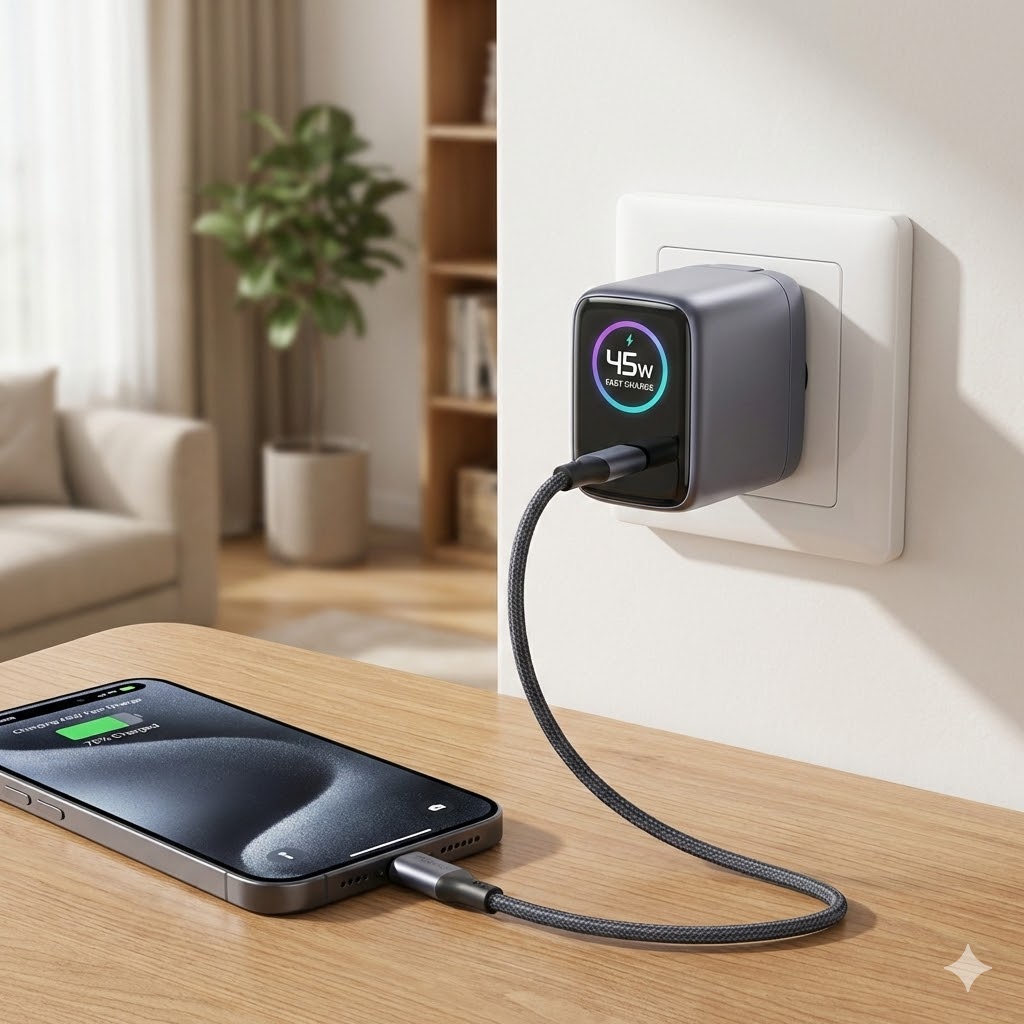
20W charges tablets too slowly, while 65W or 100W chargers are overkill in size and BOM cost for the average commuter. 45W happens to hit the sweet spot.
Meeting Multi-Device Needs: From Smartphones to Ultrabooks
The hardware ecosystem is undergoing major changes. Take the Samsung S23 and S24 Ultra, for example. To activate their “Super Fast Charging 2.0,” the charger must support 45W Programmable Power Supply (PPS) technology with up to 5A current.
It’s not just the Android camp. The standard charger for Apple MacBook Air is 30W, but a 45W custom USB-C power adapter can fully charge it in two hours while remaining backward-compatible with the iPhone 15 series’ 27W peak handshake protocol.
What does this mean? SKU simplification. Your brand only needs to stock this one main model to cover 80% of mobile device scenarios.
Market Trend Data Analysis
Capital often has the sharpest sense. According to the latest Grand View Research industry report, the global fast charging power adapter market is expected to grow at a CAGR of 8.3% from 2023 to 2030. Within this, the 30W–60W power density segment grows the fastest. When consumers refuse to carry bulky traditional laptop chargers, whoever can pack 45W into a lipstick-sized mold will seize the next three-year channel opportunity.
Four Core Dimensions to Evaluate a 45W PD Fast Charging OEM Factory
Looking for OEMs on Alibaba will return thousands of results. But experienced power buyers don’t check the boss’s mahogany desk; they go straight to the workshop to inspect SMT machines and test labs.
Real R&D & PCBA Design Capability
Many so-called factories don’t have their own hardware engineering team. They buy public reference designs, put them in a shell, and ship. This may work at low power levels, but at 45W, it’s a disaster.
Excellent PCBA layout design is the heart of a power supply. Engineers must strictly isolate high and low voltage areas to fit all components in a compact volume while meeting safety distances. During design review, we focus primarily on the selection and layout of the high-frequency transformer. Once switching frequencies reach 130kHz or higher, EMI (electromagnetic interference) and EMC (electromagnetic compatibility) issues follow.
Professional factories add shielding layers between primary and secondary circuits and design proper snubber circuits in critical paths. Furthermore, robust protection logic is mandatory: over-voltage protection (OVP), over-current protection (OCP), and short-circuit protection (SCP). Skimping on thermistors (NTC) to save a few cents is equivalent to planting a time bomb in your product.
Thermal Management & Structural Design: Solving the “Temperature Rise” Issue
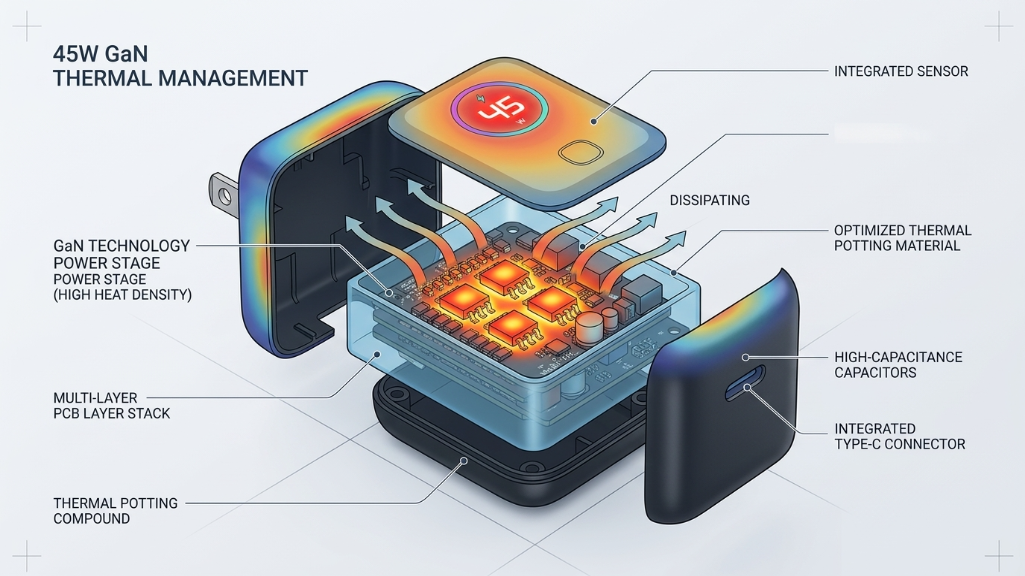
Higher power density means heat has nowhere to hide. Thermal management is the dividing line between top-tier manufacturers and low-end workshops.
Ignore claims like “V0-rated fire-retardant casing material”—this is the industry minimum and not worth boasting. The real question: how is the internal thermal path designed?
In compact 45W designs, standard thermal pads are often insufficient. Technically advanced manufacturers use thermal management potting, injecting specially formulated thermal gel in a vacuum into gaps between PCBA and casing.
This is not just a process; it’s a combined approach. Potting expels air (a poor conductor), allowing heat from components like GaN switches and rectifier bridges to conduct rapidly across the casing for even dissipation. The cured gel also provides mechanical reinforcement, ensuring that internal solder joints remain intact during a 1.5m drop test. Provide you with 45W dual port charger manufacturer guide 2026.
45W Design Comparison Table
| Evaluation Dimension | Traditional Silicon 45W | GaN 45W | Procurement Recommendation |
|---|---|---|---|
| PCBA Volume (approx.) | 65–75cc | 35–45cc | Choose GaN for portability & premium positioning |
| Average Conversion Efficiency | 87–89% | 91–93% | Higher efficiency reduces heat loss |
| Core Heat Area | Transformer, MOSFET (localized hot spots) | Uniform distribution | Silicon may overheat locally |
| Potting Requirement | Optional (thermal pad sufficient) | Strongly recommended | Potting adds ~$0.15 per unit but greatly reduces complaints |
| BOM Base Cost | Base price | Base + 15–20% | Low-end market may still use silicon |
Supply Chain Resilience
Power supply is capital- and material-intensive. A shortage of one protocol IC can halt your entire line. Evaluate whether the factory has second-source reserves. If the lead time for GaN power devices extends, can your OEM partner complete pin-to-pin substitution testing within 48 hours?
Factories with direct strategic cooperation with semiconductor leaders like Navitas, Innoscience, or PI gain priority capacity during peak season.
Global Safety Compliance

Customs holds are a nightmare for cross-border sellers. 45W PD fast chargers are high-voltage devices subject to strict regulations.
Many buyers rely on a claimed “CE/FCC” certificate, not realizing it’s not tested for the actual PCBA. USB-IF requirements for Type-C PD 3.0/3.1 certification are rigorous; any parameter exceeding limits can result in removal in the destination country.
Your OEM must provide genuine test reports from SGS, TÜV, UL, etc., covering UL 62368-1 safety standards—not just plug-and-play testing.
OEM/ODM Customization Process: From Concept to Mass Production
Don’t trust sales who promise “two-week delivery.” A high-end custom 45W charger requires rigorous engineering validation.
Step 1: Requirement Assessment & ID Design
Appearance is the first productivity factor in a crowded market. AOVOLT provides distinctive industrial design with thermal simulation 3D renders. Even surface roughness and corner radius are precisely defined.
Step 2: Mold Development & PCBA Prototyping
With in-house injection molding and mold workshops, we eliminate dependency on external vendors. CNC machining and first PCBA prototyping proceed simultaneously. High-frequency transformer winding and GaN thermal curves undergo extreme stress testing.
Step 3: DVT Verification & Safety Testing
Design Verification Test (DVT) exposes inferior designs. Samples undergo temperature/humidity cycling, surge, and ESD testing. Any slight deviation requires layout revision.
Step 4: Pilot Run & Mass Production
Pilot runs reveal assembly line blind spots. For a North American top 10 Amazon 3C client, we delivered 50,000 units of 45W dual-port GaN chargers with dynamic displays from ID to shipment in 45 days—three days early, with OQC defect rates below 0.1%.
Supplier Dimension Core Metrics Comparison
| Evaluation Dimension | AOVOLT (Vertical Integrated Factory) | Traditional Assembly OEM | Pure Trading/Procurement Agent |
|---|---|---|---|
| Mold & Injection | In-house closed loop (fast adjustment, cost control) | Outsourced (long lead, communication loss) | No manufacturing |
| ID & Appearance | Independent design, highly distinctive | Rely on public designs, high homogeneity | Off-the-shelf OEM shells |
| Quality Control | Full coverage from plastic pellets to PCBA | Only final assembly & aging | Random sampling |
| Lead Time Response | Rapid, critical processes unconstrained | Limited by upstream supply | Cannot guarantee |
Strict QA/QC: Protecting Your Brand Reputation
In the power industry, quality control is serious money, not slogans.
Data-Driven IQC to OQC
Incoming inspection checks actual resistance and capacitance; MLCC micro-cracks require X-ray detection. Outgoing inspection strictly follows AQL sampling standards.
100% Burn-In & ATE Testing
All 45W PCBAs undergo at least 4 hours of full-load burn-in before assembly, followed by 20+ electrical parameter tests via ATE. Combined with ISO 9001:2015 and Six Sigma standards, overall production yield remains above 99.8%.
B2B Buyer FAQ
1. What is the MOQ for 45W PD fast charge customization?
Standard minor tweaks (logo or packaging) usually 1,000–3,000 pcs. Full ODM with new ID and mold: typically 5,000 pcs.
2. Lead time from confirmed ID to first shipment?
Full ODM 35–45 days; standard OEM with ready materials: 20–25 days.
3. Is your 45W solution backward compatible with older fast charge protocols?
Yes. Supports PD3.0, PPS, QC3.0, FCP, AFC, Apple 2.4A.
4. How to verify OEM’s true mold and injection capability?
Request video or on-site inspection. Ensure CNC, EDM, and injection workshops exist; otherwise, molds are likely outsourced.
5. What support is provided if customs inspect shipments?
Professional factories provide complete test reports (UL, CE, FCC), REACH/RoHS-compliant BOM, and detailed technical specs.
The 45W PD fast charging space is crowded, but high-end custom capacity with design expertise, compliance knowledge, and fast delivery is scarce. If you’re tired of generic shells, endless delays, or planning your next blockbuster product line, it’s time to speak directly with a genuine source factory. Bring your product concept or request our 2024 advanced custom catalog to start with a real BOM and R&D assessment.
References: