
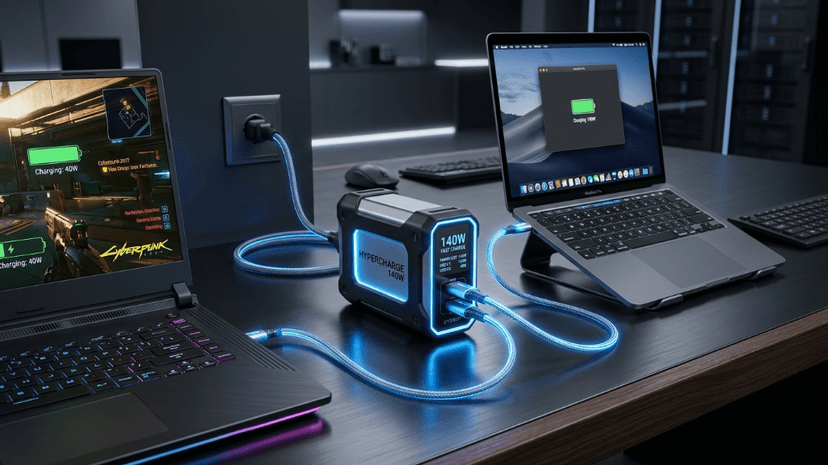
Every day, cross-border brand product managers ask me the same question: “If I invest tens of thousands of dollars in tooling to make a 140W charger, besides charging a 16-inch MacBook, what other devices can actually utilize this power? Can the market justify my R&D cost?”
As a product manager who has monitored hardware supply chains on the front line for 15 years, I don’t sugarcoat—here’s the full picture.
First, let’s address your core concern: the audience for 140W is definitely not limited to MacBook users. It is reshaping the entire power delivery standard for high-performance PCs and gaming peripherals. From a cost perspective, in 2026, a 140W 2C1A multi-port charger using true third-generation Gallium Nitride (GaN III) chips, with PFC+LLC architecture and full protocol support, has a wholesale FOB floor price of $22–$26. If you see a market price of $15 or lower for a “hot seller”? Don’t touch it. That product is either stripped of the PFC (Power Factor Correction) circuit or uses low-quality high-frequency transformers to force power output—industrial trash that will overheat and melt within half an hour under heavy load.
For 3C digital brands, adopting high-power Type-C power adapters is no longer optional—it’s a strategic battle for survival. Next, we’ll unplug marketing buzzwords and dissect the 140W fast-charging ecosystem from the ground up, based on protocols and real handshake logic.
The Market Demand: Why 140W is the New Battleground for Electronics Brands
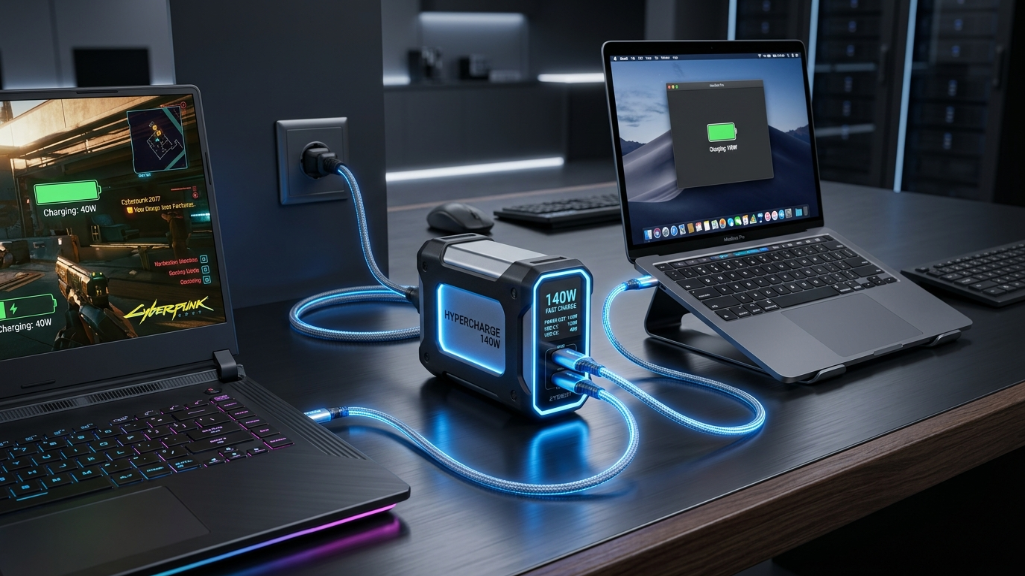
Why are top peripheral brands converging on the 140W power range? Because the underlying physical ceiling has been broken.
The Leap from 100W to 140W: USB PD 3.1 Explained
For a long time, 100W (20V/5A) was the absolute physical limit of the Type-C interface, known in the industry as the Standard Power Range (SPR). But this power is insufficient to feed gaming laptops or support multiple simultaneous outputs.
This changed when the USB-IF (USB Implementers Forum) officially released the revolutionary USB PD 3.1 EPR specification. EPR (Extended Power Range) raises the theoretical upper limit to 240W and adds three fixed voltage levels: 28V, 36V, and 48V. The 140W we discuss today is achieved via the new 28V/5A charging protocol. By raising the voltage from 20V to 28V while maintaining 5A, power output jumps by 40%. This high-voltage, low-current solution significantly reduces cable heating losses but creates major PCBA layout challenges for manufacturers.
Evaluating the Addressable Market for High-Power Type-C Power Adapters
Don’t focus on a single device. B2B buyers evaluating this segment should emphasize “dimensional reduction” and “intelligent power distribution.” A 140W GaN charger isn’t just for single-port 140W output. In real travel scenarios, consumers may want to plug in a laptop (drawing 100W) and an iPhone (drawing 30W) simultaneously, with both ports maintaining uninterrupted charging. This full-scenario redundant power is what justifies a retail premium of $80+ for 140W products.
The Master List: What Devices Actually Support 140W Charging?
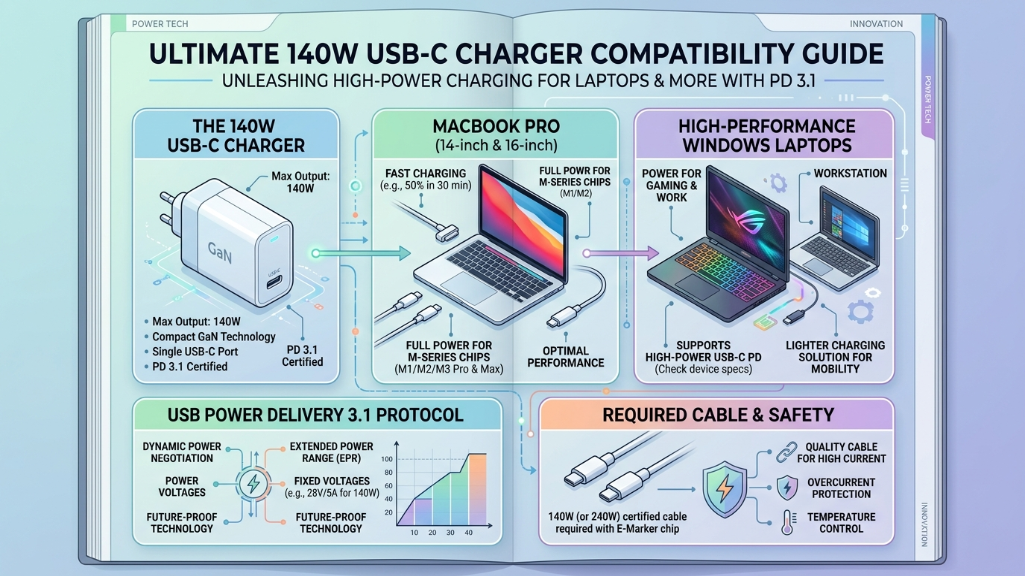
Putting theory aside, which devices actually trigger the 28V handshake when a Type-C cable is connected? Here’s the verified ultimate device list.
The Apple Ecosystem: MacBook Pro 16-inch (M1/M2/M3 Max)
Apple continues to lead the education market. According to Apple’s official technical specifications, the 16-inch MacBook Pro with M1, M2, or M3 Max chips is the largest and most stable 140W user base on the market.
Technical Caveat: For the M1/M2 16-inch MacBook Pro, you must use Apple’s MagSafe 3 cable to connect to a 140W charger to achieve fast charging (50% in 30 minutes). Early Type-C ports do not support EPR reception. Only with the M3 Max did Apple fully open PD 3.1 140W support on Type-C ports.
High-Performance Windows Gaming Laptops (Lenovo, Razer, Asus)
If Apple is the base, Windows laptops are the growing incremental market. TrendForce and IDC data show that the shipment share of Type-C high-power gaming laptops is growing 15% annually.
In gaming laptop Type-C charging, Lenovo Legion series fully supports PD 3.1, with the latest Y9000P models natively supporting 140W Type-C input. Razer Blade 16/18 and Asus ROG high-end lines have abandoned traditional “brick” DC adapters in favor of 140W–240W GaN solutions. Provide you with safe fast charging PCBA wholesale: 140W GaN guide.
Table: Typical 140W Device Trigger Conditions and Protocol Restrictions
| Device | Trigger Condition | Port Requirement |
|---|---|---|
| Apple MacBook Pro 16" (M1/M2) | PD 3.1 (28V/5A) | Must use MagSafe 3 cable |
| Apple MacBook Pro 16" (M3 series) | PD 3.1 (28V/5A) | Type-C or MagSafe 3 |
| Lenovo Legion Y9000P 2023/2026 | Private protocol compatible / PD 3.1 full-feature Type-C | Type-C |
| Razer Blade 16, Thor ZERO | PD 3.1 EPR full-feature Type-C | Type-C |
Fast-Charging Smartphones (Proprietary vs. Universal PD 3.1)
Can phones use 140W? The answer is harsh: currently, many Chinese smartphones claiming 120W, 150W, or even 240W (e.g., Xiaomi, vivo, Realme) rely on proprietary protocols (dual battery + buck charge pump). Using a standard 140W PD 3.1 charger typically only triggers backward compatibility at 18W or 27W. Protocol barriers remain for the short term.
The "Hidden Bottleneck": Why Cables Matter Just as Much as the Charger
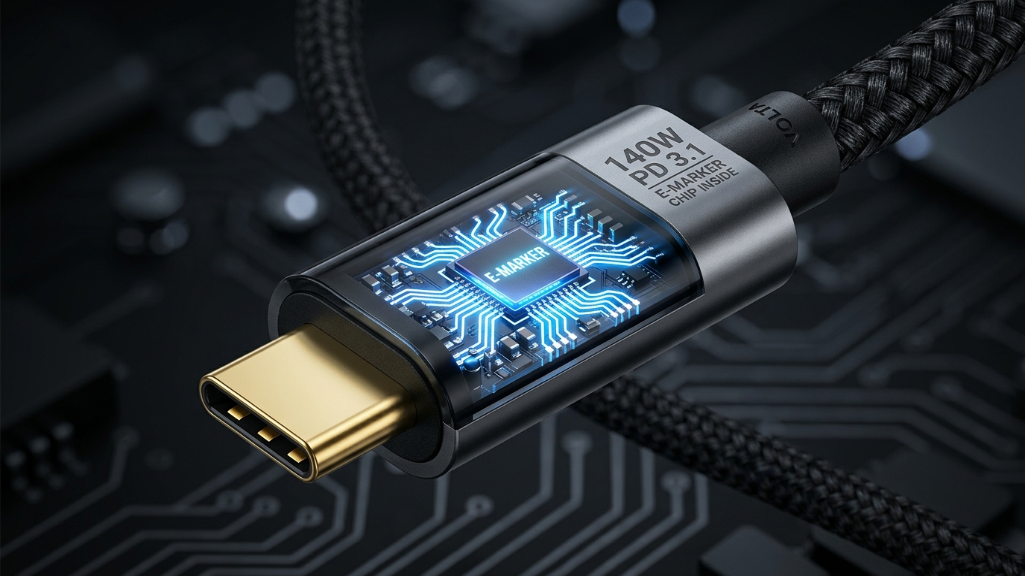
I’ve handled countless cross-border RMA complaints. Customers buy a top-of-the-line 140W charger but only see 60W on their laptops, then leave 1-star Amazon reviews. Why? Poor-quality cables.
The Necessity of EPR-Capable USB-C Cables and E-Marker Chips
In the Type-C ecosystem, cables are not just copper—they have “intelligence.” 140W requires carrying 5A current at 28V. A standard 3A cable could instantly overheat and destroy the connector.
For safety, USB-IF mandates that cables for over 60W must include E-Marker chips. Upon connection, the charger first queries the cable via the CC pins: “What maximum power can you handle?” If the cable is not E-Marker or reports SPR, the charger locks at 60W or 100W. Only when recognized as an EPR-capable cable will 28V/5A full power be delivered.
Avoiding Customer Returns (RMA) Due to Cable Mismatch
For brands sourcing OEM 140W chargers, don’t sell bare units. Bundle chargers with 140W EPR cables or include prominent consumer education on packaging and product pages. This prevents post-sale disputes due to cable mismatch—a hallmark of experienced product management risk control.
Manufacturing Challenges of OEM 140W Wall Chargers (B2B Insight)
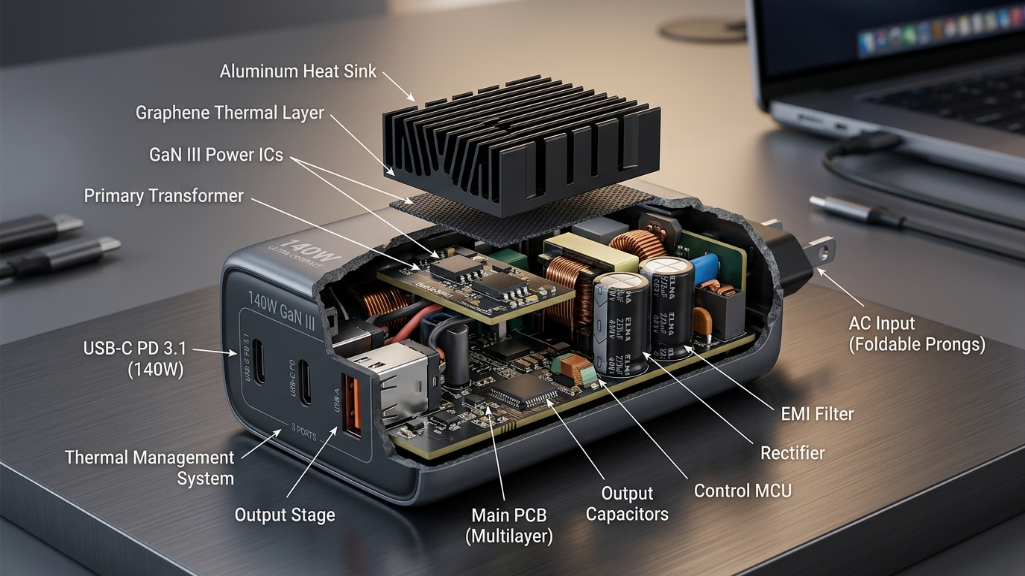
Stacking power to 140W in the lab is easy; the challenge is making it run at full load for two hours in a compact form factor without overheating, whining, or failure. This is the true benchmark of a 140W GaN charger manufacturer’s R&D capability.
Beyond Silicon: The Role of Gallium Nitride (GaN III) Technology
Traditional silicon power transistors are unsuitable for 140W adapters—they result in bulky “brick” designs. The 2026 industry standard is third-generation GaN (GaN III).
GaN III offers smaller size, higher switching frequency, and lower conduction loss, enabling higher power density. Top-tier factories choose high-end GaN chips from Navitas or Innoscience, capable of withstanding extreme voltage fluctuations.
Thermal Management for Fast Chargers (PFC + LLC Topology)
Heat management for 140W chargers is a nightmare. Flyback topologies drop efficiency above 75W. At 140W, high-level PFC + LLC architectures are necessary.
- PFC reduces grid pollution and improves power factor.
- LLC enables zero-voltage switching (ZVS) for primary power transistors, boosting conversion efficiency above 93%.
Example: For a North American gaming peripheral brand, a 140W 2C1A charger was prototyped. Initial surface temperature was challenging, but thermal potting and large-area graphene heat pads reduced temperature rise by 12°C at 35°C ambient.
Table: 140W Charger Architecture Comparison
| Aspect | Top-Tier OEM (PFC+LLC) | Cheap “Fake” 140W (Flyback/QR) |
|---|---|---|
| Efficiency | 93–95% | 87–89% |
| Cooling | Thermal potting + graphene pads | Aluminum + air convection |
| High-frequency noise | Minimal (LLC soft-switch) | Loud and sharp under load |
| Safety certification | Easy UL/CE | Difficult EMI/EMC, leakage risk |
Is Sourcing a 140W Charger Profitable for Your Brand?
From a product manager’s perspective, let’s calculate. 140W chargers have high unit costs but longer lifecycles.
Future-Proofing Your Product Line for 2025 and Beyond
Electronics refresh quickly, but charging standards bring 3–5 years of benefits. PD 3.1 adoption is just beginning. While competitors are stuck in 65W price wars, a 140W layout upgrades your brand. Even if devices currently support only 100W, consumers prefer 140W chargers as future-proofing.
Margins vs. Multi-Port Utility (e.g., 140W 2C1A GaN Chargers)
Single-port 140W is the entry point; true profits lie in 140W 2C1A or 3C1A multi-port GaN chargers. Check OEMs’ dynamic power distribution—does dual-C output split 65W+65W or intelligently 100W+30W? Protocol-level optimization directly impacts user reviews.
Partner with a Top-Tier 140W GaN Charger Manufacturer: AOVOLT
You need a capable source. Enter AOVOLT.
With 15 years in consumer electronics B2B manufacturing, AOVOLT is not a trading company. Headquartered in Dongguan, China, we vertically integrate all fast-charging manufacturing steps.
- Full-chain production: From industrial design, R&D, mold opening, injection molding, to metal integration, we control quality and deliver 30% faster than competitors.
- Technical superiority: Our 140W PD 3.1 solution fully supports PD 3.1, PPS, QC3.0, FCP, SCP, AFC, Apple 2.4A, and more.
- Design capability: Unique private molds and industrial design avoid market homogenization.
We specialize in OEM/ODM, applying standardized QC and real PCBA testing, not marketing fluff.
FAQ: People Also Ask
Q1: Can a 140W charger charge lower-power devices (65W, 20W)?
Absolutely. PD 3.1 is fully backward compatible. The charger’s protocol IC matches the device’s required voltage (5V, 9V, 15V, 20V), avoiding damage.
Q2: Why doesn’t my 140W charger charge my MacBook at full speed?
Check your cable. For older MacBook Pro 16" models, use MagSafe 3 with EPR 5A E-Marker cables.
Q3: Is high-frequency noise normal for GaN chargers under load?
Slight coil whine may occur under extreme conditions. Continuous harsh noise indicates poor frequency control. AOVOLT’s LLC topology minimizes noise.
Q4: Why are 140W chargers much more expensive than 100W?
It’s not just 40W more—it’s a cross-generation architecture upgrade requiring PFC, LLC transformers, and higher-spec capacitors. BOM and R&D costs multiply geometrically.
Q5: How important are certification reports when sourcing OEMs?
UL (North America), CE (Europe), and PSE (Japan) are essential for mainstream markets. AOVOLT products follow these standards from PCBA design stage for smooth customs and legal sales.
In the competitive consumer electronics arena, 140W is your ticket to the high-end market. If you’re tired of poor OEMs causing overheating, interrupted charging, and delayed deliveries, it’s time to bypass middlemen and partner directly with a vertically integrated manufacturer.
Whether you need high-performance private molds or large-volume stable supply, AOVOLT delivers 15 years of manufacturing expertise. Instead of struggling in price wars, bring your product concept and see what true fast-charging manufacturing looks like in Dongguan.
References:
USB Power Delivery 3.1 Specification
Apple Official Technical Specifications – MacBook Pro 16‑inch