

In OEM manufacturing, one of the most common challenges is that a product performs well during sampling but fails once production scales. Many brands encounter inconsistent charging performance, battery variation, overheating in certain units, and defect rates rising above acceptable levels. These issues are not caused by product design alone but by the lack of a stable mass production power bank system that ensures consistency across batches. When production volume increases, small variations in components, assembly processes, and testing coverage become amplified, leading to unstable product quality and higher return rates.

The Real Cause: Why Production Instability Happens
To understand the problem, it is important to look beyond the product itself and analyze the manufacturing process. In unstable systems, differences in battery cell batches, inconsistent SMT precision, and uncontrolled assembly conditions lead to performance deviation. For example, even a small variation in internal resistance or soldering quality can affect output stability and temperature control. Without a controlled system, a stable mass production power bank cannot be achieved, regardless of how good the initial prototype is.
Performance Comparison Between Unstable and Stable Production Systems
| Parameter | Unstable Production | Stable Mass Production System |
|---|---|---|
| Defect Rate | 3–7% | <1% |
| Voltage Stability | ±7% | ±3% |
| Temperature Variation | ±10°C | ±3–5°C |
| Battery Consistency | Low | High |
| Return Rate | 5–8% | <1.5% |
This comparison clearly shows that production stability directly determines product performance and market success.
Engineering Solution: Designing for Stable Mass Production
A stable mass production power bank must be designed with scalability in mind from the beginning. This includes optimizing PCB layout for balanced current flow, using multi-layer boards with higher copper thickness, and ensuring voltage stability within tight tolerances. Battery systems must also be controlled through strict matching processes, with capacity deviation kept below ±2%. These engineering decisions reduce variability and ensure that performance remains consistent when production volume increases.
Manufacturing Solution: Building a Controlled Production System
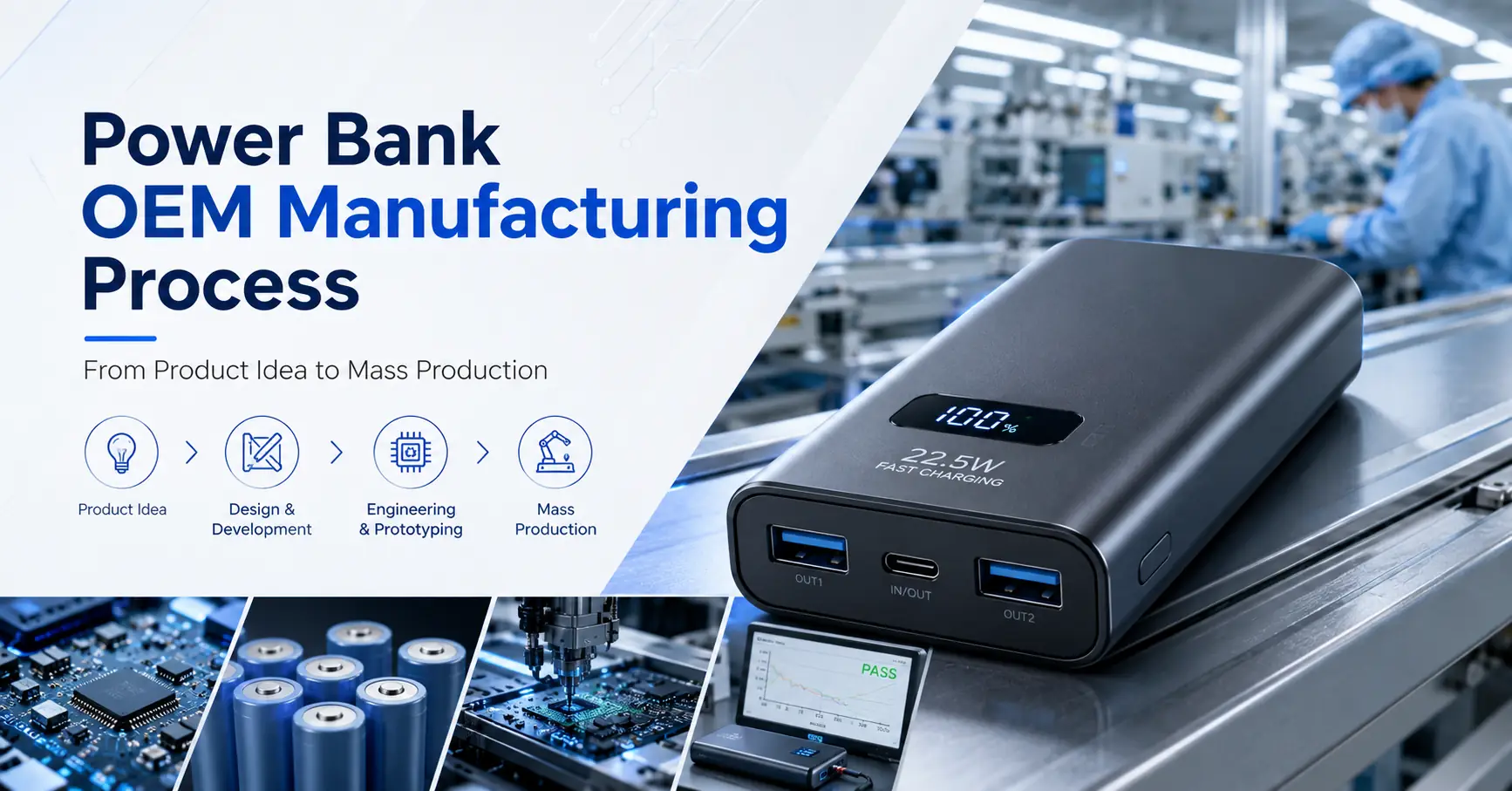
Achieving stable production requires a structured manufacturing process. This starts with supplier control, ensuring that key components such as battery cells and power management chips come from consistent sources. During production, SMT precision and automated assembly help reduce human error. Testing plays a critical role, including full-load output testing, thermal testing, and aging tests that simulate real usage conditions. A complete quality control system covering incoming inspection, in-process checks, and final inspection ensures that every unit meets the same standard.
Why Stable Mass Production Power Bank Capability Is a Competitive Advantage
For brands, the ability to maintain consistency across thousands of units is more important than achieving peak performance in a single prototype. A stable mass production power bank reduces return rates, improves customer satisfaction, and strengthens brand reputation. It also lowers after-sales costs and ensures smoother expansion into global markets where quality consistency is critical.
Application Scenarios Where Stability Matters Most
Stable production is especially important in scenarios where products are used at scale or under continuous load. In cross-border e-commerce, consistent quality directly affects reviews and rankings. In corporate procurement, uniform performance across all units is essential. In high-volume retail distribution, stable supply ensures predictable performance and fewer complaints. These scenarios highlight why production stability is not optional but a core requirement.
Selection Guide: How to Choose the Right OEM Partner
When selecting a manufacturer, brands should evaluate more than just price or specifications. Key factors include production consistency, defect rate control, supply chain stability, and testing coverage. A reliable partner will provide data-driven quality control, traceability systems, and proven experience in high-volume production. Choosing a supplier with strong stable mass production power bank capabilities is essential for long-term success.
FAQ
Q1: Why do power banks fail more often in mass production than in samples?
Because small variations in components and processes become amplified at scale, leading to inconsistent performance.
Q2: What is an acceptable defect rate in power bank production?
High-quality manufacturers typically maintain defect rates below 1%.
Q3: How can brands ensure consistent product quality?
By working with OEM suppliers that implement strict production control, component standardization, and full testing coverage.
Conclusion: Stable Mass Production Determines OEM Success
A successful product is not defined by its prototype performance but by its consistency at scale. AOVOLT provides stable mass production power bank solutions through engineering optimization, controlled manufacturing processes, and strict quality systems. If you are looking to scale your power bank project with reliable performance and low defect rates, explore our solutions here: https://www.esccharge.com/products/power-bank
or contact us for OEM support: