
In an era of multi-device simultaneous charging, if your multi-port charger causes the first device to disconnect instantly when a second device is plugged in—or if its power distribution is still stuck in rigid “fixed output” mode—your brand has already lost its premium positioning.
For advanced B2B procurement, the core solution can be summarized in one sentence: abandon cheap fixed-split designs and switch to GaN (Gallium Nitride) architectures supporting Dynamic Power Sharing. According to current B2B shipment data from Dongguan factories, PCBA solutions supporting PD3.1 and enabling 140W smart allocation typically range from $18–$35 per unit wholesale, depending on customization. This cost is not just hardware—it reflects the R&D premium for solving multi-protocol handshake mismatches and preventing device damage caused by transient loads.
What Is Smart Power Allocation, and Why Is It Key to Brand Premium?
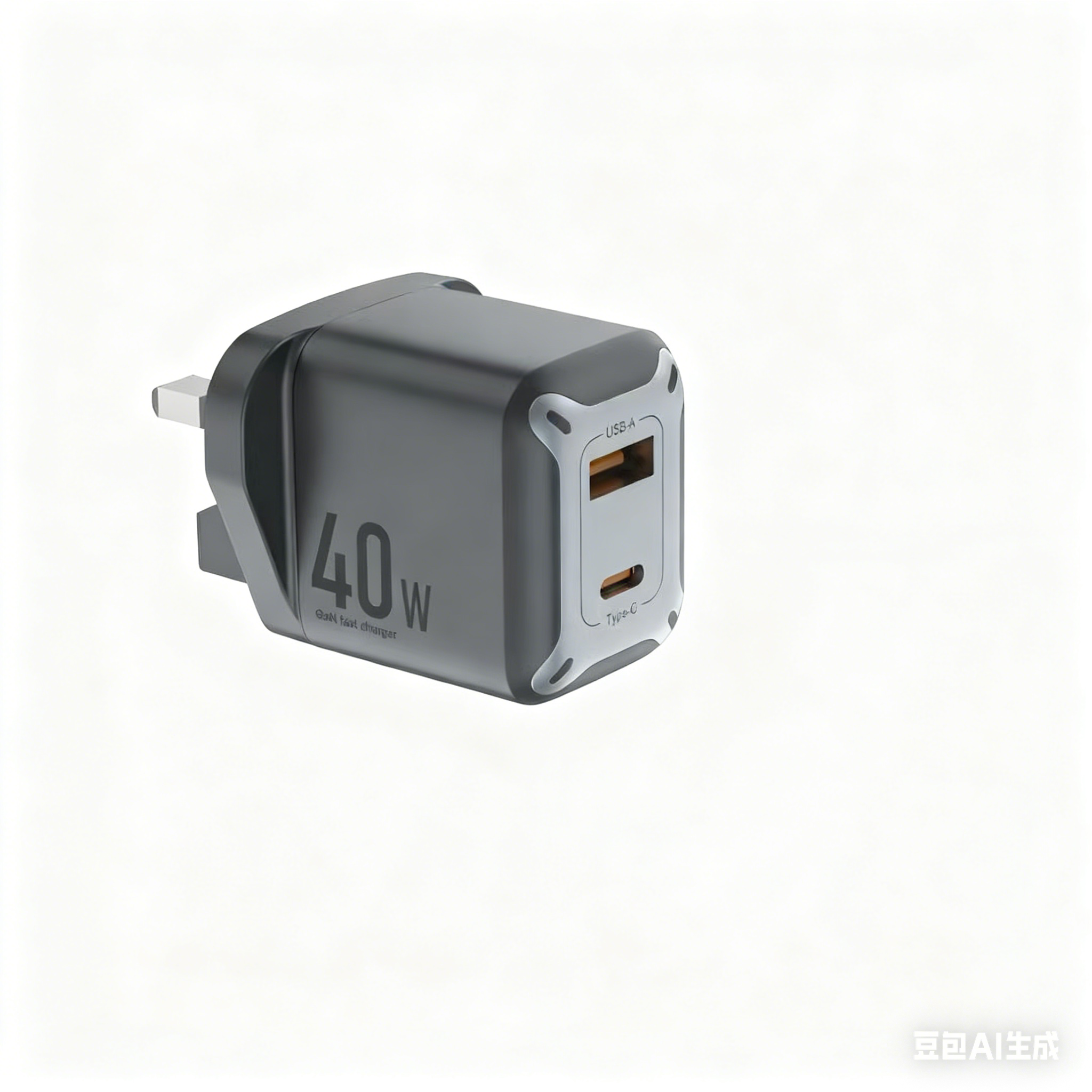
Traditional multi-port chargers often act like simple “power splitters.” For example, when connecting a 65W laptop and a 20W phone to a 100W charger, many chargers can only output via a fixed C1:65W + C2:30W allocation. If the phone is unplugged, the C1 port remains locked at 65W instead of dynamically returning to 100W.
This rigid, mechanical experience leads to high return rates and cheapens the brand image.
Smart Power Allocation, by contrast, leverages an advanced MCU (microcontroller) to monitor each USB-C port’s Sink device requests in real time.
Feature Comparison: Fixed Output vs. Dynamic Power Sharing
| Feature Dimension | Traditional Fixed Output | Smart Dynamic Allocation (Dynamic Power Sharing) |
|---|---|---|
| Power Response | Port locked; idle power does not return | Millisecond-level reallocation; idle power instantly merged |
| Device Compatibility | Stiff protocol handshake; prone to disconnects | Full protocol support (PD3.0/PPS/SCP, etc.), precise current matching |
| Thermal Management | Fixed heat, uneven dissipation | Dynamic switch frequency adjustment, load-optimized thermal efficiency |
| User Experience | Frequent “plug-unplug disconnects” | Ultra-short handshake time (<500ms), near-seamless switching |
During development of our 140W PD3.1 series, we found that B2B clients prioritize ripple control under load balance rather than theoretical peak output. Once multi-port dynamic allocation is involved, DC-DC circuit complexity grows exponentially. Essentially, a “smart” allocation solves the deep communication between the Battery Management System (BMS) and the charger protocol stack.
Core Technical Standards for High-End Charger OEMs: PD3.1 and 140W Full Protocol
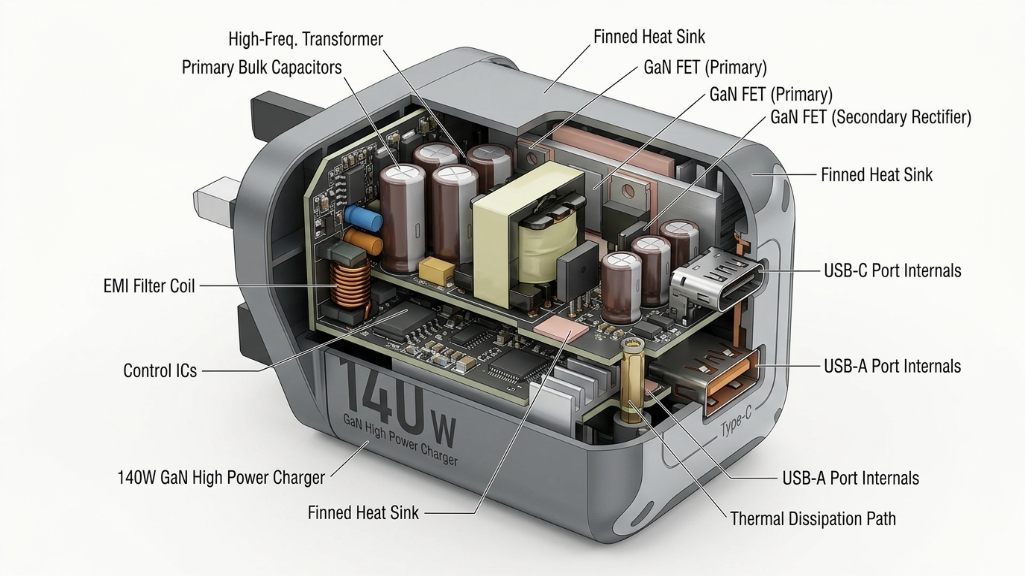
For brands targeting the mid-to-high-end market, 140W PD3.1 with PPS (Programmable Power Supply) is a non-negotiable standard. This requires chargers capable of outputting 28V/5A.
As a team with 15 years of experience, we at AOVOLT realized that achieving full protocol compatibility is more than just adding components. Many “140W” chargers on the market are pseudo-compatible; when encountering Huawei SCP or Samsung AFC protocols, power often drops sharply.
Our High-End Standards Include:
-
Full Protocol Compatibility: Genuine OEM factories must fully support PD3.0, PPS, QC3.0, FCP, SCP, AFC, Apple 2.4A, BC1.2.
-
High-Density Power Supply: Using third-generation GaN technology to fit 140W output in a smaller form factor than an Apple single-port charger.
-
Multi-Level Safety: During Smart Power Allocation, the system reacts within 20 microseconds to over-current (OCP) or over-voltage (OVP), protecting expensive devices.
This technical depth determines your brand competitiveness on Amazon or professional electronics channels. That’s why we maintain a dedicated B2B R&D lab in Dongguan: handshake optimization requires thousands of real-device tests, not simulations alone.
Evaluating B2B OEM Factories: Beyond Assembly
Many “manufacturers” in cross-border trade are merely assembly shops, buying PCBs, enclosures, and hardware from various suppliers and assembling them in rudimentary facilities. For B2B managers seeking high-end Smart Power Allocation Charger OEMs, such a supply chain is fragile and quality uncontrollable.
Value of 15 Years Manufacturing Experience
Real manufacturing barriers come from capital-intensive vertical integration. AOVOLT’s position in Dongguan and global client service rests on controlling the full production chain.
Mold Opening & Design:
Most factories use public molds, resulting in homogeneous products. We insist on independent R&D for distinctive, recognizable industrial design, allowing buyers to identify your brand immediately.
Injection Molding & Hardware Integration:
High-power chargers require flame-retardant materials (UL94-V0) and precise hardware. Our in-house injection workshop ensures consistent wall thickness and heat dissipation channels, preventing deformation or uneven seams.
Without vertical integration, promises of “fast delivery” and “strict QC” are empty; traders cannot control upstream mold schedules, but we can, with production lines right downstairs. Provide you with 45W dual port charger manufacturer guide 2026.
Customization & Industrial Design: Breaking Through Market Homogeneity
In B2B trade, nothing frustrates procurement managers more than identical products. Ten 140W chargers may look identical on Amazon or in stores, leaving no room for brand premium.
Industrial Design (ID) is not just aesthetics—it’s a firewall against price wars.
From 15 years of experience, we found that high-end buyers define “premium feel” precisely: seamless precision injection, delicate CMF surface treatment, and a unique, patent-protected look.
Differentiated Customization Levels
| Custom Level | Core Service | Applicable Brand Stage |
|---|---|---|
| Basic OEM | Logo printing, exclusive packaging, customized cable ties | Early-stage brands, rapid testing |
| Standard OEM | Shell color (CMF) modification, indicator light customization, protocol firmware tweaks | Stable customer base, seeking brand consistency |
| Deep ODM | Mold opening from scratch, PCBA circuit stacking optimization, exclusive design patent | Leading brands aiming to establish industry benchmarks and tech barriers |
True deep customization often begins at PCBA layout. To achieve high-efficiency cooling in compact GaN space, engineers optimize transformer and capacitor placement based on chosen enclosure size. This “inside-out” design ensures surface temperatures stay below international safety limits even at high power output.
Global Market Access & Quality Control: The Line Between Success and Failure
If Smart Power Allocation is the brain, quality control is the skeleton. For B2B clients, a single batch defect can destroy years of brand reputation.
At AOVOLT, every 140W PD3.1 charger undergoes “hell mode” reliability testing before shipping:
-
High-Temperature & High-Voltage Aging Test: Continuous full-load operation for 4–8 hours at 45°C to catch early component failures.
-
Dynamic Load Switching Test: Simulates frequent device plug/unplug cycles thousands of times, ensuring MCU handles power reallocation without glitches.
-
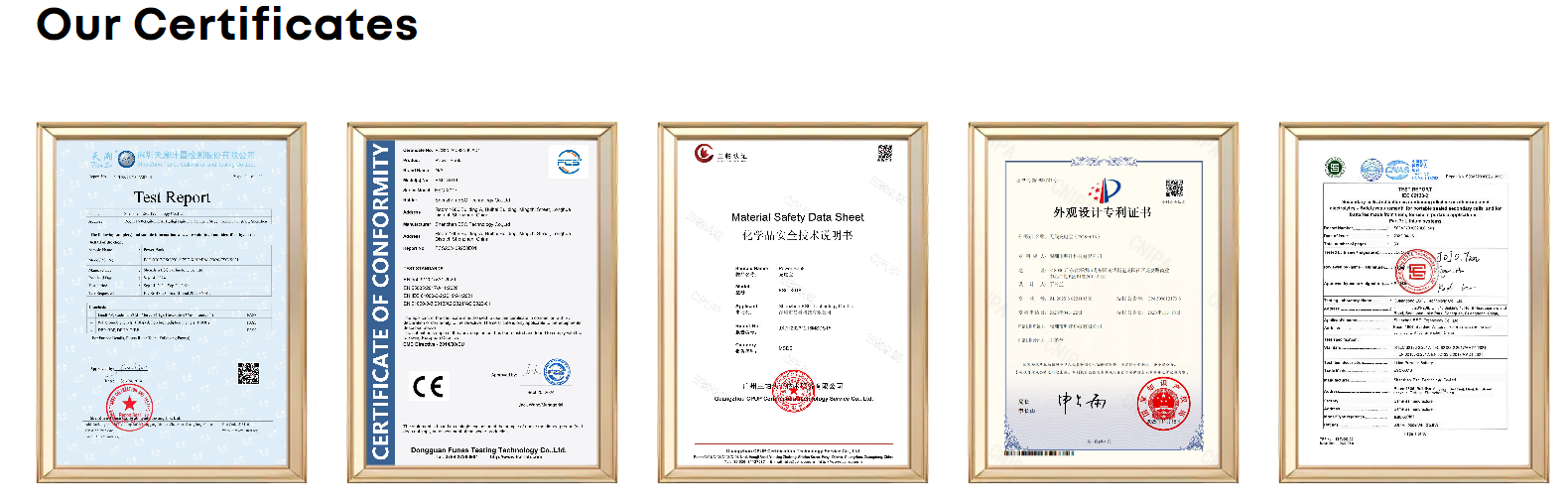
Multi-Country Certification Compliance: Designed according to UL, CE, FCC, RoHS, PSE, KC standards.
True OEMs integrate compliance from the product definition stage, embedding safety distances and creepage parameters into design, ensuring smooth cross-border e-commerce inspections.
Supply Chain Collaboration: Why “Fast Delivery” Is More Than a Slogan
Lead time is life or death in B2B, especially in fast-evolving fast-charging tech. Releasing a product a month earlier can capture a market advantage.
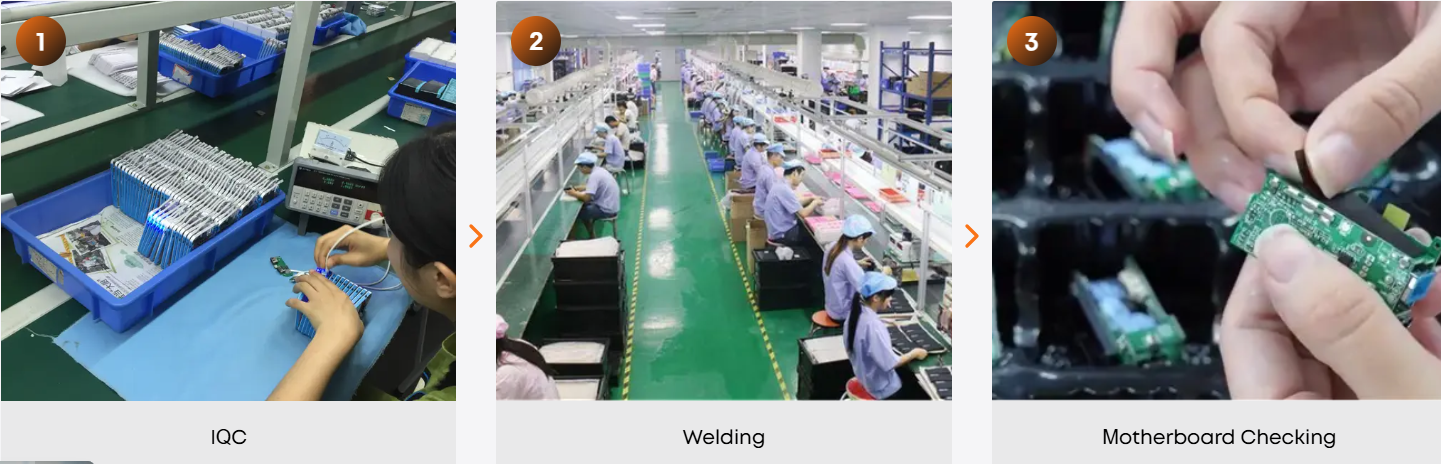
Thanks to Dongguan’s mature electronics ecosystem, AOVOLT achieves vertical integration. Our factory houses assembly lines, injection workshops, and hardware integration workshops.
Efficient Supply Chain Logic:
-
Synchronized R&D: ID design and PCBA development proceed in parallel, minimizing communication delays.
-
Self-Produced Core Components: Molds, enclosures, some hardware produced in-house, eliminating external supply risk.
-
Standardized QC: SOPs ensure uniform quality from the first to the 10,000th unit.
B2B Procurement FAQ
Q1: Can Smart Power Allocation logic be customized to our needs?
A1: Absolutely. We can adjust port priority. For office users, C1 can stay locked above 65W, while other ports share remaining power, or we can implement a more balanced dynamic allocation.
Q2: Why is the 140W PD3.1 solution more expensive than 100W alternatives?
A2: PD3.1 uses Extended Power Range (EPR) technology. MOSFETs, inductors, and transformers must handle over 28V. EMI handling costs are higher. This is not just more power—it’s a generational leap in circuit design.
Q3: Can you provide PCBA output (SKD/CKD)?
A3: Yes. For clients with local assembly capability, AOVOLT provides mature PCBA solutions, including hardware, protocol stack software, and debugging.
Q4: How long does it take to customize a new mold?
A4: From ID confirmation to tooling: 25–35 days. Our in-house mold shop is ~30% faster than the industry average.
Q5: How do you ensure multi-port protocol compatibility, especially for non-standard protocols?
A5: We have full-protocol analyzers and thousands of mainstream devices. Private protocols (FCP/SCP/AFC) are deeply analyzed and tested to ensure 99.9% handshake success in dynamic allocation.
Conclusion: Choose a Technology Partner That Grows With Your Brand
In fast-moving consumer electronics, finding an OEM is easy; finding a strategic partner with vertical manufacturing depth, global compliance knowledge, and technical foresight is rare.
A great Smart Power Allocation Charger OEM is not just a production site—it’s a technology backbone. From ID sketches to PCBA circuit design to final global shipments, every step embodies meticulous attention to power density and safety.
If you are planning a next-gen 140W PD3.1 high-end fast-charging series or upgrading your current line with intelligent capabilities, AOVOLT’s engineering team is ready to provide deep technical support. We don’t just produce chargers—we help build a complete, replicable technology barrier for your brand.
Contact our product experts anytime to discuss your customization needs and let technology drive your business growth.
References: