
Why Power Bank Output Matters More Than Capacity
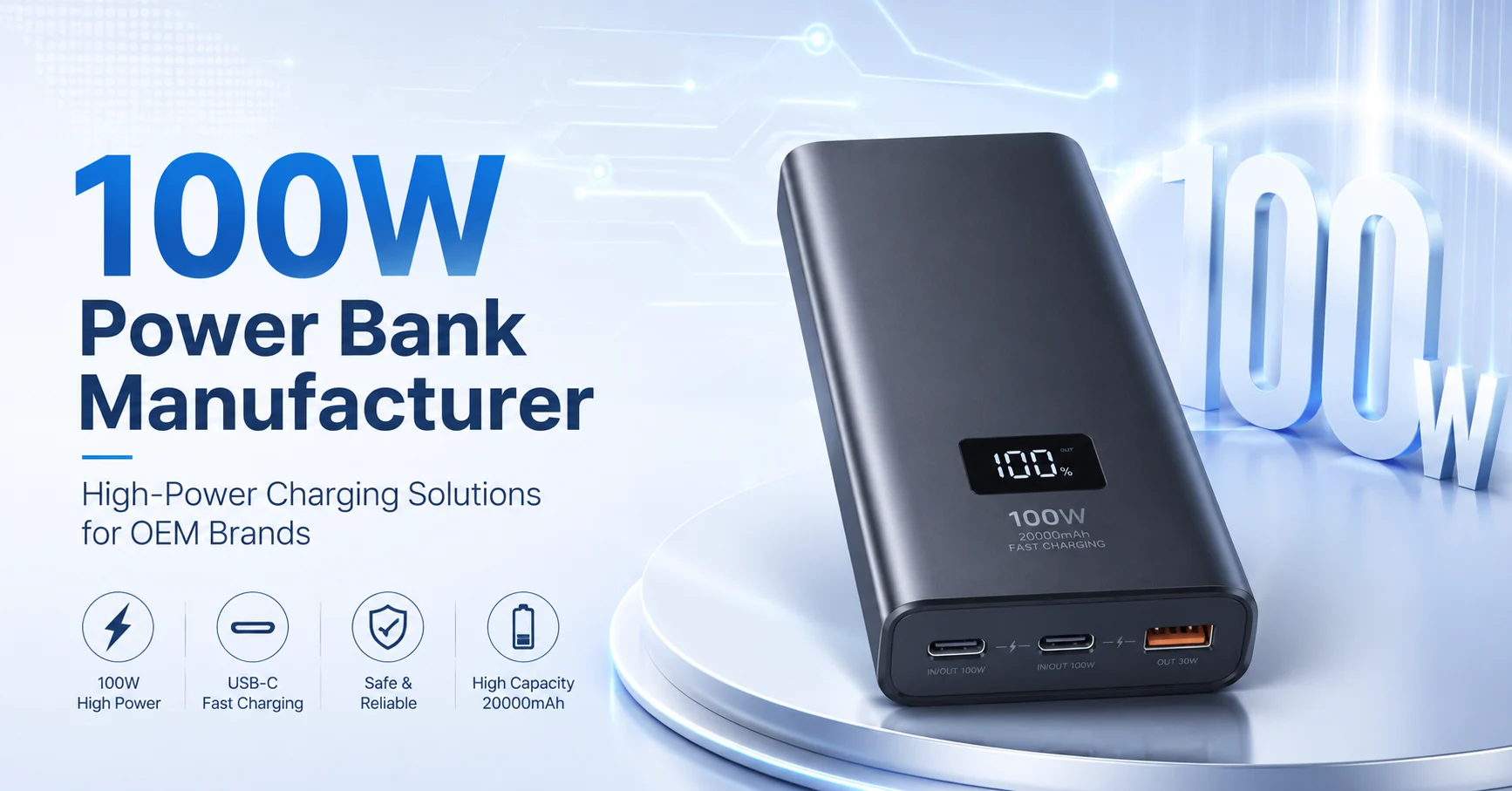
Many users focus on battery size — 10,000mAh or 20,000mAh — but ignore output power, the true measure of how efficiently a power bank charges your phone.
Output, rated in watts (W), is calculated from voltage (V) × current (A). Choosing the wrong output leads to slow charging, overheating, or battery wear over time.
A 20,000mAh power bank with only 10W output may charge slower than a 10,000mAh one delivering 30W PD. Hence, wattage defines performance, not just capacity.
Understanding Voltage and Wattage Basics
Voltage Tiers and Their Functions
-
5V / 2A (10W): Standard USB output for low-power accessories.
-
9V / 2.2A (20W): Typical fast charging for smartphones.
-
12V / 3A (36W): High-speed PD or PPS for foldables and tablets.
-
20V / 3.25A (65W): Laptops and high-end devices.
PD vs. PPS Explained
-
PD (Power Delivery): Dynamic voltage adjustment in 5V, 9V, 12V, 15V, 20V steps.
-
PPS (Programmable Power Supply): Micro-level adjustment (3.3–21V in 0.02V increments), offering greater efficiency and temperature stability — used in Samsung and Huawei flagships.
Power Bank Output for iPhone Devices
Apple devices have specific PD requirements, and exceeding or mismatching wattage leads to inefficiency.
Recommended Power Bank Output for iPhone
| iPhone Model | Ideal Wattage | Charging Protocol | Notes |
|---|---|---|---|
| iPhone 13 / 14 | 18–20W | PD 3.0 | Standard fast charge |
| iPhone 15 / 17 | 25–30W | PD 3.1 | Best for MagSafe and wired |
| iPad Mini / Air | 30–35W | PD 3.1 | For larger battery size |
Apple uses PD (Power Delivery) exclusively, and authentic power banks use E-Marker chips to negotiate the correct voltage curve.
MagSafe-compatible power banks should support 15W wireless output and PD 3.1 wired for simultaneous dual charging.
Tip: Avoid power banks over 40W output if you use smaller iPhones — it won’t damage the phone but wastes power through unnecessary heat.
Power Bank Output for Samsung Devices
Samsung’s latest flagships — S23, S24, and Fold5 — support PPS (Programmable Power Supply) charging, a more flexible system than Apple’s PD.
Recommended Power Bank Output for Samsung
| Device | Ideal Wattage | Protocol | Remarks |
|---|---|---|---|
| Galaxy S21 / S22 | 25W | PD / PPS | Standard fast charge |
| Galaxy S24 / S24+ | 45W | PPS | Super Fast Charging 2.0 |
| Z Fold5 / Flip5 | 45W | PPS | Dual-cell voltage balancing |
Samsung’s PPS protocol continuously adjusts voltage during charging, maintaining a cooler battery temperature (~38°C average).
A PD 3.1-compatible, PPS-enabled power bank from a reputable brand like ESCCharge is the safest and fastest choice.
Example: The ESCCharge 45W PPS Power Bank uses GaN chips and adaptive current control to deliver 95% efficiency even under gaming load.
Power Bank Output for Huawei Devices
Huawei’s SuperCharge system uses its own voltage curve (4.5V/5A, 10V/4A, or 11V/6A), requiring special attention for compatibility.
Recommended Power Bank Output for Huawei
| Model | Ideal Wattage | Protocol | Remarks |
|---|---|---|---|
| Mate 60 / 50 | 40W–45W | PD / SCP | Fast wired charge |
| P70 / Nova 12 | 22.5W | SCP | Standard high-speed mode |
| Mate X5 (Foldable) | 65W | SCP / PD | Heavy multi-tasking usage |
Although Huawei uses proprietary standards, universal PD power banks often still provide 60–70% charging efficiency.
For full speed, ensure your chosen power bank supports both PD and SCP, or opt for a dual-protocol ESCCharge model designed for hybrid compatibility.
How to Match Your Power Bank with the Right Output
Step 1: Identify Your Device’s Peak Input
You can find it on the phone’s original adapter — e.g., “Output: 5V/3A, 9V/2.77A.” Match or slightly exceed this in your power bank.
Step 2: Check for Protocol Support
-
iPhone → PD 3.1
-
Samsung → PD 3.1 + PPS
-
Huawei → PD + SCP
Step 3: Use Certified Cables
Using non-E-Marker cables can cap performance below 15W even with a 45W power bank.
Step 4: Balance Power and Heat
If you often game or stream while charging, a GaN-based power bank is worth the investment — it runs cooler and sustains higher wattage longer.
Common Mistakes to Avoid
-
Buying by capacity alone: 20,000mAh doesn’t mean fast if output is capped at 10W.
-
Mixing old cables with new PD banks: Bottlenecks performance.
-
Ignoring thermal control: Excess heat shortens phone and battery life.
-
Using uncertified PPS chargers on Samsung: May throttle charging speed or cause safety issues.
Buying Guide: Output Recommendations by User Type
| User Type | Recommended Output | Why It Works |
|---|---|---|
| Light Users / Daily Commuters | 20W | Compact, low heat |
| Frequent Travelers | 30–45W | Charges multiple devices |
| Power Gamers / Foldable Users | 65W | Sustained high load charging |
| Business Professionals | Dual-port 45W PD | Laptop + phone support |
Choosing a power bank that fits your lifestyle ensures optimal efficiency without overheating or wasted capacity.
FAQ: Understanding Power Output Compatibility
1. Can I use a 65W power bank for an iPhone?
Yes. PD protocols automatically regulate voltage. The iPhone will only draw 20–30W safely.
2. Why does my power bank feel hot when charging fast?
High-speed output increases internal resistance; look for GaN-based models that reduce heat.
3. What’s the best all-round output for most smartphones?
A 30–45W PD 3.1 power bank suits 90% of modern devices.
4. Do wireless chargers support the same output?
No. Wireless output peaks at 15W due to energy loss through induction.
Final Thoughts: Precision Power for Every Device
Whether you use an iPhone, Samsung, or Huawei, the right power bank output determines charging speed, temperature stability, and long-term battery health.
Rather than chasing capacity, focus on output wattage, PD/PPS compatibility, and smart GaN regulation — the true indicators of power quality.
For brands or distributors seeking OEM power banks optimized for PD 3.1, PPS, and SCP standards, explore ESCCharge’s advanced smart-charging series — engineered for multi-brand performance and global certification.
Visit ESCCharge Official Website to learn more about scalable, high-efficiency charging solutions for every device ecosystem.