
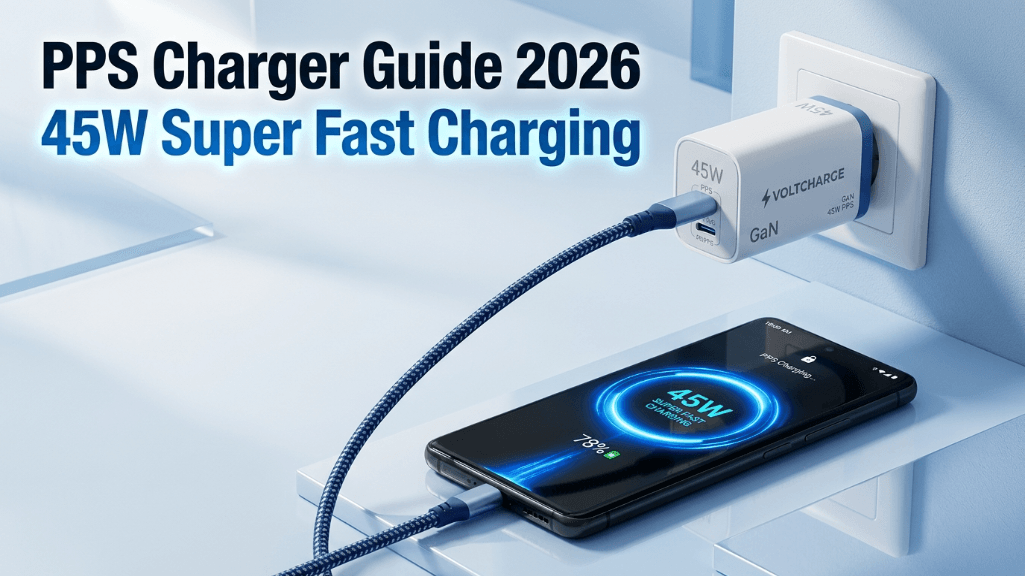
If you are pairing fast chargers with Samsung Galaxy series or Google Pixel devices, a charger without PPS support—no matter how many watts it claims—will only trigger standard 15W PD output on these phones, instead of the expected 45W Super Fast Charging 2.0. This is not an exaggeration; it is a hard limitation of Samsung’s protocol stack.
From a procurement cost perspective, a real PPS-supported 45W GaN charger currently has an FOB Shenzhen wholesale price of about $5.8–$9.5/pcs (MOQ 1000 units), which is around 20%–35% higher than a same-power PD 3.0 charger without PPS. The extra cost translates into: lower end-user complaint rates, reduced return rates on platforms, and elimination of “fast charging failure” complaints on Samsung flagship devices.
In early 2026, Apple launched the iPhone 17 along with a new 40W AVS (Adjustable Voltage Supply) charger, bringing USB PD 3.2 AVS into mainstream consumer awareness and sparking discussions about whether “PPS is becoming obsolete.” The answer is: no. AVS serves the Apple ecosystem, PPS serves the mainstream Android ecosystem. They operate in parallel, with no short-term replacement relationship. Correct understanding of PPS remains a core skill for B2B sourcing in the fast-charging category in 2026.
What is a PPS Charger: Protocol Mechanism Explained
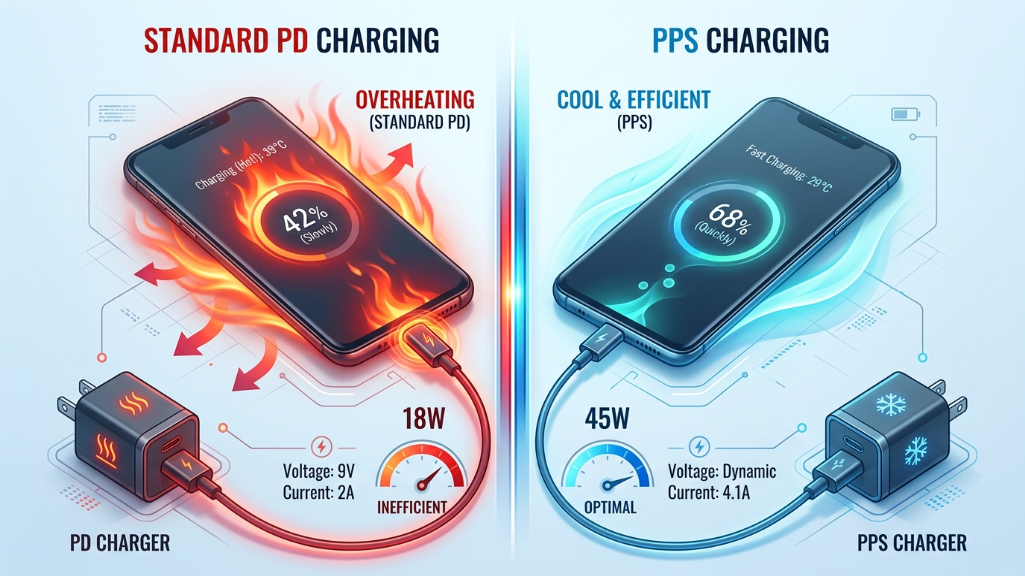
PPS stands for Programmable Power Supply. Despite sounding like industrial equipment, it is actually a sub-protocol formally incorporated into the USB PD 3.0 standard by USB-IF in February 2017. It is not an independent fast-charging standard, but an extension module of PD 3.0.
A standard PD 3.0 charger outputs fixed voltage levels: 5V, 9V, 12V, 15V, and 20V. The device selects the closest voltage level and then uses an internal buck-boost converter to step it down to the battery’s required voltage. The issue is that about 10%–15% of energy is lost as heat inside the phone during this conversion process.
PPS eliminates this heat-generation pathway at the source.
The charger communicates via the CC pin (Channel Configuration Pin) and broadcasts an APDO (Adjustable Power Data Object). The device requests precise voltage values within the APDO range. Voltage adjustment precision is 20mV steps, and current adjustment is 50mA steps, with renegotiation every 10 seconds. This means a PPS-supported Samsung Galaxy S24 continuously adjusts charging voltage throughout the process. The phone’s internal charge pump receives power directly, bypassing most conversion losses. The result: faster charging, lower temperature, and improved battery lifespan.
A key technical requirement often overlooked is firmware-level APDO handshake implementation. This is where many “fake PPS” products fail. The hardware may use a PD 3.0 controller chip and claim “PPS supported,” but the firmware does not implement APDO logic. When connected to a Samsung device, it falls back to fixed PDO output, and the phone only shows “Fast Charging” instead of “Super Fast Charging.”
PPS vs PD vs QC 3.0 vs AFC: Full Protocol Comparison for B2B Selection
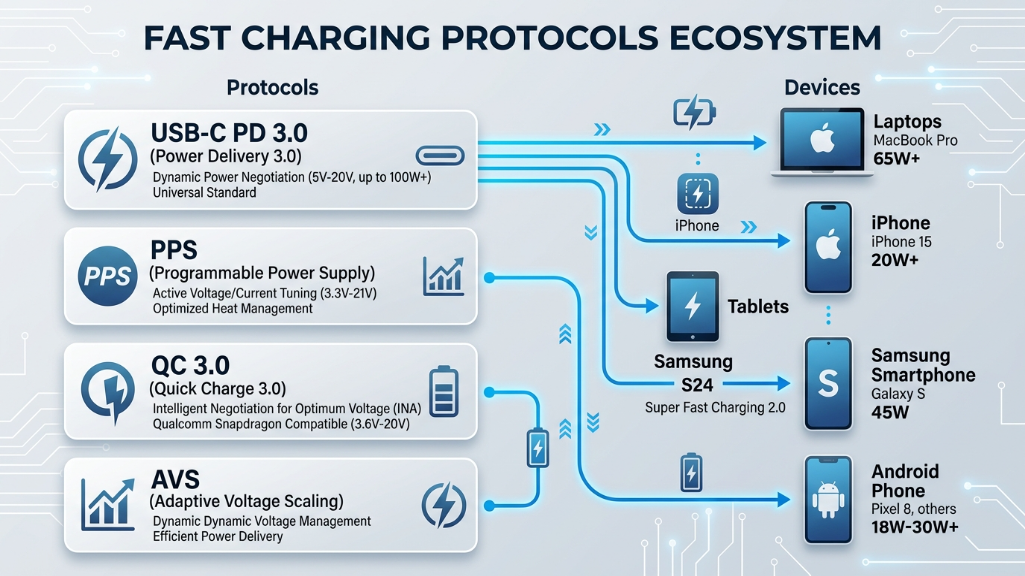
The protocol landscape in the fast-charging market is far more fragmented than expected. Even if two chargers are both labeled “65W,” a fixed-PDO PD 3.0 charger and a true PPS implementation can differ by up to 30W actual output on Samsung flagship devices. Let me show you what the power limit of PD3.0 is? 100W truth that every buyer must know.
Table 1: Mainstream Fast Charging Protocol Comparison (B2B Selection View)
| Protocol | Standard Type | Voltage Regulation | Max Power | Licensing Fee | Ecosystem Coverage |
|---|---|---|---|---|---|
| PD 3.0 (Fixed PDO) | USB-IF Open Standard | Fixed 5-step | 100W | None | Apple / Dell / Nintendo Switch |
| PD 3.0 PPS (APDO) | USB-IF Open Standard | Dynamic 20mV steps | 100W | None | Samsung / Google Pixel / 일부 gaming laptops |
| PD 3.1 EPR | USB-IF Open Standard | Dynamic + extended voltage | 240W | None | High-power laptops / professional displays |
| QC 3.0 | Qualcomm Proprietary | 200mV steps | ~18W | Required | Snapdragon Android devices |
| Huawei AFC/SCP | Huawei Proprietary | Fixed steps | 40W–66W | Required | Huawei / Honor |
| Apple AVS (PD 3.2) | USB-IF Open Standard | 100mV steps | 60W peak | None | iPhone 17 and later |
Two key insights for B2B buyers:
First, PPS vs QC 3.0: QC 3.0 is proprietary and requires Qualcomm licensing fees. It uses 200mV steps with lower precision compared to PPS’s 20mV. PPS is an open USB-IF standard with no licensing cost. This means QC 3.0 increases BOM cost, while PPS is purely firmware cost.
Second, Apple AVS (2026 variable): Apple’s 40W AVS (PD 3.2) uses 100mV steps, less precise than PPS, but optimized for Apple devices. AVS and PPS are not conflicting. A GaN charger can implement PPS + PD 3.0 + AVS simultaneously, covering Samsung, Pixel, and iPhone ecosystems. This is the most valuable protocol combination for 2026 sourcing.
PPS Pitfalls in the Samsung Ecosystem: Not All 45W Is Real 45W
This is a major but often overlooked cause of high return rates in procurement.
Samsung defines two PPS-based charging tiers:
- Super Fast Charging (SFC 1.0) = 25W PPS
- APDO range: 3.3V–11V
- Max current: 3A
- Super Fast Charging 2.0 (SFC 2.0) = 45W PPS
- APDO range: 3.3V–11V
- Max current: 4.5A
- Requires 5A-rated cable support
The critical issue: if a charger’s APDO only supports up to 3A current, it will only achieve 25W SFC 1.0 on devices like the Samsung Galaxy S24 Ultra—even if the charger is rated at 45W or 65W total output.
Therefore, when you see “45W PPS” in a spec sheet, you must verify whether the APDO list includes:
[3.3V–11V, 0–4500mA]
Only then can it truly support Samsung flagship fast charging.
Table 2: Samsung Super Fast Charging Trigger Conditions
| Charging Level | Display Name | Power | PPS APDO Requirement | Cable Requirement | Example Models |
|---|---|---|---|---|---|
| Standard Fast Charging | Fast Charging | 15W (Fixed PD 9V/1.67A) | No PPS required | Standard USB-C | Galaxy A series low-end |
| Super Fast Charging | SFC 1.0 | 25W PPS | Max 3A APDO | 3A USB-C cable | Galaxy S22 / A54 / A55 |
| Super Fast Charging 2.0 | SFC 2.0 | 45W PPS | Max 4.5A APDO | 5A USB-C cable (required) | Galaxy S23 / S24 / S25 Ultra |
Procurement value insight: when sourcing for Samsung Galaxy S series, always request Protocol Analyzer capture screenshots from suppliers. The APDO entry must show a 4500mA limit; otherwise, you are effectively buying a “crippled 45W charger” for Samsung flagships.
How to Identify Real PPS Suppliers: A Practical Factory Audit Standard
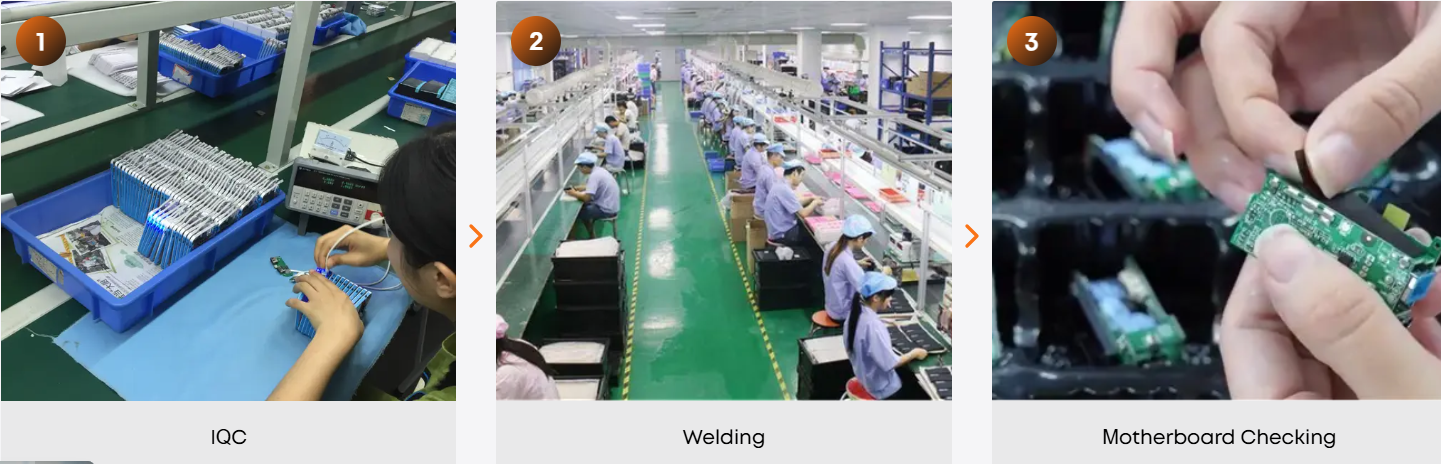
After understanding Samsung’s protocol constraints, the next question is: how do you filter real PPS-capable factories instead of suppliers who simply write “PPS supported” on a spec sheet?
Below is a validated four-step verification system.
Step 1: Check APDO Parameter Completeness
A real PPS spec sheet must clearly show voltage range and current limits, e.g.:
- PPS: 3.3V–11V, 0–3000mA
- PPS: 3.3V–11V, 0–4500mA
If it only says “PPS: Yes” or “Supports PPS fast charging” without parameters, it should be treated as unverified.
Step 2: Request Protocol Analyzer Capture
This is the only reliable proof of PPS firmware implementation. A legitimate factory uses USB Power Delivery analyzers to capture PDO/APDO negotiation logs. Verify APDO existence and consistency with spec sheet.
Step 3: Real Device Charging Proof
Request screenshots of Samsung Galaxy S23 or S24 charging status showing:
- “Super Fast Charging”
or - “Super Fast Charging 2.0”
If it only shows “Fast Charging,” it fails validation.
Step 4: PPS Stability in Aging Test Reports
PPS requires frequent renegotiation every 10 seconds, making firmware stability critical. Request an 8-hour PPS dynamic load aging test report. Voltage ripple must be within ±50mV under full load.
These four steps eliminate over 80% of fake PPS products. Factories that can provide all four documents usually have in-house firmware R&D capability.
PPS Charger B2B Product Matrix: SKU Strategy by Channel
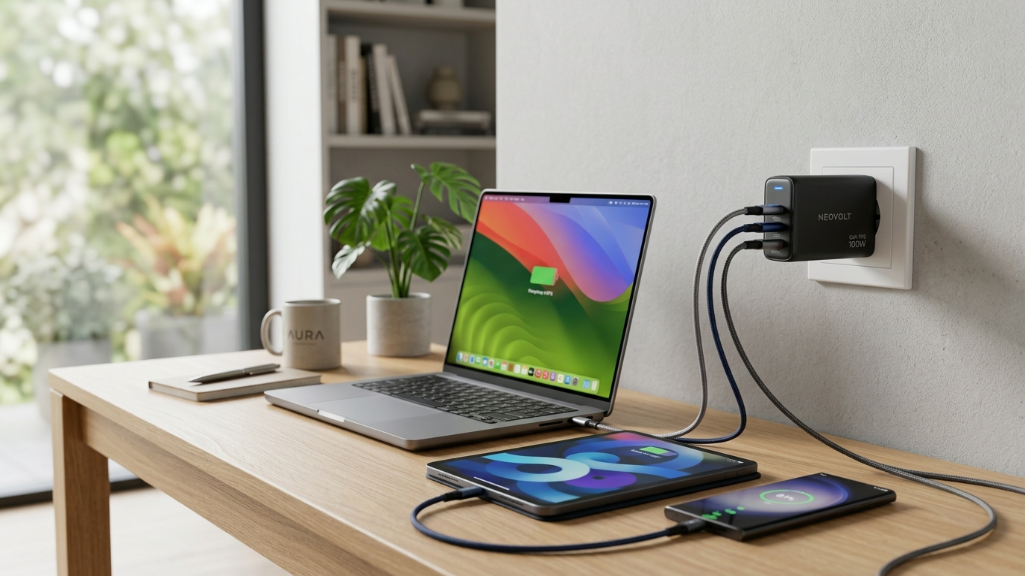
PPS chargers are not a one-SKU-fits-all category. Different channels require different optimal combinations.
Table 3: PPS Charger B2B Channel Strategy (2026 Version)
| Channel | Recommended Power | Protocol Combo | Cable Requirement | FOB Price Range | Key Risk |
|---|---|---|---|---|---|
| Amazon Samsung bundles | 45W | PPS (4.5A) + PD 3.0 + AFC | 5A cable required | $6–$9 | Return due to insufficient APDO |
| EU/US general 3C distribution | 65W | PPS + PD 3.0 + QC 3.0 + Apple 2.4A | 3A cable OK | $8–$13 | Certification gaps (CE/FCC) |
| Southeast Asia / Middle East | 25W–45W | PPS + AFC + FCP | Standard | $4.5–$7 | Low-cost competition |
| Enterprise IT procurement | 65W–100W | PPS + PD 3.0 + QC 3.0 | 1m braided cable | $11–$18 | Compatibility complaints |
| Private label / DTC | 45W–140W | Full protocol (AVS-ready) | Custom kit | $9–$22 | Mold & certification lead time |
A key number here is 140W. Achieving full compatibility across PPS, PD 3.0, QC 3.0, FCP, SCP, AFC, Apple 2.4A, and BC1.2 at 140W output requires advanced firmware arbitration logic and serious thermal management engineering for GaN components.
AOVOLT is one of the Dongguan-based factories capable of delivering this level of integration. With 15 years in consumer electronics manufacturing, its chargers support up to 140W output and cover PD 3.0, PPS, QC 3.0, FCP, SCP, AFC, Apple 2.4A, and BC1.2 protocols. One SKU can optimize charging across Samsung Galaxy S25 Ultra, Google Pixel 9 Pro, iPhone 16, Huawei Mate series, and Lenovo ThinkPad devices.
Its advantage is not only protocol breadth but also vertical integration: product design, R&D, mold opening, injection molding, and metal integration are all handled in-house. This reduces mold iteration cycles by nearly half compared to outsourced suppliers and allows faster firmware adjustments for APDO tuning—critical for Amazon sellers and DTC brands competing in fast-charging markets.
FAQ: 5 Key Questions Before Buying PPS Chargers
Q1: Spec says “PPS supported,” but supplier cannot provide protocol analyzer logs. Can I buy?
Not recommended. Protocol analyzer logs are the only objective proof. Without them, PPS support may be only a spec-sheet claim. Minimum acceptable proof is Samsung real-device charging showing “Super Fast Charging.”
Q2: Can one charger optimize both Samsung and iPhone fast charging?
Yes, if protocol combination is correct:
- Samsung: PPS (45W APDO 4.5A)
- iPhone 15/16: PD 3.0 (up to 27W)
- iPhone 17: AVS (PD 3.2)
A 65W charger with PPS + PD 3.0 + AVS is the optimal 2026 solution.
Q3: Is there a difference between 25W and 45W PPS on Galaxy A series?
Yes, but not in output power. Galaxy A series caps at 25W, so both chargers output 25W. The difference is multi-device flexibility and power headroom.
Q4: Do PPS chargers require extra cable certification?
Yes. 45W SFC 2.0 requires a 5A USB-C cable with E-Marker chip certification. Cable may require separate UL/CE testing if bundled.
Q5: Will PPS and QC 3.0 conflict when used together?
Yes, if firmware arbitration is poorly designed. Improper implementation can cause protocol misidentification and power drop. Request dual-protocol stress test reports and firmware version documentation.
Conclusion
PPS itself is not technically complex, but turning it into a globally compliant B2B product requires firmware engineering capability, deep protocol integration, certification readiness, and supply chain responsiveness—all at the same time.
If you are planning a product line for Samsung Galaxy, Google Pixel, or future iPhone AVS ecosystems, the real question is not “Do you support PPS?”, but:
“Show me your APDO capture logs and Samsung real-device charging screenshots.”
These two documents reveal more about a factory’s true capability than any spec sheet ever could.
For B2B buyers managing multi-brand compatibility, private label customization, and end-to-end sourcing needs, a vertically integrated factory with in-house mold and firmware capability is worth serious consideration in your supplier shortlist.
References:
USB Implementers Forum (USB-IF) – USB Power Delivery Specification Revision 3.0 / 3.1
International Electrotechnical Commission (IEC) – IEC 62680-1-2:2021 (USB Power Delivery)