
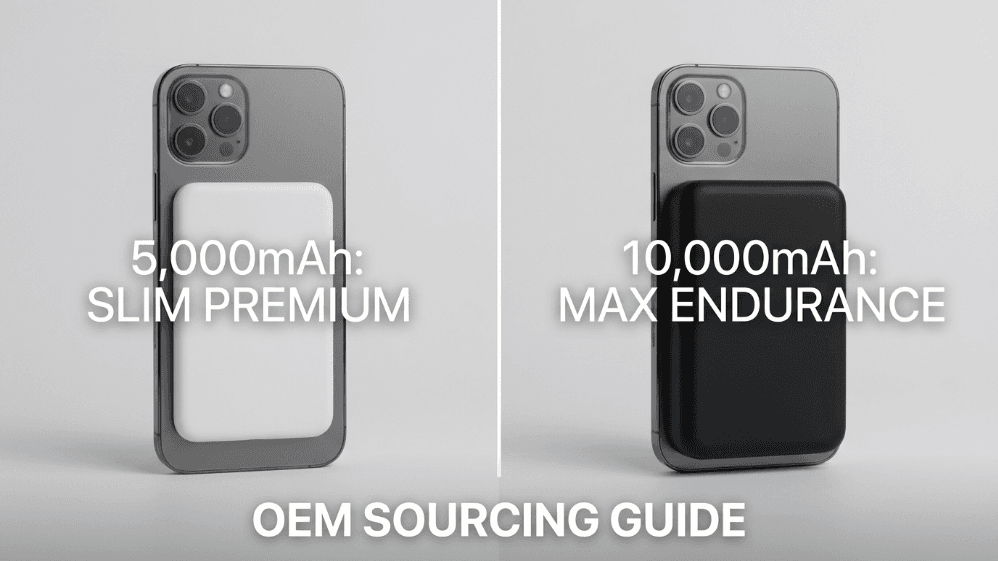
The conclusion first: If you are planning a capacity strategy for your private label magnetic power banks, 5,000mAh for a slim premium line and 10,000mAh as the volume-driving main SKU is the optimal solution verified by the 2026 market. OEM bulk price reference ranges: Qi2-certified 5K magnetic power banks at $12–$18/unit (MOQ 500pcs), and 10K Qi2.2 solutions at $22–$35/unit. As for Apple's official 1,460mAh MagSafe Battery Pack—discontinued in September 2023—it left behind not a regret, but a market vacuum.
This vacuum is being rapidly filled by third-party brands. The competitive focus in 2026 has shifted from "can it attach magnetically" to "can it deliver a stable 25W output under the Qi2.2 standard while maintaining a surface temperature below 39°C." Your product definition window is narrower than you think.
The Truth Behind Apple MagSafe Battery Pack Capacity: Why Official Data is Misleading
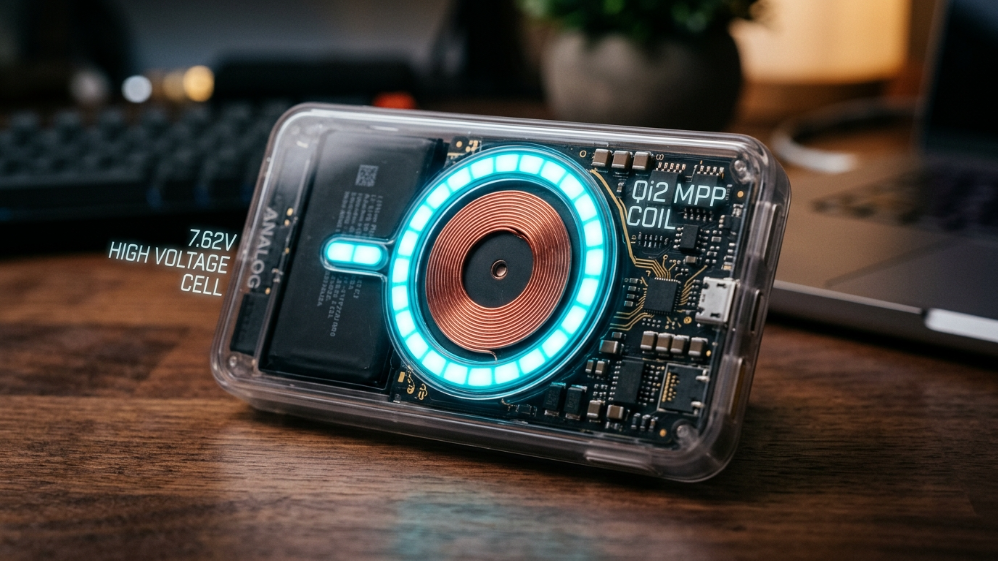
The Double-Voltage Logic Behind 1,460mAh
Apple never proactively explained this figure. It wasn't until regulatory labels were exposed that the outside world discovered the MagSafe Battery Pack’s actual operating voltage is 7.62V—nearly double the 3.81V of an iPhone's internal battery. This means comparing mAh alone is essentially comparing numbers in two different dimensions.
The metric that truly matters is Watt-hours (Wh): $1,460\text{mAh} \times 7.62\text{V} \div 1,000 = 11.13\text{Wh}$. In comparison, Anker MagGo 622’s 5,000mAh solution corresponds to 18.5Wh; the gap shrinks from a superficial "3.4x" to an actual "1.66x." Furthermore, accounting for the approximately 30% efficiency loss in MagSafe wireless transmission, the effective charge Apple's battery can actually transfer to an iPhone is roughly 2,000mAh. This perfectly explains why it charges an iPhone 13 Pro to about 53%, aligning closely with calculated expectations.
Efficiency loss is a variable every OEM buyer must face. In the Qi1 era, wireless transmission loss was as high as 40%–50%. Qi2 improved coil efficiency through precise magnetic alignment, compressing loss to about 30%. The Qi2.2 standard (25W), finalized in July 2025, combined with more advanced thermal management architectures, has pushed actual transmission efficiency even higher. This isn't just about charging speed—lower loss means the same nominal battery capacity provides more effective power to the user, directly impacting your product's reputation and repurchase rate.
Table 1: Multi-Dimensional Comparison of Mainstream MagSafe Power Bank Capacities (2025–2026 OEM Selection Reference)
| Product Tier | Nominal Capacity | Voltage | Wh | Wireless Protocol | Max Wireless Output | Actual iPhone Charge % | Typical Thickness | OEM Target Channel |
| Apple Original (Discontinued) | 1,460mAh | 7.62V | 11.13Wh | MagSafe | 7.5W | ~60% (iPhone 13) | 11.3mm | Reference Baseline |
| Apple Air Version A3466 | 3,149mAh | 3.89V | 12.26Wh | MagSafe | 12W / 20W (Wired) | ~65% (iPhone Air) | 7.7mm | Air Compatible Only |
| 3rd Party 5K Qi2 | 5,000mAh | 3.7V | 18.5Wh | Qi2 | 15W | ~85% (iPhone 16) | 8–10mm | Gifts / Boutique E-commerce |
| 3rd Party 10K Qi2 | 10,000mAh | 3.7V | 37Wh | Qi2 | 15W | ~177% (1.7 Charges) | 13–15mm | Business Travel / Corporate |
| Flagship 10K Qi2.2 | 10,000mAh | 3.7V | 37Wh | Qi2.2 | 25W | ~177% (Faster Speed) | 15–16mm | Premium OEM Focus |
This table conveys a key message: transitioning from Qi2 to Qi2.2 keeps the capacity digits the same but increases charging speed by 67%. The leap in perceived user value far exceeds the increase in BOM cost. This is the core business logic for OEM brands switching protocol versions in 2026.
What Signals are Released by Apple Developing a Standalone MagSafe Battery for the iPhone Air?
In September 2025, Apple released a dedicated MagSafe Battery (Model A3466) alongside the iPhone Air, priced at $99. Several parameters of this product are worth dissecting: a built-in 3,149mAh lithium battery (identical to the iPhone Air’s internal capacity), support for USB-C input (9V/3A), wireless output of approximately 6.84W, and an additional 65% battery life.
More importantly, its magnet layout—Apple intentionally designed the magnet array closer to the center to accommodate the iPhone Air's extremely high camera bump—makes this battery physically incompatible with all other iPhone models. It’s not that Apple lacks the technology for a universal solution; they chose not to make one.
The significance of this decision for third-party brands is clear: a universal MagSafe magnetic power bank for the entire range from iPhone 12 to iPhone 17 Pro Max is a market Apple has actively ceded. No official channel is doing this, yet the user base numbers in the hundreds of millions.
Wireless Charging Efficiency Loss: The Capacity Discount Every OEM Product Definition Must Face
35%–45% Capacity Evaporation: Full-Link Loss from Cell to Device
The product page for the Baseus Picogo AM52 contains a rare honest statement: due to battery cell and circuit efficiency losses, a 10,000mAh Qi2.2 magnetic power bank delivers an actual effective charge of approximately 5,500–6,500mAh to the device. This 35%–45% loss comes from three stages: DC conversion loss from the cell discharge to the coil, wireless inductive transmission loss, and charging loss from the device-side receiving coil to the internal battery.
Table 2: Quantitative Impact of Qi Protocol Evolution on Effective Capacity and User Experience
| Protocol Standard | Finalized Date | Max Wireless Output | Magnetic Alignment | Typical Efficiency | 10K Effective Capacity | Representative Products (2025–2026) |
| Qi 1.x | 2008–2020 | 7.5W (iPhone) | No Magnets / Manual | ~50%–60% | ~5,000–6,000mAh | Obsolete |
| MagSafe (Apple) | 2020 | 15W (Wired Asst) | Apple Magnet Array | ~70% | — | Apple Discontinued |
| Qi2 (15W) | Early 2023 | 15W | MPP Precision Alignment | ~68%–72% | ~6,800–7,200mAh | Anker MagGo, Belkin |
| Qi2.2 (25W) | July 2025 | 25W | Enhanced MPP + NTC | ~72%–76% | ~7,200–7,600mAh | Baseus AM52, KUXIU S3 |
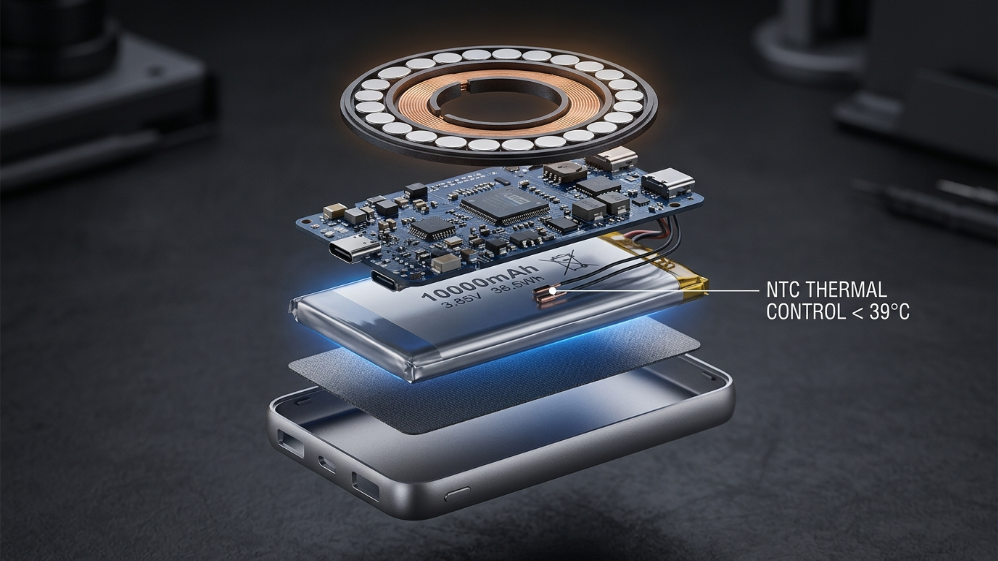
The core breakthrough of Qi2.2 isn't just the power figure; it's the ability to keep heat loss under control even at higher wattages. The Baseus AM52 uses a three-layer cooling architecture—graphene thermal layer + aluminum alloy heat sink + NTC real-time temperature monitoring—maintaining a surface temperature below 39°C at full 25W load, which is 9°C lower than the industry limit of 48°C. In B2B procurement, the gap in thermal control translates directly into differences in return rates and customer complaints.
MagSafe Power Bank Certification Systems: The Most Common Compliance Landmines in B2B Procurement
MagSafe Compatible, Qi2 Certified, MFi Certified—Three Labels, Three Legal Meanings
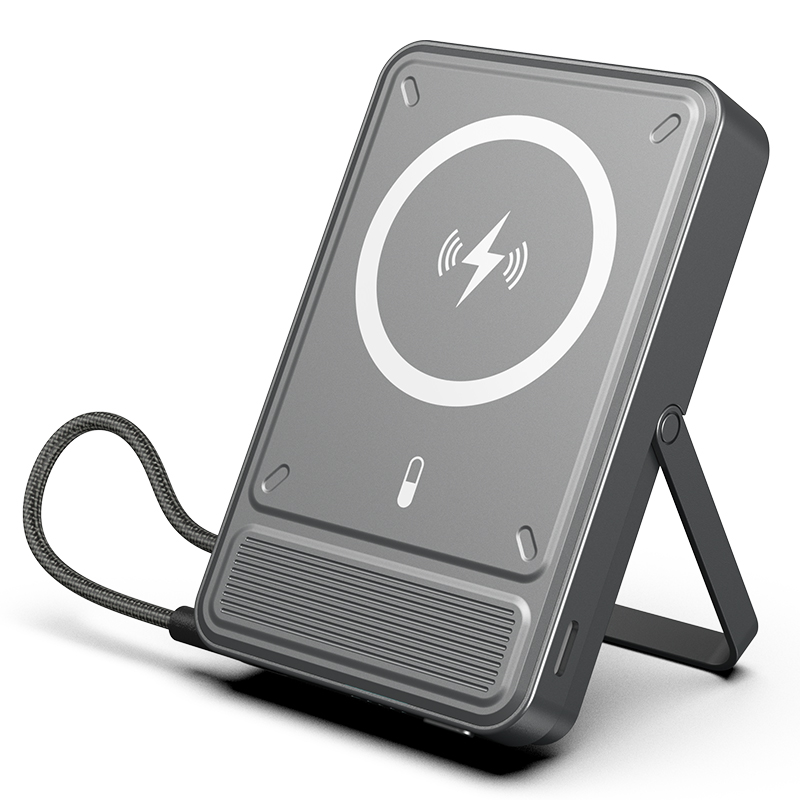
The market is flooded with magnetic power banks labeled "MagSafe Compatible," but these words themselves represent no certification endorsement. It is merely a marketing description meaning the product uses a physical structure matching MagSafe magnet specifications and can adhere to the back of an iPhone—nothing more.
What truly determines market access and user experience quality is the overlapping coverage of the following three certification levels:
Table 3: MagSafe Ecosystem Certification Levels and B2B Procurement Decision Matrix
| Certification | Authority | Core Guarantee | Direct B2B Consequence if Missing | 2026 Priority |
| Qi2 Certification | WPC | 15W output & cross-brand interoperability | Output may drop to 7.5W; high negative review rates | ⭐⭐⭐⭐⭐ |
| Qi2.2 Certification | WPC | 25W output + MPP precision alignment | iPhone 16/17 cannot trigger max speed charging | ⭐⭐⭐⭐⭐ |
| MFi Certification | Apple | Native iOS battery percentage display | Users cannot see remaining battery on lock screen | ⭐⭐⭐⭐ |
| FCC | USA | RF compliance for US market | Amazon US removal; customs rejection | ⭐⭐⭐⭐⭐ |
| CE (incl. RED) | EU | Electrical safety & wireless compliance | Border seizure; forced recall; brand bans | ⭐⭐⭐⭐⭐ |
| UN38.3 | Global | Lithium battery air transport qualification | Goods restricted to ground/sea; doubled logistics costs | ⭐⭐⭐⭐⭐ |
| UL / TÜV | 3rd Party | Thermal safety & overcharge protection | Failure of corporate procurement qualification audits | ⭐⭐⭐⭐ |
UN38.3 is a certification frequently underestimated by many small and medium OEM buyers. Lithium batteries are classified as dangerous goods, and international air transport has strict testing and packaging requirements for them. Without a UN38.3 report, your cargo can only travel by sea on most routes—which, in a cross-border e-commerce replenishment scenario, means 30–45 days of extra lead time and a missed sales window. Providing you with wireless power bank wholesale prices: 2026 B2B Buyer’s Guide.
B2B Capacity Selection Framework: Reverse Engineering Specifications from Channel Scenarios
Capacity is not "the bigger the better." This is common sense in consumer scenarios, yet often ignored in B2B product definitions. Choosing the wrong capacity tier means either selling a heavy 10K power bank in a gift channel (users find it too heavy, low repurchase rate) or pushing a 5K slim sheet in a corporate distribution channel (employees on a one-day business trip run out of power, causing IT complaints).
-
The business logic of 5,000mAh is thinness and visual premium. A thickness of 8–10mm allows it to be stacked with a phone and slipped into a pocket, a scenario critical for business gifts and boutique e-commerce. From an OEM design perspective, the 5K solution leaves more room for aesthetic innovation—slimmer shells allow for finer curved craftsmanship and high-end material choices (aramid fiber, anodized aluminum), which are the physical carriers of brand premium.
-
The business logic of 10,000mAh is absolute endurance. A 10K magnetic power bank under the Qi2 protocol can charge an iPhone 16 Pro to approximately 177%, making a two-day business trip without relying on hotel outlets a reality. This matches B2B scenarios such as corporate IT procurement, airline business travel kits, and high-end hotel room amenities. Procurement decision-makers look for device uptime coverage, not product thickness.
At this intersection of product definition and manufacturing capability, AOVOLT provides an option worth deep investigation. This B2B source factory located in Dongguan has focused on consumer electronics manufacturing for 15 years, with core product lines covering power banks, magnetic power banks, and fast chargers. Unlike many suppliers who rely on external subcontracting, AOVOLT has built a vertically integrated production line—from industrial design, R&D, and mold making to injection molding and hardware integration. The coil precision of magnetic modules, the injection molding tolerances of shell curves, and the assembly consistency of magnet arrays are all controlled within their own factory.
Technically, AOVOLT's fast charging solutions support up to 140W output, with protocols covering PD 3.0, PPS, QC 3.0, FCP, SCP, AFC, Apple 2.4A, and BC 1.2. This full-protocol compatibility means the same charging IC can perform the optimal "handshake" with almost all mainstream devices on the market—for OEM brand owners, this directly reduces the density of after-sales complaints due to protocol incompatibility. What is harder to replicate is AOVOLT's accumulation in industrial design. Owning a mold workshop means a true ODM path starting from structural engineering drawings, rather than just swapping a logo on a standard shell. In a market where magnetic power banks are evolving from functional items to design items, the strategic value of aesthetic differentiation is rising rapidly.
FAQ: 5 Substantive Questions Most Searched by B2B Buyers
Q1: How much charge can the Apple MagSafe Battery Pack 1,460mAh give an iPhone? Is it enough for a day?
The actual effective charge is approximately 2,000mAh (equivalent capacity after 7.62V double-voltage conversion, minus ~30% wireless transmission loss). For an iPhone 13 Pro (3,095mAh internal battery), it charges to about 53%–60%. For light users, combined with the phone's remaining power, it can last a day; for heavy users, a third-party 5K or 10K Qi2 solution is recommended. Apple has discontinued this product, and the effective capacity of current market mainstream alternatives is generally 2–4 times higher.
Q2: What is the substantive difference between Qi2 and Qi2.2 magnetic power banks? Which should OEMs bet on?
Qi2 supports up to 15W wireless output. Qi2.2, finalized in July 2025, pushes the limit to 25W and strengthens MPP magnetic alignment precision and thermal management standards. Currently, only the iPhone 16/17 series and Pixel 10 Pro XL support 25W. As it becomes popularized with the iPhone 18, 25W will become the market benchmark in 2026–2027. Advice for OEM buyers: lock in the Qi2.2 solution supply chain now to avoid inventory passivity caused by forced generational updates 12–18 months later.
Q3: How long does it take to OEM a Qi2-certified magnetic power bank from mold to mass production? What is the MOQ?
Standard process: Design confirmation (1–2 weeks) → Structural mold making (3–4 weeks) → Qi2 certification testing (4–6 weeks) → Parallel FCC/CE certification (3–5 weeks, can overlap with molding) → Mass production (3–4 weeks). Factories with internal mold shops can compress the total cycle to 12–14 weeks. MOQ for Qi2 5K solutions usually starts from 500pcs, while 10K Qi2.2 flagship solutions may require 1,000pcs due to higher certification costs.
Q4: What is the difference between N52 magnets and ordinary magnets in magnetic power banks? How does it affect quality?
N52 is the highest performance grade for NdFeB permanent magnets, with a magnetic energy product (BHmax) of approximately 52 MGOe, much higher than N35/N38. In magnetic power banks, the quantity (8 vs 16) and grade of magnets jointly determine attachment stability and coil alignment. The MPP standard requires a precision tolerance within ±0.5mm; a 16-magnet N52 array is necessary to meet this consistently in daily use. Products using lower-grade magnets suffer from charging interruptions caused by slight shifts, which is one of the highest-frequency user complaints.
Q5: Is UN38.3 certification mandatory for wireless power banks? What happens without it?
For any lithium battery product requiring cross-border transport via air, UN38.3 is a de facto mandatory threshold, not an option. Without a UN38.3 test report, cargo will be rejected or seized on most international air freight routes and must be diverted to sea. Sea freight cycles are typically 25–40 days longer than air; for cross-border e-commerce sellers relying on rapid replenishment, this significantly increases the risk of stockouts during peak seasons. It is recommended to request the UN38.3 report from the supplier at the initial sample order stage rather than discovering its absence just before the first shipment.
Conclusion: Building Real Product Barriers in the Market Ceded by Apple
Apple defined the direction of this market with two moves: discontinuing the universal MagSafe Battery Pack and then making a dedicated battery for the thinnest iPhone alone. This is not an exit, but a contraction—leaving the volume market to third parties while serving only the most niche scenarios themselves.
This ceding is becoming a window of opportunity. The Qi2.2 standard has just been finalized, the user base of 25W-capable iPhones is still expanding, and consumer brand awareness of "25W magnetic charging" has not yet solidified. Launching products, accumulating review weight, and establishing channel relationships during this cognitive vacuum is a more cost-effective market move than ever.
But product strength is the prerequisite. A magnetic power bank that compromises on mold precision will have its magnet alignment deviations magnified in high-power Qi2.2 scenarios—the requirement for coil alignment tolerance at 25W is much stricter than at 15W. This is precisely why vertically integrated manufacturing capabilities have more decisive value in this category than in general charging products.
If you are planning an OEM partnership for magnetic power banks in the 2026 fiscal year, it is worth putting design capability, certification paths, and manufacturing verticality on the negotiation table together. A deep technical dialogue with a factory like AOVOLT, which intervenes starting at the mold level, will better predict your product's final market position than simple price comparisons.
References:
UN38.3 Lithium Battery Testing Requirements
Federal Communications Commission (FCC) - Equipment Authorization for Wireless Chargers