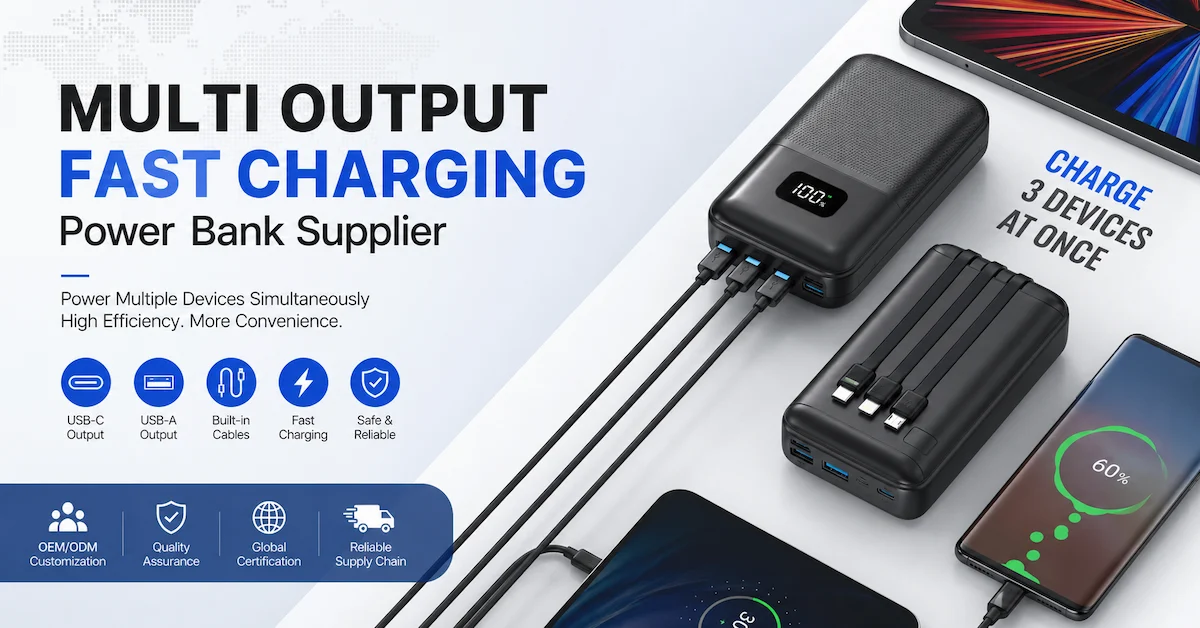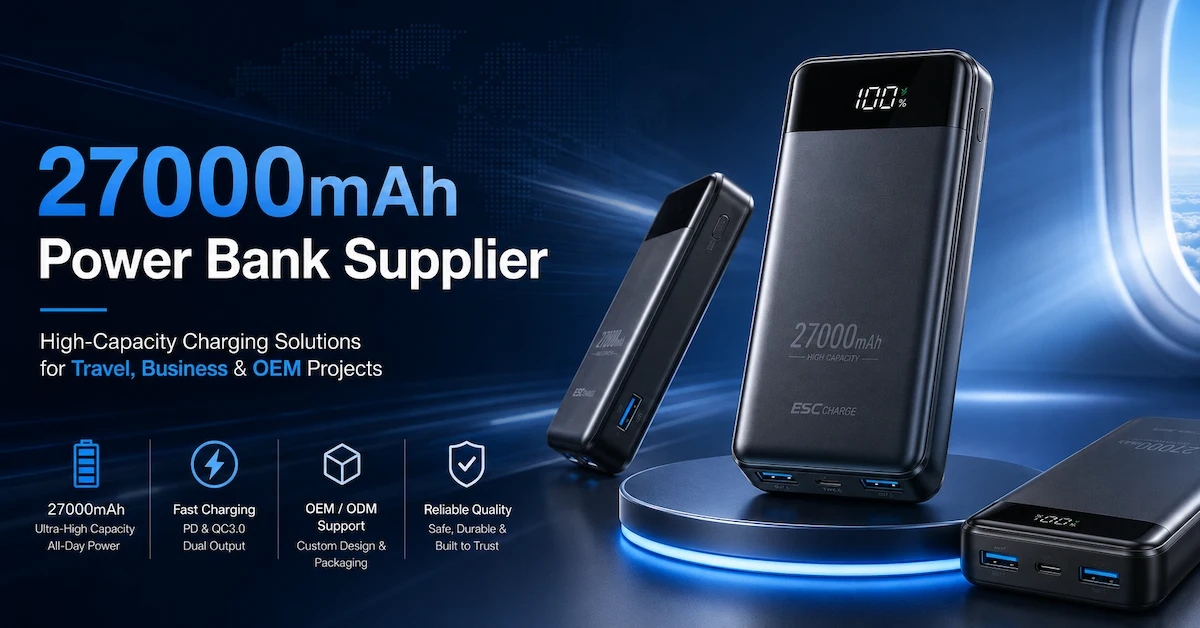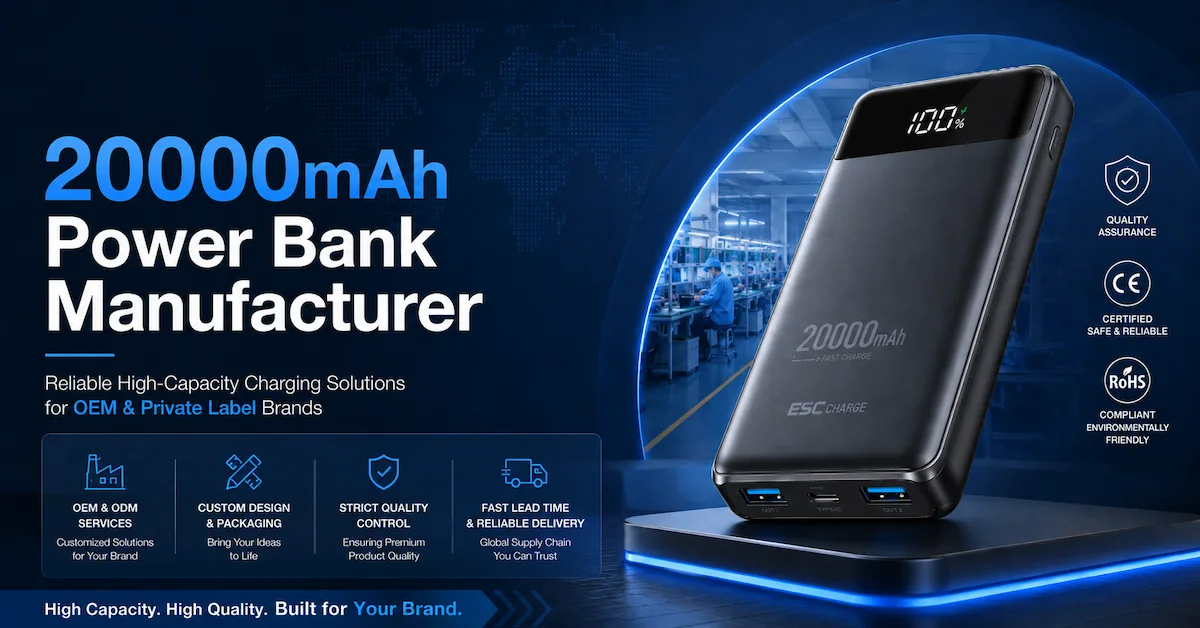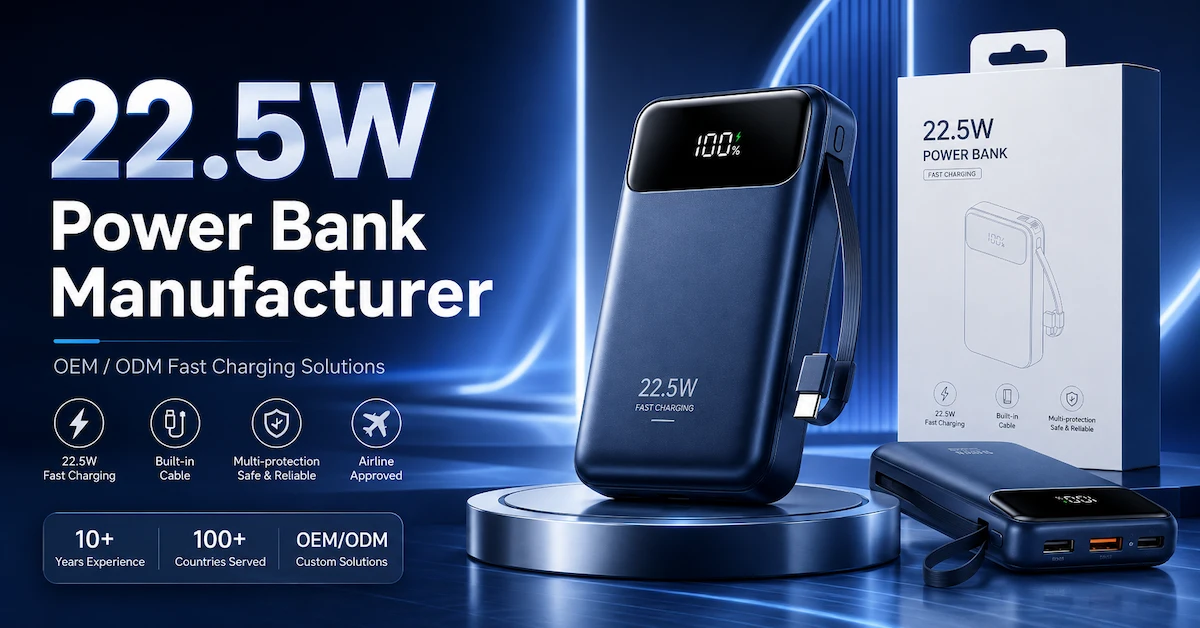

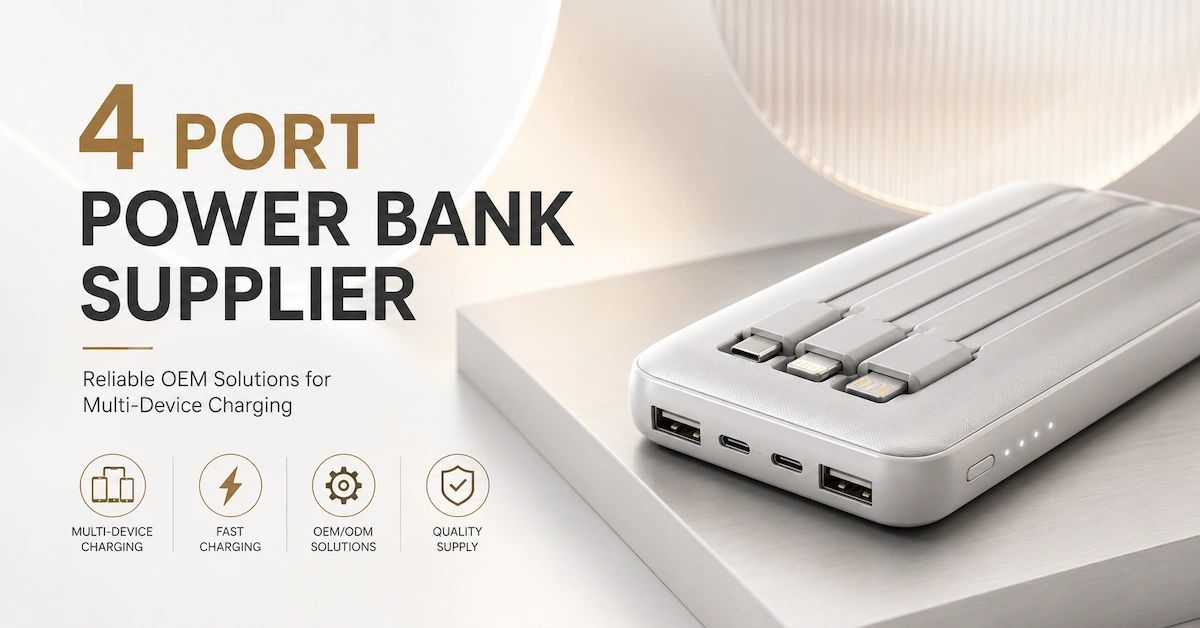
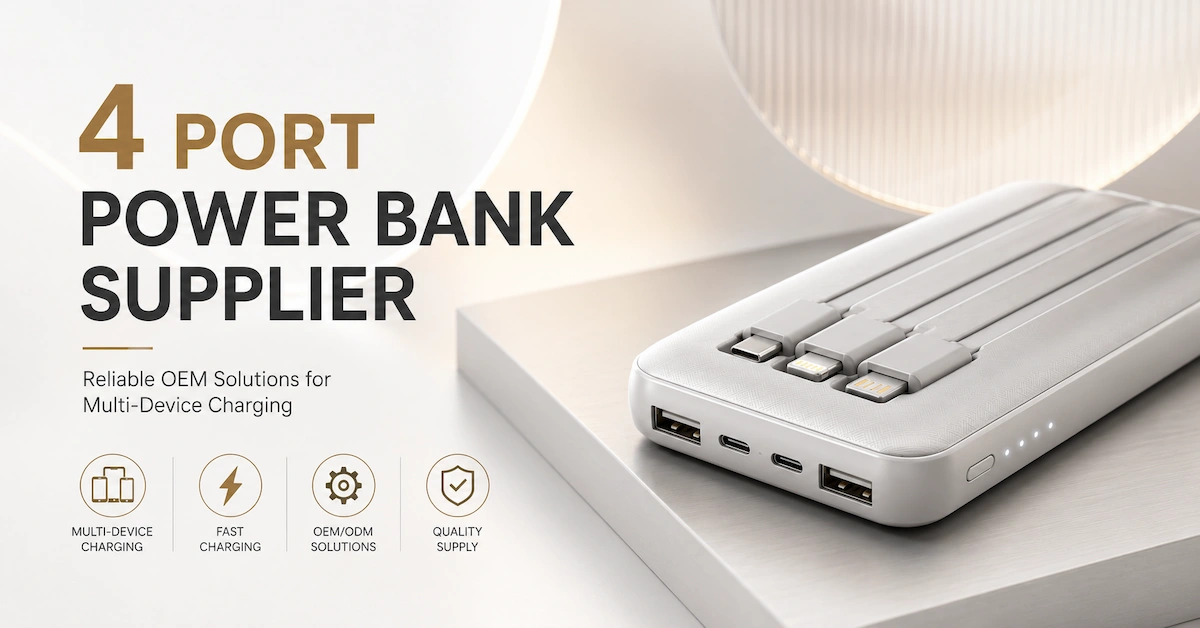
A reliable 4 port power bank supplier helps brands develop portable charging products for users who need to power several devices from one battery pack.
A four-port model may combine USB-C and USB-A interfaces, allowing users to charge smartphones, tablets, earbuds, cameras, handheld gaming devices, and selected laptops. It is especially useful for business travel, family trips, shared workspaces, retail electronics, and emergency charging.
However, the number of ports does not automatically indicate product performance. Buyers must understand the maximum output of each interface, total shared power, charging protocols, battery capacity, PCBA stability, thermal control, and full-load behavior.
Before selecting a model, buyers can review ESC’s power bank product range to compare capacities, port layouts, built-in cables, displays, and fast-charging options.
What Is a 4 Port Power Bank?
A four-port power bank includes four charging interfaces or output channels. Depending on the product platform, these may include:
- Two USB-C ports and two USB-A ports
- One USB-C port and three USB-A ports
- Three USB-C ports and one USB-A port
- Two physical ports plus two built-in cables
- Multiple ports combined with wireless charging
| Product Element | Common Options |
|---|---|
| Battery capacity | 10000mAh, 20000mAh, 27000mAh |
| USB-C output | 20W, 27W, 45W, 65W or 100W |
| USB-A output | 18W, 22.5W or model-dependent |
| Port combination | USB-C and USB-A |
| Display | LED, LCD or TFT display |
| Protocols | PD, PPS, QC, FCP, SCP, AFC |
| Housing | ABS, PC or mixed-material construction |
| Customization | Logo, color, packaging, port configuration |
The best configuration depends on the target devices, product capacity, price range, and sales channel.
Who Needs a 4 Port Power Bank Supplier?
A professional 4 port power bank supplier is suitable for businesses targeting multi-device users.
Typical B2B buyers include:
- Consumer electronics brands
- Mobile accessory distributors
- Amazon and Shopify sellers
- Travel accessory brands
- Laptop and tablet accessory suppliers
- Camera and creator accessory companies
- Corporate gift suppliers
- Retail chains
- Private-label charging brands
- Regional wholesalers and importers
A four-port product may be unnecessary for simple promotional projects where buyers prioritize minimum cost and compact size. For those channels, a single-port or built-in cable model may be more suitable.
Why Four-Port Power Banks Have Strong Market Potential
Several devices can charge from one product
Users increasingly carry multiple electronic products. A four-port power bank can support several devices without requiring multiple chargers.
Clear retail selling points
Four visible interfaces create an easy-to-understand product benefit for online listings, packaging, catalogs, and retail displays.
Suitable for travel and shared use
Families, colleagues, and business travelers can share one power bank rather than carrying several separate units.
Higher perceived value
Multiple ports, a large battery, fast-charging support, and a digital display can justify stronger retail positioning.
Flexible OEM development
Brands can customize the housing, port configuration, display, capacity, charging output, packaging, and accessories.
For customized appearance, power output, branding, and packaging, buyers can review ESC’s customized solution.
Four Ports Do Not Mean Four Maximum Outputs
One of the most important sourcing points is shared power distribution.
A product may advertise 65W or 100W, but this figure often refers to the primary USB-C port used alone. When additional ports are activated, output may be divided.
For example:
| Charging Scenario | Example Output Logic |
|---|---|
| USB-C1 alone | Up to 65W |
| USB-C2 alone | Up to 30W |
| USB-A1 alone | Up to 22.5W |
| USB-A2 alone | Up to 18W |
| USB-C1 + USB-C2 | 45W + 20W |
| USB-C1 + USB-A | 45W + 18W |
| All four ports | Shared total output |
These figures are examples only. The actual values depend on the PCBA, firmware, battery system, and product platform.
A qualified supplier should provide a complete power-distribution table before packaging or product listings are approved.
Single-Port Output and Total Output
Buyers should distinguish between two specifications.
Single-port output is the maximum wattage available from one interface when the remaining ports are inactive.
Total output is the combined maximum power available when several ports are used simultaneously.
A 100W primary port does not necessarily mean the product can deliver 100W plus full output through the other three interfaces.
Incorrect power claims may lead to:
- Customer complaints
- Negative reviews
- Product returns
- Marketplace disputes
- Distributor dissatisfaction
- Compliance risks
The manual and packaging should clearly state both single-port and shared-output performance.
Which Port Configuration Is Best?
Two USB-C and two USB-A ports
This configuration balances modern USB-C charging with compatibility for older USB-A cables.
Three USB-C and one USB-A port
Suitable for markets with high USB-C adoption and users carrying newer phones, tablets, and laptops.
One USB-C and three USB-A ports
Better for cost-sensitive or legacy markets but may provide less premium positioning.
Ports combined with built-in cables
This option improves convenience but increases structural complexity and testing requirements.
| Configuration | Main Advantage | Best Market |
|---|---|---|
| 2 USB-C + 2 USB-A | Balanced compatibility | Mainstream retail |
| 3 USB-C + 1 USB-A | Modern device support | Premium USB-C users |
| 1 USB-C + 3 USB-A | Broad legacy compatibility | Cost-sensitive wholesale |
| Ports + built-in cables | Maximum convenience | Travel and e-commerce |
Charging Protocol Compatibility
Different ports may support different charging standards.
Common protocols include:
- USB Power Delivery
- PPS
- Quick Charge
- FCP
- SCP
- AFC
The primary USB-C port may support PD and PPS, while USB-A ports may support QC, FCP, or SCP.
Buyers should request:
- Supported protocols for every port
- Voltage and current profiles
- Tested device categories
- Multi-port protocol behavior
- Input charging specifications
- Sample test data where available
The same connector type does not guarantee identical charging speed.
Which Battery Capacity Is Suitable?
10000mAh
Suitable for compact daily-use models, commuting, gifts, and mainstream retail.
20000mAh
Suitable for travel, tablets, several smartphones, and longer multi-device charging.
27000mAh
Suitable for premium travel, creators, outdoor users, and selected laptop applications.
| Capacity | Main Advantage | Suitable Application |
|---|---|---|
| 10000mAh | Portable and compact | Daily use |
| 20000mAh | Balanced capacity and size | Travel and shared charging |
| 27000mAh | Longer backup time | Premium multi-device users |
For four-port products, 20000mAh is often a practical choice because several connected devices can quickly drain a smaller battery.
PCBA Design Determines Real Performance
The PCBA controls:
- Output from each port
- Charging protocol recognition
- Power distribution
- Input charging
- Battery management
- Temperature monitoring
- Over-current protection
- Short-circuit protection
- Charging efficiency
- Display accuracy
A weak PCBA may cause output instability, unexpected power reduction, excessive heat, or charging interruptions.
A capable 4 port power bank supplier should explain how each output behaves individually and in combination.
Thermal Management Under Full Load
Using four ports simultaneously places greater load on the battery and power-management system.
The manufacturer should test:
- Single-port temperature
- Dual-port temperature
- Three-port operation
- Four-port full load
- Continuous high-power output
- Input charging temperature
- Automatic power reduction
- Temperature-protection response
A short demonstration is not enough. Buyers should test the product over a realistic charging period using representative devices.
Port Layout and User Experience
Port placement affects usability.
Buyers should check:
- Space between connectors
- Whether wide plugs block adjacent ports
- Port alignment
- Cable insertion stability
- Display visibility
- Button position
- Product stability on a desk
- Housing temperature
- Label clarity
Four ports provide little value when two cannot be used at the same time because the connectors are positioned too closely together.
Buyers developing a complete charging range can combine power banks with ESC’s charger plug products.
OEM and Private-Label Customization
A professional supplier should provide flexible but production-safe customization.
Common options include:
- Logo printing
- Laser engraving
- Custom housing color
- Matte, glossy or soft-touch finish
- Port-configuration selection
- Capacity selection
- Output-power configuration
- LCD or TFT display
- Built-in cable options
- Retail packaging
- Gift packaging
- Multilingual manuals
- Barcode and SKU labels
- Custom carton marks
The final pre-production sample should include the actual housing, ports, logo, display, packaging, manual, and accessories.
4 Port vs 2 Port Power Banks
| Factor | 4 Port Power Bank | 2 Port Power Bank |
|---|---|---|
| Number of devices | Up to four | Usually two |
| Product complexity | Higher | Lower |
| Power distribution | More complex | Simpler |
| Product size | Usually larger | More compact |
| Cost | Higher | Lower |
| Testing requirements | More combinations | Fewer combinations |
| Best market | Families, travel, shared use | Daily individual use |
A four-port model provides greater flexibility but requires stronger PCBA design and more complete testing.
Quality Control Before Mass Production
Recommended inspection steps include:
- Battery-cell inspection
- Battery-capacity testing
- PCBA function testing
- Each port tested individually
- Two-port combination tests
- Three-port combination tests
- Four-port full-load test
- Protocol-recognition test
- Input-charging test
- Temperature-rise test
- Aging test
- Connector insertion test
- Port durability test
- Display-accuracy test
- Housing inspection
- Packaging verification
- Final shipment inspection
Buyers can review ESC’s company and production background through the About Us page.
Certifications and Export Documentation
Depending on the market and shipping method, buyers may require:
- CE
- RoHS
- FCC
- MSDS
- UN38.3
- IEC62133
- Battery transport reports
- Product specification sheets
Documents should match the actual battery, PCBA, capacity, port configuration, and product model.
Common Procurement Risks
The headline power applies to only one port
The primary USB-C port may provide the highest output only when used alone.
Four-device charging is slower than expected
Total available power may be divided among all connected devices.
Excessive heat under full load
Continuous four-port operation may increase temperature significantly.
Protocol conflicts
Different devices may trigger unexpected output changes.
Ports are positioned too closely
Large connectors may block nearby interfaces.
Battery capacity is insufficient
Four devices can quickly drain a small-capacity power bank.
Packaging claims are unclear
Customers need accurate information about each port and shared output.
Repeat orders use different components
Changes in cells, ports, or PCBA components may affect later batches.
MOQ, Samples, Pricing and Lead Time
Before requesting a quotation, provide:
- Required capacity
- Port configuration
- Maximum single-port output
- Required total output
- Target devices
- Housing color
- Logo method
- Display requirement
- Packaging format
- Target market
- Certification requirements
- Order quantity
- Delivery deadline
The quotation should separate standard pricing from costs for custom color, logo, packaging, certification, tooling, PCBA changes, or firmware adjustment.
Approve a branded pre-production sample before mass production begins.
SKD Options for Local Assembly
An SKD project may include:
- Housing
- PCBA
- Port modules
- Display module
- Battery components
- Packaging
- Assembly instructions
ESC’s SKD Powerbank Solution supports eligible semi-finished product and local assembly projects.
Why Work with ESC as Your 4 Port Power Bank Supplier?
ESC supports fast-charging power banks, multi-output products, built-in cable designs, wireless charging products, charger plug products, customized solutions, and SKD projects.
For four-port products, ESC can support:
- Product-platform selection
- Battery-capacity configuration
- Port-layout planning
- Protocol selection
- Power-distribution planning
- Display options
- Logo and color customization
- Packaging development
- Sample approval
- Quality inspection
- Bulk production
- SKD housing and PCBA solutions
A reliable supplier should explain how the product behaves across all important port combinations rather than only showing the highest single-port output.
FAQ
What is a 4 port power bank?
It is a portable charger with four charging outputs, typically combining USB-C and USB-A ports.
Can all four ports fast-charge simultaneously?
Usually not at their individual maximum wattages. Total power is normally shared between connected devices.
What capacity is suitable?
20000mAh is a practical option for shared and multi-device charging. Smaller models are more portable, while 27000mAh provides longer backup.
Which port normally provides the highest output?
The primary USB-C port usually provides the highest output, but the exact specification depends on the model.
Can built-in cables be added?
Yes. Some four-output designs combine physical ports with integrated USB-C or Lightning-compatible cables.
What should buyers test?
Test each port separately, all important port combinations, full-load temperature, protocol compatibility, capacity, input charging, and display accuracy.
Can the port configuration be customized?
Some platforms support configuration changes. Deeper modifications may require PCBA development, firmware adjustment, testing, and higher MOQ.
Which certifications may be required?
Common requirements include CE, RoHS, FCC, MSDS, UN38.3, and IEC62133.
Is a four-port model suitable for wholesale?
Yes. It is suitable for travel, family use, electronics retail, e-commerce, corporate gifts, and multi-device customers.
Can ESC support SKD projects?
ESC can support eligible SKD housing, PCBA, port-module, and local-assembly projects.
Conclusion
Choosing the right 4 port power bank supplier helps brands source flexible portable chargers for customers who need to power several devices simultaneously.
The supplier should document single-port output, total shared output, protocol compatibility, power distribution, battery capacity, thermal performance, packaging claims, quality control, and repeat-order consistency.
ESC can support four-port power bank projects through product selection, OEM/ODM customization, power-distribution planning, packaging development, testing, mass production, and SKD solutions.
Contact ESC to discuss your four-port power bank requirements, request samples, and receive a customized OEM or wholesale quotation.