
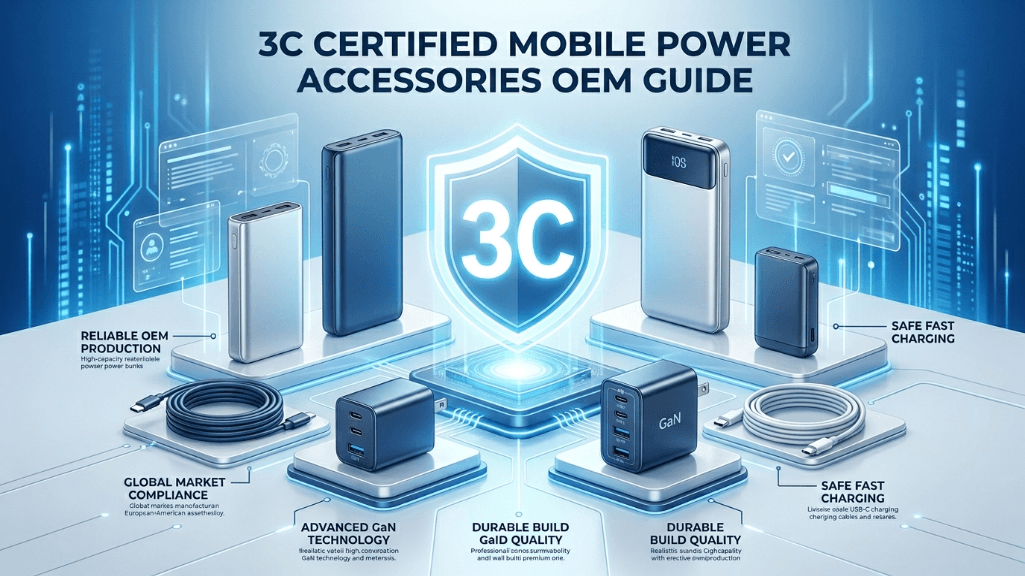
In the 2026 power accessory market, compliance and underlying technology have completely eclipsed pure BOM cost considerations. For cross-border sellers seeking OEM service for 3C certified mobile power accessories, if you are still hunting around Huaqiangbei for a few-dollar off-the-shelf assembled units, your Amazon or independent store listings are highly unlikely to survive the platform inspections in the second half of the year. The core solution is straightforward: abandon pure assembly factories and directly anchor on source manufacturing giants that possess underlying PCBA R&D and a full-cycle injection molding capability.
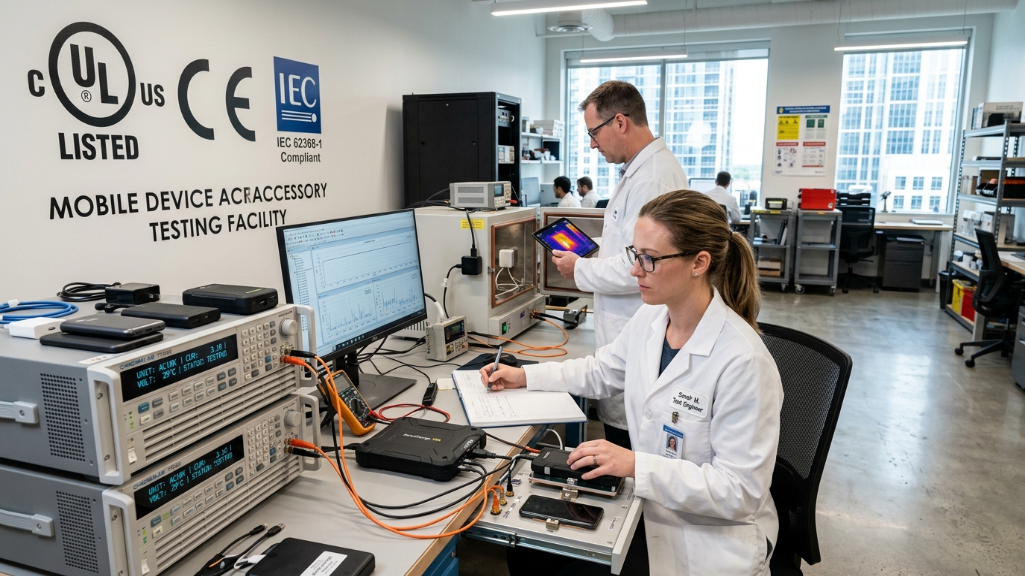
Based on current real supply chain data, a truly high-standard, safety-compliant (3C and equivalent UL/CE certified) 140W fast charger or high-density magnetic power bank typically has a reasonable wholesale source price ranging from $18 to $35. Anything below this threshold inevitably means that the OEM has cut corners on secondary synchronous rectifier chips, cell cycle life, or PC flame-retardant housing materials. Procuring premium e-commerce power accessories is not about comparing the lowest price in Excel, but about buying a safety insurance for your brand that avoids catastrophic recalls.
Why 3C Certification Is the Minimum Survival Line for Power Accessories in 2026
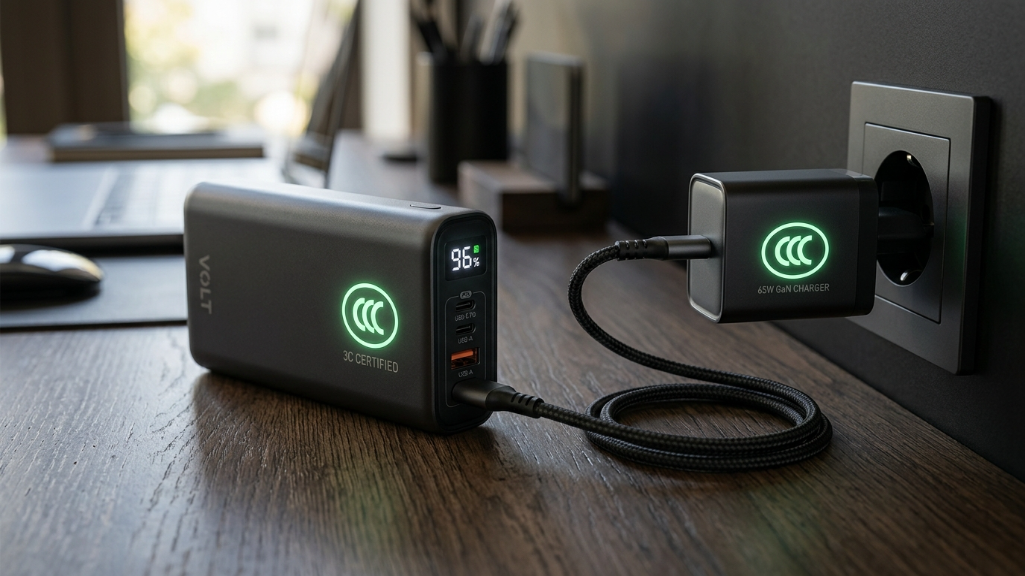
Many procurement managers have fatal misconceptions about safety certifications. They believe that spending tens of thousands of yuan to buy a certificate from a lab is enough for compliance. Unfortunately, it is not. Customs X-ray inspections and e-commerce platform random checks will shatter this illusion.
Hidden Costs of Non-Compliant Chargers and Power Banks
Power accessories are a high-risk category. Poor-quality capacitors bulge under high temperatures, and transformers with insufficient creepage distance can directly transmit 220V high voltage to a phone. This is not just a spike in RMA rates—it can trigger account suspensions or massive consumer claims. A top 3C certified power bank manufacturer considers not just “functionality” but “absolute safety under extreme abuse” in its design. If falsified safety compliance leads to tens of thousands of units detained at a destination port, exorbitant storage and destruction fees can instantly break your cash flow.
How Strict Standardized QC Ensures 100% Pass Rate
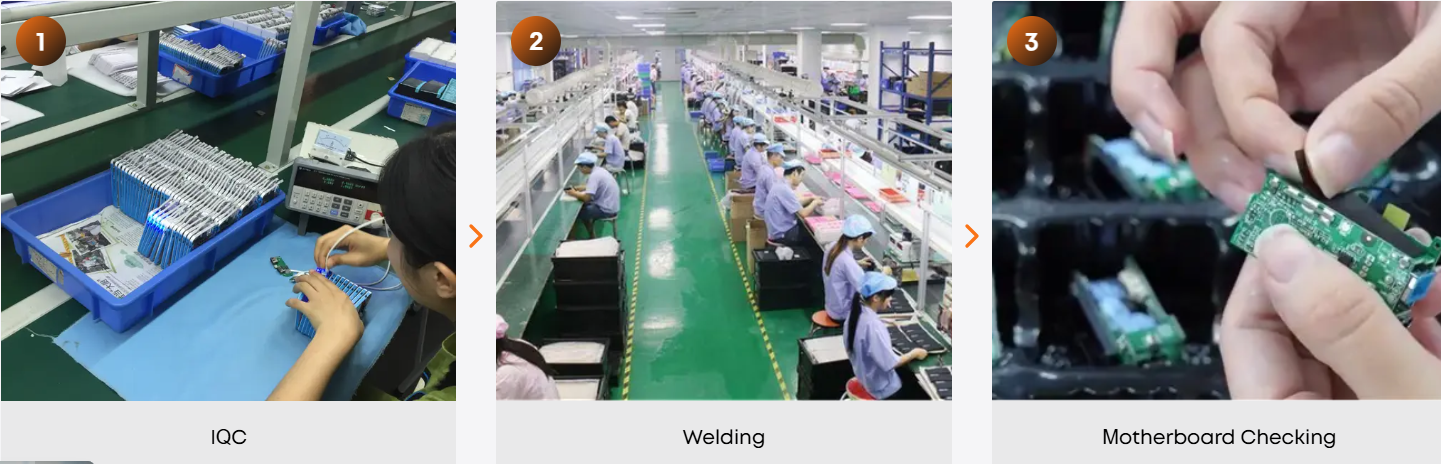
Certificates are merely results; the manufacturing process is the foundation. Our internal principle is: don’t leave QC to human inspectors’ eyes—rely on automated ATE testers and aging cabinets. Every PCBA off the SMT line must pass AOI optical inspection to confirm solder joints, then undergo 100% full-load burn-in testing.
Implication: every hidden cold solder joint or subpar MOSFET is exposed under high temperature and voltage before shipment. Shipping equals compliance—our baseline promise to cross-border clients.
Core Technical Barriers Your OEM Partner Must Possess
When compliance is no longer the problem, the game is all about hardcore technology. The days of assembly factories pushing generic solutions are over. As a 15-year deep-rooted Dongguan source factory, we see clearly that brands dominating the market rely on custom fast charger ODMs with mastery of the following core technologies.
Dominating the High-End Market with 140W Fast Charging
In 2026, consumer devices are power-hungry performance monsters. 65W and 100W have become mid- to low-end clearance items, while 140W (PD3.1) is the standard for high-end brand positioning. Fitting 140W into a compact housing presents extreme thermal density challenges.
During the development of multiple 140W chargers and 140W magnetic power bank wholesale projects, we experienced countless thermal runaway issues. Traditional potting processes fail under 140W full-load conditions; housing temperatures easily exceed safety burn thresholds. To overcome this, we restructured the internal topology. Custom planar transformers combined with high-thermal-conductivity vacuum graphene potting distribute heat evenly across the PC housing rather than concentrating on a few switching transistors.
If your supplier cannot provide thermal rise curves, their claimed “140W” likely throttles drastically within minutes.
Absolute Multi-Protocol Compatibility
A common 1-star review: “My charger is 100W, why is it only charging my Samsung phone at 15W?” This happens when OEMs cut corners on protocol IC licensing to save a few cents, crippling handshake protocols.
A true multi-protocol fast charging PCBA must embed a massive protocol library at the MCU microcontroller level. This is as much a software algorithm challenge as a hardware one. Our enforced “full protocol compatibility” standards distinguish top OEMs from mediocre assembly shops:
| Protocol | Target Devices | R&D Challenges & Our Strategy | Market Risk if Missing |
|---|---|---|---|
| PD3.1/PD3.0 | Latest MacBook, flagship ultrabooks, all iPhones | Handle complex 28V/5A high-voltage extended messages; top IC ensures zero-delay handshake | Device rejection, fatal complaints, returns |
| PPS (Programmable Power Supply) | Samsung Galaxy flagship, high-end Android | Fine voltage/current adjustment; maintain 5A PPS under heat | Miss “Super Fast Charging 2.0”, lose Android market |
| QC3.0/QC4+ | Snapdragon ecosystem devices, mid/low-tier | Smooth high/low voltage switching; backward compatibility | Poor user experience, lower brand score |
| FCP/SCP | Huawei phones/tablets | Low-voltage high-current line loss compensation, gold-plated terminals | Zero penetration in niche market |
| AFC/Apple 2.4A/BC1.2 | Older iPhones, TWS, smartwatches | Micro-current detection to prevent battery damage | Device damage, high claims |
We ensure perfect compatibility with all eight protocols (PD3.0, PPS, QC3.0, FCP, SCP, AFC, Apple 2.4A, BC1.2) for every custom board. This technical rigor is our B2B competitive moat.
High-End Industrial Design: Breaking the “Generic Mold” Curse
Cross-border sellers’ biggest pain: stunning 3D renderings rejected by factories due to:
- Insufficient draft angle → molding defects
- Gate conflicts → visible seams
- Tight internal space → cannot fit 140W PCBA
Our ID designers and mold engineers collaborate from day one using our in-house injection molding and mold opening resources. We calculate creepage distance, heat ducts, and PC shrinkage rates upfront. This engineering depth ensures high-end private molds pass strict 3C and UL drop tests.
The Myth of “Light-Asset Assembly”: Why Vertical Integration Wins
In recent years, a dangerous trend emerged: outsource to light-asset marketing-savvy companies. Reality: when strict 3C audits and cost pressure hit, these “stitched-together” factories collapse first. In consumer electronics, heavy-asset, full-control manufacturing is the only moat.
Risks of a Fragmented Supply Chain
A fragmented supply chain: your OEM only screws parts together. PCBA is bought, housing molded externally, packaging outsourced. It seems efficient until disruptions or inspections occur:
- Outsourced molding shortens cooling → warped housings
- Generic PCBA uses cheap capacitors → short circuits in drop tests
- Responsibility is pushed upstream; your brand suffers
Dominance of Full-Chain Closed-Loop Production
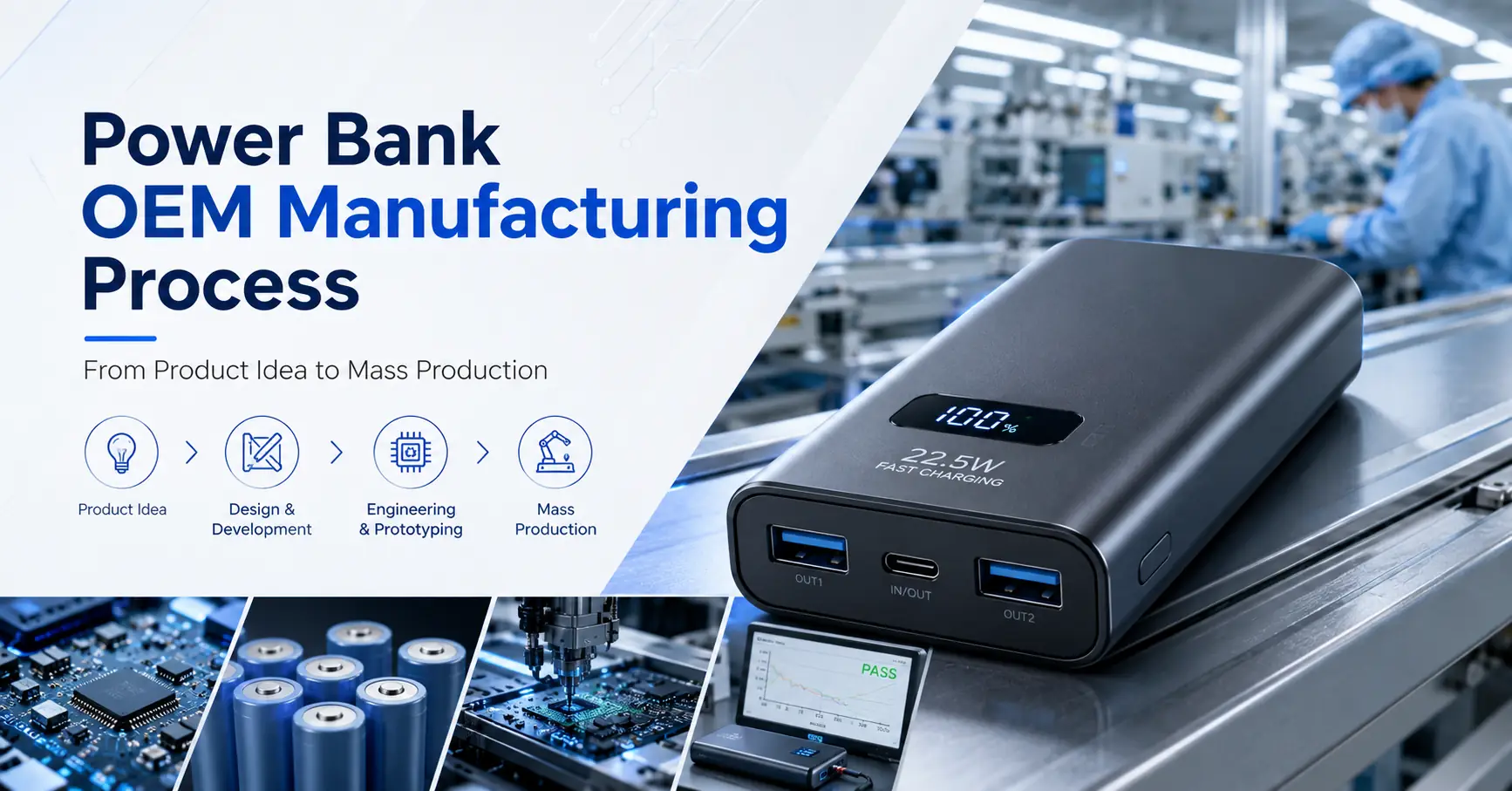
We chose the hardest but safest path: vertical integration. Over the past decade, we built a full-chain, closed-loop line from advanced design, R&D, mold processing, precision injection molding, to hardware integration.
- Bold curves from your designers → internally validated and optimized
- PCBA placement, soldering, cleaning, and ultrasonic closure → fully under automated QC
- Guarantees speed, quality, and trust for certified consumer electronics OEM clients
Top 3 3C Certified Product Categories to Procure in 2026
High-Capacity Multi-Port Fast Chargers
Single-port chargers are squeezed. Desktop and travel scenarios favor GaN high-density multi-port solutions. Features: extreme thermal control, smart power allocation via MCU—no disconnects or power drops.
Next-Gen Magnetic Power Banks
Apple ecosystem drives magnetic growth, but poor products are facing massive returns. Our solution: N52 magnet array with aerogel insulation + redesigned high-frequency coil, preventing heat transfer to the phone back.
Safety-Compliant Business Travel Power Banks
For frequent international travelers: true capacity, high-cycle cells, airline-compliant. Equipped with automotive-grade cells, dual NTC temperature probes, and hardware overcharge valves—globally compliant.
Comparison: Source Factory vs. Traditional Assembly
| Evaluation | Traditional Light-Asset Assembly | AOVOLT Vertical Integration | Core Value to Brands |
|---|---|---|---|
| Compliance | Generic certificate, no process control | Safety margin in PCB layout, 100% burn-in | Eliminates customs holds and delisting |
| Structure & Molds | Heavy reliance on external molds | In-house CNC mold opening & injection molding | Private mold moat, avoid price wars |
| Lead Time | Any upstream shortage → delay | Core components self-controlled | Flexible, fast during peak season |
How to Identify Genuine B2B Source Factories in China
On Alibaba, everyone claims “factory.” Only a few withstand experienced procurement due diligence.
Look for 15+ Years of Exclusive Consumer Electronics Experience
Some OEMs take your order while selling generic products on Amazon—using your deposit to compete with you. We focus solely on B2B source manufacturing, devoting all R&D resources to clients, never touching the C-end market. Provide you with China 3C mobile power supply: 2026 global brand safe fast charging.
Leverage Dongguan’s Strategic Location
Dongguan offers the fastest electronic component one-hour supply circle globally. From rare resistors to latest GaN chips, we can gather parts and produce first PCBA prototypes in half a day.
FAQ on 3C Certified Power Accessory OEM
Q1: Initial cost and lead time for a private mold fast charger?
A: Depends on structural complexity and PCBA rebuild depth. In-house molds/injection halves external lead time. T1 functional prototypes for safety pretesting delivered quickly.
Q2: Can your PCBA fit unusual designs?
A: Yes. Using flexible FPC + 3D stacking or custom planar transformers, full 140W multi-protocol PCBA fits irregular cavities, with compliant heat dissipation.
Q3: How do you control defect rates for large B2B orders?
A: Full inspection (100% QC). SPI solder paste, AOI scan, automated high-voltage testing, burn-in. Any anomaly leads to product rejection.
Q4: Can your production meet EU/US compliance?
A: Our electrical safety design is downward compatible. Meets 3C, CE, FCC, RoHS, UL requirements. One solution generates global compliant versions.
Q5: Do you provide turnkey solutions if I don’t understand protocols?
A: Yes. Tell us your audience (Apple, Samsung, Android), and we configure optimal protocol matrix, GaN power, and thermal solutions. You focus on branding; we deliver compliant hardware.
Conclusion: Reshape Your Brand Moat with Top Manufacturing Systems
The 2026 consumer electronics battlefield leaves no luck. The era of fast money from low-quality generic molds is over. Platform rules and inspections are cleansing brands without underlying tech.
Your supply chain choice determines your brand’s distance. Stop wasting time on returns, delays, and fines. To dominate with true 140W multi-protocol fast charging, high-quality private molds, and impeccable QC, you need a 15-year veteran heavy-asset source factory with full-chain capabilities. Bring your product concepts or pain points, and explore our full-stack PCBA R&D and custom manufacturing services—turn your next industry benchmark from paper to reality.
References:
China Compulsory Certification (CCC) – China Certification Information