
A 10,000mAh wireless power bank can be quoted at $5.80 or $14.00 by a factory. This price gap is not merely negotiation room; it is the result of three overlapping variables: battery cell grade, Qi-certified chips, and BMS protection circuits. If your supplier cannot provide specific parameters for these three items, that "competitive quote" is likely hiding Grade B lithium polymer cells. This article provides the FOB Shenzhen reference prices for various capacities in 2026, as well as the certification verification process you must complete before placing an order.
Why Wireless Power Bank Wholesale Prices Vary So Dramatically
The root of the vast price disparity lies in the supply chain hierarchy rather than the market itself.
Four cost variables determine the quality of the product you receive:
-
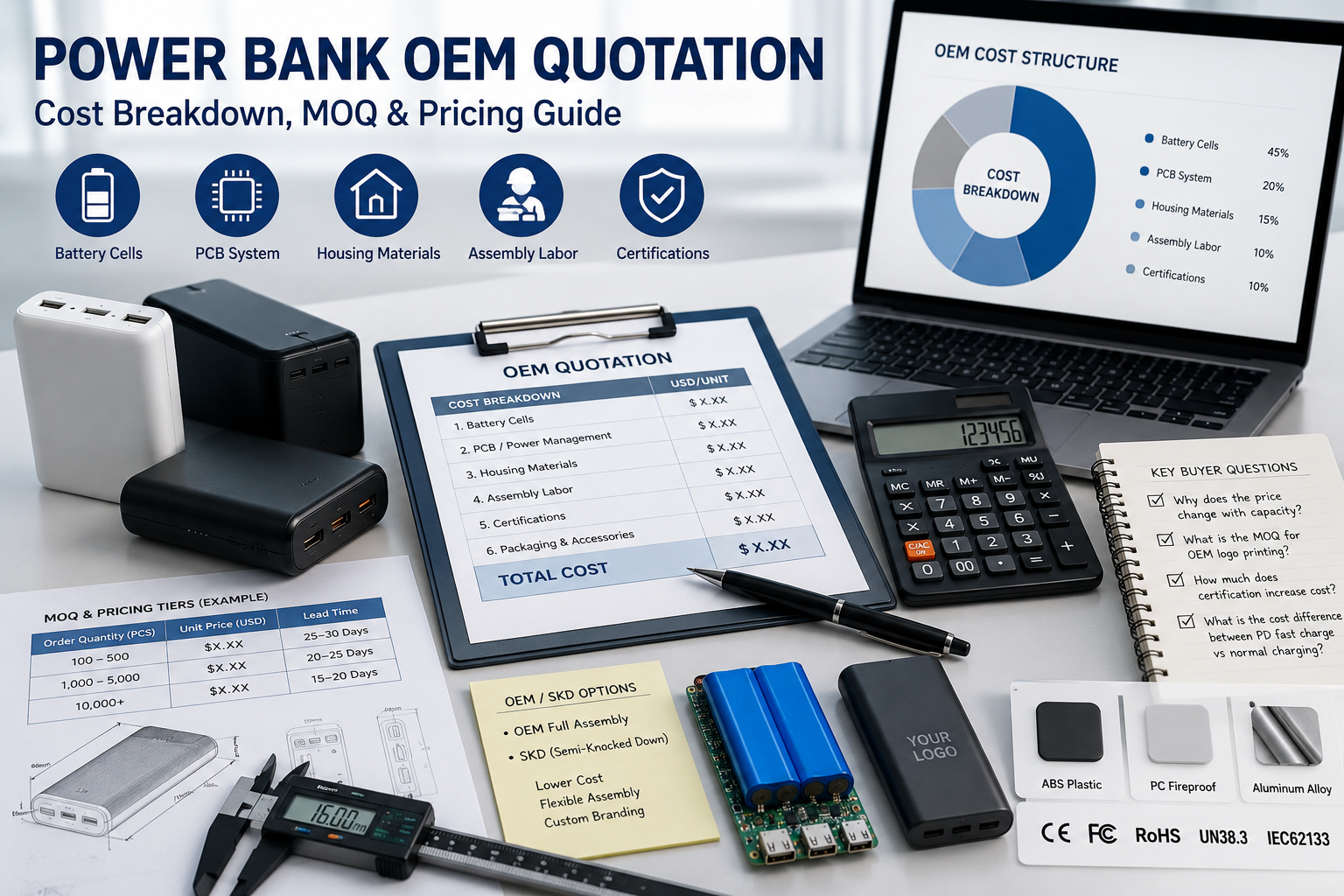
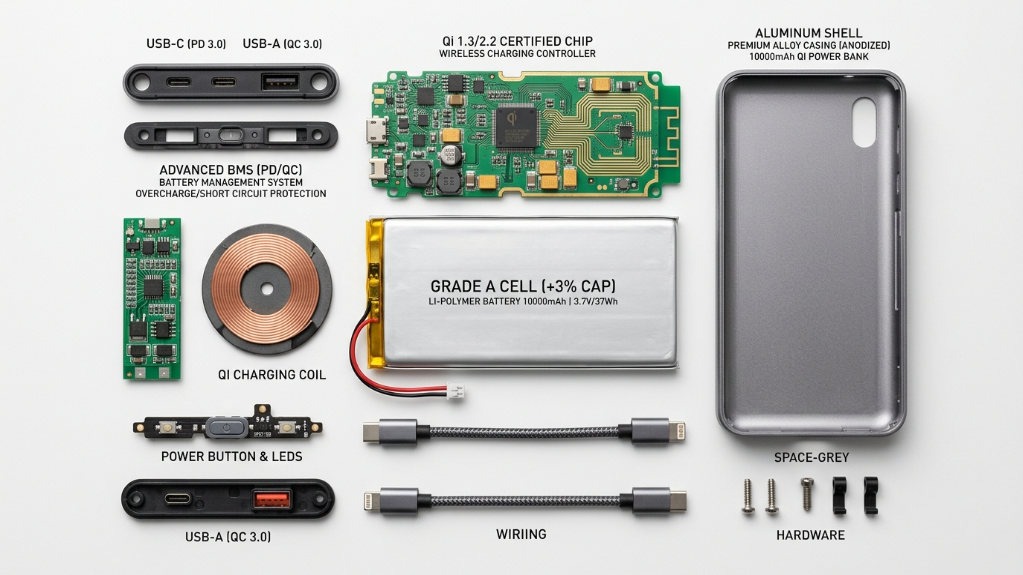
Battery cell grade is the largest hidden variable. Grade A lithium polymer cells have an actual capacity error controlled within ±3%, with a cycle life exceeding 500 times. Conversely, Grade B cells commonly have a capacity inflation rate of 15–30%, with significant decay after only 150 cycles. The cost difference per cell is about $0.80–$1.50, but the impact on the final product quote can exceed $3.00.
-
Qi protocol chips directly affect charging efficiency and device compatibility. Products equipped with genuine Qi 1.3 or Qi2 standard chips require certification fees paid to the WPC (Wireless Power Consortium), which are factored into the unit price. Knockoff chips can handle basic charging functions, but their actual output on MagSafe devices is often only 60–70% of the rated value; more importantly, they cannot pass FCC radio frequency tests.
-
BMS (Battery Management System) complexity also splits pricing. Entry-level BMS only provides overcharge protection; mid-range solutions add over-discharge, short-circuit, and temperature protection; high-end solutions integrate charging protocol recognition (PD/QC/AFC multi-protocol) and cell balance management. For the same 20,000mAh specification, the BMS cost difference can reach $1.20–$2.00.
-
Casing and packaging are the most underestimated cost items. ABS plastic casings cost about $0.30–$0.60, while aluminum alloy matte casings cost $1.20–$2.50. Gift box packaging costs $0.50–$1.20 more per set compared to standard color boxes. This difference is particularly crucial for corporate gift procurement.
Understanding these four variables clarifies the logic behind the price distribution in the following supplier hierarchy comparison table:
In March 2026, the EU RAPEX system's warning notifications for consumer electronics showed that lithium battery products accounted for 38% of all recalls, with over 60% of problematic products having forged or expired certification documents. This data does not suggest a decline in overall industry quality, but rather that the cost of failing the verification process for B2B buyers is amplifying.
Wireless Power Bank Wholesale Price Table by Capacity (2026)
The following prices are based on FOB Shenzhen, Grade A cells, and include basic Qi certification for standard MOQ ranges of 200–500 units. OEM customization, certification upgrades, and packaging schemes will incur additional costs, which are detailed later.
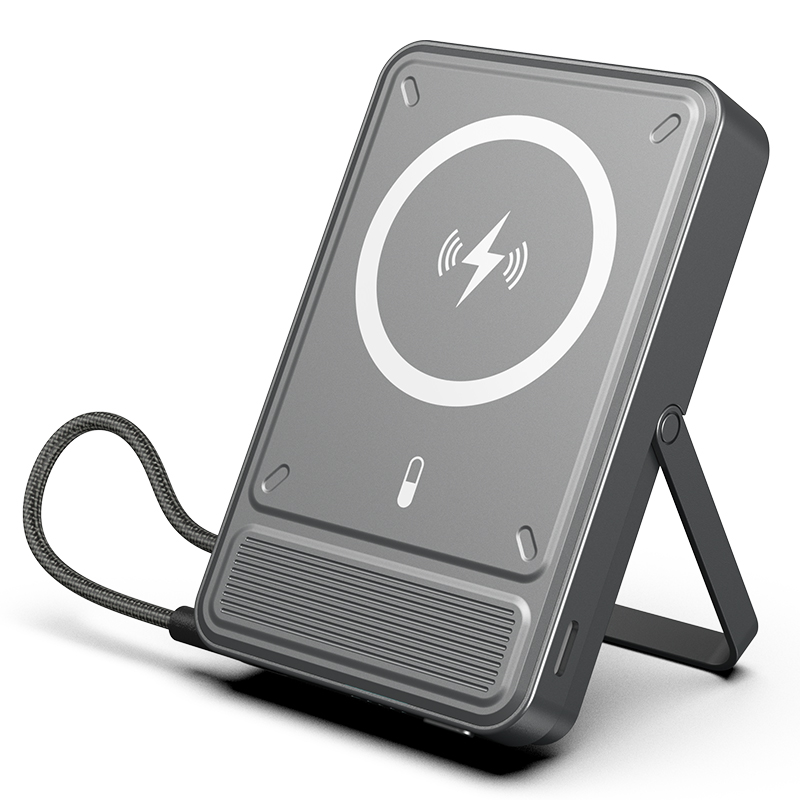
The last row deserves separate mention. At the end of 2025, the WPC officially released the Qi2.2 standard, supporting 25W wireless output. Coupled with the charging specs of the iPhone 17 series, B2B inquiries for this capacity segment saw a significant year-on-year increase in Q1 2026. Global Sources data indicates this specification has become one of the fastest-growing product lines for factory orders. If your target market is North America or Western Europe, this spec should be in your 2026 product matrix.
Price range logic: The lower bound usually corresponds to orders over 500 units, standard packaging, and a single color; the upper bound corresponds to small batches, mixed SKUs, and amortized certification fees. The gap between these two numbers is your actual room for negotiation.
Certifications That Actually Matter—and How to Verify Them
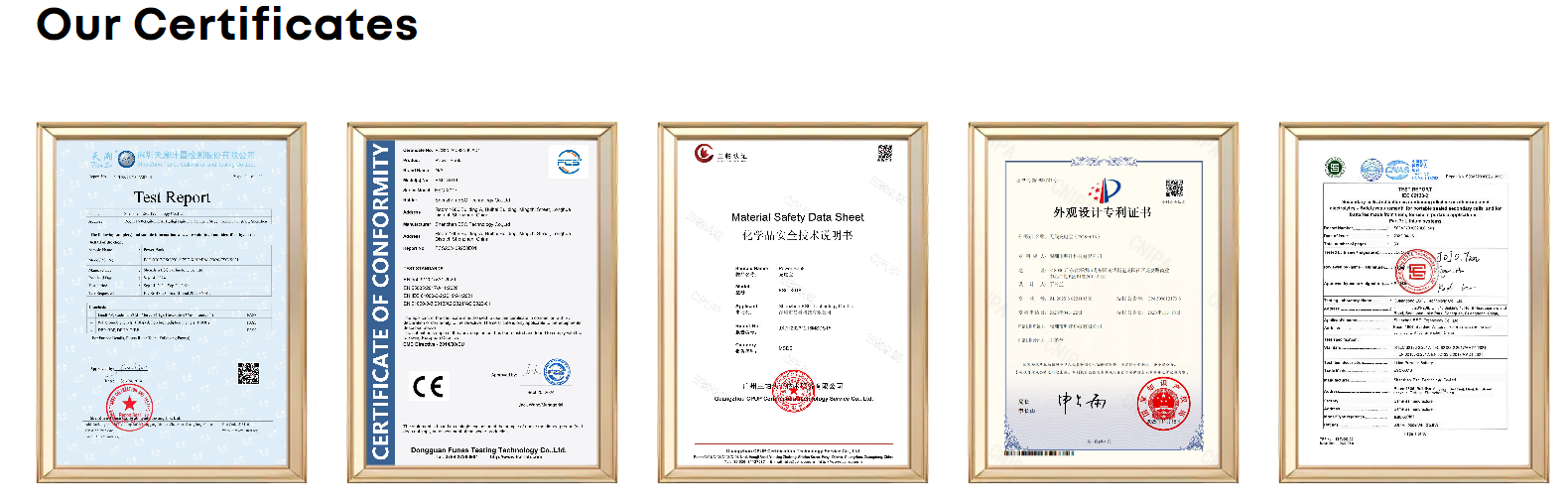
Certification is not an optional add-on; it is a hard threshold for market access.
A common mistake for many buyers is treating certification as a "just have it" checkbox. In practice, the legal risk of an expired CE certificate is nearly identical to having no certificate at all. A certification document that cannot be found in an official database via an FCC ID is equally useless against Amazon compliance audits.
Mandatory certification requirements for different target markets are as follows:
IEC 62368-1 is currently the core safety standard for audio/video and IT equipment (including power banks), officially replacing the old IEC 60065 and IEC 60950-1 in 2023. When purchasing, ensure the factory's CE certificate is based on IEC 62368-1 testing rather than the obsolete versions—this is a frequent certification trap.
OEM & Custom Branding: MOQ, Timeline & What’s Actually Customizable
Once certification is settled, the next decision point for most B2B buyers is: What level of customization do I need?
The answer determines your MOQ, capital tie-up period, and competitive barriers. Building a private label is more than just printing a logo on a casing—that is only Level 1, which has the lowest barrier to entry. True retail differentiation comes from systematic customization, from structural design to charging protocols.
The gap between Level 2 and Level 3 is essentially the factory's manufacturing depth. Many traders can do logos, but fewer than 30% of factories in the Shenzhen and Dongguan supply chains can independently open molds, complete injection molding, integrate hardware components, and output a full production line. This directly affects whether your product has visual identity—and visual identity is the prerequisite for premium pricing. Provide you with 10000mAh wireless charger power bank OEM guide.
How to Calculate Your True Landed Cost
The FOB unit price on the quote is not your procurement cost.
From the Shenzhen factory to your warehouse, the price will undergo at least four layers of accumulation. Many first-time importers miscalculate their profit margins by an entire order of magnitude by ignoring this calculation.
Example: 500 units of a 10,000mAh Magnetic Wireless Power Bank, FOB unit price $11.00, target market USA:
Landed Cost Calculation (Reference Model)
-
FOB Unit Price: $11.00
-
Sea Freight Amortization (LCL): +$0.85/unit
-
US Import Tariff (HS 8507.60): +$0.88/unit (approx. 8%)
-
Amazon FBA First-leg + Storage: +$1.20/unit
-
CE/FCC Certification Amortization: +$0.40/unit
-
PSI Inspection Fee Amortization: +$0.15/unit
-
Total Landed Cost: Approx. $14.48/unit
If your Amazon price is $29.99, after deducting FBA commissions (15%, approx. $4.50) and FBA shipping fees (approx. $3.80), the actual gross profit is about $7.21 (24% margin). This is a healthy level for the North American market, but if you use low-priced goods without certification, your initial margin might look better, but once the ASIN is removed due to compliance complaints, all prior marketing costs drop to zero.
Why AOVOLT: Factory-Direct Wireless Power Banks with Engineering Depth
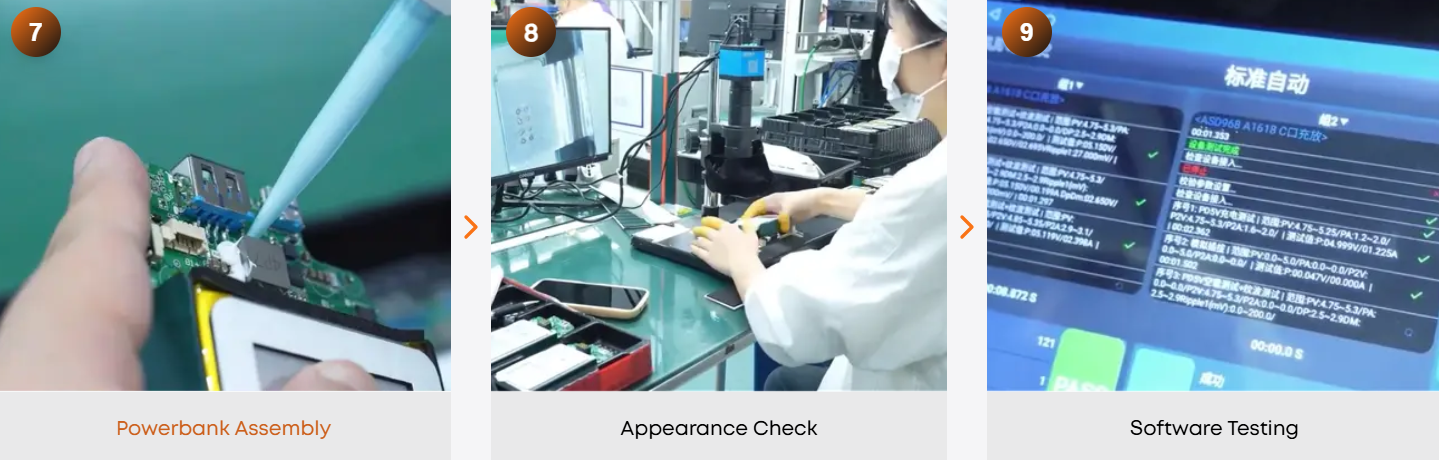
With an understanding of cost structures and certification logic, the standard for choosing a factory becomes clear: you don't need the supplier with the lowest quote, but a source factory that meets standards in manufacturing depth, certification integrity, and customization speed.
Headquartered in Dongguan, China, AOVOLT has been deeply involved in consumer electronics manufacturing for 15 years, with core lines covering wireless power banks, magnetic power banks, and fast chargers. Unlike assembly-type factories that rely on external molds, AOVOLT completes a full-chain closed-loop production—from structural design and R&D to mold opening, injection molding, and hardware integration. This means Level 2 and Level 3 ODM projects do not require third-party mold shops, providing structural guarantees for development cycles and exclusivity.
In fast-charging technology, AOVOLT supports up to 140W output, with a protocol compatibility matrix covering PD3.0, PPS, QC3.0, FCP, SCP, AFC, Apple 2.4A, and BC1.2. This is one of the most comprehensive protocol coverages in the wholesale market. For B2B buyers serving both iOS and Android users, this means one SKU can cover most terminal devices, reducing selection complexity.
Industrial design is another substantial barrier. AOVOLT has an independent design team that outputs visually distinct schemes rather than just changing colors on public molds. For Amazon sellers, retailers, or corporate gift buyers building their own brands, this directly impacts the product's visual differentiation among competitors.
FAQ: 5 Real Questions from B2B Buyers
Q1: What is the minimum order quantity (MOQ) for wireless power banks? Standard logo customization usually starts at 200 units, while some stock items can be as low as 50 units. New mold ODM projects generally require 1,000+ units. If you are in the validation stage, we suggest starting with a 200-unit order to test market feedback before scaling.
Q2: How do I confirm if a supplier's CE/FCC certification is genuine? CE doesn't have a unified database, but you can request the full Technical Construction File (TCF) and original test reports to verify if the testing body is an EU Notified Body. For FCC, enter the FCC ID at fcc.io for cross-verification. Any supplier refusing to provide full technical docs should be considered high-risk.
Q3: Is FOB or CIF more cost-effective for buyers? FOB allows buyers to arrange their own shipping, offering high flexibility for mature importers. CIF is arranged by the supplier, suitable for first-time buyers with limited resources. Once volume stabilizes, switching to FOB typically reduces total logistics costs by 5–12%.
Q4: What are the latest trends for 2026? Which specs should I stock? Qi2.2 (25W) is the priority for 2026 to match the iPhone 17 series. Additionally, magnetic + wired dual-mode products (MagSafe compatible with USB-C PD output) are becoming the mainstream, as pure wireless-only models are losing market share. GaN-integrated solutions are also seeing increased inquiries for business travel gifts due to their compact size.
Q5: How long does delivery take? Can the cycle be compressed? Standard logo customization takes 8–10 weeks (including production and sea freight). Fast OEM projects using existing molds can be compressed to 4–6 weeks for production. To avoid peak season risks (Q3/Q4), it is best practice to order at least 12 weeks in advance to lock in production schedules.
Conclusion
Wholesale procurement of wireless power banks looks like a price comparison issue on the surface, but it is actually a supply chain risk management issue. Choosing the wrong battery grade allows return rates to eat your profit; ignoring certification compliance leads to platform bans; choosing a factory without tooling capabilities ensures you can never replicate competitive barriers.
Getting these three things right requires finding a factory with substantial assets in manufacturing depth, certification systems, and customization capabilities—not just a middleman with a price list. If you are planning wireless power banks for 2026 or need an OEM upgrade, AOVOLT's team can provide customized quotes with certification details and samples within 48 hours.
References:
Wireless Power Consortium (WPC) - Qi Specification
FCC Part 15 and RF Exposure Requirements for Wireless Chargers